DD
MM
YYYY

PAGES

DD
MM
YYYY

spot_img

PAGES

Home Blog Page 5818

Leadership, Human Capital & Project Management At Tekedia Mini-MBA

0

It is always a special week. Yes, this week at Tekedia Mini-MBA focuses on “Leadership, Human Capital & Project Management”. At the end of everything, it comes down to LEADERSHIP and human capital.  Combining and recombining factors of production can only happen when leaders lead strategically, tactically and operationally at different nexus of production with quality.

We have the best in these domains including my undergraduate classmate Dr. Chisom Ezeocha of Shell and other eminent Faculty of Tekedia Institute.

 -Leadership, Knowledge Management – Prof. Ayodeji Oyebola, Saint Mary’s University of Minnesota
-Human Resources Management – Adora Ikwuemesi, Director Kendor Consulting
-Leading and Managing Teams, Stakeholder Management with NICER Model – Dr. Chisom Ezeocha, Project Delivery Manager, Shell
-Career Planning – Precious Ajoonu, Manager, Jobberman
-Effective Project Management – Taiwo Abraham, Project Manager, Horizant Canada

How to Increase Islamic Giving Market Value in Africa During Ramadan

0

This year Ramadan fasting will start across the world in the next few hours. This is a month in which 1.9 billion Muslims, 24.7% of the world population are expected to increase in spiritual activities in addition to fasting from dawn to night. At least, the increase in spiritual activities is expected to be more in countries with the largest Muslim populations

In 2020, some of the voluntary and compulsory spiritual activities were suspended due to the COVID-19 spread. Where the activities were held, Muslims adopted strategies that aligned with the global measures for the containment of the virus spread. As this year’s fasting period closes, governments and health officials in countries where the cases of the virus are still occurring are working out modalities for reducing the spread. Our analyst reports that measures employed in 2020 are being reintroduced. For instance, the Morroccoan government has suggested the introduction of curfew in areas considered hot spots

Apart from observing special prayers during the day and night, Muslims are mandated to also participate in activities that increase social inclusion, interpersonal relationship and kingship in respective of age, gender and race or nationality. In line with this our analyst examines the African giving market in relation to the Muslims population in select countries from 30 countries studied by Care Aid Foundation between 2010 and 2020. The foundation looks at three aspects of giving behaviour; helped a stranger, donated money to a charity and volunteered time to an organisation.

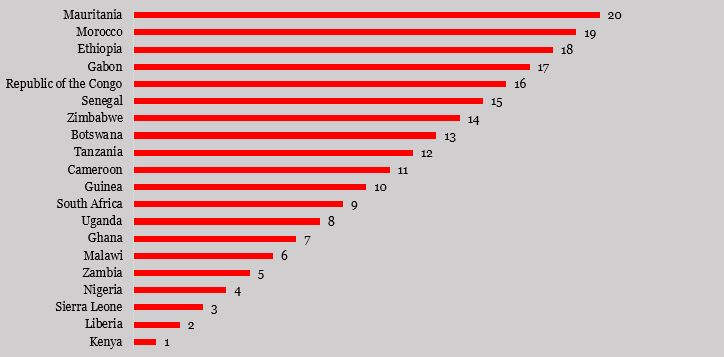
Further examination of the overall rank and scores for each behaviour by our analyst indicates 36.3% connection between citizens’ donation to charity organisations and helping strangers among 20 of the 30 countries [see Exhibit 1] in 10 years. Analysis also reveals that donating and volunteering time for participation in activities of organisations that help people resonate by 48.2%. Over 63%, which is the largest and significant connection, was found for volunteering and helping strangers, indicating that people are more likely to help strangers while volunteering their time for social causes than when they wanted to donate.   In other words, a strong difference exists between donating  and volunteering time in the 20 countries. 

Muslims in the Context of African Giving Market

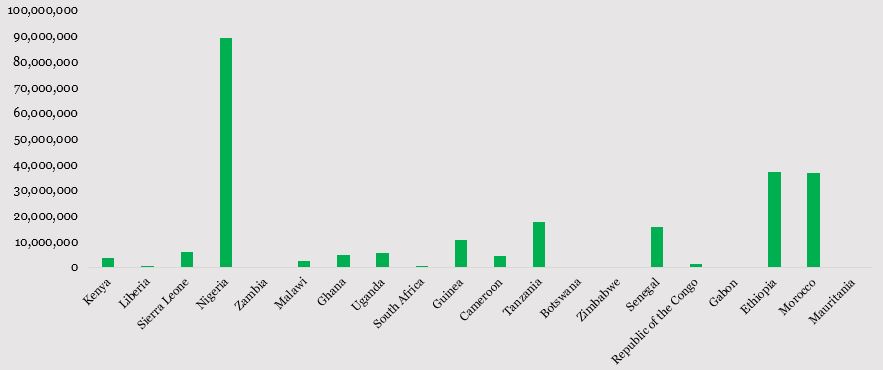
Though CAF sampled the views of people irrespective of their religious practice across the world, our analyst exrapolates the data to set the Muslim Giving Market into proper perspectives along with the Muslim population of the countries [see Exhibit 2]. Analysis shows 27.6% connection of Muslim population with the donating behaviour while negative connections were found for the population and helping strangers [-11%] and volunteering time [-2.2%]. 

According to our analyst, these results suggest that Muslims in the countries are more likely to donate to organisations, which would be organising various programmes such as lecturers and meal production and distribution for the people during the month than assisting strangers and volunteering their time for special causes at Mosques and other places, where people are expected to congregate.

If we are to follow the general data released by the CAF, Muslims in Kenya and Tanzania are likely to donate more than those in the remaining 18 countries we studied.  It is also possible to have Muslims in Kenya and Liberia, helping strangers and volunteering their time during the month. Meanwhile, our check reveals that as of April 11, 2021, interest in help is huge among the people in Ghana, Nigeria, Zimbabwe, Uganda, Zambia, Kenya and South Africa.  

Existing statistics for 2020 indicates that the population of Muslims in the top 20 African giving countries is 238,720,776. According to our aggregate analysis, 9.8% are expected to donate to charity organisations, helping strangers and volunteer during the month. We also found that 31% of the population would donate while 9.8% and 6.2% are likely not to help strangers and volunteer their time for certain activities during the month. Disaggregate analysis shows that 7.6% would donate, 1.2% would help strangers, all are likely not to volunteer during the month. 

Exhibit 1: Top 20 African Giving Countries in Last 10 Years

Source: World Giving Index 2010-2020; Infoprations Analysis, 2021

Exhibit 2: Muslim Population of Top 20 African Giving Countries

Source: Kettani, 2020; Infoprations Analysis, 2021

Enhancing Value Co-Creation and Capturing of the of Giving Market 

From the insights and perspectives given, it is clear that Islamic scholars and organisations need to work collectively towards improved value creation and capturing in the market. Scholars, who will be delivering lectures during the months, need to stress the concept of giving and its benefits on earth and hereafter. Muslims need to be equipped with the sustainable value they will capture while donating, helping strangers and assisting organisations in uplifting the poor and the needy during and after the month. 

Scholars need to remind Muslims the essence of self-discipline, self-control, sacrifice, and empathy for those who are less fortunate. This will go in a long way of increasing the actions of generosity, compulsory and voluntary charities.  Charity organisations should look into appropriation of an integrated communication method for the communication of the value and benefits  such as “Who is he that will loan to Allah a beautiful loan which Allah will double unto his credit and multiply it many times?”(Quran 2:245) of giving to the Ummah. 

Tekedia Live Schedule For This Week – How To Discover Opportunities

0

Good People, here is the schedule for Tekedia Mini-MBA Live for this week. The week begins with a demonstration of process improvement and automation in the downstream sector of the energy industry. The Guest Faculty will also show how an efficient inventory management system would improve any business.  Then it moves to what lawyers and professionals do during transaction due diligence as they gather  business intelligence for deals. Finally, the last Live session will be on how to discover opportunities at offices, markets, etc by examining two critical elements, which from our perspectives, everything depends upon.

  • Tue, April 13 | 7 – 8pm WAT | Process Improvement & Automation (session lab) – Tokunbo O. Arannilewa, CEO Eonsfleet
  • Thur, April 15 | 7-8pm WAT |  Transaction Due Diligence/Business Intelligence – Chike Obimma,  Partner at Niccom LLP
  • Sat, April 17 | 7 – 8.30pm WAT | How To Discover Opportunities, General Topic –  Ndubuisi Ekekwe

Zoom links in the Board

Meanwhile, the courseware for this week is in the Board. We are focusing on Leadership, Human Capital and Project Management.

Have a great profitable week. If you have not joined Tekedia Mini-MBA, go here for the next edition.

Watch The Containers And Understand Market Systems With Us

0

Good People, I like to see containers arriving in the deep sea. And for years, I have made sure that I have friends who work in one of the high rises in Marina Lagos. If you look through those buildings, you can see the far harbour. In those ships/containers, you see the productivity of nations, and the balance of trade.

During recession, few ships arrive, but one thing is constant: most ships come loaded into Nigeria but usually go lighter. I do not need government data to understand how those visuals will affect our balance of payments.

Interesting? That is how we co-learn at Tekedia Mini-MBA. We bring new insights on how to understand market systems. It is an amazing experience, and I invite you to join us. It runs for 12 weeks with thrice weekly LIVE sessions.

Go here, register and let’s co-learn .

Egypt Gearing Up to Upset the African Fintech Market As Paymob Raises $15m in Series A Round

0

On Thursday, Paymob, an Egyptian digital payment startup, announced it has raised a new $15 million Series A round led by Global Ventures. A15 and FMO, the Dutch entrepreneurial development bank, also participated in the investment.

This brings the total money raised by the startup to $18.5 million having secured $3.5 million that came as its first tranche in July 2020. It is the largest-ever Series A raised by a fintech in Egypt and one of the largest equity rounds in North Africa.

The round also points to a change in the African fintech industry, where Nigeria, Kenya and South Africa have been leading the way.

Founded in 2015 by Alain El Hajj, Islam Shawky and Mostafa El Menessy, Paymob was rated among top 10 of the 83 fintech startups in Egypt in 2020.

The startup helps online and offline merchants accept payments from their customers via several products and solutions.

With its different products and APIs, it enables online and offline businesses to accept and send payments. The merchants can easily integrate Paymob’s payments APIs in their websites or mobile apps to accept payments from their customers using different payment methods including cards, mobile wallets, and cash on delivery.

Nigerian payment startup, Flutterwave, which recently attained unicorn status, is seeking to expand its services to North Africa, where Fawry, Paymob’s country rival, reigns. The move which underscores how ripe and vast the African fintech market is, also points to the fact that Egypt’s fintech startups are yet to catch up with their sub-Saharan Africa counterparts.

Paymob said in a statement that the revenue for its payment acceptance business grew over 5x in 2020, with its technology now being used by over 35,000 local and global merchants including Swvl, LG, Samsonite, and the American University in Cairo. The startup claims to have processed payments worth over $5 billion to date.

Paymob also offers white-label mobile wallet solutions, helping businesses build a digital wallet into their apps, using its technology. The startup said that its mobile wallets infrastructure processes over 85 percent market share of transactions in the Egyptian market. The solution also serves merchants across international markets like Kenya, Pakistan, and Palestine.

With the fresh capital, the company aims to accelerate its expansion to Saudi and other regional markets this year. It will also use the funds to expand its merchant network and further enhance the suite of products.

Islam Shawky, the co-founder and CEO of Paymob, said the latest round will be used to fill abounding digital payment gaps through the acceleration of its services.

“We couldn’t be more excited for Paymob’s next phase of growth; the market opportunity in the region is unprecedented. The large digital payments gap still exists and we are delighted to be working with progressive-thinking regulators to address this,” he said.

“This latest capital raise will accelerate our progress to reducing the digital payments bottleneck. All our existing investors have increased their holdings, and we thank them both for their support and the confidence they have in our business model and track record of execution,” he added.

Aside from Egypt, Paymob is also present in Kenya, Pakistan and Palestine. Shawky said the company has plans to expand into more Sub-Saharan African countries.

Paymob has a perfect combination of high-quality technology, a product customers increasingly cannot do without, and an outstanding management team. Their market opportunity is also huge; Egypt’s transformation to a cashless society is being enabled by the unique products Paymob has built, Basil Moftah, General Partner of Global Ventures, said,

Last year, Fawry became a publicly traded unicorn for the first time, a major boost to the Egyptian fintech ecosystem and is also seen as an inspiration to other startups in Egypt and the North African region.

With investors racing to grab a cut of the African fintech boom, every startup appears to stand a chance for maximum growth. But with Egypt’s startups attracting more investors now, the market is about to get more competitive.