Good People, if you applied for the David Onaolapo Scholarship at Tekedia Institute before 2.30pm today, you must have received a full scholarship from Tekedia Institute to attend Tekedia Mini-MBA which begins tomorrow. David is sponsoring 30 people who lost their jobs in the last 12 months. But I told our team to admit anyone who had emailed us before 2.30pm WAT (Sunday). My understanding is that everyone who applied must have received a login by now. In total, 45 people emailed and we admitted them all; it was a very short-time window of hours.
?Good People, join me to thank David Onaolapo who is sponsoring 30 people on full scholarships to Tekedia Mini-MBA. For this one, we are focusing on only those who lost their jobs during the last 12 months and are looking at getting back to work. Our hope is that our program will deepen their capabilities and prepare them for new opportunities.?
As it stands now, we cannot admit more. However, we have other scholarships on special needs homes, and rural education, strictly adhering to the instructions from the donors. To the recipients, congratulations.
We do have processes now to provide internships via some projects people bring to us. However, most have been technical in nature. We are refining the process to ensure people can get skills that will position them for jobs. I invite everyone to register at hub.tekedia.com as we share such therein.
Both academics and professionals are expected to contribute to the containment and management of Covid-19. Academic leaders are among the critical leaders needed for a proper understanding of the disease in terms of its interaction with human and non-living things. This is expected to be done through researches and community outreach. According to our analyst, the outreach is usually planned and executed within the outcomes of the researches.
Since 2019, academic researchers in the medical and non-medical fields have been conducting researches on various issues around the disease. In most cases, attention has been paid to the discovery of vaccines by the clinical or medical researchers. Researchers in the social science field have equally contributed publications that could help stakeholders in containing and managing the disease. This has largely been done from the awareness, attitude and behaviour perspectives.
In all these situations, like their counterparts in the public higher education sector, private universities in Nigeria have also contributed to the global conversation on Covid-19 using their research resources, especially publications in national and international journals, books, monographs and clinical trial reports.
Nigerian Private Universities Contribute 156 Publications to Global Covid-19 Research in 14 Months
In the previous analysis, our analyst reported that institutions in Nigeria contributed 1,634 publications to the global publications of over 300,000 from 196 countries between December 6, 2019 and February 7, 2021. Out of 1,634 publications from Nigeria, analysis indicates that private universities had 156 publications, representing 9.54%.
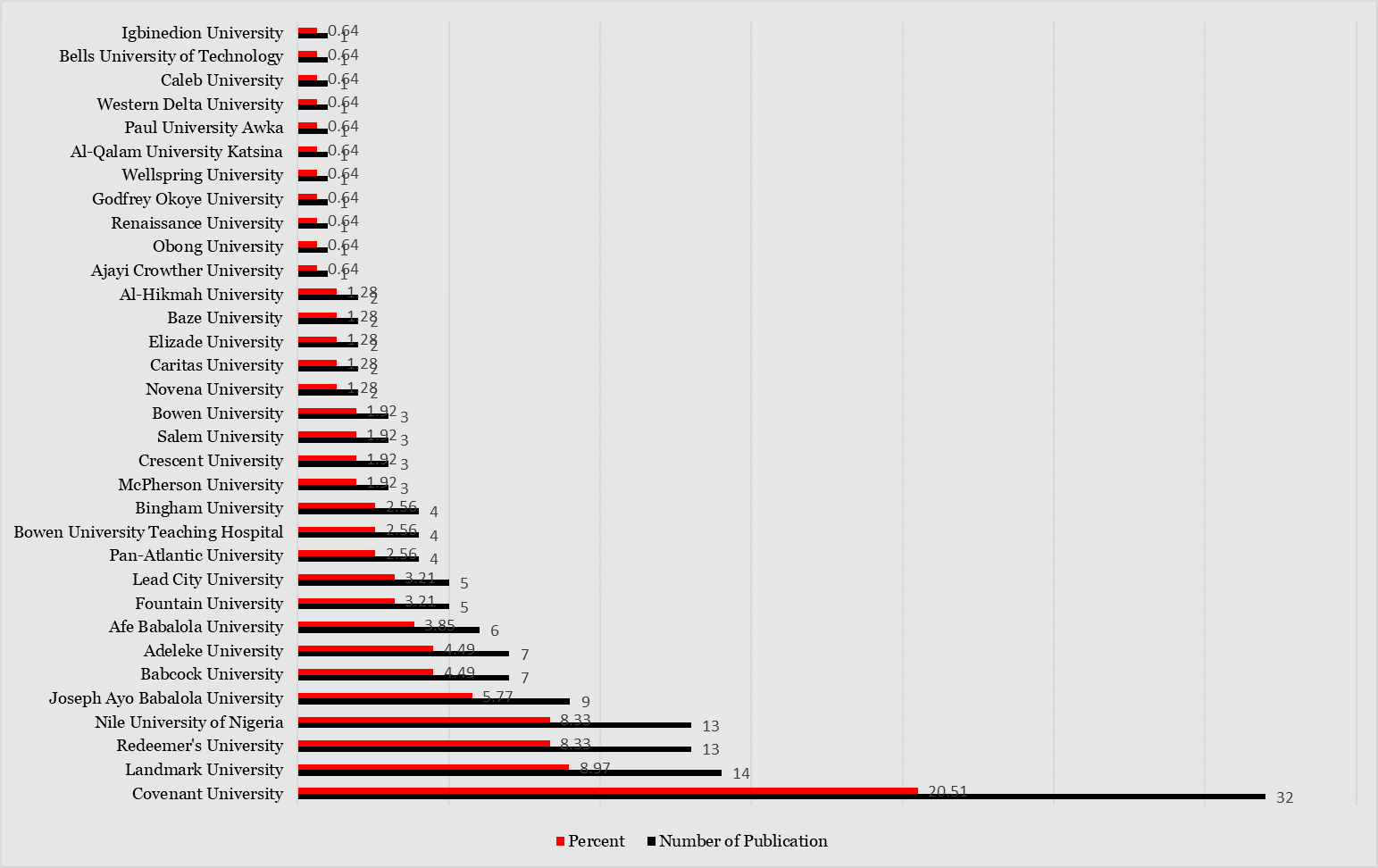
In 14 months and 7 days of the global publications, it emerged that Covenant University led other private universities in Nigeria with 20.51% of the 156 publications from the universities. With 8.97% of the publications, the Landmark University followed Covenant University.
According to our analysis, these universities are the only universities that occupied first and second positions conveniently during the period of the publications. Though, Joseph Ayo Babalola University and Afe Babalola University had 5.77% and 3.85% of the publications, which made them distinctive among others, they failed to occupy the first three positions. Bowen University appears on the research table twice. It appears as an academic institution and also as a hospital institution [see Exhibit 1].
Exhibit 1: Institutions and Publications [Frequency and Percent]
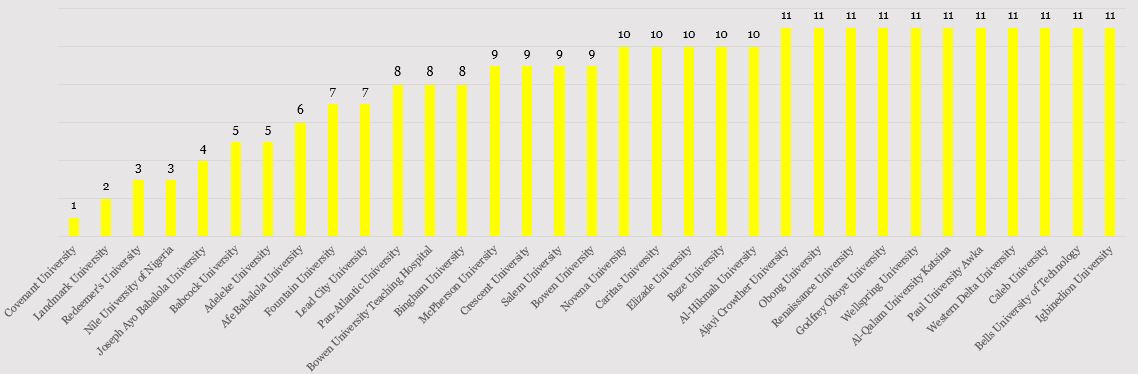
Our check further reveals that Covenant University’s researchers explored different aspects of the diseases in their researches. This is also applicable to the researchers at the Landmark University. Our analyst found that academics from the Computer Science, Agriculture, and Biochemistry, Medicinal Biochemistry, Infectious Diseases, Nanomedicine & Toxicology Departments contributed to the University’s publications. Analysis also reveals that Ajayi Crowther University, Obong University, Renaissance University, Godfrey Okoye University, Wellspring University, Al-Qalam University Katsina, Paul University, Western Delta University, Caleb University, Bells University of Technology and Igbinedion University had one publication each, making them to occupy the last position [see Exhibit 2].
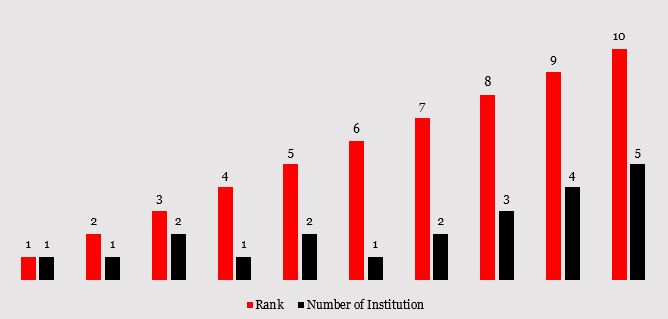
In our analysis of the research competition, Covenant, Landmark, Joseph Ayo Babalola and Afe Babalola Universities edged out the others from occupying the first, second, fourth and sixth positions and pushed them to third, fifth, seventh, eighth, ninth and tenth positions. Redeemer’s University and Nile University of Nigeria jointly occupied the third position.
Babcock University and Adeleke University occupied fifth position, while Fountain University and Lead City University slugged it out and both retained the seventh position. The eighth position was jointly occupied by Pan-Atlantic University, Bowen University Teaching Hospital and Bingham University. McPherson University, Crescent University, Salem University and Bowen University occupied the ninth position. With the contribution of two publications each, Novena University, Caritas University, Elizade University, Baze University and Al-Hikmah University occupied tenth position.
Good People, join me to thank David Onaolapo who is sponsoring 30 people on full scholarships to Tekedia Mini-MBA. For this one, we are focusing on only those who lost their jobs during the last 12 months and are looking at getting back to work. Our hope is that our program will deepen their capabilities and prepare them for new opportunities.
If in this group, click and send an email to our team; we will not be using the NGOs which usually do the vetting since there is no time: program begins 12 noon WAT on Monday. Be honest and let us help only those who need it.
As that happens, we still have funds to support people working in orphanages, special needs homes and teachers in rural areas. We have offered full scholarships with the restriction that each entity can send a maximum of two employees.
Last year, we offered hundreds of scholarships through the kindness of many global citizens and our own internal funds. And we have established one thing: Nigerians and Africans are very generous.
Once again, thanks David and all the donors who continue to pay money into our accounts. This is a community service and I want to thank our global Faculty for making this mission possible.
Nigeria needs to begin a regime of deep intellectual conversation. Until we do that we cannot advance as a nation. No one is challenging the central bank’s power to protect our financial system by banning bitcoin and cryptos. But in the course of its work, the citizens will prefer a more nuanced and intellectually engaging playbook. You build through ecosystems. Read this comment here.
The emperor has spoken! No reasons, no explanations, just absolute compliance! That was how the Boko Haram founder was killed, and the country is yet to emerge from that strategic blunder.
We do not know how to engage in intellectual debates, we do not know how to experiment; all we do with reckless abandon is issuing orders and reining insults on whoever disagrees.
The dearth of leadership qualities is dizzying and alarming, and the outcome has been a dysfunctional system all round.
You flog a child, you refuse to tell him the reason for the lashing, and still warn him not to cry! This is how Nigeria handles her citizens.
Until we learn how to communicate and debate intelligently, we will keep botching everything here.
Our shortcomings and inadequacies are too many, yet we have zero desire or ambition to improve.
Nigeria, we hail thee!
(Francis Oguaju on Tekedia Comment section)
As a student in Johns Hopkins University, the National Science Foundation, one of the highest bodies driving the United States science and technology policies, invited me to join a committee. I was a foreign student and America wanted that insight. I sat on a committee with eminent professors and technology luminaries for four years; I learned from them, and they got some insights from me!
By the time I was done, an electrical engineering student became a policy expert. I wrote a book – Nanotechnology and Microelectronics: Global Diffusion, Economics & Policy. That book is on display in my department in the university, and it later received the IGI Global Book of the Year award.
The book award
That is America. But in my native country – would the government even care to talk to its CEOs and scholars consultatively before big policy changes (forget the “common students”). We must learn that playbook because that is our missing link on how to build, nurture and advance modern ecosystems in commerce. The fiat style will not advance Nigeria.
The argument around the marginalisation of African research on the global podium has been a longstanding and controversial matter over the years.
The above statement is to the extent that unilateral action has been taken by some universities on the continent requiring that publications in international journals alone cannot be deemed the golden ticket to promotion application by academics.
So while it may be good to have a global footprint by publishing in global or international journals of repute – notably ticking the metrics of abstracting and indexing bodies such as Scimago, Scopus, ABDC and CABS, to mention just a few, publishing in “local” journals have now been thrown into the equation. So what and where are these so-called local journals? Who are the custodians of these local journals?
I have discussed the issue and complexity of scholarly publishing on the continent for about a decade now, and nothing seems to have changed, at least not at the envisaged pace. In my article on textbook publishing, this issue was raised. However, the challenge has taken on a new turn in recent years.
Whither African University Publishing?
Indeed, while I was piecing this article together, I decided to do a quick search of the internet, and guess what I found? An article that was published as far back as 2017, “The African university press – A gloomy picture.” Although there were quite a lot of issues raised by in the article, one that stands out for the purpose of this post reads thus:
The African University Press study did not individually profile any Nigerian university presses. I remain particularly interested in university presses in West Africa, and Nigeria in particular, as I was involved with setting up the University of Ife Press (now Obafemi Awolowo University Press) in the early 1970s, and did consultancy work in the late 1980s to review the operations and publications management of Ibadan University Press.
Moreover, a number of Nigerian university presses were founder members of the African Books Collective, or ABC, which I helped to establish along with African colleagues in 1989. At that time, it could be said that those presses were quite active, with diverse lists, and producing some high quality scholarly titles.
Let’s picture this. If African Universities want their faculty members to patronise local journals, then the question that readily comes to mind, for potential contributors, is rightly why? To what extent does my article or research make a global impact? How does it raise my visibility on the global stage? Who recognises the work and on what basis? These are legitimate questions that every University in Africa needs to have readymade answers to. Do you have a reputable, institutional journal? What measures of quality have been put in place to ensure that articles are at the right/ competitive level? Who are the members of your editorial board? How is the packaging of the journal? What is the reach of the journal? Who should be interested in reading the journal and why?
My Experience and Closing Points
I have been privileged to serve as a lead for a resuscitated University Journal i.e., the Unizik Journal of Business, which is published by the Nnamdi Azikiwe University. Although this should have been done much sooner, it is nonetheless a case of “better late than never.” In this third volume of the journal, under my leadership, the contributions touch upon salient issues that border on the African discourse – notably the United Nations Sustainable Development Goals touching upon aspects of Education (SDG 4), Healthcare and well being (SDG 3), Youth Development & Entrepreneurship (SDG 8), as well as Agricultural development to tackle SDGs 1 and 2 (poverty and zero hunger) respectively.