Good People, this is an update on the Remote Work Administration training which we have added as part of Tekedia Mini-MBA special live sessions. We will communicate to all members on the protocol via the Board.
But note this: our Institute wants to provide training in an emerging trend of the future where people are expected to develop capabilities to manage projects and people remotely. We are partnering with a Florida-based company called Krozu to do the training and its staff will handle it. I just spoke with the team yesterday and we are finalizing the process.
Can you work remotely or can you manage remotely, effectively? We hope you can answer YES after this process. We will provide tools for this emerging domain.
Besides the Remote Work Administration, there is also another special session on Blockchain, Cryptocurrency Decentralized Finance to be handled by Lagos-based Bitfxt and BoundlessPay. Then Infoprive, a cybersecurity and digital forensics firm, handles the last on digital security.
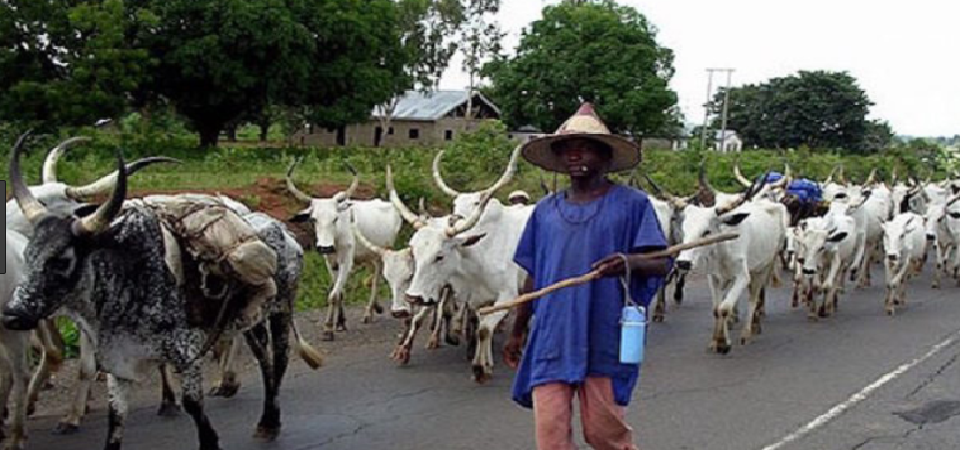
In the last five years, solving herder-farmer crisis and kidnapping remains a huge task for the state and the federal governments. On several occasions, stakeholders meeting and various community conversations have been held. The outcomes have remained mixed. Peace continues to elude people, especially those living in the rural areas across the country. In some locations, peace is being enjoined once a while. In the South region, Oyo, Enugu, Anambra, Ebonyi, Ogun, Ekiti and Ondo States have had the largest share of the outcomes of the crisis and kidnapping. People have been killed and raped, according to a number of sources.
In Oyo state, Oke-Ogun area, especially Ibarapa Local Government, has been the hotbed of the crisis and kidnapping. This is largely due to the agrarian nature of the region, which has huge potential for herdsmen. With the good hospitality usually extends to foreigners by the people of the region, one would expect that both the indigenes and herdsmen live in peace.
Nigerian Government Needs to Pay Attention to These Issues for Sustainable End to Herders-Farmers Conflict
In a recent study, researchers note that the farmers-herdsmen conflict in the region is being stimulated by multi-causal factors which majorly includes limited resources in face of greater need, reprise attack and shortage of pasture lands even climate change among others. In another study “scarce dividends of democracy are distributed to the exclusion of the Fulani due to their status as settlers. The Fulani feel cheated of their rights, even though they vote responsibly during elections. The host communities feel the Fulani are not entitled to the dividends of democracy because they are settlers and thus should return to their homeland. This has promoted division between the settlers and indigenes despite them living side by side.”
In Fashola community, a study indicates that crop-livestock farmers are using tolerance and compensation as coping strategies. The study reveals that when livestock destroyed farms, pastoralists compensate the farmers. This is being done for peaceful co-existence.
Our analyst notes that adoption of these results and others from academic and applied researches conducted in the last five years would have helped the governments and other stakeholders in solving the crisis and end kidnapping. The failure to take decisive actions led to the emergency of a Sunday Igboho, a Yoruba activist recently. Within the few days of his eviction notice to a Fulani community in Igangan [a town in Oke-Ogun region], he became prominent and people see him as the right person who can eliminate the pains and agonies associated with killing and kidnapping in South West region.
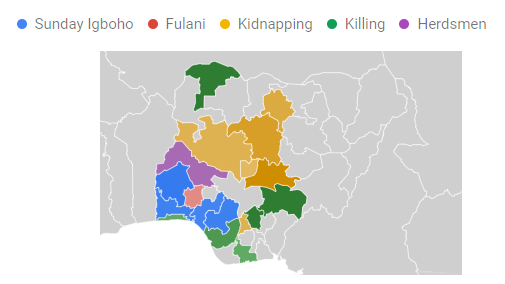
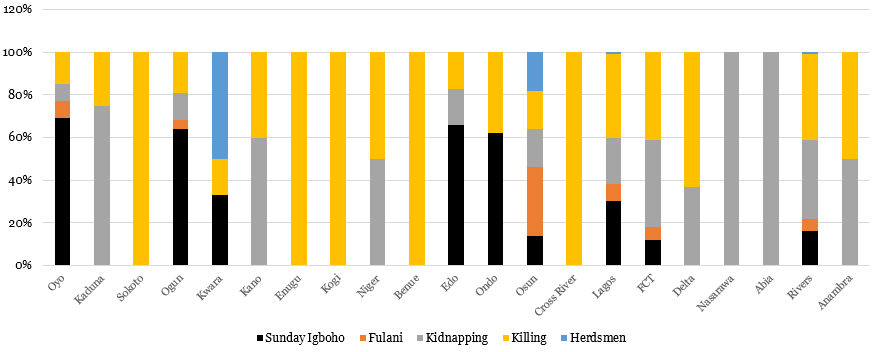
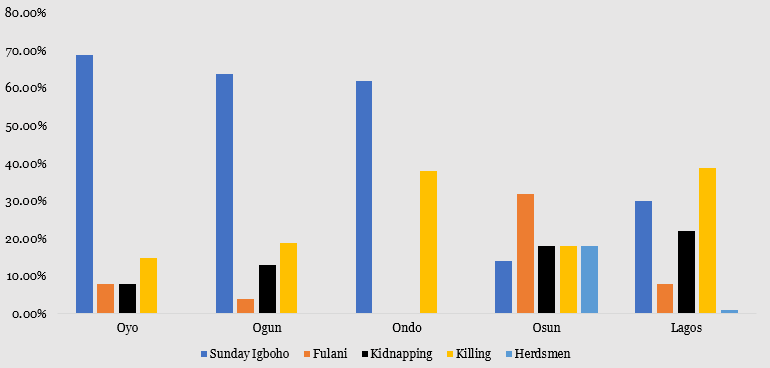
Analysis shows that Sunday Igboho was searched and understood through a number of information on the Internet between January 16 to January 23, 2021. The interest about him was high among the people in the Southern region than other regions in the country. Our analysis reveals that the higher the interest in knowing him, the lower people developed interest in Fulani, kidnapping, killing. This is quite different from their interest in him and herdsmen.
Analysis establishes a 48% interest in herdsmen when they developed interest in him by 1%. Our predictive analysis indicates that 65.8% of the people’s interest in Sunday Igboho could be explained from their interest in Fulani. It was 54.5% in kidnapping, 1.5% in killing and 65.4% in herdsmen.
Exhibit 1: Public Interest in 7 Days
Source: Google Trends, 2021
Exhibit 2: Public Interest per State and Capital Territory in 7 Days
Source: Google Trends, 2021; Infoprations Analysis, 2021
Exhibit 3: Public Interest in South-Western States
Source: Google Trends, 2021; Infoprations Analysis, 2021
Strategic Options
There is no doubt the emergence of Sunday Igboho has added a new basis of resolving the conflict and ending kidnapping in Nigeria. It has shown that people would hardly wait for government security agencies to protect them and their property. It has also indicated that people can voice out when security issues reach a high proportion with the tendency of having severe impacts on socioeconomic activities and development. Despite the relevance of Igboho’s action to the people of Ibarapa and Igangan in particular, government stakeholders need to be assertive and decisive in their approaches to security issues. Paying lip service to the insecurity would continue to create Igbohos across the country.
Like other industries in Nigeria, our analyst has previously noted that the Facilities Management industry cannot grow without constant radical and incremental innovation. This is highly imperative considering the current stage of the industry among others. Apart from the fact that constant innovation would change the face of the industry, making stakeholders to develop more interest in the ability and capability of the players to solve emerging frictions in critical and soft facilities management, it would enhance the industry’s place among other markets in Africa and Asia.
Therefore, both the players and professionals need to be creative and innovate ideas, concepts and products that will effectively deliver facility-related solutions. In our previous analysis, it was noted that employees at business, functional and corporate levels need to work together for innovation to happen. A clear innovation strategic plan must be developed. Innovation vision should be shared among the employees while the business owners and employees at the corporate level should exhibit a clear commitment to the cause.
When these happen, who should finance innovative ideas from the concept to developmental and expansion stages? This is the question this piece intends to answer briefly. Financing innovation is a mechanism that gives room for internal and external support. It also entails personal support or effort towards the successful innovation journey. In our experience, we have discovered that players in the industry can finance their innovation projects using internal and external approaches. Internal approach remains the most appropriate. The appropriateness is hinged on the fact that it gives players opportunity to capture absolute value from the outcomes of the innovation execution.
Using an internal approach means that both the employees and business owners must commit their financial resources to innovation projects. Financing innovation in the industry starts from when an employee or a group of employees [at functional and business levels] developed innovative ideas or concepts and spent their personal money on understanding the nucleus of the ideas or concepts before proposing it to employees at the corporate level. If the ideas or concepts are viable, there is a probability of getting corporate backing. This leads us to the second category of financing innovation.
However, the extent to which corporate financing can happen depend on the financial capacity of the business owners or investors. When it is obvious that the ideas or concepts cannot be financed internally, the needed fund is expected to be sought using external approach. With this approach, both the employees and business owners can discuss the ideas or concepts with a number of external stakeholders. For instance, grants, loans (including convertible debt), and equity investments can be explored. With the external approach, players would have the opportunity of establishing a strong interaction with the key stakeholders towards more recognition of the industry and what it means to the sustainability of public and private facilities.
These approaches must have been employed by Alpha Mead Group, which innovated Call2Fix [solving perennial friction of having dependable technicians for secure homes and workplaces maintenance], and FilmoRealty that launched its proptech products recently. The company developed Vamp Facilities Intelligence, a software makes planning and execution of facilities projects easier. This software is useful for immersive facilities management practices in a pandemic period suggested by our analyst previously.
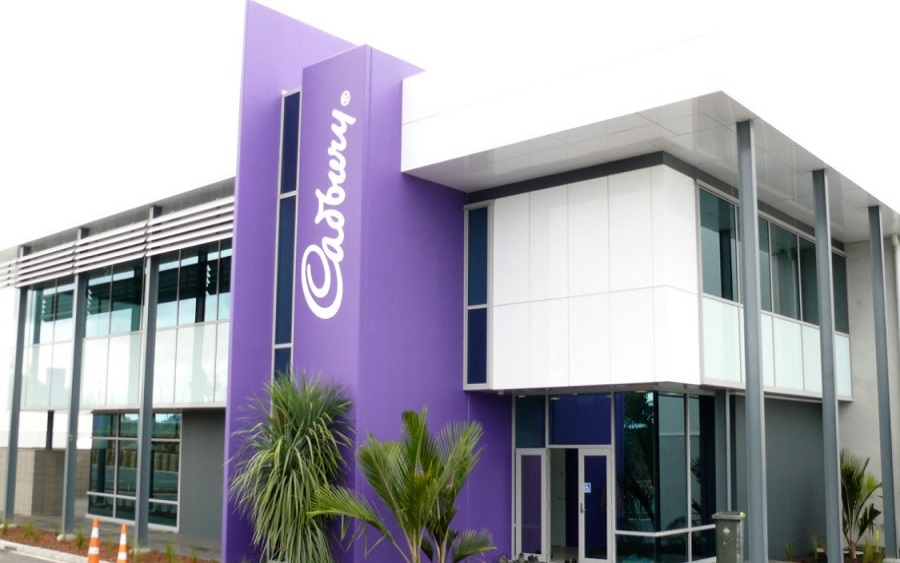
Time to declare a state of industrial growth emergency in Nigeria? If you have been paying attention, you ought to have noticed something: Nigeria’s industrial giants are struggling severely. Yes, Cadbury Nigeria Plc just declared a profit of N172 million (about $400,000) for 2020. Unilever was all red at N1.59 billion loss: “Unilever Nigeria Plc a leading consumer goods company in Nigeria declares in its unaudited annual financial report that it made a loss amounting to N1.59 billion in the year 2020. This is according to the information and figures disclosed in the Company’s unaudited financial statement published by Unilever on the website of the Nigerian Stock Exchange”.
Cadbury Nigeria Plc has declared in its recently published unaudited year-end financial statements, that it made a profit of N172 million at the end of its operation in 2020.
This is according to the information and figures contained in Cadbury’s un-audited year-end 31st December 2020 financial statements, published on the website of the Nigerian Stock Exchange.
Revenue decreased to N35.41 billion, down by 9.97% Y-o-Y.
Cost of sales decreased to N29.64 billion, down by 4.39% Y-o-Y.
Gross profit decreased to N5.77 billion, down by 30.73% Y-o-Y.
Other income increased to 108.04 million, up by 24% Y-o-Y.
Selling and distribution expenses decreased to N4.58 billion, down by 12.12% Y-o-Y.
You can blame Covid-19 but I do not buy that argument. These companies make what we use daily, Covid-19 or not.
So, there is a problem somewhere and a dislocation is happening, frontally or through the flanks. It is either Nigerians have moved from semovita to black akpo [black local fufu] or someone somewhere is offering the same products at better rates. But one thing is evident: a shift is happening and these firms are under threats. I just hope that people are not getting poorer that few care for what they sell!
But do not miss that the local ones are doing better; Flour Mills broke sales records. It is possible that its products are more competitively priced since it does not have the global multinational structure of the competitors which can make flexibility on pricing more difficult, besides freedom to source some raw materials locally. Yes, like the ways Accenture and BCG were knocked down in Lagos by the local competitors, and both exited Nigeria. Pricing is a very important component in Nigeria’s business climate now.
Nigeria’s integrated food business and agro-allied group, Flour Mills of Nigeria Plc, has continued its strong performance, growing its profit after tax (PAT) for the third quarter ended December 2020/21 by 91 per cent. The Group posted a revenue of N555.342 billion in Q3, up from N423.479 billion in the corresponding period of 2019/20.
So, in the end, if you do not do sachetization in anything you are doing in Nigeria, you will struggle. Nestle is a foreign brand but has gone full sachet-playbook and is killing it. Update your playbook and begin to sell in “sachets” where necessary.
The world today has many farmers that owe no farms. Thanks to different investment options, people can invest in farming while others manage those farms for them. Many farmers you know today were able to generate their capitals through investors, who could not lift hoes but hoped to reap proceeds from their farms. This method is also obtainable in livestock farming, where a person rears animals through a third party.
In addition to farming through a third party, farmers have discovered that they must not own a large expanse of land before they go into commercial farming. This tradition has been in existence for a long time. Even our forefathers “borrowed” farmlands and crops from others for an agreed sharing formula. Sometimes, the agreement is that all the farm produce will be shared equally between the lessor and the lessee. In most cases, legal landowners take the best economic crops on the farm and then leave the rest for the poor farmers. This arrangement is also found in livestock farming and has been sustaining farmers, especially those that lack land and seed capital.
Presently in Nigeria, a lot of people want to go into the farming business but they cannot afford to buy lands for that purpose. Leasing may not be a wonderful option considering that the high demands for land made it expensive. Even though some landowners rent out their properties at cheaper rates for this purpose, they are barely enough for the number of persons that need them. Apart from that, such arrangements may not suit commercial farming because the size of land allotted to farmers may be too small for anything other than subsistence agriculture. Livestock farmers also encounter this difficulty and it hinders their progress. This is one of the reasons farmers always call for government intervention towards providing land for agricultural purposes.
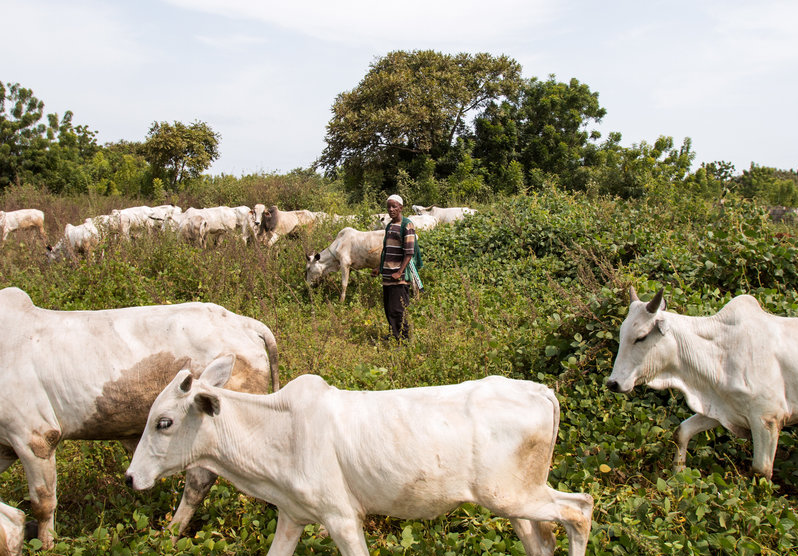
Apart from the land challenges, food crop farmers have complained bitterly about the encroachment of their farms by Fulani cattle herders, whose animals destroy their crops as a result of their open grazing method. The destruction of crops has led to several clashes between the herders and the farmers and has resulted in the death of many. Efforts made by farmers to discourage open grazing have led to multiple face-offs with herders and had shown no sign of stopping the problem. This means that only government intervention can stop the menace of open grazing in the country. To solve this problem as well as to provide land for livestock farmers, the government launched the National Livestock Transformation Plan (NLTP), an initiative that can answer the prayers of many farmers when it becomes operational.
NLTP is a scheme adopted by the National Executive Council (NEC) on 18 January, 2019. It is an initiative designed to partner with interested state governments to provide land for livestock farmers to practice their profession. Through this programme, livestock farmers, including the controversial Fulani herders (and their employers), will have access to land for ranching. The good thing about this scheme, when it starts fully, is that it will make land available to farmers at a considerably cheap rate. This means that Nigerians that wish to try their luck in livestock farming will have a place to do so.
However, the controversy surrounding the Rural Grazing Area (RUGA) scheme has found its way into NLTP. Some Nigerians believe NLTP is the baptismal name for RUGA. They believe the Federal Government repackaged the RUGA agenda in NLTP, whereby the government will ‘grab’ land from citizens and hand it over to Fulani cattle herders. As much as it is understandable for Nigerians to become sceptical of new initiatives, especially when they come from the government, they should understand that NLTP did not specify that the programme is designed only for a particular type of livestock farmers or people from a tribe. The sole objective of NLTP is to improve livestock farming by providing land for ranching.
Nevertheless, Nigerians should demand more from this programme. So far, considering that ranching is usually for grazing animals such as cattle, it has not been specified if all the ranches that will be provided through this initiative will be reserved for cattle farmers alone. Kindly note that Nigerians from different tribes engage in cattle rearing and, hence, providing land for cattle rearing does not imply they are only for people from a particular tribe. Hence, if you have an interest in cattle rearing, you can key into the NLTP and benefit from its objectives. However, farmers of other livestock should not be left out. Cattle are not the only sources of meat or income in Nigeria and so should not be treated specially.
Furthermore, there is a need for proper dissemination of information concerning this programme. Many Nigerians might not know what it entails and will, therefore, kick against it. It is also important that people know when the programme starts so that those interested can join in. This is a call to the appropriate authorities to do the needful because the publicity level of this scheme is poor.