DD
MM
YYYY

PAGES

DD
MM
YYYY

spot_img

PAGES

Home Blog Page 5970

Six Types of Crowdfunding

1

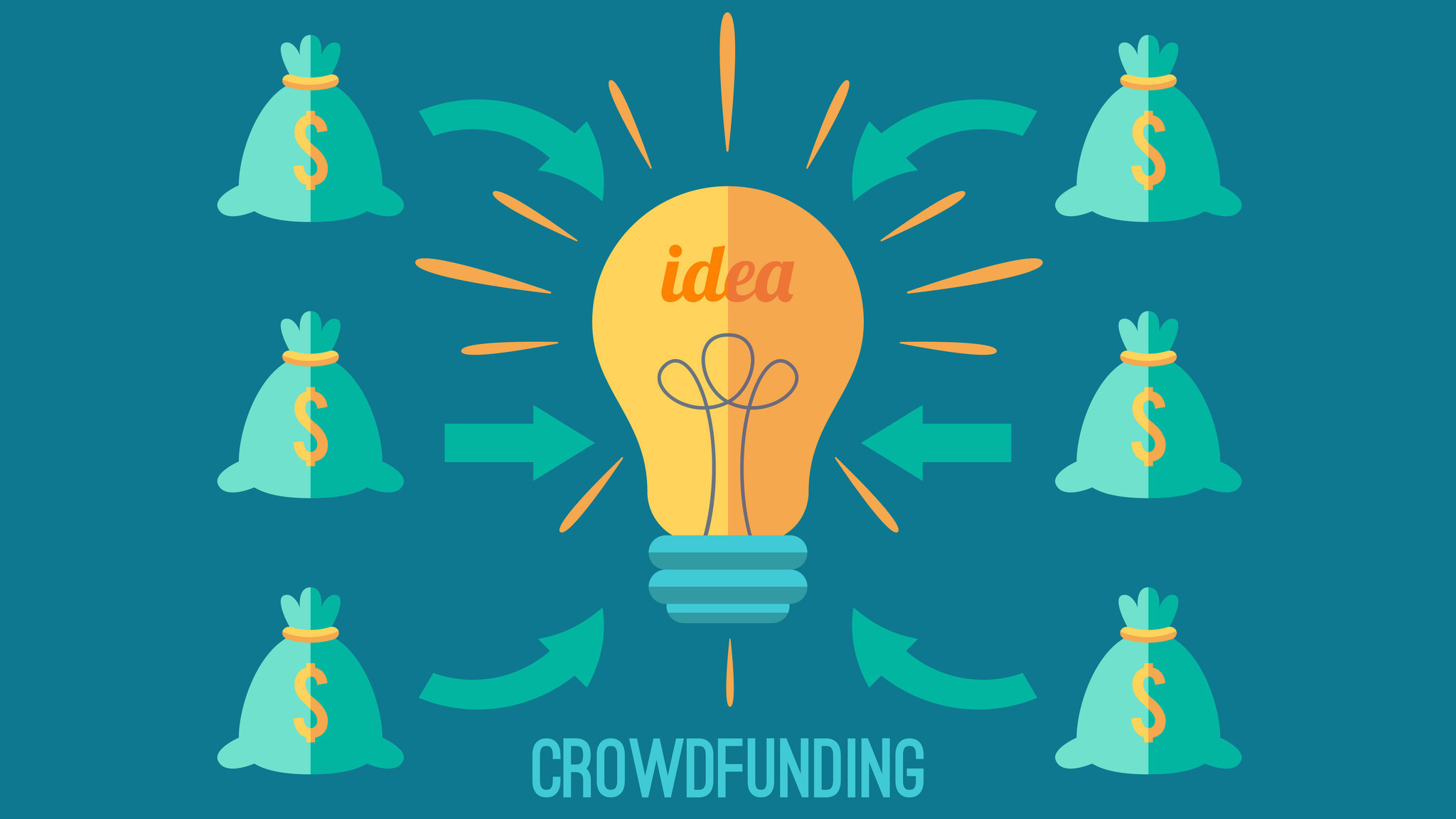
One of ways of raising capitals for starting and expanding businesses is through crowdfunding. This is a fund sourcing approach, whereby a large number of investors contribute money to sponsor a business in return for something or nothing. Crowdfunding has its perks and drawbacks as mentioned here. However, it is a project that is worth giving a try.

But for crowdfunding to be most successful, the entrepreneur needs to consider some things. One of them is the model to opt for. Some types of crowdfunding require returns on investment (ROI) while others don’t. Further, each type has advantages and disadvantages. Hence, considering the one you can opt for will be necessary as you make your plans towards the project.

Types of Crowdfunding

There are several types of crowdfunding but they all follow one or two basic formats. The basic types of crowdfunding, therefore, are peer-to-peer lending, equity crowdfunding, reward-based crowdfunding, donation-based crowdfunding, profit-sharing, and hybrid models.

  • Peer-to-Peer Lending

This is in the form of a loan. It is borrowing from the crowd with the intention of paying back with interests. Put differently, peer-to-peer lending, also known as debt crowdfunding, is borrowing money from many investors, whose money will be repaid with interests. This is more like borrowing from the traditional banks except that a large number of investors are involved here, and the capital sourcing is usually done online.

The benefit of this type of crowdfunding is that SMEs and start-ups have access to loans without providing collaterals. This is also beneficial to entrepreneurs that could not meet requirements requested by traditional banks for accessing loans. Hence, entrepreneurs could set-up their businesses through loans even when they don’t have the wherewithal to obtain loans. However, it is possible the investors may demand for higher interest than what the bank would have asked for. Another disadvantage here is, like other crowding funding types, investors may demand to know everything about the intended business. This could cause the entrepreneur to divulge all secrets regarding his business and, thereby, risking having his ideas stolen by competitors and idea thieves.

  • Equity Crowdfunding

This type of crowdfunding is similar to selling and buying stocks of companies. Here, investors raise money for the entrepreneur in return for shares. In this case, the ROI is shares or stakes in the company even though the business is not registered with the stock exchange. So, after contributing for the business, the investors become part owners of the company.

The benefit of this type is that shareholders act as the promoters of the business. Just imagine if you have two hundred investors in your business and the two hundred own shares in it; this means you have two hundred advertising outlets. This is because the investors will want the business to grow because they are, partially, its owners too. Further, the entrepreneur has control over how much the investors contribute since he decides how many shares to sell and how much each will cost. However, the entrepreneur will encounter challenges with finding investors in this case because it’s a long term investment, which ROI might not come immediately.

  • Reward-Based Crowdfunding

This is also referred to as seed crowdfunding. This involves borrowing from the public with the intention of paying back in kind. Here, investors are paid for their investment in the business with nonfinancial rewards. The reward could be provision of services at a reduced rate, being the first to access products after they are finished, free services, donating to the community, acknowledging investors, sending appreciation letters, and so on.

Entrepreneurs that opt for this type have a lot to benefit from it. First of all, the no-interest feature makes it cheaper for entrepreneurs to raise capital. Furthermore the business owner has total control over his business. However, because the ROI does not involve financial gain, investors may not be forthcoming. This means this approach might not work for entrepreneurs seeking a huge amount of money.

  • Donation-Based Crowdfunding

This is usually done for charitable purposes. It is where the public contributes funds for a project without expecting any ROI, be it in cash or kind. In donation-based crowdfunding, there is no fixed amount of money each investor should contribute. Usually, they donate small amounts of money to raise the huge sum needed. Nevertheless, beneficiaries usually encourage large donations by providing rewards for them. However, the money invested is never returned.

This type is best for humanitarian purposes. It is best for NGOs and other charity organisations for funding their projects. However, because of lack of ROI, investors do not usually contribute large sums. This makes it unsuitable for capital-intensive projects.

  • Profit-Sharing Crowdfunding

This is also known as revenue-sharing crowdfunding. As the name suggests, entrepreneurs that use this model pay back their investors by sharing profits made by the business. For this to happen, investors have to contribute a fixed amount of money. The benefit of this model is that the entrepreneur is only obligated to pay ROI from profits the business generated. This method might be most suitable for high risk businesses that may or may not generate profits. The returns are higher when profits are high and lower when profits are low. Hence, entrepreneurs are not pressured to pay back their investors: so long as profit is made, investors will be repaid. Hence, the financial performance of the company determines how investors are repaid. This is one model that favours both investors and investees immensely. However, it will be imperative to convince investors that the business will be profitable so they can part with their money.

  • Hybrid Model

As the name suggests, this model combines two or more types of crowdfunding depending on the entrepreneur’s needs and choices.

Note that choosing the type of crowdfunding that is suitable for you requires you consider the purpose and the intended investors. By purpose, you have to consider the type of project you want sponsored and its purpose. By intended investors, you need to consider if you want business moguls in your team or just anyone that has interest in the purpose. This means you need to research further on the type of investors that each crowdfunding type attracts. That way, you won’t make avoidable mistakes.

Cryptocurrency Hits Over $1tr Value As Bitcoin Continues It’s Bull Run

0
Bitcoin is soaring

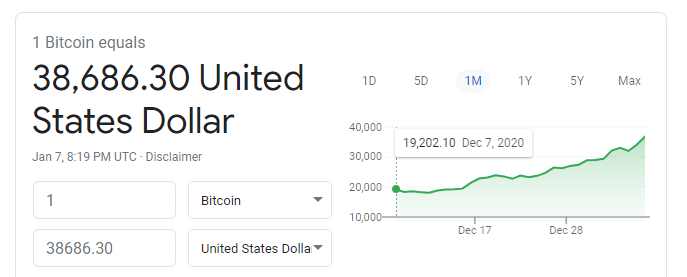
Bitcoin’s volatile rally has put the value of cryptocurrencies past $1 trillion for the first time. The surge in bitcoin has boosted other cryptocurrencies following a fivefold climb in market value in the past year.

Bitcoin rose over 5% on Thursday to top $39,000 for the first time as it continues its amazing run from late last year that has placed its value at $700 billion. The digital asset has quadrupled in the past year and accounts for about two-thirds of cryptocurrency market value, followed by Ether on about 14%. Ether has risen 62% this year, according to a composite of prices compiled by Bloomberg.

Strategists attribute the rise to demand from speculative retail traders, trend-following quant funds, the rich and even institutional investors. Wall Street billionaires publicly backed the coin last year as more investors started seeing the coin as an inflation hedge.

There has also been a surge in demand of bitcoin by prominent organizations and individuals that led credence to its frenzied rally. Investors such as Paul Tudor Jones and Stanley Druckemiller were among those who joined the trend, following the step of Twitter founder and CEO, Jack Dorsey. Large financial companies like PayPal, Fidelity, MicroStrategy and Dorsey’s Square have also made moves in the cryptocurrency.

“When you look at this bitcoin rally that we have been seeing in the last couple of weeks and months, really, there’s two big elements driving it. One is the continuous entry of institutional players,” Henri Arslanian, PwC’s global crypto leader told CNBC.

Data from CoinGecko, a crypto tracker platform confirmed that cryptocurrencies hit a milestone after a fivefold climb in market value in the past year.

It has been up about 30% since the start of the year following a nearly 370% surge in the past 12 months.

Researcher Flipside Crypto said active bitcoin accounts are nearing their all-time high levels of late 2017, which is a possible sign that some holders are planning to sell. Bloomberg noted that fewer than 2% of accounts hold 95% of bitcoin supply, so a few traders can impact prices. It means the recent invasion of the coin by rich individuals and organizations may result in a few controlling cryptocurrency.

Other factors like JPMorgan Chase & Co.’s long-term bitcoin price forecast of $146,000 and the US regulatory update that allows a class of less volatile coins to be used by banks for payments, have been also fingered by traders as possibly fueling the rally.

Arslanian said regulatory measures by the government is another factor driving the surge, as it wasn’t the case in the past year, and he expects the trend to continue in coming months.


As the government gets more involved in the activities of bitcoin, more investors are seeing it as the ‘digital gold’, a safe haven asset and inflation hedge. The idea has continued to penetrate the many business minds that are looking for a secure investment place from the pandemic.

JPMorgan said bitcoin could hit $146,000 in the long term as it competes with gold as an alternative currency. But the bank’s analysts added that it has to become less volatile to reach the price, considering its wild price swings.

However, its current run is expected to attract more investors in the next few months.

“This latest bull run in January is sure to attract the asset managers’ attention to diversify even more of their assets to crypto as they are keen on finding alternative investments, such as cryptocurrency or gold, to hedge inflation and geopolitical risks,” Simons Chen, executive director of investment and trading at cryptocurrency financial services firm Babel Finance, told CNBC.

“A large number of retail investors have also joined the race recently as they fear to miss out on opportunities to make easy, quick gain from the latest bull run,” he added.

The current value of cryptocurrency reflects the rise in the use of bitcoin. The total transaction volume of the digital asset in 2020 was greater than that of Venmo, Paypal or Apple Pay.

“There was more usage of the bitcoin payment rails than some of the most popular fintech products.

“Bitcoin is transitioning from what used to be a contrarian idea or a contrarian trade to a consensus trade. I think that’s where you’re getting this re-pricing of the asset and the rapid price appreciation, as more and more folks on Wall Street come into the asset and want exposure,” Anthony Pompliano, co-founder of crypto hedge fund Morgan Creek Digital, told CNBC.

However, the short time surge of bitcoin is casting doubt in the minds of many investors who believe it wouldn’t last long.

The Age of Elon Musk

3
Elon Musk

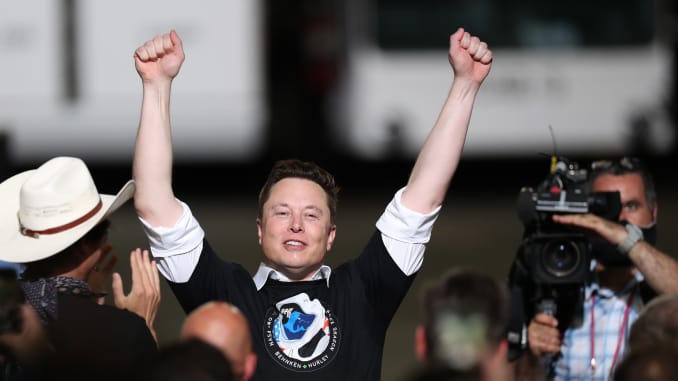
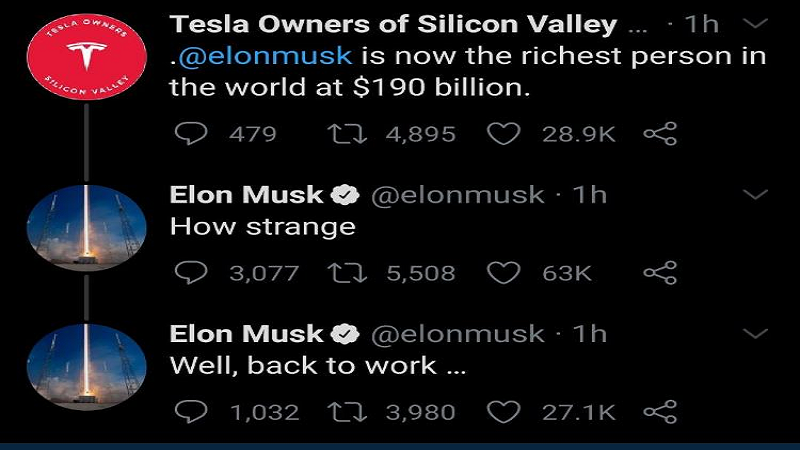
Elon Musk is now the richest person on the planet, with a $185 billion large purse. A recent stock surge in Tesla’s share price pushed Musk past Jeff Bezos, who held the mantle since 2017 and currently controls $184 billion. Musk’s wealth surge is unprecedented – and even the ancestral wealthy Musa of Mali would be jealous.

Elon drank the African waters before he moved to Yankees and that is a validation on something: it can come from any place. His rise is uncommon and shows the beauty of America. People, this is now an Elon Musk age – and this one could be very durable when you combine Tesla with moonshot-visioned SpaceX. I mean this guy could rule the empires of wealth for a very long time.

Many got it all wrong: ‘Long-term bear RBC Capital Markets upgraded its recommendation on Tesla Inc., admitting it had misjudged the electric-vehicle maker.. There is no graceful way to put this other than to say we got TSLA’s stock completely wrong,” analyst Joseph Spak wrote in a report lifting Tesla to sector perform. The broker had maintained a sell-equivalent underperform rating since January 2019, according to data compiled by Bloomberg. During that time, the shares have surged by about 1,200%.’

Mr. Musk is the generation’s best innovator – and it is hopeless betting against him.

Tesla has the best technology, best brand and remains well ahead of competitors on electric vehicles. Yes, the category-king has been anointed and Tesla will win the electric vehicle (EV) business. And provided it keeps that dominance, markets believe others will just break down. What GM and Ford are doing could be described as “marginal”, and daily, Tesla is extending the goal posts, making it harder for them to catch-up.

In the marketing construct of Needs, Expectations and Perceptions, Tesla is taking the world into Perception while other brands are meeting needs and expectations in the EV sector. When you are in the perception space, you set a new basis of competition, bringing new competitive ordinances that disrupt markets for your advantage.

Where are the Nigerian men with traditional titles “Eze Ego” [King of money], “Oba Ego” [the barn which holds money], “Osimiri Ego” [the ocean of money] etc? There is a launching program in the village, and Elon Musk is coming – let there be a match! Do not call in sick due to Covid-19; we are aware you have tested negative. We want to know who is the real king of money!

Tekedia Institute Welcomes Kiakiagas to Tekedia Mini-MBA

0

I have just spent a couple of minutes looking at the frictions they are fixing. Kiakiagas.com is your supplier of cooking gas in Nigeria. They offer free delivery of cooking gas to most homes in the major cities within 45minutes. The differentiation is that you can use an app to place the order and they will deliver. I see huge new frameworks they can apply to deepen the business.

At Tekedia Institute, we welcome Kiakiagas to Tekedia Mini-MBA. CEO Emmanuel Uwandu, Jane, and team, we are confident that our program will support your mission of growing this business.

We have many related courses, one delivered by an operating manager from Schlumberger and another by a U.S.-based executive in the pipeline industry. So, besides the business courses, you will get great insights on the business cases of gas and oil business.

Again, welcome to the largest business school in Africa!

Tekedia Institute offers an innovation management 12-week program, optimized for business execution and growth, with digital operational overlay. It runs 100% online. The theme is Innovation, Growth & Digital Execution – Techniques for Building Category-King Companies. All contents are self-paced, recorded and archived which means participants do not have to be at any scheduled time to consume contents.

It is a sector- and firm-agnostic management program comprising videos, flash cases, challenge assignments, labs, written materials, webinars, etc by a global faculty coordinated by Prof Ndubuisi Ekekwe. Register here.

Tekedia Academic Programs

The Kano’s $46 Wage Shock

1

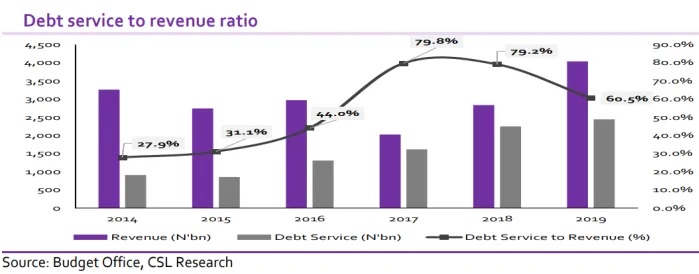
I do not know how to begin this note. Yes, when the Nigeria Labour Congress was pushing for the evidently deserved raise on workers’ wages, I made a comment that winning the strike and legal battles for workers may not mean that their bank accounts would see the money. Yes, in a nation where population growth is growing faster than economic opportunities, shocks will happen. When you add that Nigeria uses 60% of its revenue to service debts, you get a clear picture that striking for wage raises may not mean much in the long-run. Yes, if there is no money, minimum wage would be frozen.

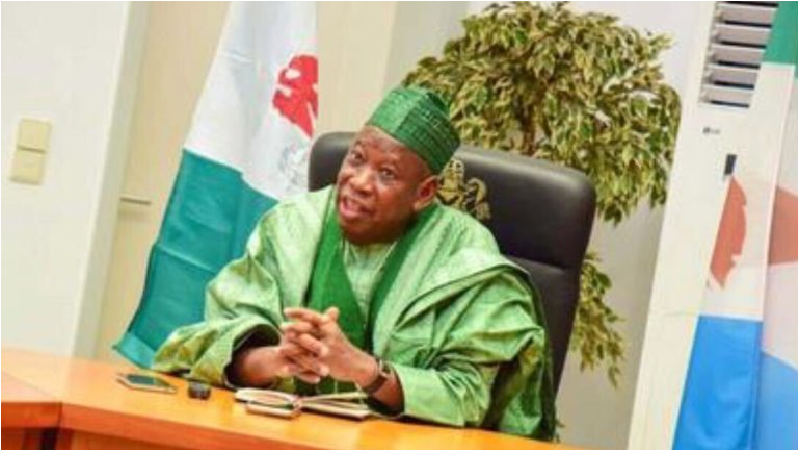
Kano state has drawn the first blood: “The Kano State Government has reverted to N18,000 (about US$46) minimum wage, …The Special Adviser on Media to Governor Abdullahi Ganduje, Salihu Tanko-Yakasai, confirmed the development in a telephone interview with The PUNCH on Wednesday in Kano.”

“Yes, the state government has stopped the payment of N30,000 minimum wage to its workers with immediate effect,” he said.

Tanko-Yakasai said the reason behind the action was due to the recession occasioned by the COVID-19 pandemic.

According to him, the state was unable to continue paying N30,000 because what the state was currently getting as a government had reduced.

“The state government has reverted to the initial minimum wage due to the recession.

“What we are getting now as a government has reduced, and we can’t afford to pay the N30,000 minimum wage,” he said.

You read it, and as the official noted, Abuja was not sending us enough money, and that means we cannot pay the old N30,000 ($79) monthly wage. But if you are truly honest with yourself, you would have expected this. When Kano state agreed to pay this minimum wage, there was no clarity on how it would do it without Abuja expanding its size! 

Of course Kano state workers are lucky; Abia state does not even care, even to pay the minimum wage. The state abandoned its college of education when workers went on strike for unpaid wages. Today, that school is permanently closed.

As always, expect some strikes in the next coming weeks. But those will not change the fundamental construct of the root cause which remains that Nigeria needs a drastic redesign on its economic architecture, to become more productive, so that the state workers could generate enough, to pay themselves whatever they want, instead of waiting for handouts from Abuja. 

Abuja may not be helpful these days as it is looking for money to fund its own bureaucracy. Since 1999, Nigeria has scaled wastes, and it seems the party will continue, as they have removed the brake pads in Nigeria’s moving train to nowhere.

Nigeria data


Nigeria’s 60% Debt Service to Revenue Ratio And Push To Borrow from Unclaimed Dividends, Dormant Bank Balances