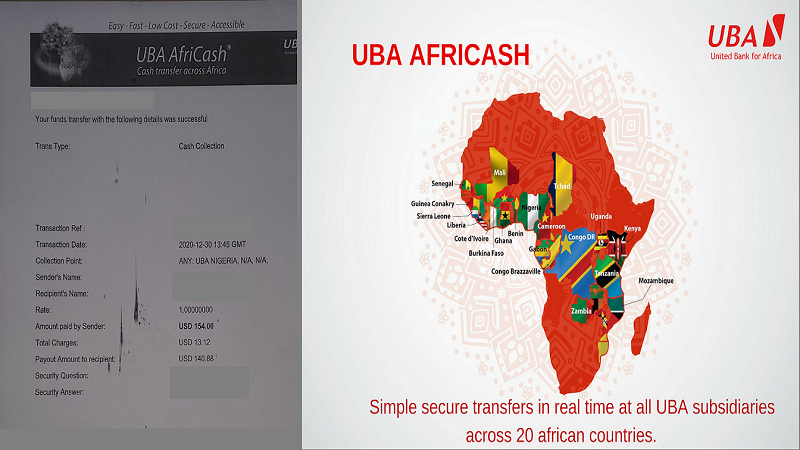
I am happy to commend the United Bank for Africa (UBA) for creating UBA AfriCash. We used it today from a customer in Sierra Leone who wanted to pay for Tekedia Mini-MBA. This is coming after all the frustrations when the fintechs could make this happen. Yes, the old banking institution which was supposed to be disrupted has the right product. We have lost many customers from Gabon, Tanzania, etc due to intra-African payment issues. Now, we think with UBA AfriCash, that friction has been fixed.
AfriCash is like a Western Union within Africa, connecting about 20 UBA operating countries. I am very impressed – and with this, our message is simple: if you live in any country where UBA operates, we can easily serve you. In some countries, we have partners; they remain our preference for payment.
If you live in any of the noted countries, simply email my Admin and the team will give you details to put when wiring the money. You will make the transfer in US dollars (you use your local currency and buy USD in your country), and our team will collect it in UBA Nigeria.
(See the fee amount, on image, to know how much USD you need to go to UBA with.)
In Nigeria, a number of companies prioritise winning awards because of the numerous benefits associated with it and being enjoyed by companies that have won one or two over the years. Like other emerging industries in Nigeria, players and professionals in the Facilities Management industry believe that winning awards equals to increasing the industry recognition by stakeholders in the public and private establishments.
In our experience, we discovered that professionals were of the view that both companies and professionals need to be recognised through awards and other means capable of improving their morale towards sustainable facilities maintenance and management in the country. Looking at their views, our analyst notes that recognizing the players and professionals cannot be done using non-standardized approaches or measurements. This is premised on the fact that issues and needs within the built environment, especially management of critical infrastructure or facilities requires innovative and sustainable solutions. For instance, in 2019, our analysis of the issues and needs within the built environment showed that over 48% of 80 issues felt and needed by the people within upper, middle income and bottom of the pyramid. This is closely followed by the people within the bottom of the pyramid with 30% and, upper and middle income class (17.5%). Situating this analysis within opportunity areas, we found that health sector dominated with over 76% of the issues and needs followed by real estate and construction (6.25%), oil and gas (5.0%), power and energy (5.0%) and public infrastructure (3.75%).
Our analyst believes that these issues and needs, and others were solved by companies in the industry in 2019 and 2020 before being considered for awards. We believe that the Business Day, a national newspaper, did its research and evaluation appropriately before awarding various awards to selected companies in the industry during its 2020 Nigerian Business Leadership Awards.
Eliezer Workplace Management won leadership in sustainability and environmental impact award. Green Facilities was considered for emerging total facilities management company, while Global Property and Facilities International and GreenKey Facility Management Services were presented with an overall excellence in facility management and technology innovation in facility management respectively. Principal Facilities Management is also seen as one of the best FM brands during the year. However, this piece is not about x-raying the processes and factors being considered by organisations before giving awards to these brands and others. It presents insights and needs regarding the place of awards in customer base increase and industry recognition by the stakeholders.
FM Brands and Quest for Awards
As argued earlier, companies are on award winning race every year. They want to be seen as being the best in terms of processes, people, technology usage and value creation. They want to justify the usual nomenclature of being ‘the leading FM company, the best FM company in the country’. As noted in one of our previous analyses, the Nigerian Facility Management industry is like the media industry, which players and professionals are highly located in and operated from Lagos.
In our analysis of 25 companies, 97.96% are located in Lagos, while 2.04% are situated in Abuja. Our efforts to get a number of players in Port-Harcourt and Kano as part of samples for analysis yielded low results. Value proposition using the mission statement and service or solution offering indicate that a number of companies in these cities did not fall within the scope of the analysis. They are yet to align with the best national and global practices, which could be used to justify their classification as facilities management companies. For example, doing cleaning service alone does not mean a company is a member of the industry.
Alpha Mead, Savvy Capire, GPFI, GreenKey, Green Facilities, Eliezer Workplace, Principal Facilities, Willco Property Management, Provast, TseboRapid, Max-Migold, Libra Reliance, Cxall, Cushman and Wakefield, Lafam, Avant Properties, ProFM Credential, Broll Properties, North-Court, Total Facilities Management, Ikon Facilities, Coco Facilities Management, Apex Link Global Concept, Trash Movers Nigeria and Preferred Facilities Management were specifically chosen for the analysis. These companies have had over 250 collective years of operation. The average years of existence of the companies is 10 years, 3 months and 6 weeks. Between 2015 and 2020, 13 of these companies won 49 awards, which entails national and international awards, our analysis reveals. Twenty-nine national awards were won during the period, while 20 international awards were achieved.
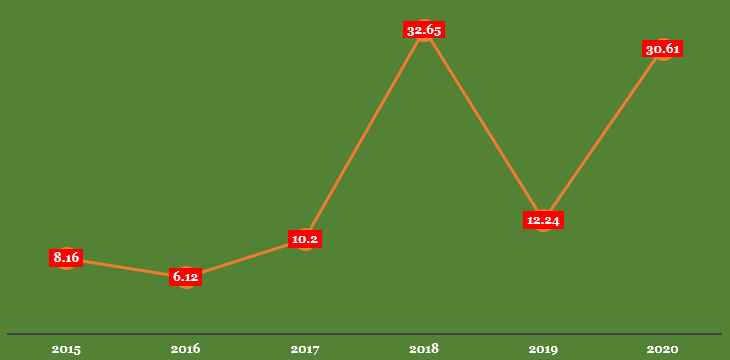
In 2015, 8.16% of the awards was won. This reduced by 2.04% in 2016. However, the companies’ train of winning awards increased by 4.08% in 2017 with a significant increase in 2018. Surprisingly, in 2019 the significant achievement attained in 2018 dipped in 2019. In 2019, the number of awards won by the selected companies reduced to 12.24% from 32.65% recorded in 2018. In our data, we also found that in 2020 the companies worked assiduously to earn recognitions from award-giving organisations, especially the national newspapers. With a 18.34% increase, the companies surpassed achievement recorded in 2019.
Does Age Matter?
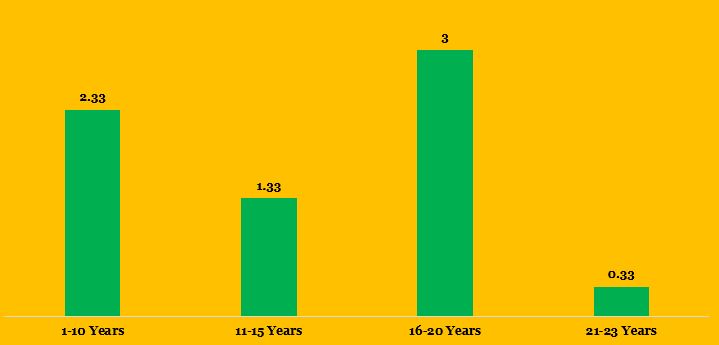
Our analyst answered this question with the classification of the companies’ years of existence into four groups. In the first group, which is tagged 1-10 years and first emerging players, 11 companies constituted the group. In the second group, which is dubbed 11-15 years and second emerging players, we have 6 companies. Three companies were in 16-20 years and first established players while two companies were in 21-23 years and second established players group. Analysis shows that companies in 11-15 years and 21-23 years associated significantly in their awards winning race between 2015 and 2020 [some companies did not win awards during the period]. Examination of the severity [using standard deviation scores] of awards along with the years of existence reveals a negative connection, indicating that the higher the awards, the lower the years of existence. This implies that companies established in the last 15 years won awards more than those established in the last 23 years during the period.
Exhibit 2: Average Award won by years of existence group
Winning Awards and Public Recognition of the Industry
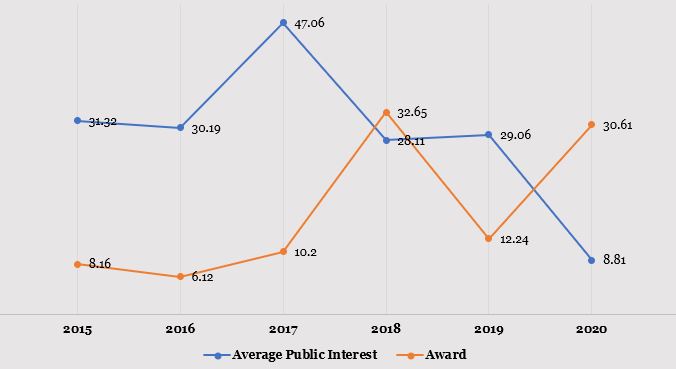
What does winning these awards connote for the industry during the period? Our analyst found that one unit of winning awards by companies within the first emerging players group led to 14.4% increase in public interest in the industry. More than 13% was found for those companies within the second emerging players group. However, analysis indicates that the more players in the first established players group won awards the less public had interest in the industry. Analysis further shows that players in the first and second established group contributed to the public interest in the industry negatively. One unit of winning awards translated to 25.9% reduction of public interest in the industry.
These results have many suggestions and implications for the industry and players. One of the suggestions is that players in the emerging groups could be said to have deployed their communication and relationship infrastructure towards effective communication of the essence of the awards to the stakeholders, especially clients. It also means that players in the established groups felt that they have had enough. Hence, there is no need for communicating or celebrating the awards through public engagement.
Exhibit 3: Average Public Interest in Facilities Management and Award per year
Source: Google Trends, 2020; Companies’ Websites, 2020; Infoprations Analysis, 2020
Exhibit 4: Severity of the awards and public interest in facilities management between 2015 and 2020
Source: Google Trends, 2020; Companies’ Websites, 2020; Infoprations Analysis, 2020
Going Forward
As the insights established, gaining brand and industry recognition after winning awards is a matter of strategic communication of the laurels to the public, most importantly prospective customers. In fact, being at infant stage is enough for the players to always use awards winning as one of the strategic tools for gaining public recognition. It is a means of letting the public know that without facilities management industry business operations would be grounded and projected revenue would not be attained.
Players in the established groups need to increase their strategic communication efforts after winning awards. Being the oldest companies and winning awards should be leveraged for robust public engagement that would increase public recognition of the industry. For instance, experiences during the early years can be shared using case and storytelling approach. This will go in a long way of connecting the past with the present towards public understanding of the place of the industry in Nigeria’s quest towards sustainable infrastructure or facilities management.
The boy is focusing on what matters: he wants light to see tomorrow – and he is reaching higher. As the dawn of 2021 arrives, I want you to reach further, and send your staff and team members to an innovative business school in Africa right now. Our rating is 4.9/5 – and we lost that 0.1 because of our platform. Now, from the next edition starting Feb 8, we are moving to a new platform. Supremely amazing!
Make a great decision to begin the new year – prepare your team at Tekedia Mini-MBA.
Tekedia Institute Mini-MBA is a school where business leaders from Shell, MTN, KPMG, Flutterwave, Nigerian Breweries, Microsoft, Infoprive, Krozu, Access Bank, Schlumberger, and indeed great gloCal companies teach. Why not learn from the best? Begin here.
Tekedia Institute offers an innovation management 12-week program, optimized for business execution and growth, with digital operational overlay. It runs 100% online. The theme is Innovation, Growth & Digital Execution – Techniques for Building Category-King Companies. All contents are self-paced, recorded and archived which means participants do not have to be at any scheduled time to consume contents.
It is a sector- and firm-agnostic management program comprising videos, flash cases, challenge assignments, labs, written materials, webinars, etc by a global faculty coordinated by Prof Ndubuisi Ekekwe.
If you are a digital challenger bank, in Africa, and you have no plan to charge the typical banking fees, from customers, what is your future? Also, if your balance sheet remains small, do you not think that traditional banks can match your no-fee model with a service, and by doing that freeze your growth? Across the globe, most digital challenger banks (N26, Revolut, Monzo) are loss-making companies despite having millions of customers.
Yet, I have written on innovation hangover which makes it hard for mature/traditional companies to match the agility of startups. Another element is the cost model where a startup could technically capture value, in markets where mature firms may struggle, due to the positioning at the edges of a smiling curve. That positioning connects to cost efficiency due to the absence of legacy systems and structures in startups when compared with traditional competitors.
For example, a digital bank in Nigeria could have one office (the app/website) to serve all states in Nigeria while a commercial bank has physical branches across the nation. Those branches are cost centers, bringing inefficiencies to the allocation and utilization of factors of production.
So, on that construct, digital challenger banks have opportunities as they can through their playbooks redesign the markets by stimulating new needs in the customers. In other words, customers who bank free could be conditioned to pay for non-banking services, through the platforms, and in that process, the new banks could capture value. How? Become an operating system in the financial lives of the users: “But for the new banks, becoming central to users’ lives is the key to accessing the wealth of data needed to nudge them toward the right products, and making money in the process.” Those products include lending, wire transfer, remittance, and others.
“The important place in people’s financial lives is where the data is,” said Starling Bank CEO Anne Boden.
Partner firms plug into the apps, creating a “marketplace” of services ranging from loans and investments to insurance and energy, and paying the banks a fee whenever a customer signs up to their offering.
The banks will rely on this for income to varying degrees.
In Nigeria, that would not be that easy as you need massive scale to create value for your partners. But there is a consolation that the model could work when you examine how companies innovate and the incentives around them.
In this piece, I explain why startups win, despite the efforts of older companies who challenge them in new areas they are pioneering. The older companies can come with money, experience and technology, but most times, they are solving problems, with the wrong incentives. Consequently, they adjust the problems to accommodate their incentives and in the process, solve an entirely different problem, resulting to loss. You read it from me: African and specifically Nigerian startups, you can win and do not be bothered by the big companies. Your incentives are different and those are inherent advantages for you.
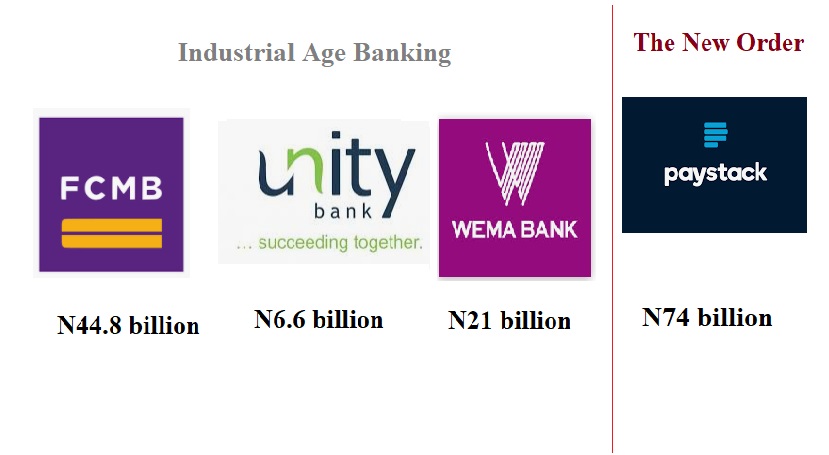
Simply, provided the challenger banks keep their incentives right, they can capture value even when the traditional competitors wake up from an innovation dilemma in the sector. While not a digital bank, Paystack demonstrated upon its acquisition, that value could come in many ways, when its market cap was put ahead of a combined market cap of Wema, Unity and FCMB in the Nigerian Stock Exchange.
The Nigerian Stock Exchange (NSE) pulled off surprising performance in the face of global economic meltdown induced by COVID-19 pandemic to rank the best in the world’s stock markets.
A Bloomberg report said Nigerian stocks are headed for their highest annual gain in seven years riding on low yields in fixed-income markets.
Nigeria’s equities benchmark index recorded its highest return, rising 45.7% this year. The report said it’s the most among 93 equity indexes tracked by Bloomberg, and makes the NSE the best performing stock market year-to-date.
The unprecedented performance was attributed to investor’s appetite for riskier assets, which have remained strong due to persistent low yield on fixed-income instruments, Bloomberg said, citing Chapel Hill Denham’s note to clients on Tuesday. It added that it has been buoyed by traders positioning for Dangote’s share buyback program which is billed to hold this week.
Denham said the equities will continue to outperform bonds in 2021 given the current overstretched fixed-income valuations.
The report said the Lagos bourse gained 0.75% to 39,092 as of 13:47 p.m local time, to reach its highest level since June 2018.
The all-share index which opened at 38,800.01, inched higher by 310.16 points or 0.80 percent to cross the 39,000 mark and close at 39,110.17.
Also, the market capitalization rose by N167 billion to close at N20.446 trillion compared with N20.279 trillion achieved on Thursday before the Christmas and Boxing Day holidays.
Year-to-date returns are currently at 45.7 percent; the best annual return since 2013.
According to analysis by TheCable, investors had booked N7.31 trillion in gains as of December 22, 2020. The rally was also supported by the dovish stand of the Central Bank of Nigeria (CBN).
The apex bank cut the base monetary policy rate by 200 basis points to 11. 5 percent, in order to boost lending, discourage savings and drive growth to counter the pandemic effect on the economy, while also keeping rates low in the fixed income market.
Excess liquidity (created by CBN’s OMO restriction), the hunt for double-digit yields and depressed pricing, helped to rekindle local interests in the equities market in 2020.
Boss of NSE
The uptrend recorded at the end of trading on Tuesday was driven by price appreciation in medium and large capitalised stocks amongst which are; BUA Cement, Zenith Bank, Access Bank, NPF Microfinance Bank and NEM Insurance.
A breakdown of the price movement chart shows that Jaiz Bank dominated the gainers’ chart in percentage terms with 10 percent, to close at 66k per share.
NEM Insurance followed with 9.56 percent to close at N1.49, while Lasaco Assurance rose by 8.82 per cent to close at 37k per share.
NPF Microfinance Bank improved by 8.39 per cent to close at N1.68, while Japaul Gold and Ventures appreciated by 8.33 per cent to close at 52k per share.
Conversely, NCR led the laggards’ chart in percentage terms, losing 9.68 per cent to close at N1.96 per share.
FTN Cocoa Processors trailed with 8.99 per cent to close at 81k, while Trans-Nationwide Express shed 8.86 per cent to close at 72k per share.
Chams shed 8.70 per cent to close at 21k, while AXA Mansard Insurance lost 4.76 per cent to close at N1 per share.
Also, the total volume of shares traded rose by 85.4 percent with an exchange of 722.57 million shares worth N4.38 billion in 5,042 deals.
This was in contrast with a total of 381.72 million shares valued at N7.97 billion exchanged in 2,925 deals on Thursday.
Transactions in the shares of AIICO Insurance topped the activity chart with 273.13 million shares valued at N326.09 million.
Oando followed with 81.45 million shares worth N323.33 million, while FBN Holdings traded 41.09 million shares valued at N294.21 million.
Access Bank traded 40.14 million shares worth N353.27 million, while Champion Breweries transacted 36.33 million shares worth N30.16 million.