

Tekedia is offering a 50% discount to current co-learners for Edition 4 (you pay N25k or $70) or 2021 annual package (N50k or $140). Register here. For members asking for project experiences, Tekedia capstones which award a different certificate, separate from Tekedia Mini-MBA, is available. We have many tracks therein. Learn more here. We have […]
What Do You Really Know About Nigeria’s 575 Football Matches in 70 Years?

When it is about understanding the history of football in Nigeria, one is likely to read that the game started in Calabar or Lagos. For the account that favours Calabar, the former capital of Nigeria, the Christian Missionary should be attributed to the emergence of the game in the country. The game started in Lagos, especially at Ajegunle. Information has it that the city is the cradle of Nigerian soccer. The first recorded football match in Nigeria was in 1904.
The first official match was played in 1949 against the Sierra Leone Team. The Nigerian Team won the match by 2 scores. From the year, with the exception of 1952, to 2019, Nigerian Team played 575 matches in different tournaments. These matches include those played at home [in Nigeria or being at home during a tournament]. Away matches entail those played in opponents’ countries or being away during a tournament. Our analyst examines the matches and brings out some insights.
Exhibit 1: Number of Matches Played Per Year [%]
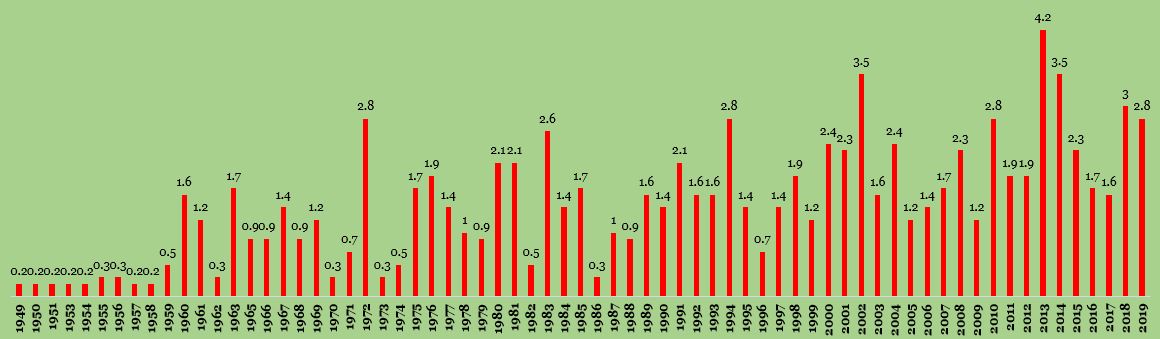
Exhibit 2: Score Per Match Category [%]
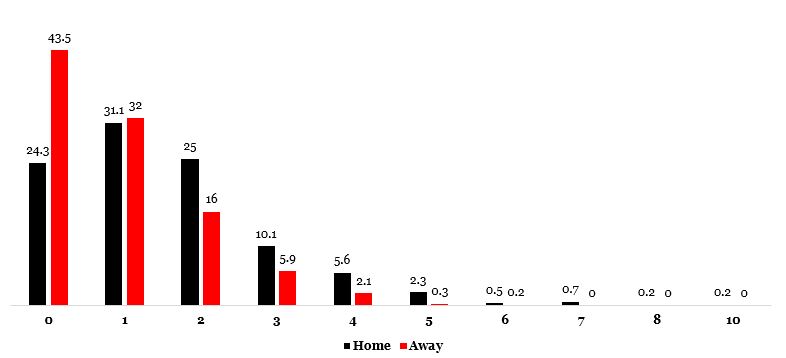
Exhibit 3: Number of Matches Per Tournament [%]
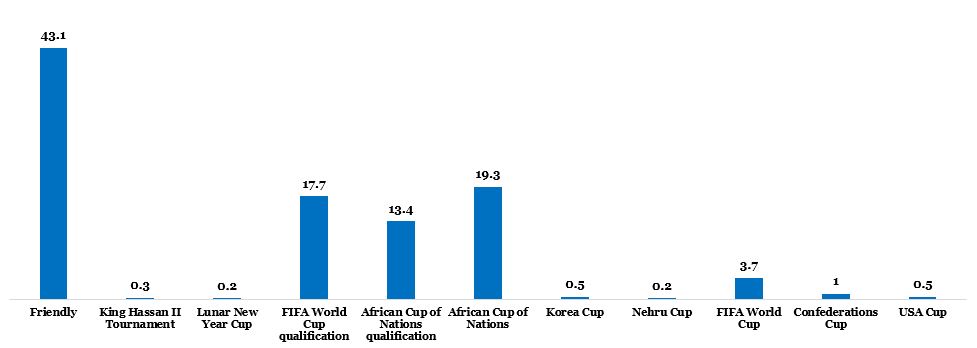
Exhibit 4: Away Score Per Tournament [%]
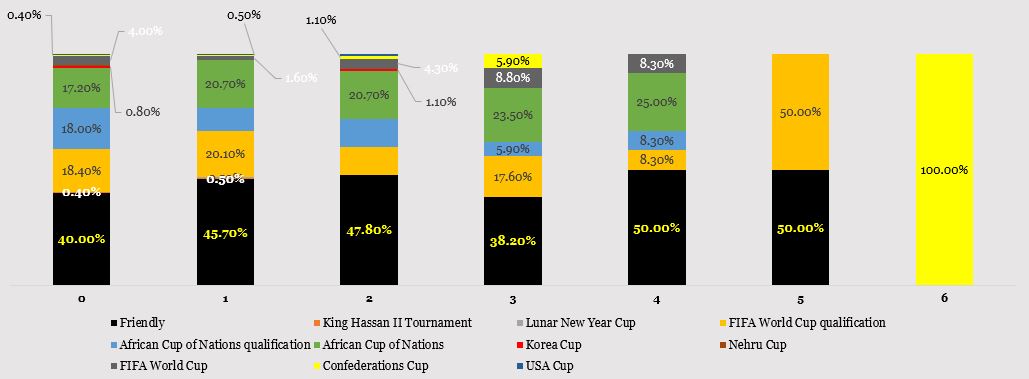
Key: 0 Score= 250 Matches; 1 Score=184 Matches, 2 Scores =92 Matches, 3 Scores =34 Matches, 4 Scores =12 Matches, 5 Scores = 2 Matches, 6 Scores =1 Match
Exhibit 5: Home Score Per Tournament [%]
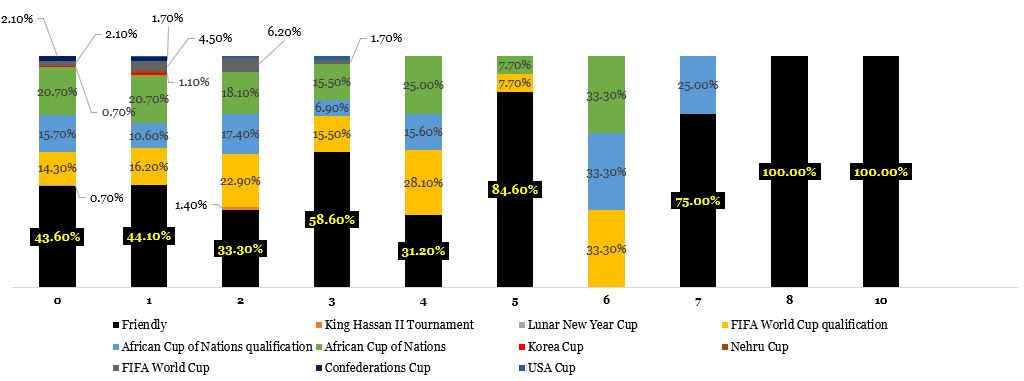
Key: 0 Score= 140 Matches; 1 Score=179 Matches, 2 Scores =144 Matches, 3 Scores =58 Matches, 4 Scores =32 Matches, 5 Scores = 13 Matches, 6 Scores =3 Match, 7 Scores= 4 Matches, 8 Scores = 1 Match, 10 Scores = 1 Match
The Possible Goodluck Jonathan’s 2023 APC Presidency in Nigeria!

It seems some politically sagacious northern states’ governors in Nigeria’s ruling party, APC, want former President Goodluck Jonathan to be APC presidential flagbearer in 2023, if Jonathan agrees to decamp from PDP to APC. Lol. That is really unfair as Ndubuisi Ekekwe has not even tasted any water in Aso Rock, and they are focusing on making more presidents out of former presidents. Haba Nigeria….Obasanjo, Buhari…and Jonathan.
It does not sound really crazy if you look at the permutation: Jonathan can only serve a single term. Period. And if that is the case, he is the only Southern Nigeria politician that would make it possible for many governors from the north to have a chance in 2027. No wonder they are the ones pushing for Jonathan. You do not blame anyone strategizing: zoning power in Nigeria looks primitive except that there is nothing modern in Nigeria when it comes to our politics!
Politics – it is more than a maze: no permanent enemy, no permanent friend; just permanent interest. These governors are smart guys as it seems power is moving to the south in 2023; picking Ndubuisi will possibly keep their tussle well to 2031, instead of 2027, if Jonathan joins the fray!
The Message from the State Capital

A state executive leadership communicated today that it has approved our proposal: providing management capabilities to artisans in a south eastern state in Nigeria. Yes, they have done well – trained the youth on farming, carpentry, bricklaying, tailoring, trading and even coding. But most would likely remain sole proprietors unless we make them entrepreneurs. That distinction is vital for the nation and the state.
By January, we will begin the process of turning artisans to become entrepreneurs; His Excellency will kickoff the event.
The crystallization on why Nigeria needs to grow entrepreneurs, fiercely, even as we empower sole proprietors in farming, shoe making, etc must be evident for that economic growth to emerge. Tekedia Institute will play our role.
We welcome channel partners across Africa to “discover and make scholars, noble, bright and useful” in markets and governments.
To execute that playbook, we will be exploring strategic partnerships with universities, polytechnics, alumni associations, newspapers, governments, consulting firms, companies and individuals.
We have divided our markets into 4 domains:
- Consumers & Individuals: Co-training citizens
- Public sector & governments: deliver training and educational programs to government workers, government programs and government institutions.
- Schools: Working with universities and other post-secondary institutions to embed our products as non-credit programs in their missions.
- Companies: Facilitate and co-train innovators and project champions in companies.
Geographically, we have three core markets: Nigeria, Africa and Global.
We welcome partners across the globe and are looking for institutions which can help us meet and exceed our targets. Contact us.
Maintaining the Objectivity of the Academic Sphere: An Open Letter to Nigerian Lecturers
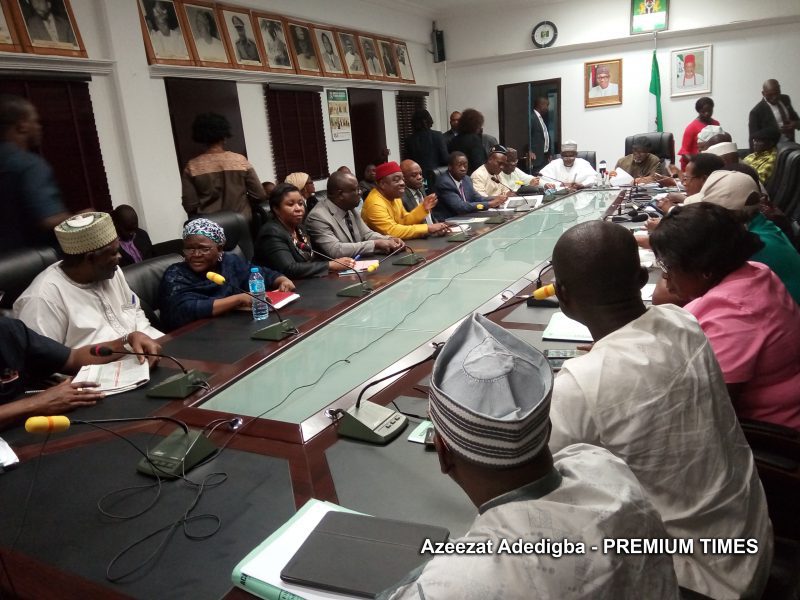
I listened to a lecturer discussing, or rather describing, the situation of things in the country in a packed lecture hall. Her lecture had something to do with economics but, somehow, it delved into politics and, of course, the issue of the president’s competency became the focal point. I became keen on what was going on in the class when some students began to debate on the conspiracy theory surrounding the Buhari/Jibril saga. I was actually enjoying the whole thing until the lecturer, who was regarded as the authority in the class, broke into the debate to take sides. Immediately she sided with one group, the class broke into a series of “what did I tell you?” and “I told you so” comments. At that moment, the lecturer stopped the students from being critical and imposed her ideology on them. At that moment, she made the students from the opposing side believe their opinions aren’t important or true. At that moment, the lecturer became subjective instead of objective.
One of the major problems we have in Nigerian academic setting was exhibited by this lecturer. During my university days, you need to find out how each lecturer wants his exam questions answered if you want to make good grades. There are some lecturers that want you to bring in new ideas into your writings while some want you to copy and paste their lecture notes or textbooks. There are those that need citation from scholarly works for each idea you introduce. There are those that insist you must condemn what they condemned and agree with what they accepted. If you decide to ignore this key aspect of your schooling and provide answers based on your own volition, well, you might be shocked at what you will see on the score sheets.
Apart from these, many Nigerian lecturers do not give students the opportunity to challenge existing knowledge. Many don’t even believe their students can extend knowledge as a result of their experiences or predict new outcomes in situations. Honestly, many Nigerian students are not allowed to ‘think’ until they have gone deep into their PhD programmes. There is always this “humble submission” mantra that hover around students each time they want to move deeper into ‘unsafe’ grounds. If you ask me, I will say that the major problem with our education system is that students are treated as machines, which must only produce expected outputs.
But the focal point of this essay is the subjectivity in our academic world. Of course, it will be a fallacy to assume that academic works, including empirical researches, are not biased. But truth remains that each research is based on facts, which must be published alongside the results. However, when empiricism anchors on and collects facts from conspiracy theories, problems emanate.
Academic setting has always been a place where people with different beliefs and values freely express their ideas and opinions and back them up with viable sources. Academic environment is a free domain for people to think outside the box and describe situations based on their experiences. Academic world is a safe haven for people to reject the existing status quo and query the essence of its existence in the first place. In summary, the academic world is the only world where arguments and counterarguments exist and are not condemned.

But what do we have in our education system today? It is a pity to see our lecturers telling students, “Shut-up, what do you know?” It hurts when students are not free to argue because they don’t want to be victimised by their lecturers. It is sad that lecturers do not allow their students to be free-thinkers. This can explain why we have graduates that cannot defend their certificates. This may explain why we have more dreamers than executors. Maybe this is why ideologies that do not conform to public opinions are condemned and attacked. Maybe this will explain why we have a lot more followers than leaders in this country. This actually explains a lot of things.
Dear lecturers, your duty is to moderate students’ arguments and not to take sides. Yes, your years of research must have revealed a lot of things the students know nothing about. But those years of experience should have taught you that knowledge cannot be monopolised. You should have known by now that different researches conducted on a particular key concept produce different results because of the varying experiences of the respondents. This should have let you understand that every student has vital information to pass on from his viewpoint. Always remember that because a student’s ideology differs from yours does not mean he is wrong. Give students the chance to observe situations critically and project their opinions freely. We need more thinkers and executors in this country.