Congratulations to portfolio Bitfxt which has launched BoundlessPay. The Boundlesspay app turns your phone into a mobile bank, making it possible that you can spend your popular cryptos wherever Naira is spent (more currencies in Africa coming). BoundlessPay is local, in Lekki, and powered by Bitfxt exchange.
More so, it connects to a community of products with a stablecoin powering decentralized finance, BITDeFI, which is available on Coinmarketcap. I want to thank our team, led by blockchain oracle, Franklin Peters, for executing at a high level. Please go and download BoundlessPay at Play store here.
Now, we have an exchange, a mobile “bank” and a DeFi, and are positioned to implement and execute any blockchain and crypto-related projects to power local and global commerce. To join this party, talk to Franklin.
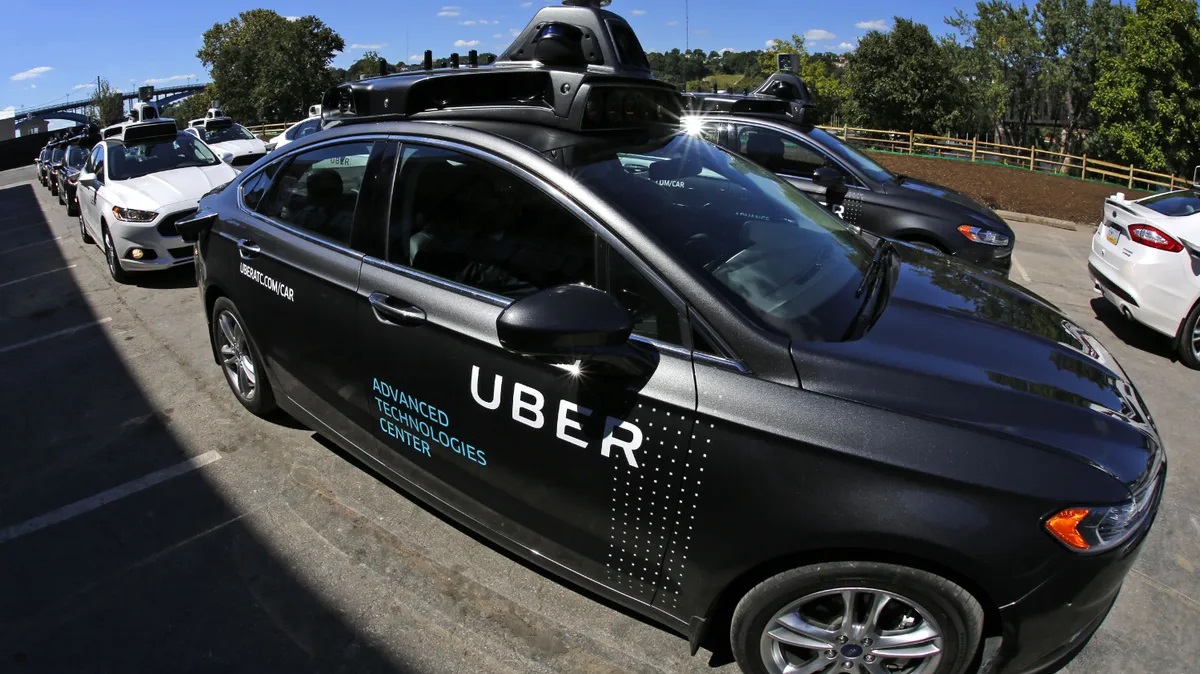
Uber in a surprising move is selling its self-driving car unit, Uber Advanced Technologies Group (ATG), to self-driving car startup Aurora, according to a statement made by the company on Monday.
The ridesharing company said the move would accelerate its goal to achieve “profitability” amidst the setbacks of COVID-19. In an era when autonomous vehicles are becoming a thing, Uber’s move to sell ATG and invest in Aurora has been borne out of a perceived future where driverless vehicles become the new normal.
Last year, ATG raised $1 billion from many investors including Toyota and Softbank at a valuation of $7.25 billion, but its valuation has since plunged.
Reuters reported that Uber is also investing $400 million in Aurora, in a deal that valued Aurora at $10 billion according to sources. Uber will hold about 26% ownership interest in Aurora on a fully diluted basis, according to the company’s filing statement.
The report said Uber and Aurora will enter into a collaboration agreement to launch self-driving vehicles on the Uber ride sharing network.
Uber’s Chief Executive Officer Dara Khosrowshahi told Reuters in an interview that the sale will accelerate the ride-hailing company’s goal to achieve profitability on an adjusted basis by the end of 2021.
The company released a video showing the robotaxi driving around the city of Shenzhen, observing traffic rules and stopping when necessary for passenger to get in or alight.
Google was the first to set the unmanned wheels moving with its Waymo project that has successfully tested autonomous cars in U.S. cities. Tesla is also working to achieve its target of running self-driving ride-hailing cars in the near future. A target it previously set for 2020 but fails to meet.
The growing interest has made startups of autonomous vehicles targets of investors.
Nevertheless, Uber has been working to have a better earning report next year after 2020 financial woes. COVID-19 lockdowns, lawsuits and state of California’s attempt to compel gig companies to declassify their workers as contractors, increased the economic troubles of the cab company this year.
Uber reported gross bookings of $14.7 billion in Q3, recording a decline of 10% compared to the same quarter last year. Bookings generated $3.1 billion revenue for the company, 18% decline compared to the same period a year ago. Uber recorded a third quarter loss of $1.1 billion.
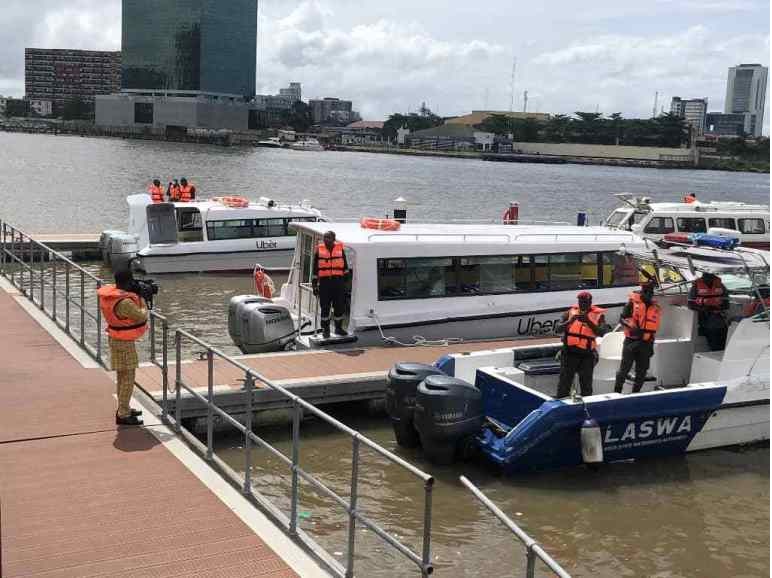
Uber trialed Uber Boat in Lagos
California is Uber’s largest market and has been hardly hit by the pandemic. On Monday, Governor Gavin Newsom imposed new restrictions that will confine Californians to their homes, following the recent surge in COVID-19 cases in the United States.
The development means that Uber will have to rely on its essential service (food delivery) once again to stay in business during the restriction. But it is a situation it is trying to avoid in the future with robotaxis.
Following the outbreak of coronavirus and the exigencies it ushered in, authorities saw an urgent need to place robots in many fields of human services, especially in areas where there is human to human contact. Therefore, there has been accelerated approval of robotic services by regulators recently.
Self-driving cars would have been operational during lockdowns, and help to elevate movement. Consequently, Uber and other companies are working to fix the friction of restricted human movement in times of novel health crises by making a push for autonomous vehicles.
Greetings. The Tekedia Institute has worked with thousands of innovators, companies and public institutions in 2020. Through co-creation and co-learning, we deepened capabilities, and advanced the knowledge of our members, on the mechanisms to efficiently utilize factors of production, to fix market frictions. Our overriding theme has been innovation, growth and digital execution.
As 2020 passes, we are now looking forward to 2021. In Nigeria and across Africa, we see 2021 as the Year of Accelerated Growth, especially for tech-anchored businesses. Massive opportunities would be unlocked as technology continues to transform markets and economies. In an upcoming Harvard Business Review article, I asked: how can companies capture value? Yes, what do firms need to do to advance their missions despite the structural redesigns in today’s market systems, after Covid-19?
During 2020 Tekedia Mini-MBA, we held 162 exclusive webinars, anchored by executives from Coca Cola, Shell, Schlumberger, Deloitte, Access Bank, Infoprive, TAFFDs USA, Jobberman, etc. The last of the year will be open, and for everyone. It is scheduled as follows to prepare for 2021:
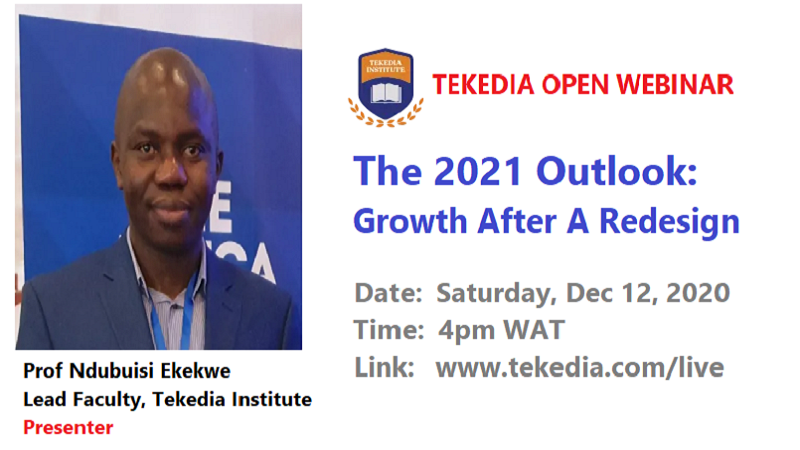
Topic: The 2021 Outlook in Nigeria, Africa & Global: Growth After A Redesign
Speaker: Prof Ndubuisi Ekekwe, Lead Faculty, Tekedia Institute
Prof Ndubuisi Ekekwe invented and patented a robotic system which the United States Government acquired assignee rights. Dr Ekekwe holds two doctoral and four master’s degrees including a PhD in engineering from Johns Hopkins University, USA. He earned an undergraduate degree from FUT Owerri where he graduated as his class best student. While in Analog Devices Corp, he co-designed an accelerometer for the iPhone. A recipient of IGI Global “Book of the Year” award, a TED Fellow, IBM Global Entrepreneur and World Economic Forum Young Global Leader, Prof. Ekekwe has held professorships in Carnegie Mellon University and Babcock University, and served in the United States National Science Foundation Committee. Since 2009, the Chairman of Fasmicro Group which holds stakes in at least 30 startups and entities has been writing in the Harvard Business Review. He was recognized by The Guardian as one of 60 Nigerians Making “Nigerian Lives Matter” on Nigeria’s 60th Independence Day.
About Tekedia Institute
Tekedia Institute is a US/Nigeria-based institution with focus on business management and leadership. We offer training and advisory services for individuals, corporations, organizations and governments around the world. Our programs include Tekedia Mini-MBA, Advanced Diploma programs, etc. You can learn more and register for upcoming programs here: https://school.tekedia.com/
AI would anchor many areas of legal practice (souce: law)
Everything is being disrupted by emerging technologies. These technologies are being developed by humans to collect and create jobs for humans. This is a double edge sword for the humanity, according to experts. Artificial intelligence, which is usually referred to machine intelligence is an intelligence displayed by machines in dissonance to the natural intelligence displayed humans and animals.
As noted earlier, RAIN when it is highly adopted in developing countries as it being used in some advanced countries will be replacing jobs in the future. Robotics and artificial intelligence will permeate wide segments of daily life by 2025. Among the experts, expectation is that RAIN will significantly collect jobs from workers working in industries such as agriculture, construction, health, and manufacturing.
The demand for workers who understand the nitty-gritty of developing robotics and machine learning products will rise. Already, we have seen how Zenvus, one of the AI driven products from Nigerian inventor, Professor Ndubuisi Ekekwe, is encouraging African farmers to embrace smart farming practice. Zenvus monitors farms with electronic sensors communicated via GSM, WIFI or Satellites to cloud servers.
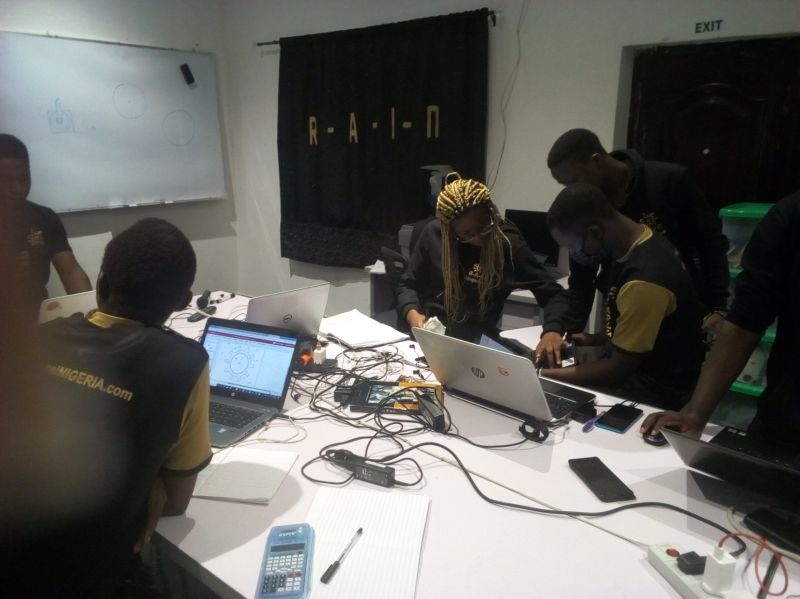
Students, learning one of Robotics and Artificial Intelligence courses in Ibadan
In our experience, we have learnt that interest in learning RAIN is growing across cities and towns with required infrastructure and learning environment. Abuja, Port-Harcourt and Ibadan are coming up, joining Lagos, which has been the centre of information technology for years. We have also discovered that RAIN has a future in emerging cities such as Ibadan, where Robotics and Artificial Intelligence [RAIN] centre is located. A recent visit to the centre by our analyst indicates that it has what it takes to produce competent robotics engineers and artificial intelligence experts for Nigeria, especially Ibadan.
While launching national centre for Artificial Intelligence and Robotics learning in Abuja, Dr Isa Pantami, Minister of Communications and Digital Economy, said: “Artificial Intelligence is the refinery of the digital economy and Robotics is very useful in supporting companies as they carry out repetitive tasks. These are two very important emerging technologies that will shape the face of future technologies and we have decided to be proactive to enable us to play a key role in how these technologies evolve.
“The Fourth Industrial Revolution, fuelled by Big Data, propelled by robust computing capacity, advanced software and Artificial Intelligence is ushering new ways of living, well-being, learning, travelling and working. Its innovative use-cases are quickly changing lives for the better and creating new types of jobs.’’
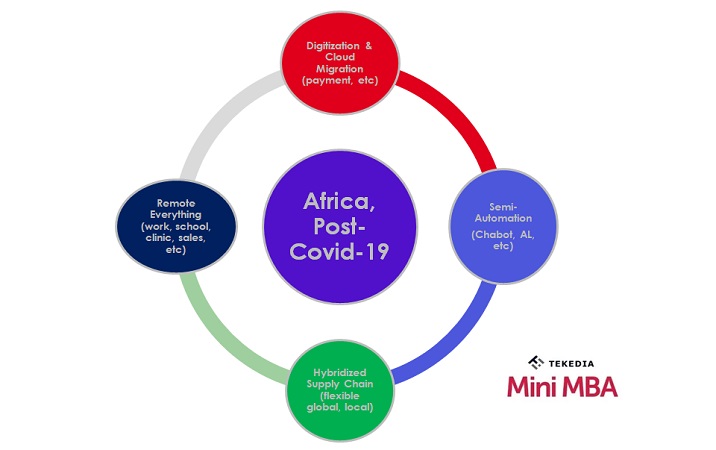
I expect technology expenditure in Nigeria to double in 2021 compared with the 2020 number. From conversations I am having with business leaders, the trajectory is clear: companies will spend and spend next year. These elements will drive this spending in Nigeria, as I noted in The State of the Tech Nation (recorded in April 2020, below) address.
Hybridized Supply Chain: Flexible, adaptive, global and local, at the same time.
Remote Everything: The web will run the world across sectors.
Digitization and Cloud Migration: The pace will accelerate.
Semi-automation: Disintermediation of humans will accelerate.
If you are selling or offering services, find how to deliver services in or around these elements because they will drive business, in the next coming years in Nigeria and Africa in general.
I gave this presentation in April 2020 to our members in Tekedia Institute . I was trying to channel our minds on the evolving opportunities due to coronavirus. The 15-minute video has a message: there is abundance in the future.