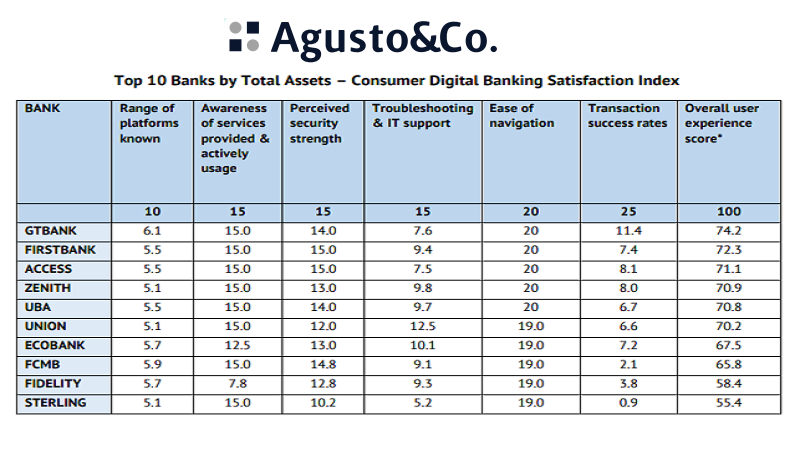
Agusto & Co in its third edition of the consumer banking satisfaction index has dissected the level of customer satisfaction towards digital banking channels in Nigeria with Guaranty Trust Bank (GTBank) scoring the highest user experience score.
According to Agusto & Co, mobile banking applications remain the most popular platform for digital banking. The increasing use of mobile banking has also been backed by the growing base of mobile phone users, which has grown by a five-year compound annual growth rate of 6% to 184.4 million as the end of 2019. Approximately 82% of the survey respondents are aware of their respective bank’s mobile banking service while internet banking recorded 57% awareness. The respondents are least aware of WhatsApp and other virtual banking platforms (such as the chatbot service and telephone banking), with only 6% of the respondents indicating their knowledge of these services.
According to the rating firm, Guaranty Trust Bank (GTBank) emerges the Best Digital Bank in Nigeria with a user experience score of 74.2. Zenith Bank was the highest-ranked bank in the 2019 edition, with a score of 74.2 but dropped to the 4th position this year (a score of 70.9) due to lower ratings in transaction success rates and troubleshooting & IT support. First Bank of Nigeria ranked second, while Access Bank ranked third. GTBank’s top position was underpinned by comparably higher transaction success rates, which is most crucial in the current ‘COVID-era’. The Bank’s position was also upheld by the significant level of awareness of its digital banking services compared to the other banks in the survey sample.
Tesla has snapped up the head of Mercedes-Benz’ Berlin plant. The German union IG Metall said on Wednesday amidst calls for protest.
Reuters reported that the Union did not mention the defecting head, but the plant has been run by Rene Reif, one of the most experienced manufacturing executives at Mercedes-Benz who helped expand manufacturing capacity for Daimler DAIGn.DE in China.
Reif used to be head of engineering and manufacturing at Beijing Benz Automotive Co. Daimler’s Chinese Joint Venture, which has a manufacturing capacity of around 480,000 cars and started building the electric Mercedes-Benz EQC last year, according to the report.
Tesla has been working on its plan to establish a Gigafactory in the outskirts of Berlin following its push to grab a market share in Europe. The American carmaker did not respond to inquiry but developments in and outside the company confirm it’s true.
A source told Reuters last month that a Tesla manager who oversaw the construction of the American electric vehicle manufacturer at the Gruenheide plant, had left his position.
Daimler said on Wednesday that Reif, who is managing its Mercedes-Benz Berlin plant, which makes powertrains, is voluntarily going into early retirement at the end of the year.
The German Union plans to stage a save-the-traditional industry protest, over concern that the traditional carmakers are cutting investment into combustion engine technologies as regulators clamp down on vehicle emission amid the strains of COVID-19 that seen decline in vehicle demands.
Reif’s decision to leave will put the future of the plant in jeopardy and IG Metall said there would be a protest in front of the Mercedes factory on Thursday and called on Daimler to present solutions that would help to guarantee the future of the plant, according to Reuters.
The union said Daimler managers had outlined cost savings plans and union officials as the fear for the plant’s future grows.
Daimler said Clemenz Dobrawa, who currently heads up the Mercedes-Benz battery manufacturing plant in Kamenz, had taken over leadership of the Mercedes-Benz plants Hamburg and Berlin earlier this month.
“Thank to his activity in Kamenz, he brings important know-how for the transformation toward electromobility,” Daimler said, adding that the Berlin plant will be restructured to serve an ‘Electric First’ strategy.
Tesla’s move underscores a growing trend of companies luring best brains from rival firms across industries. Big companies like Amazon and Apple are up in the table. Amazon has poached prominent people from Microsoft, Google, VMware and so on.
But the e-commerce giant has a strict rule forbidding its employees from joining rival firms. Recently, the company sent a stark warning to some of its employees thinking about defecting to other companies: ‘Do so and we might sue’.
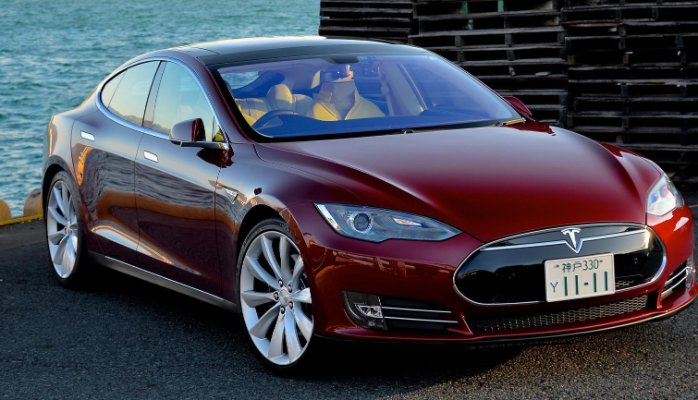
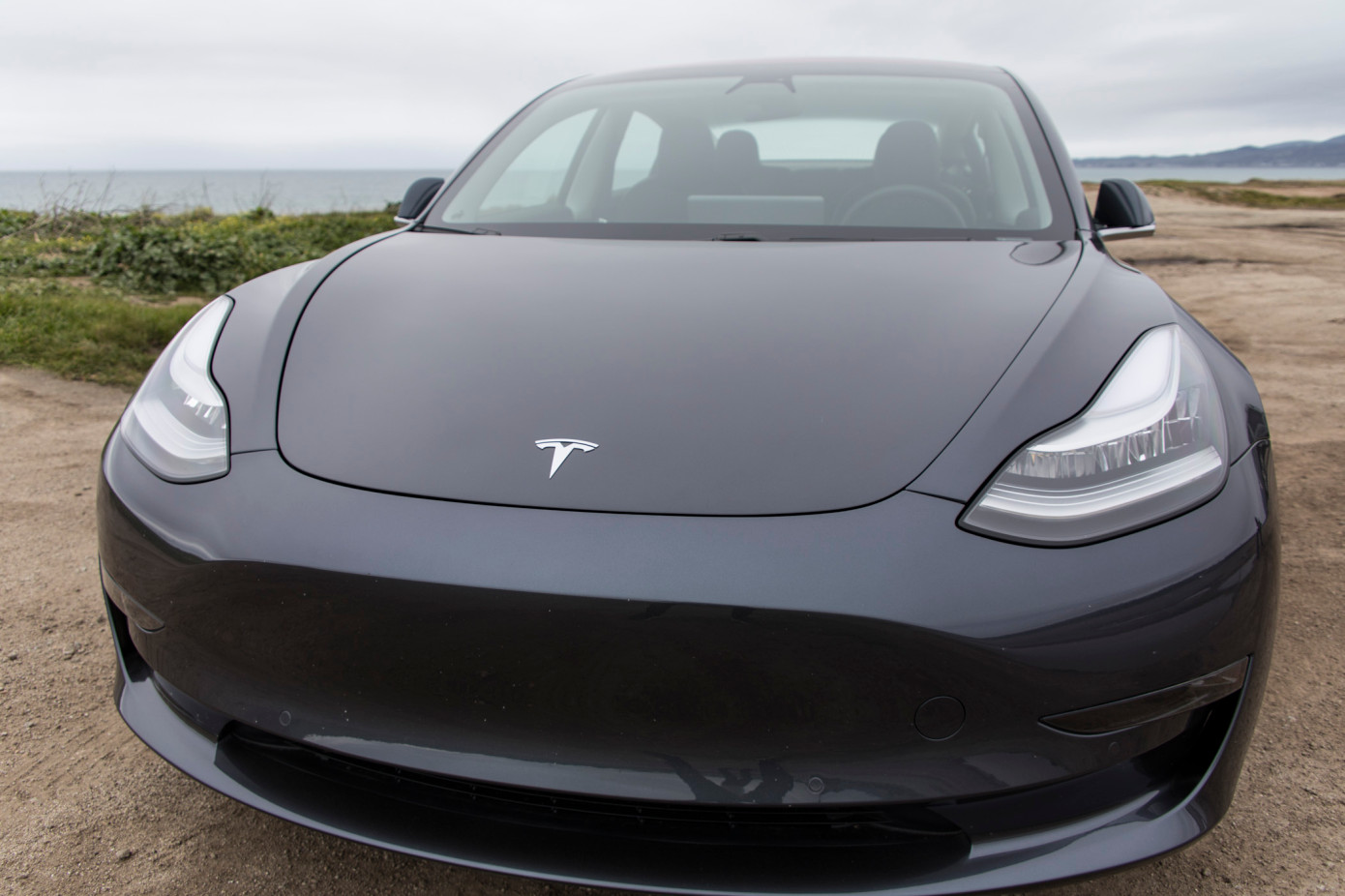
Tesla electric car
There has been a growing number of lawsuits against defector employees, especially in the tech industry, prompting many companies to enact policies that limit workers’ rights to join rivals.
Companies are becoming more aware of the danger of passing their tech idea or trade secrets to their rival companies, or their weaknesses being exploited by others as a result of employee’s defection.
“I am delighted to report that Dangote Cement experienced its strongest quarter in terms of EBITDA and strongest third quarter in term of volumes. Despite a challenging environment, Group volumes for the nine months were up 6.6% and Group EBITDA was up 17.1%, at a 46.6% margin,” the company said in its Q3 report.
This unimaginable growth means that Lafarge’s market share has been depleted, and the brain behind it is Pucheros, a man who once took the company to great heights.
Tesla has the same game plan for its Berlin’s car plant. If the company will beat one of its greatest rivals, it will need an insider who knows his way around the market, and what it takes to win.
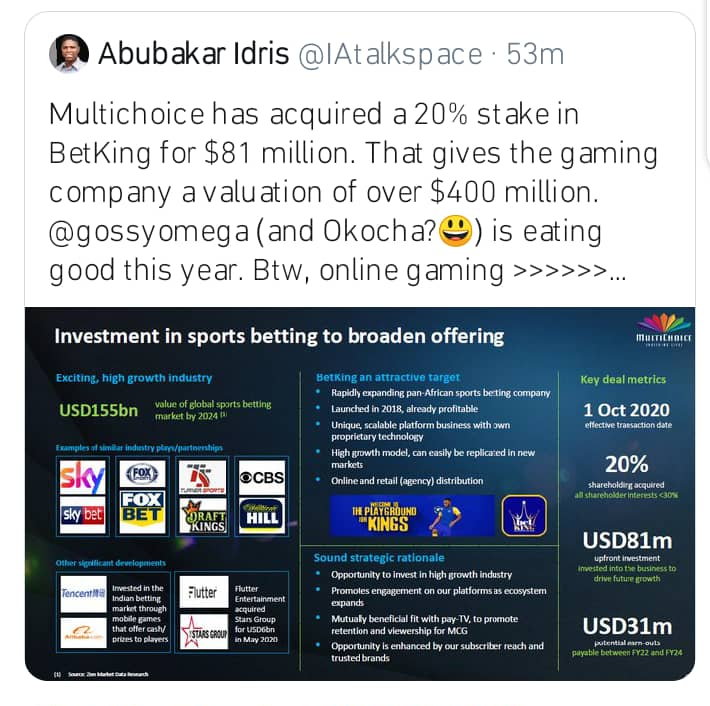
MultiChoicebuys 20% in Betking for $81 million, valuing the company in excess of $400 million. Essentially, MultiChoice does not just want to live on European soccer rights which keep rising on aggregate price, affecting margins in a continent where consumers are discovering alternative ways to be entertained.
So, provided you call it entertainment – watching Ronaldo and Messi or playing and betting their avatars – money can be made. With BetKing, MultiChoice thinks there is an opportunity to ramp up revenue from this exploding sector in Africa, and it could do that without relying on the capacity to ship more money to hold football rights in European capitals.
MultiChoice, Africa’s biggest pay-TV operator, has acquired a 20% stake in BetKing, a pan-African sports betting group.
As part of the deal, MultiChoice has made an upfront investment of $81 million
(R1.3 billion), with the potential for a further payment of $31 million (R500 million) should certain earn-out targets be met between December 2021 and December 2023.
As the group exercises significant influence over BetKing, the business will be equity accounted as an associate from 1 October 2020 by MultiChoice.
Now that MultiChoice has moved into betting, expect major regulations to begin to emerge in this domain. Why? It is easier to attack a visible enemy than these digital startups no one knows where they operate from. I am not sure BetKing may like what would come, in near future, but of course that is a good problem to have when you can cash $81 million.
I voted in 2020 because of one critical issue: I want to ensure that black kids in America would continue to attend top universities in the nation. The Trump administration had mounted ferocious attacks on one of the ways which enable black kids to get into Harvard, Yale, Princeton, etc, by fighting to dismantle affirmative action. Today, I am happy that the Appeals court has sided with Harvard: race could be considered during admission.
When people write that America does not need affirmative action in these top schools, they have been unable to explain why in some schools, most students who needed affirmative action to get in are not ALWAYS the least performing in classes. Yes, Obama needed one but he was never the bottom of his class. This does imply that the “stable state system” is not fair. So that perturbation of considering race becomes necessary since implicit privileged race had played a role in the stable state selection. The Appeal court ruling is correct.
A Boston-based US appeals court has rejected a challenge to Harvard’s affirmative action policy brought by a group representing Asian Americans who claimed the school discriminated against them as it favored Black and Hispanic applicants.
“Harvard has an ongoing obligation to engage in constant deliberation and continued reflection regarding its admissions policies,” Judge Sandra Lynch wrote for the appellate panel. The ruling said that the school’s “limited use of race” in its admissions policy to achieve diversity is consistent with court precedent.
“Harvard has shown that its holistic consideration of race is not impermissibly extensive,” the court said.
Edward Blum, president of Students for Fair Admissions, which began the lawsuit in November 2014, said the decision would be appealed. Blum has long opposed racial policies that have primarily benefited Blacks and Hispanics. He lost a case against the University of Texas at the high court in 2016.
[…] The sweeping decision by the 1st Circuit US Court of Appeals was also a sharp rebuke to the Trump administration whose Justice Department joined the case, siding with Blum’s Students for Fair Admissions group. […]
For its new class of 2024, Harvard said, Asian Americans make up 24.6% of the class; African Americans 13.9%; Latinx 11.8%; and Native Americans and Native Hawaiians, 2.0%. The remaining category, 47.7%, is overwhelmingly White students.
The argument has been: allow written tests to be the exclusive parameters to admit these students. My point remains: when hiring workers in your company, do you just employ the top performing applicants in written tests? Yes, you still look for other means to evaluate the candidates. The same thing is happening when universities look at students’ backgrounds and “race” when making decisions.
A poor latino girl, raised by a single mother, who scored 360 could be a better student than a son of medical doctors who scored 361. If someone extrapolates that the girl could be a better achiever, looking at what she has accomplished, despite her background, should not be seen as discriminating. That blacks and Latinos need this support must be classified as being unfair to the boy who scored 361.
Possibly by 2050, America will overgrow it when men and women will not see any race as being superior, and with that bias chose them over minorities. But today, a fudge factor is needed to balance the equation, and affirmative action is it.
Some of the biggest names in tech came out in support of Harvard’s affirmative action admissions policies in its fight against a federal lawsuit. Apple, Microsoft (LinkedIn’s parent) and Twitter were among those signing a friend-of-the-court brief this spring that sided with the university against the U.S. Justice Department. The companies cited their need for workers who are diverse and thrive in an “inclusive environment,” and for colleges and universities to provide these workers — especially as K-12 schools in the U.S. have become more homogenous. The U.S. Court of Appeals in Boston upheld the ruling Thursday that Harvard has the right to consider race in selecting a student body — setting the case up for a possible Supreme Court review.
We are building business cases for mainly African and Africa-operating businesses and brands as we prepare for Tekedia Mini-MBA in 2021. We have expanded our curriculum with many empirical learning systems to deepen outcomes. I report that MTN business case is in. We see three phases in the growth of his amazing African brand:
– The age of Voice telephony (before and decade of 2000s)
– The age of mobile internet (decade of 2010s)
– The age of application utilities (decade of 2020s)
From MTN, we postulate how the future of the industry would be. As SpaceX Starlink and other satellite players arrive (with expected affordable satellite phones), we see disintermediation threats to the likes of MTN, Airtel and other terrestrial players, but those threats could be mitigated if they play well in the age of application utilities. Yes, selling data will not be enough but playing into that data becomes strategic.