Let us begin the healing. Let us find ways to have energy to rebuild. Tomorrow remains a promise. May God in His Grace give support to the families of our compatriots who paid the price for the peace and hope of tomorrow. May God bring wisdom to men and women in positions to lead.
And to those down in their spirits, we have hotlines you can call counsellors. I encourage everyone to begin to find energy to return. We still need a nation and we need to BELIEVE. May God heal the land. May God Bless Nigeria.
For healing to begin, you must open your heart, anger has never solved problem anywhere, rather it leaves miseries and sorrow behind.
Some argue that it’s better to destroy everything, then start rebuilding from scratch, but again, the rest of the world aren’t so nice to wait for countries who are still struggling; so you have to battle your way to the front row.
Above all, not all of us are interested in seeking visas or foreign residency anywhere else, and calling me a refugee will be more insulting; so we still need a nation.
Anyone who loves Nigeria must continue pushing, to find constructive ways to make the country function; reducing everything to rubble cannot be most efficacious way to make it happen.
Interswitch became a category-king by creating a new basis of competition in the Nigerian financial sector. It went beyond the immediate needs and expectations of customers to their perceptions. As that happened, it seeded leverageable factors, and in the process unlocked values for citizens and firms in the digital payment sector. A pioneer and an industry leader, Interswitch became a new modern architecture for the Nigerian economy. While they are competitors today, Nigeria runs on Interswitch, and is arguably one of the most important companies in the nation.
Interswitch is an Africa-focused integrated digital payments and commerce company that facilitates the electronic circulation of money as well as the exchange of value between individuals and organisations on a timely and consistent basis.
The company started operations in 2002 as a transaction switching and electronic payments processing company that builds and manages payment infrastructure as well as deliver innovative payment products and transactional services throughout the African continent.
In a new case, Tekedia Institute with Maro Elias, looks at what we can learn from this company. What was the motivation that in the “early 2000s, Mitchell Elegbe, Interswitch Founder, had a moment. He had been trying to use an ATM machine in Scotland to withdraw funds when the machine seized his card. Although it was a moment of despair, it was also a light bulb moment for him. That moment crystallized a vision to build an electronic payment system in Nigeria, and in the process gave Nigeria its first indigenous unicorn.”
The case will be available from Feb 8 when Tekedia Mini-MBA edition 4 begins. We are introducing cases in our program to make it more empirical with deeper analytical rigours.
The U.S. government has sued Google (yes, Alphabet, the parent of Google), setting up a battle on the future of web search and digital advertising. The government articulated its position that Google has allegedly broken antitrust laws by undercutting competitors to remain the gatekeeper and the number one ICT utility of the 21st century in the domains of web search and digital advertising. Google controls 80% of the U.S. search market. The government noted that Google pays “mobile-phone manufacturers, carriers and browsers, like Apple Inc.’s Safari, to maintain Google as their preset, default search engine”.
The Justice Department has sued Google for allegedly breaking antitrust laws as it undercut competitors to maintain its status as gatekeeper for internet search and advertising. The department says the Alphabet-owned company, which controls at least 80% of search, pays “mobile-phone manufacturers, carriers and browsers, like Apple Inc.’s Safari, to maintain Google as their preset, default search engine,” according to The Wall Street Journal. The suit is the biggest U.S. challenge to a tech company over its dominance in two decades.
This is a very solid case despite what many journalists are writing. Some see this case as overly weak but I see it differently. The government is essentially saying that Google could have been a brilliant technology company, winning on search through innovations, triggering a virtuoso circle of positive continuum which platforms enjoy, but besides that, there is another element, and that element is not evidently legal.
That element is that Google pays companies like Apple, Firefox, etc to make Google their default search engine on their browsers. By doing that, other small competitors are denied opportunities to ever be known since Google is the “best” search today and by paying these companies, no competitor will ever have a chance since they are locked out in the gateways to the users. Simply, Google won on technology innovation but is using these exclusive default agreements to keep competitors out! And the government thinks that is not evidently right.
“Google, no doubt, is more powerful and omnipresent today than it was in 2004. And its deals make it difficult for competing search engines to break in. But it’s interesting that, in this situation, the DOJ focused on the rent payer vs. rent-seekers like Apple. With some credibly, Google could argue that it has no choice but to pay. Just look at the history”
Yet, you may argue why should Google be penalized if it has to pay Apple to be the default search on Safari, the Apple browser. Yes, the power is really with Apple, not Google. Apple generates about 20% of its profit from such payments from Google. If you look at it carefully, this is a circle: Google pays Apple, Google gets funds from advertisers, and sends some to Apple, provided Apple does not allow another company into the party. Apple is happy since it is guaranteed a solid inflow. Government thinks that is illegal.
Google search is the default search engine in Safari and for Siri on iPhone and iPad devices. According to the Journal, that has been a major source of revenue for both companies. In 2018, for example, Google is said to have paid Apple upwards of $9 billion to maintain the arrangement.
Although neither company has confirmed how much the deal is actually worth, the lawsuit indicates that it accounts for between 15% and 20% of Apple’s annual profits. That suggests payments of as much as $11 billion.
Of course, paying to be displayed better in a shelf should not be illegal. Unfortunately, in the digital space with winner-takes-all, some things which are harmless in the physical space may not be harmless in the digital space. This is the heart of the inversibility construct.
A few years ago, I was in Casablanca and rode in the same car with the CEO of DuckDuckGo, a search engine that “emphasizes protecting searchers’ privacy and avoiding the filter bubble of personalized search results”. I asked him how he would get over the challenges for people to know DuckDuckGo since all the major gateways have been prepaid by Google. He focused on the strong privacy which his product offers, and hoping that over time people will align for it. In reality, it is a tough order. Why?
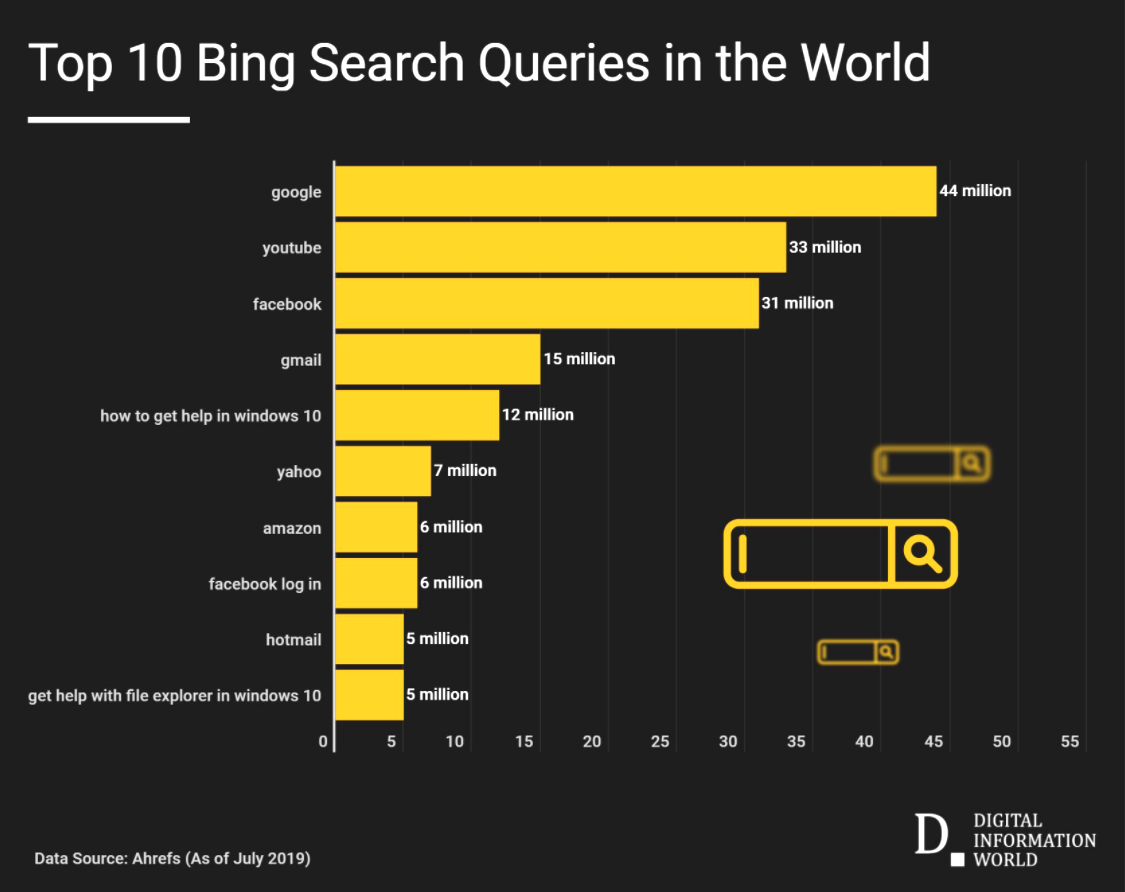
The only product line in the world which is guaranteed non-default Google search but another search (Bing) is Windows systems, including laptops and desktops. Unfortunately, for those who are not in the party of Google, the number one search term on Bing is Google. What does that mean? Once people get their Windows systems up and running, and launch Internet Explorer with Bing default search, they use Bing search to look for Google, and once that setup is done, Bing is history on that machine.
So, Google should not worry – the government may be helping it on one thing: stop funding Apple’s 20% profit and discontinue wasting money paying others. Yes, Google does not need to be paying anyone because most will converge back to its product irrespective of the default search on the browsers, provided its search remains the best. This may not make the government happy as if it bans Google from paying for this self-positioning, it will not hurt the company that much.
Yes, Google will save the money it is shipping to these companies and still get nearly everything it is getting now. Google is the category-king and everyone knows about it. So, this suit should be good for investors: it will cure Google’s bad habit of wasting money where it is not necessary. That should happen irrespective of the legal winner or loser!
You see, I have not noted who will win this suit. The fact is this: it does not matter. There would only be one major search engine in the world due to the network effect phenomenon. It is irrelevant whether that company is under Alphabet or a separate company. Yes, over time, if cut-out, that branch will grow to dominate the search if it is the best product.
If you decide to break Facebook apart, one part will grow and dominate others. This is possible because of the positive continuum of network effect where the biggest keeps getting bigger and also better. I explained that in a recent piece in the Harvard Business Review. You can regulate Facebook but another company will come to take over its position because in this sector, it is winner-takes-all. Yes, the best wins. Why? The scalable advantage improves with lower marginal cost.
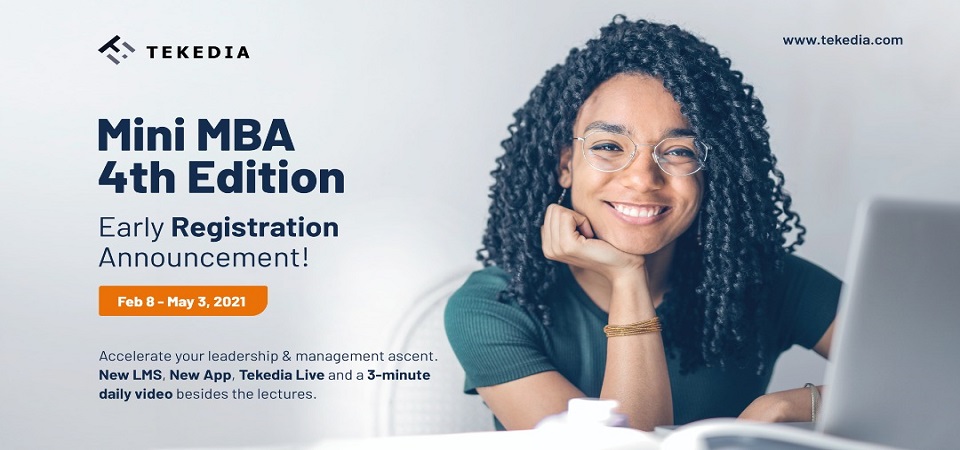
Tekedia Mini-MBA 4th Edition (Feb 8 – May 3, 2021) Early Registration Announcement: This is an early registration call due to popular demand. Our community members want to just pay now they have the money. So, we are opening registration ahead of schedule. Go ahead and register; and ask our team to give you access to Africa’s Sankofa Innovation and The Dangote System books immediately.
This edition comes with full business case studies, concept notes and investment briefs. I have been writing, examining African businesses and chronicling my perspectives on them. It would be an experience – better, richer and more impactful.
Accelerate your leadership & management ascent. Accelerate your leadership & management ascent. New LMS, new App, Tekedia Live and a 3-minute daily video BESIDES the lectures. Click our last edition here.
Tekedia Mini-MBA Program & Cost
Tekedia offers an innovation management 12-week program, optimized for business execution and growth, with digital operational overlay. It runs 100% online. The theme is Innovation, Growth & Digital Execution – Techniques for Building Category-King Companies. All contents are self-paced, recorded and archived which means participants do not have to be at any scheduled time to consume contents.
It is a sector- and firm-agnostic management program comprising videos, flash cases, challenge assignments, labs, written materials, webinars, etc by a global faculty coordinated by Prof Ndubuisi Ekekwe.
Code
Program
MINI
Tekedia Mini-MBA costs US$140 (N50,000 naira) per person.
MINR
Add extra (optional) $30 or N10,000 if you want us to review and provide feedback on your labs.
MINF
Annual Package (includes 3 editions of MINI and 2 Capstones) – $280 or N100,000
Add extra (optional) $60 or N20,000 for each certificate specialty course. You must have attended, begun, or about attending Tekedia Mini-MBA to qualify. The following Certificate tracks are available:
CLSM: Certificate in Logistics and Supply Chain Management
CBIS: Certificate in Business Innovation, Growth & Sustainability
CMAB: Certificate in Media, Advertising & Branding
CSBM: Certificate in Startup and Small Business Management
CIBA: Certificate in Business Administration
CPFM: Certificate in Personal Finance & Wealth Management
CMSM: Certificate in Marketing and Sales Management
CDBG: Certificate in Digital Business Growth
CIAM: Certificate in Agribusiness Management
CHRM: Certificate in Human Resources Management
CETS: Certificate in Exponential Technologies and Singularity
CBPM: Certificate in Business Transformation & Project Management
The Certificate program is completely capstone-based. Tekedia capstone is a research paper or a case study exploring a topic, market, sector or a company. Tekedia Institute supervises the work.
NB: We have incentives (free books, Facyber.com cybersecurity courses, etc) for early registrants.
Contact: tekedia@fasmicro.com
Payment: Pay via any of these means and inform us via email
Name: First Atlantic Semiconductors and Microelectronics.
Flutterwave:follow this link to use Verve, Visa, Mastercard, etc in Naira, USD, Ksh, Cedi, etc.
PayPal: follow this link and pay in US dollars with global debit/credit cards
Stripe: follow this link and pay in US dollars with global debit/credit cards
Zelle (USD): use tekedia@fasmicro.com
After payment, email info@tekedia.com
Note: The Edition 4 program page is coming – this is just an early registration announcement due to demand. Our community members want to ensure they do not spend the funds on other things. For edition 3,see this page. For testimonials on our program,visit the testimonial page.
Help me document and build the largest database of business cases on African companies and brands. We are already working on Andela, Paystack, Tenecee, BBNaija, M-KOPA, Cellulant, Ashesi University Ghana, Copia, etc. Provided you understand business, we have case samples which will help you and under our guidance, you will make it happen.
Tekedia Institute is building a library of short business cases, concept notes and investment briefs. We are looking for business strategists and analysts who can look at companies, and make sense of what they are doing. And then, in words, produce documents for our learners at Tekedia Mini-MBA. We hope to have dozens of short business cases, concept notes and investment briefs, with deep focus on African companies (and selected global ones). All documents must be sourced from publicly available information.
Each work is not expected to exceed 10 pages. We have a sample if you want to take a look. As we begin planning for edition 4 of Tekedia Mini-MBA in Feb 2021 (register here), this playbook will become a critical part of our learning process. By the end of 2021, Tekedia Institute expects to have 200 documents in our library.
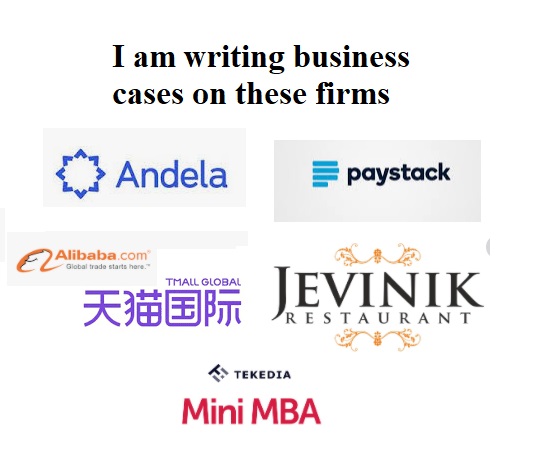
Personally, I am writing a case study on Paystack, Andela, Alibaba TMALL and Jevinik. If you want to support this community service of Tekedia Mini-MBA and contribute, please email tekedia@fasmicro.com . We have some samples to share with you as you get started. You can write on a company (eg Jumia) or a product or brand under a company (eg JumiaPay).
We are concluding Tekedia Mini-MBA for 2020 (sure, Dec 3!). Year 2021 editions would be super-awesome as we are working to introduce 200 business cases, concept notes and investment briefs on African companies as part of Tekedia Institute’s library. Let’s hear from you because we want you to be part of this collection of cases and notes. It would help many of our young people to advance.