DD
MM
YYYY

PAGES

DD
MM
YYYY

spot_img

PAGES

Home Blog Page 6122

Nigeria is Becoming the Home of Anomalies

0

Some days ago, I was collating data for a client from newspaper opinion columns. The client needed to write a review of the debates on President Donald Trump’s fascism status and so he needed to know exactly the reasons behind the negative branding. As I was reading through opinions and noting down perspectives of different writers and columnists, I couldn’t help laughing at some of them. But then, I had to call myself to order when I discovered that I was actually the one that needs to be laughed at. The truth is that I was comparing the actions that incited these debates with what is happening in Nigeria.

My people will say that “ife ojoo gbaa afo, o buru omenala”, meaning that anomalies become norms when they are allowed to linger. Nigeria claims to practice democracy but we are practicing a system of government that does not have a name yet. No, Nigeria is not a fascist nation and our leaders are not particularly fascists. But what they are is yet to be defined.

Now, back to the survey of people’s opinion, I realised that most of the things Americans complained about Trump is what we have accepted and adopted in our country. People like me felt they were being dramatic because what appals them is entertaining to us. Things they condemned are what we have approved. It was as if we were moving in the opposite direction; yet we claim to practice democracy.

In case you want to ask, the five major events that made Americans scream about Trump are his dispersal of peaceful protesters with teargas and rubber bullets; his statement that he might come for third term and his hint that he will not accept election result if it doesn’t favour him; his claim that he is the best president America can ever have; his verbal attacks on his political opponents; and his sending the military into the cities. Now, compare these factors with Nigerian ones and tell me what you think. Do you still blame me for laughing?
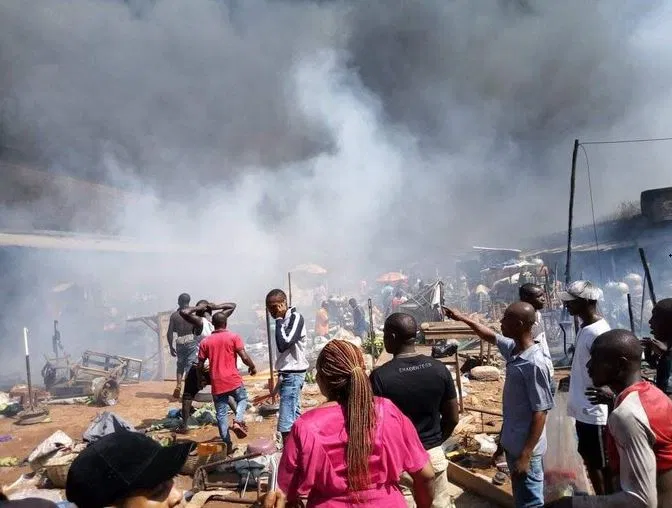
Blown fuel

Let’s look at how Nigerian leaders handle protests, peaceful or not. Have you ever heard of any protest that the police and the military have not brutalised the demonstrators? Is there any protest in this country where people were not shot dead? Are demonstrations even allowed to be held in this country? Let’s be honest with ourselves, our leaders are actually suppressing us. We are being intimidated and subjected into accepting whatever that is thrown at us. We are free and still in bondage. I just pray that this changes.

The next thing that touched me about the above mentioned events is the attack on political opponents. Do you know why I laughed here? I guess you will rightfully say that in Nigeria, political opponents do not face verbal attacks; theirs is settled between the DSS detention camp, EFCC cells and the prisons. I know most of them have skeletons in their cupboards but those in the right camp also have smelly skeletons. But they are moving about freely. This attitude is also displayed on protesters, journalists, religious leaders, and anybody considered a “threat” to the government. Yes, we have democracy, but we are not free.

What about the accusation that Trump may not accept the election result? Apart from Goodluck Jonathan, which other politician in Nigeria gladly conceded to defeat? The normal thing here is that you lose at the polling unit and then go to the court to revert it. Well, what do I know?

The abnormality in our system is like an ulcer that has spread to other sectors. And like a cancer, it is eating us up and shutting us down. People are afraid to talk. People are afraid to act. The only way to call the government’s attention to people’s grievances, which is peaceful demonstration, has been turned into the military and police shooting practice ground. Right now, we are doing siddon look, wondering what next will be thrown at us. But from all I can see, we are definitely not practising democracy in Nigeria.
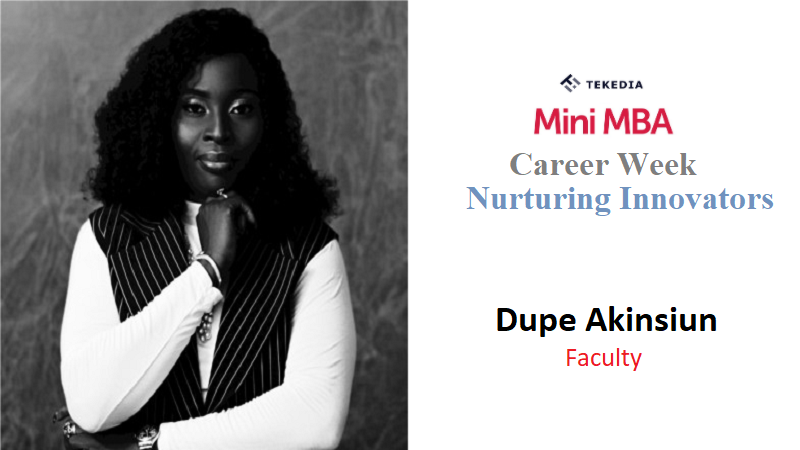
A Global HR Leader Will Teach During Tekedia Mini-MBA Career Week

0

She is a Certified Leadership & Behavioural expert, and heads the Leadership & Culture Center of Expertise (CoE) in one of the finest companies in the world, Coca Cola HBC. As a strategic HR Business Partner, she covers nine countries. Her experiences cut across  management consulting, financial Services, pharmaceutical, and FMCG. She seeks to “equip emerging leaders with the knowledge, skills and abilities required to excel in life and in their respective careers”.

Dupe  Akinsiun, a Tekedia Institute Faculty, will TEACH during Tekedia Mini-MBA Career Week  (Nov 2-6, 2020) on Career Planning within the theme Nurturing Innovators.   This career week is not designed for finding jobs. Rather, it is structured to TRANSFORM workers, founders & entrepreneurs into business leaders and champions of innovation in their companies.

Join Dupe and our Global Faculty, and accelerate your leadership and general management ascent.

https://www.tekedia.com/tekedia-mini-mba-2020-career-week-full-schedule-with-faculty/


Easy Solar Raises $5 Million to Expand Cleaner Energy Distribution in West Africa

0

Easy Solar announced the closing of a $5m round of funding, to scale operations in West Africa including a $3 million Series A Equity round led by global impact investor Acumen and FMO, the Dutch entrepreneurial development bank, in addition to a $2m debt facility from investment platform Trine.

Easy Solar provides energy solutions ranging from small lanterns for lightning and mobile charging, to pico solar home systems with appliances like TVs and fans, including KW sized systems designed for residential, commercial, and industrial users. The energy company has overtime, established an extensive distribution network and high volume of prior credit data. Easy Solar now offers more than solar, it serves other services such as clean cooking devices and pay-as-go smartphones.

Earlier, investment platform Trine, had invested $2 million in the solar company, and now FMO Ventures said the electricity deficiency in West Africa and the need for cleaner energy has spurred it to close the deal.

“Off-grid energy companies play a critical role in delivering clean, affordable, reliable energy without the need for grid infrastructure. Sierra Leone’s low electrification rates combined with limited alternatives for clean energy make Easy Solar’s business model highly relevant,” Marieke Roestenberg, FMO venture program manager said.

“The company has a strong and dedicated founding the team, which has managed to grow the company substantially during the past years. FMO’s funding allows the company to continue this expansion, both inside and outside Sierra Leone,” he added.

The deal places Sierra Leone and Liberia in a position to enjoy stable electricity supply. Easy Solar is an innovative distribution company making energy and financial services affordable and accessible for those with limited access to power in the two countries.

The vast majority of people in Sierra Leone and Liberia are off-grid, both countries are low income with electrification rates below 20%. Consequently, the funding will enable Easy Solar to expand cleaner energy distribution between the West African countries.

Acumen said Easy Solar has defied the odds of low income to expand electrification to Liberia, and they are thrilled to become part of the progress.

“Acumen is thrilled to support Easy Solar’s growth in markets that are too often overlooked. Despite low mobile-money penetration and a high concentration of low-income customers, Easy Solar has made pay-as-you-go solar accessible to Sierra Leoneans and now Liberians,” said Megan Curran, West African director of Acumen.

The CEO of Easy Solar Alexandre Tourre said the company will continue to learn from local markets as it aims to expand in West Africa.

“While further expansion in West Africa is on the horizon with this funding, we remain committed to our vision of going deep into the markets we operate in. we will continue to improve the reach of our brand and distribution networks in Liberia and Sierra Leone – where we operate the country’s largest direct retail network – and leverage it to offer additional products and services to our customers, directly or through strategic partnership.

“We’re also very excited to have brought such experienced and committed investors to the table as we continue with the scaling up of our C&I activities to answer the growing energy needs of offices, farms, factories, schools, hospitals, etc. across West Africa, with the same commitment to quality, ease of use and affordability,” he said.

Since 2016 when Easy Solar was founded, it has provided renewable energy to over 450,000 people, thereby providing over 600 jobs. The solar energy company has established a transformative energy network to serve the underserved to the last mile. The progress thus serves as a complement to Solarize which has been expanding in East Africa.

The African continent has been making tremendous progress in partnership with investors in the cleaner energy ecosystem. There has been increasing input from solar energy since the 2018’s record of 1.6% power generated from renewable energy. The African Development Bank’s Africa Renewable Energy Fund (AREF), has also been providing finance across Sub-Saharan Africa for innovations geared toward renewable-energy-based power generation.

The BBNaija and Why Showmax is a Promise for Multichoice (DStv, GOtV)

1

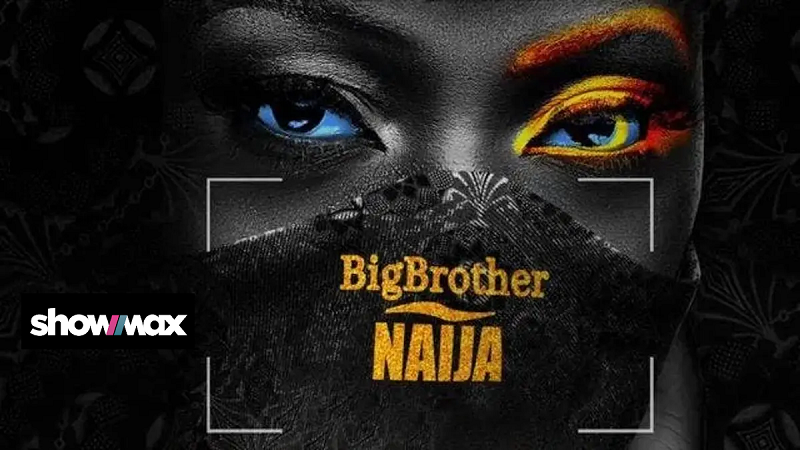
I am doing very poorly on Twitter. I have struggled on how to write in stanzas with short codes over having space to develop my thought processes. So, that thing is not working. Yet, when I mentioned that BBNaija winner would get a free pass on Tekedia Mini-MBA, the Twitter nation took up that tweet and made it the most popular I had ever written there. Then, I started looking at what was happening. Ladies and gentlemen, BBNaija is a potent brand in Nigeria.

With BBNaija, Showmax has a future online and that means MultiChoice has a potential moat to hold on to some customers from Netflix. BBNaija is the most popular show in Africa right now and if you have it on your online streaming platform, you have something of value. If they clean it up a little (yet to watch BBNaija though; many have noted that it could be crazy for families), they could win more markets, beyond Africa to the Caribbean and North America.

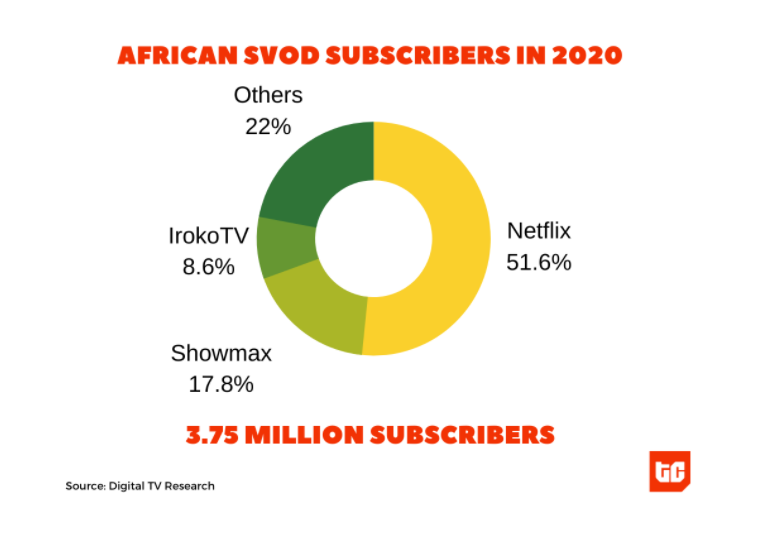
Source: Techcabal

So, if European football holds the world of DStv and BBNaija keeps the online video streaming going for Showmax, MultiChoice may not be as imperiled by Netflix as most are predicting. Bundle the two – DStv’s Football and Showmax’s BBNaija – and you have a new basis of competition in the market.

Like The Bachelor and The Bachelorette which ABC runs in the US, Big Brother Naija (BBNaija) may soon get  Big Sister Naija (SisNaija). And say in three years, open BBNaija and SisNaija supermarkets in selected major Nigerian cities, under a partnership to milk the brand equity. The possibilities are huge.

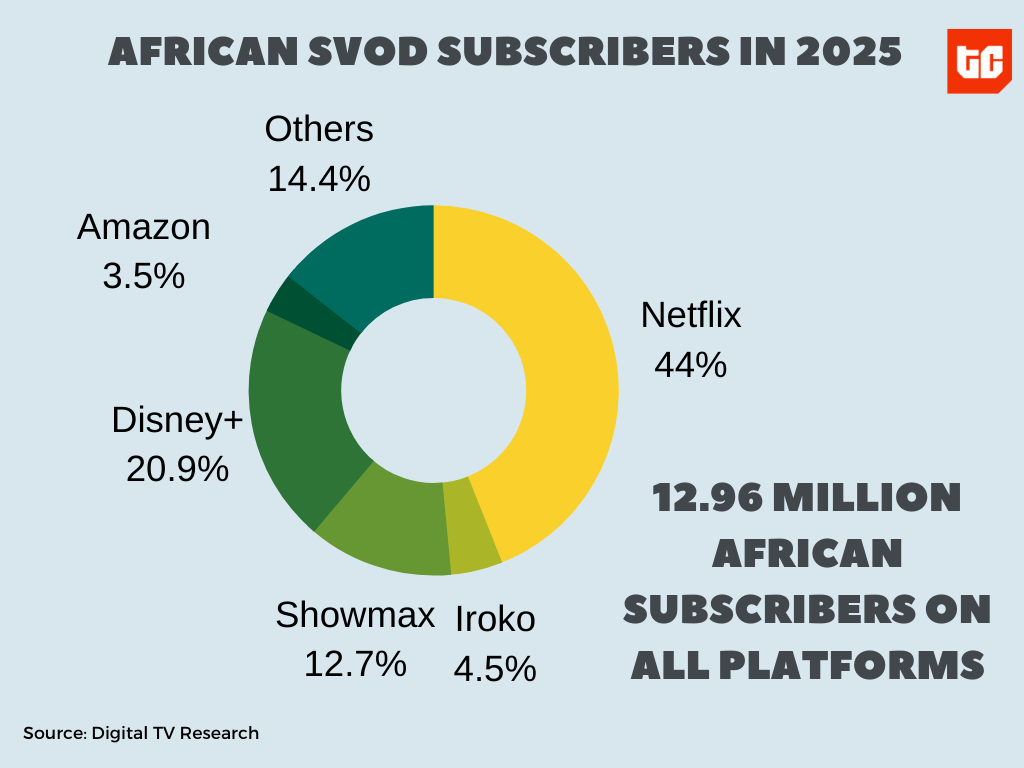
Source: Techcabal

That Netflix, MultiChoice (DStv, GOtv) Partnership in Africa

6

After five years, in Africa, Netflix has 1.4 million users. MultiChoice has about 20 million customers and certainly has deeper roots in the continent. To grow that business, Netflix has moved into licensing local movies and commissioning new ones. Yet, the double whammy where people who do not have a lot of disposable income must first pay for Netflix subscriptions, and then find money to pay for the internet broadband services to binge, makes everything complicated. For MultiChoice, through its satellite TV services, all you need is to pay for the subscription and that does it. So, right at the beginning, Netflix has a new layer on its pricing which has to be managed in Africa. Unfortunately, that layer – the mobile internet – is not within its control.

Netflix is testing if viewers will buy the mobile-only service at N1 200 (about R45) a month, well below the N2 900 it’s been charging for its most basic account. With over 100 million Nigerians living on less than R32/day, it could still be a stretch. …

The offer is still costlier than the equivalent of N250/month charged by Iroko, a streaming platform that has the largest online catalogue of Nigerian “Nollywood” content, including long-running hit comedy Jenifa’s Diary.

For the same broadband cost, the iROKOtv pricing did not work well in Africa. The company had noted that Africa would not be part of its immediate future.

It should not come as a surprise to anyone: selling video streaming products in Africa is a hard business. It is a double whammy for most potential customers: pay subscription fees and then cover the broadband costs. So, it was not entirely unexpected when iROTOtv announced that it was refocusing out of Africa: “Over the next week, IROKO will be defocusing our Africa growth efforts and we will revert to focusing on higher ARPU customers in North America and Western Europe. Even after pushing incredibly hard in Africa for the last 5 years, our international business represents 80% of our revenue today…” This is really a smart move as now the company can focus where it can earn U.S. dollars; I made that case a few days ago when I explained how Nollywood producers are focusing on international markets.

But interestingly, DSTv, owned by MultiChoice, is a distributor for Netflix in Africa which means if you check carefully, this battle is muted. I have called it the unification as MultiChoice closes the flanks, taxing its competitors because it has the pipe to the pockets of Africans. But Netflix is happy with it because it is selling a digital product which has a fairly low marginal cost. Provided there is something coming in as revenue from that DStv deal, it would be fine. And over time, the users will get used to its products and could then go straight to the web and subscribe, disintermediating DStv. 

In June 2020, I wrote, “The weakest link in MultiChoice’s DStv business is defending itself from Netflix. Netflix was picking some of its best customers in South Africa. Also, because Netflix was not under the high voltage searchlight DStv was subjected as a local operating company, by regulators, the cost was not optimized to compete against  the global juggernaut which does not need to open many African locations to do business in the continent. No matter how you look at it, DStv was going to struggle for years to manage the problems from Netflix.” Then, magically, there was a truce and Netflix chose DStv as a distributor. That was wisdom as Disney+ and Amazon Prime were coming after it; the distraction in Africa was not evidently necessary.

Everyone could actually win right now but what happens as mobile internet becomes cheaper would be different. I see DStv waking up one day, in 2022, to decide to part ways with Netflix. Yes, that will come after a clear realization that it has simply used its channels to promote the services of its major future competitor. The future of Netflix in Africa is the web. Whatever it is doing with DStv now is to take care of the marketing budget towards driving higher penetration of the brand in the continent! This is a typical fish bait acquisition construct.

The Fish Bait Acquisition Construct