DD
MM
YYYY

PAGES

DD
MM
YYYY

spot_img

PAGES

Home Blog Page 6132

Google To Spend $1 Billion On News Media Outlets for Their Contents

0

Google is implementing a new licensing program that will enable it to pay news media outlets for their contents. The program will take more than $1 billion over the next three years.

The Silicon Valley giant has signed licensing deals with about 200 publications in select countries with plans to add more and expand geographically.

The program is part of Google’s attempt to address the challenge of poor revenue generation hitting news organizations, especially in the COVID-19 era. The crippling impact the pandemic unleashed on the global economy, forced news organizations to take drastic measures, including downsizing, to stay in business.

“A vibrant news industry matters – perhaps now more than ever, as people look for information they can count on in the midst of global pandemic and growing concerns about racial injustice around the world. But these events are happening at a time when the news industry is also being challenged financially. We care deeply about providing access to information and supporting the publishers who report on these important topics,” Google said in a blog post.

Google and Facebook lead the web ad revenue generation table by miles, a feat they achieved serving contents from news media outlets among others. The News Media Alliance said in 2019 that Google made $4.7 billion off the news industry in 2018.

To compensate news outlets for the gains, countries like Australia and France started making a case for publishers to get paid for their contents. The subject has long been debated between governments, publishers and Google.

When France made the rules requiring publishers to be paid for snippets of news stories displayed in search results in 2019, Google said it would be displaying only headlines. CNN reported how earlier in April, the French competition authority ruled that removing the snippet amounts to abuse of Google’s market dominance, and ordered the search giant to negotiate with French publishers.

In Australia, Google has been in tussle with the government as it resists the call for search and social media platforms to pay publishers for their contents.

It is against this backdrop that Google announced in June; the new licensing deal that will see some select publishers around the world get paid first, in what seems like a pilot phase of the program.

“Today, we are announcing a licensing program to pay publishers for high-quality content for a new news experience. This program will help participating publishers monetize their content through an enhanced storytelling experience that lets people go deeper into more complex stories, stay informed and be exposed to a world of different issues and interests,” Brad Bender, Google’s VP Product Management for News said.

The program will take off first in Australia, Brazil and Germany. Part of the deal involves removing paywalls from news sites to make monetized articles free for non-subscribers.

The program named News Showcase, took effect on Thursday in Brazil and Germany. The app will be available in the Google News app on Android and subsequently, Apple store, and later expand to the Google’s discover app and Google search.

Bender told CNN that Google will extend the program beyond the three-year commitment and add more funds to the $1 billion. However, he did not say how Google intends to select participating countries and news organizations, or which countries and news outlets will be included in the next phase of the program.

He said publishers will be allowed in the future to include video and audio to News Showcase, not just text and images, as it will give them the opportunity to tell their stories the way they want.

“Depending on the story and how they want to tell it, participating publishers can pick the best template to showcase the best of journalism and tell stories the way they want to. This additional context for users not only helps users understand the story better, but also helps them get to know the publisher’s editorial voice and priorities,” he said.

The move is expected to tune down the prolonged controversy between the news media and Google, and subsequently create more revenue opportunities for publishers.

 

In Africa, Execution Rules Over Competition Because the Problems Remain There and Unsolved

0

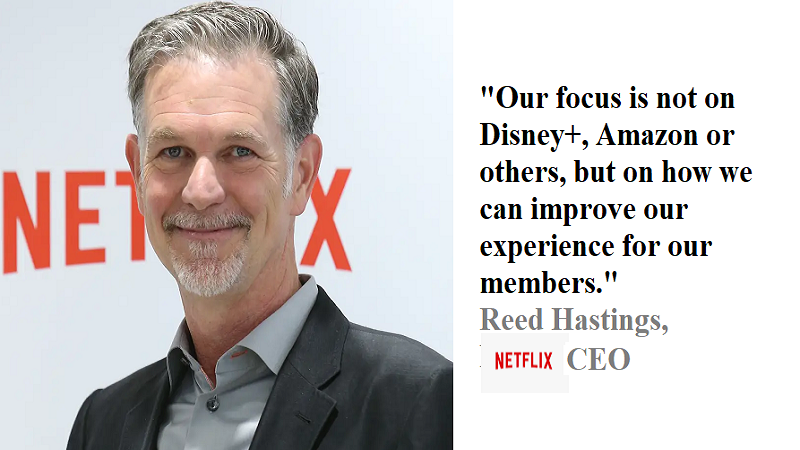
In the US, we earn around 10% of television screen time and less than that of mobile screen time. In 2 other countries, we earn a lower percentage of screen time due to lower penetration of our service. We earn consumer screen time, both mobile and television, away from a very broad set of competitors. We compete with (and lose to) Fortnite more than HBO. When YouTube went down globally for a few minutes in October, our viewing and signups spiked for that time. Hulu is small compared to YouTube for viewing time, and they are successful in the US, but non-existent in Canada, which creates a comparison point: our penetration in the two countries is pretty similar. There are thousands of competitors in this highly-fragmented market vying to entertain consumers and low barriers to entry for those with great experiences. Our growth is based on how good our experience is, compared to all the other screen time experiences from which consumers choose. Our focus is not on Disney+, Amazon or others, but on how we can improve our experience for our members.

Netflix CEO Reed Hastings

So, as a founder, give yourself a break and focus on the real business: building great products and a fantastic company. Do not allow another new fund-raise by a perceived competitor to stress you. Do not allow another new city expansion by the same competitor to stress you.

But worry if you are not serving your customers and improving your products. Many African startups do not die of competition, they die due to lack of execution.

Execution rules over competition because the problems remain there and unsolved. Continue reading here.

Founders, Competition is Not Your Problem; Execution Is.

Law Session at Tekedia Mini-MBA Is Next Week

0

Dear Community,

As the drumbeats of sub-optimal relationships  between founders and investors in some companies in Africa, sound louder, we are updating the current editions on the fly. On Monday, two faculty members will discuss commercial law, contracting, agreements, and IPs.

Mr. Chukwuemeka Mbah (LLB, BL, LLM)  holds a postgraduate degree in European and International Business Law.  Jeff Chineme Maduka (LLB, BL, LLM) holds a First Class Law degree in Nigeria and  Harvard Law in Banking, Corporate, Finance, and Securities Law.

Meanwhile, Tekedia Mini-MBA is moving to a dedicated subdomain to make it easier for users to use our platform. This will improve learning at a higher level.

Tekedia Mini-MBA continues to run three live sessions weekly. Please visit your board for schedules. More so, early registration for Edition 4 has now opened; register here.


Tekedia Team

Blockchain Startup, Bitfxt, Is Hiring CTO, HR Manager, Sales Manager & Engineers in Lagos

1

NB: The email is updated

Bitfxt Technologies, a Fasmicro Group portfolio company, is looking to fill some positions in Nigeria. The pioneering blockchain startup creates utility solutions which make it easy for both the banked and the unbanked to transact with digital assets seamlessly within Africa. It bridges the gap between the Decentralized finance and centralized finance ecosystem by building micropayment solutions and wallets on the blockchain, leveraging on the borderlessness, speed, transparency and security of distributed ledgers blockchain. It operates on two brands:

  • Bitfxt: Secure Digital Asset marketplace for buyers and sellers of verified digital assets and commodities.
  • Boundlesspay: A mobile application that serves as a wallet for storing money and other digital assets as well as a payment solution for utility bills and global remittance.

Chief Technology Officer (CTO):

A chief technology officer (CTO) is the executive in charge of an organization’s technological needs as well as its research and development (R&D). Also known as a chief technical officer, this individual examines the short- and long-term needs of an organization and utilizes capital to make investments designed to help the organization reach its objectives. The CTO usually reports directly to the chief executive officer (CEO) of the firm. 

Business Development & Sales Manager:

Work to form new client relationships and strengthen existing client relationships to forge new opportunities. Assist in the sales and service processes to ensure client satisfaction to help increase revenue and develop lasting professional relationships that will fuel sales and lead to possible partners with organizations associated with these clients.

Human Resources, Partnership & Operations Manager

Human resource planning: knowing the future needs of the organization. What kind of people we need, and how many? Using this knowledge to shape the recruitment, selection, performance management, learning and development, and all other HR functions.

Application & Software Engineers

Identifying and evaluating technological solutions : Responsible for using technology to improve business performance and strategy. Using one’s complex problem solving skills to brainstorm software solutions, and then work together in a small group to craft a pitch to present the idea to the company’s decision makers. Report to Chief Technology Officer.

For each of the positions below, send your CV to  info@bitfxt.com

4-month Free Use of Microsoft 365 via Reliance Infosystems

0

We are broadening services and support to the Tekedia Community. We now have law firms, consulting firms, tech startups, etc who are offering special services to support our members. This one was originally made for Tekedia Community but I am very happy to share here. To Tekedia Mini-MBA corporate members, send to Admin and they will share with our community.

Message: Many organizations are finding it difficult to operate remotely because they do not have appropriate technologies to empower their employees to do so. Reliance Infosystems offers them free 4-month use of the Microsoft 365 to allow them communicate, collaborate, co-author documents and digitally replicate all the traditional office activities within the comfort of their homes. The offer is completely free and can be converted to regular use after 4 months.

Interested, click here for contact: engage@relianceinfosystems.com