DD
MM
YYYY

PAGES

DD
MM
YYYY

spot_img

PAGES

Home Blog Page 6183

The Challenges of Remote Work

0
Virtual event or meeting has gone mainstream, benefiting Zoom

Once a person hears “remote work”, the first thing that comes to his mind is “working from the comfort of my home”. If you happen to be a freelancer, you will enjoy all the benefits that come with working from home. For instance, you don’t have to rent a shop because a corner in your house will be converted to your office. You won’t be harassed by revenue collectors that disturb shop owners. You can reach out to clients from different parts of the world. You just name it.

But then, if your mind tells you that remote work means that you have all the time in the world to yourself, well, I’ll like to tell you that it’s not so. I’m here to let you know that your tiny laptop can be a more demanding boss than that man barking out orders in your office. Somehow, that laptop will squeeze into your life and take up all your spaces so that you do nothing else but answer to it, even late in the night. That laptop you’re looking at can cost you a peaceful night sleep. This is why many remote workers hardly sleep at night.

We know that remote work is becoming the in-thing right now. Even before the pandemic, people were gradually going into it. Platforms such as Upworks made it easier for remote workers (that were lucky to be accepted into the platform) to meet with clients regularly. But now that the pandemic has changed the face of so many things, more remote workers and workers are going to emerge in the near future.

It will be necessary that you find out what you might experience as a remote worker. You may not hear of any of these until they hit you. Well, without wasting much time, here are the dangers of remote work.

  • Burning Out

You might be surprised to see yourself getting tired easily. You might think that you’re coming down with something. You can even start taking multivitamin supplements or even start treating malaria but all to no avail. Worst is that you will dread looking into your laptop. At this moment, all you want to do is lie down and sleep.

Well, the commonest cause of this is over working. Because you’re in your home and you feel you have all the time in the world, you will over work yourself. Going to the office ensures that you share duties with your colleagues. You also had colleagues to chat with and ask for directions in the office. But here, it is just you and your laptop. You have to crack your brain and carry out research to find ways to solve clients ‘problems. By the end of the day, your brain is stressed and you feel drained.

  • Zero Social Life

Like I said earlier, you might think you will have all the time in the world to socialise when you start working remotely. This ideology will stay with you until you go into it and find out that you might stay indoors for days without even brushing your teeth. Remember, you work based on when work came in and when the client wants it done – this could mean you don’t own your time. The thought of a deadline is enough to keep you away from sleep and social activities. It may even get to a stage where you stop mingling with people because your work has become demanding.

  • Family Interference

Family interference can come in various forms. It could be children and spouses complaining about lack of attention. It could be children distracting you while you work. It could be children adventuring with your laptop when you stepped out to pee so that they accepted orders for you (ask me about this). It could even be voices of your playing children or nagging spouse finding its way into your video or audio recording/streaming. Remember the stories of spouses that walked about naked in the room while their husbands/wives were in live streaming? Well, they are all part of it.

I know you may say that you won’t allow your family to interfere in your work. Believe me, unless you have a study or library at home, which is always under lock whether you’re in the room or not, they will definitely do something to mess up your work. Just be extra vigilant.

  • Biting More than You can Chew

It’s easier to accept work when you’re working from home. Somehow you will continue telling yourself that you will make out time to finish them until they start choking you up. The danger here is that you can get drained or fail to meet the deadline. Either way, it doesn’t pay.

Ways of Preventing the Dangers of Remote Work

These tips may not work for everybody but they work for me.

Set your Schedule

Draw up a timetable of how and when you will work. For instance, I have stopped jumping from my bed to my laptop in the morning. I have decided not to turn it on until 10am, after I must have done my morning chores and settled the children. Then, I also shut down at a particular time in the afternoon to take a break as well as to take care of some needs for the family. Then at night, I shut down for the day by 10pm or 11pm, depending on the stage I am at with work.

Aside these, timetables should also indicate which work will be done at a particular time and day. This way, tensions and pressures that come with having so many undone works on the table will be reduced. Also, your schedule should specify the day of the week that will be kept aside for a total break from work. In fact, even if you’re working from home, give yourself a “weekend” (it mustn’t necessarily be Saturdays and Sundays). Remember to be flexible with your schedule. Make appropriate changes when the need arises. For example, my schedule is bound to change when schools reopen fully.

Work when there is less Distraction

Even if you have a secluded area in the house, where you can work in peace, try to work when distractions have been brought to the lowest level. If the family members or neighbours start distracting you, kindly turn off and settle them first.

Eat Well and Sleep Well

These can never be overemphasised. You may see yourself as a sedentary worker, but remember your brain is at work, even when you’re sleeping. So give your body the food it needs and allow it to rest through sleep. Also remember to take a lot of fluids.

Remote work has a lot of advantages but it comes with its own challenges. As you go into it, make plans to avoid issues that might arise from it.

Building A MultiChoice (DStv, GOtv) Challenger in Nigeria; HiTv, TStv Weakest Factors

12

HiTV failed. TStv is struggling. DStv is winning territories. If you look at these companies, you will notice a clear catalytic difference: funding mechanisms. DStv was built by the largest purse in Africa, the unlimited Naspers of South Africa, which has so much money that it could buy all the publicly traded stocks in Nigeria with just 30% of the Group’s market cap. This is a company that battles Facebook and comes out as a winner. MultiChoice, though separated and traded differently now, connects to that heritage of wealth. At any point, Naspers has more cash on its balance sheet than …. (let me not make people feel bad).

This is my point: MultiChoice was not built with debt. But HiTv and TStv went through life via debts. In the media business, in Nigeria, that is very risky. It is nearly impossible to grow faster than your bank interest rate. Yes, if the interest is 25%, it technically means that to have the capacity to pay that loan, you need to be hitting excess of 40%, on value creation. That is nearly impossible in a media business where leverageables are linear, not exponential.

Read this piece by Toyin Subair, the former CEO of bankrupt HiTv. He summarized the HiTv paralysis elegantly: “As I said earlier, we were impeded from doing this at the right time. At 25-27% interest on debt, most businesses cannot survive and you will be a slave to the banks for life. That is why they take collateral from you. They lend against your collateral not your business case.” Then, he dropped more lines on why HiTv failed.

We paid 40 million dollars for the first year of the second term of the EPL from mostly equity. But still had to come up with a guarantee of about 70 million dollars for the latter 2 years and in Nigeria, guarantee requires cash in bank. The alternative bank we were forced to use despite all their assurances and being offered half of the amount by another Bank failed to issue same on that fateful Tuesday and only offered it to us on Thursday. Meanwhile the EPL sold it to our competition on Wednesday morning.

[…]

What laws do you need, or what interpretations of the laws do you require, go and get it passed or adjudicated. Don’t assume its there and don’t be afraid of offending anyone. A few weeks before we lost the EPL rights we were approached by the competition to share it with them, in writing. We agreed and were completing the approvals on both sides when we lost the rights. Since they bought it, we asked them for it on the same terms as we had agreed to give it to them just 2 weeks prior, they refused. We ran to government to enforce the fairness clauses of the NBC Act but it fell on deaf ears.

There is one conclusion here: if you take debts, running at 25% per year in a total addressable market of about 30 million people, with only possibly 20% interested (i.e. 6 million customers), you need to do magic to survive your 5th birthday on this business. (MultiChoice has about 5.2 million customers). Largely, the size of the effective market is too small to fund that level of debt in Nigeria. Based on that, there is no way anyone can build DStv challenger on debt. The best path remains equity where the cost of capital is not high, directly at most, on the business balance sheet.

Comment on LinkedIn Feed

One can build on debts on some sectors. So, it is not a blanket statement. The point is that the business most grow faster than the rate of debt-growth for that debt to be leverageable. But you cannot be growing 10% when you debt is at 27%! I have a small equation for the inflection point – when to go debt or equity across sectors. But note that dollar denominated debts when you are collecting revenue in Nigerian naira will largely fail.

UI VC Selection and the Need for Televised Public Debate with the University Community, Nigerian Society

0
University of Ibadan, a federal university

From the University community to the larger society, all eyes are on the people and committees in charge of the selection of a new Vice Chancellor. Since the creation of the University and appointment of indigenous professors as Vice Chancellors, this year’s selection and appointment remains the most debated. As captured in some of our previous analyses, it has generated a number of divided views driven by ethnicity, religion and politics [internal and external influences].

In preparation for the new administration after the end of Professor Abel Idowu Olayinka’s tenure, the outgoing Vice Chancellor, the congregation election has been held. Reports indicate that the election has never been really competitive like what was recorded in July, 2020. According to the reports, in the past, the University usually begged academic members to contest for posts to meet the required 153 seats. One of the factors that made this year’s election competitive is that some of the aspirants for the Vice Chancellorship position were seen printing and distributing form to their trusted ones.

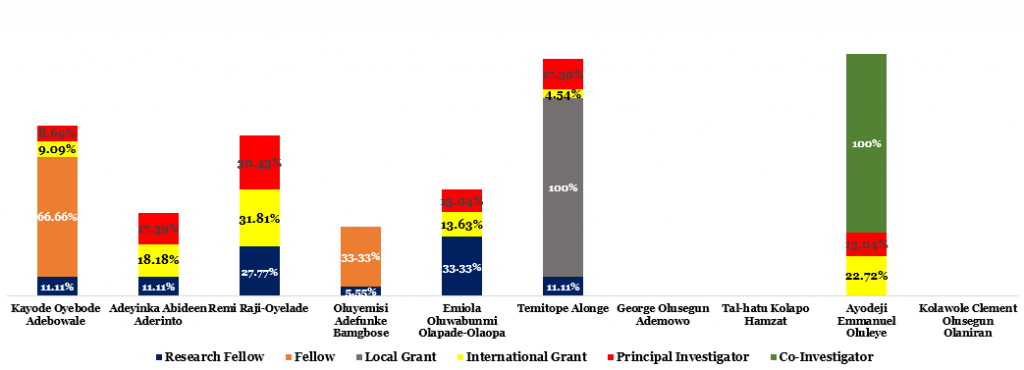
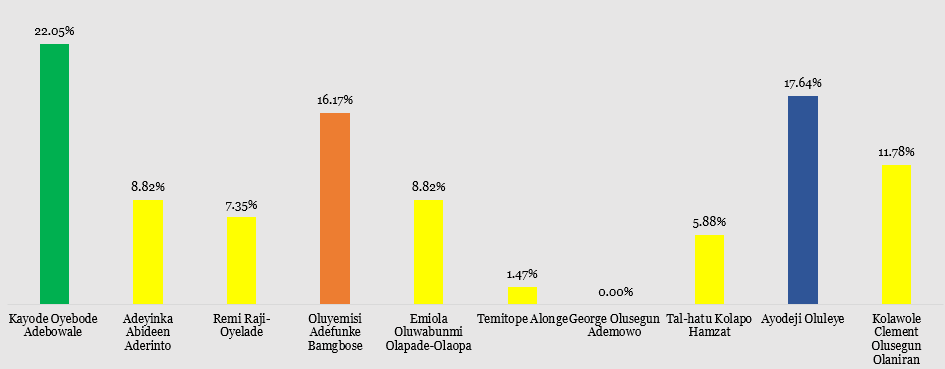
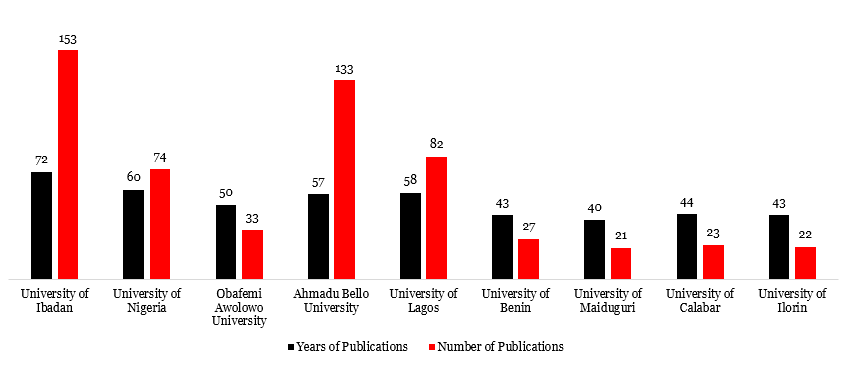
From our previous analyses, it emerged that selection and appointment of the new Vice Chancellor should be done within academic and administrative leadership metrics including grants attraction factors [see Emerging Insights]. In the current piece, our analyst proposes a televised debate, where each candidate will present his or her plans to the University community and the larger society. This is imperative as it evident that the University needs to set the right example for other universities. Beyond this, Nigerians, especially the parents and guardians, including Alumni of the University have the right to know how any of the contenders will manage human and material resources for sustainable growth and development.

Emerging Insights

Exhibit 1: Grants and Participation Metrics

Source: Staff Profiles on the University’s Website, 2020; Others; Infoprations Analysis, 2020

Exhibit 2: Current and Previous Leadership Positions Metrics

Source: Staff Profiles on the University’s Website, 2020; Others; Infoprations Analysis, 2020

Exhibit 3: Academic Leadership Metrics

Source: Google Scholar, 2020; Infoprations Analysis, 2020

The Effects of the Debate

The debate will go in a long way of knowing capable contenders. Apart from this, the presentation and interaction will be reference points when it is necessary to hold who emerges accountable in the future. There is no doubt the televised debate will enable contenders to position themselves to the world beyond the abilities and capabilities stated in their resumes, which are not likely to be seen by the global audience [considering non-availability of most on the Internet]. It will also help in correcting some wrong impressions about the contenders.


Testimonials [Updating…]

2

We are updating this page as readers, critics and reviewers comment on this book. To read this book, you must be a participant in Tekedia Mini-MBA. Join here.


This book is a worthy read to all aspiring, low-fly and high-flying entrepreneurs, including those envious of the privileges that Dangote Empire has enjoyed. Noteworthy to say, I doubt Mr Aliko Dangote himself understands these privileges as a Conglomerate Tax (reward for helping Government out on high-pains by moving upstream) and not benefits of tribalism, feudalism, and/or Northern Nigeria cabalism. (source)


This book is a very amazing piece. It presents concise, well thought-out and very clear insights on how to build companies with focus on solving problems not many people can solve and consequently, have government’s attention and support. Thank so much for this Prof. (source)


Though relatively new in the core business world, this is the best business book I have read after reading some international ones. Thanks, Prof Ndubuisi Ekekwe for this book and all your faculty for this platform. I have taken numerous courses on Coursera and the like, but this platform is down to our business climate. Kudos. (source)


Nice job, thanks!  A great read to start a prosperous year journey. (source)


The focus of this book will certainly culminate into creating great African innovators. It is a great book (source)


“This is my best read so far in 2021. I’m reading “The Creative Edge” by Matthew Ashimolowo now, let’s see if it will topple this one”. (source)


“Ndubuisi – a really great effort on this book. Very nice you ask your Tekedia Mini-MBA members to read it as a practical case study. I see things differently now. I never knew that Dangote Group had failed in other ventures. I will check Dangote Noodles, Liberty Merchant Bank, Dangote Capital, etc to learn more. While he gets government support, I can see his success is not only through government since government could not help him in other areas he did not have intrinsic advantages.  All my managers are reading and I have asked them to give me one area we can become a king. Elumelu/Ovia for banking, Dangote/ASR for cement, … brilliant perspective and thought leadership”(email)


The insights in this book are educating and inspiring. I have learned what it takes for a business to be a conglomerate( moving from downstream to upstream) with Nigeria as a case study. Thank you very much indeed for this. (source)


Well researched and presented book. I’ve learnt a lot and a good eye opener. (source)


“This book is a very amazing piece” – A critic on “The Dangote System”, my new book

0

“This book is a very amazing piece. It presents concise, well thought-out and very clear insights on how to build companies with focus on solving problems not many people can solve and consequently, have government’s attention and support. Thank so much for this Prof.” A critic/reviewer, on “The Dangote System”.

Source: the Conclusion page

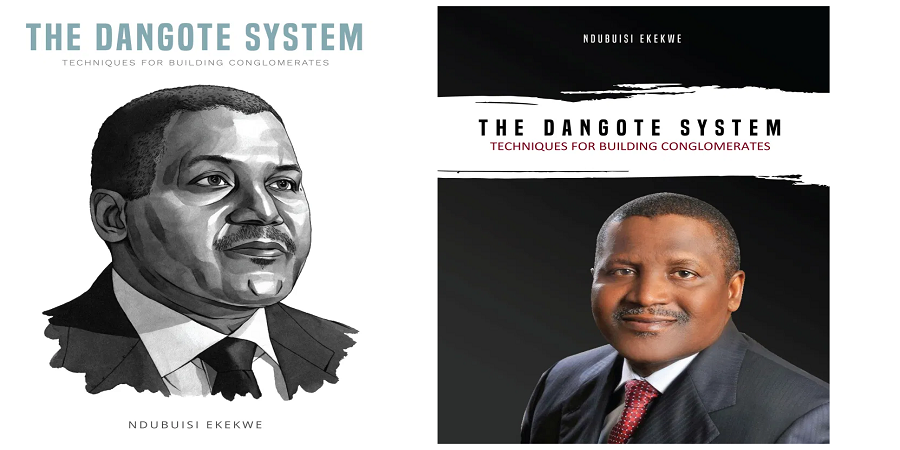
Read “The Dangote System: Techniques for Building Conglomerates”, and master what it takes to build great companies. It is exclusive to Tekedia Mini-MBA participants, register here for full access.

Tekedia Academic Programs