DD
MM
YYYY

PAGES

DD
MM
YYYY

spot_img

PAGES

Home Blog Page 6191

The Lagos State’s Missing Helicopters

0

In 2015, the Lagos State Government under the leadership of Governor Akinwunmi Ambode, acquired three helicopters for security and medical emergencies. The acquisition of the helicopters was hailed by Lagosians as it would help first responders to beat Lagos’ crazy traffic.

That’s what it was meant to be, and what Lagosians believe it is until on Monday, when the Lagos State House of Assembly summoned the Chief of Staff to the Governor Babajide Sanwo-Olu, Mr. Tayo Ayinde; the Commissioner for Economic Planning and Budget, Mr. Sam Egube; Commissioner for Special Duties, Mr. Tayo Bamgbose-Martins; and the management of the Lagos State Security Trust Fund over the helicopters.

According to Punch, the concern was raised by the Chief Whip of the House, Mrs. Mojisola Meranda, under matters of Urgent Public Importance on Monday, during the plenary.

She said that the helicopters are missing, and their whereabouts should be investigated as well as the contractual agreement between the Lagos State Government and companies designated for their maintenance.

“In 2015, three helicopters were bought under Governor Akinwunmi Ambode to strengthen security in the state. But the helicopters are nowhere to be found now.

“I will want us to look at it and get the concerned parties to tell the house House the location of the three helicopters to see if they are just lying fallow or if the state government has entered into an agreement with an entity on the equipment and see to what extent the agreement has been working,” Mrs. Meranda said.

The Speaker of the House of Assembly added his voice to the issue, demanding answers to the whereabout of the helicopters. He said they were meant for security and commercial purposes and the Lagos State House of Assembly should know what the situation of the assets is.

“We need to know what has happened to the helicopters,” he said, and directed the Clerk of the House, Mr. Azeez Sanni to give an account on the helicopters.

While there is hope that the helicopters could be lying in waste on some tarmac somewhere, the development calls to mind a similar incident that took place years ago.

In 2004, MT African Pride, a seized Russian ship laden with 30,000 barrels of oil disappeared from the custody of the Nigerian Navy without a trace. It was an embarrassing moment for Nigeria that charges was instituted against responsible naval officers.

A comedian made a joke story from the incident; he talked about a commercial motorcyclist whose okada (motorcycle) was stolen. He had gone to a police station to report the theft and was chased away by a policeman who said that a motorcycle is so insignificant to be bothered about. After all, if a whole ship could disappear in Nigeria without a trace, there’s no need looking for a missing motorcycle.

And the police officer was right, the okada would never be found just as so many other things that disappear in Nigeria.

It is the 16th anniversary of the missing ship incident, and Lagos State Government is having a helicopter episode. Nigerian public officials are notorious for keeping government assets they used while in the office; from cars to every other thing movable, but helicopters could be an exception.

As emergency situations still abound in Lagos, it is hoped that the three helicopters will be found and returned to their designated services.


I want everyone to #Believe. It is a new dawn for transportation in Nigeria.

0

Tomorrow, Aug 27, Vetifly will run its debut flight. I had hoped I would be in person to fly with you, but with the international airports closed, that would not happen. From our Board of Directors, we wish everyone flying with Vetifly to fly into GREATER promise and abundance. We come with a great vision and will serve our nation and continent in great ways. Thank you all for the amazing support we have received.

The fascinating young lady going out to do the amazing tomorrow, thank you. Let me hold that one until after tomorrow. We are truly thrilled. Thank you Nigerians. Thank you GOOD People – you are the best.

As Vetifly helicopters leave the solid  bounds of the land to reach skywards, I want everyone to #Believe. It is a new dawn for transportation in Nigeria. Download our app and book your flight.

Download Vetifly App and Book Your Helicopter Ride – Operations Commence Aug 27

Nigeria’s Supreme Court Upholds The Rights of Igbo Female Children to Fathers’ Inheritance

27
Igbo traditional marriage

In a landmark ruling, the Supreme Court of Nigeria has upheld the judgment of the Appeal Court respecting the right of a female child to her father’s inheritance. The Apex Court judgment has however, disrupted a long-held tradition of the Igbos that prohibits female children from inheriting their father’s properties.

The Supreme Court ruled that the tradition contradicts Nigeria’s constitution and it is discriminatory. It said the practice is a clear violation of section 42(1)(a) and (2) of the 1999 Constitution.

Gladys Ada Ukeje, the daughter of late Lazarus Ogbonna Ukeje had filed a suit challenging her family’s decision to disinherit her from her father’s estate based on the Igbos’ native law. The trial court had ruled in her favor, but the widow of late Mr. Ukeje, Mrs. Lois Ukeje, and her son; Enyinnaya Ukeje appealed the ruling of the trial court.

Consequently, the Appeal Court upheld the judgment of the trial court, prompting the duo to appeal to the Supreme Court. The long legal battle that started in 2004 with the file number SC 224/2004 ended in a historic verdict which does not give only Gladys a right to her father’s inheritance, but every other female child of Igbo race.

In its ruling, the Apex Court held that the Appeal Court has been right in its judgment that nullified the Igbo tradition that prohibits females from inheritance.

The panel made up of Justices Samuel Walter Nkanu Onnoghen, Clara Bata Ogunbiyi, Kumai Bayang Aka’ahs and John Inyang Okoro and others, agreed with the lead decision.

Justice Bode Rhodes-Vivour, reading the verdict said: “No matter the circumstances of the birth of a female child, such a child is entitled to an inheritance from her late father’s estate.”

Rhodes-Vivour added: “Consequently, the Igbo customary law, which disentitles a female child from partaking in the sharing of her deceased father’s estate is breach of Section 42(1) and (2) of the Constitution, a fundamental rights provision guaranteed to every Nigerian.

“The said discriminatory customary law is void as it conflicts with Section 42(1) and (2 of the Constitution. In the light of all that I have been saying, the appeal is dismissed. In the spirit of reconciliation, parties are to bear their own costs.”

While the ruling has voided the practice of disentitlement of a female child in Southeast Nigeria, it has also created a new conflict. The tradition has been upheld for ages, and consequently many have found the Supreme Court’s judgment unacceptable.

Igwe Simeon Osisi Itodo, the traditional ruler of Aji autonomous community in Igbo-Eze North Local Government Area of Enugu State, told Vanguard that the Supreme Court ruling will not change the custom of Ndigbo, and any effort to enforce it will bring chaos.

“There are traditions which had existed before the law. Before the emergence of law courts, Igbos have their tradition and custom which cannot be wiped out because of Supreme Court ruling.

“We are not against that ruling but we would not abolish our customs and traditions which all of us met. You can imagine a married woman coming back to her father to share his property with the sons.

“We would not allow it because it would breed chaos and troubles in our communities. If there are customs that allow such inheritance, let the people continue the practice but it won’t work in Igboland. In India, women pay the dowry but the reverse is the case here. We would not abolish our unique customs because of court ruling,” he said.

While there are many voices in support of the court’s judgment, many have acknowledged the difficulty in its implementation.

Another Monarch, Igwe Christopher Nnamani of Likke Iheaka, in Igbo-Eze South Local Government Area of Enugu State, who added his voice to the development said the Igbo custom that denies females’ right to their fathers’ property has been unfair, and needs to be changed. But he acknowledged that it would be difficult to introduce something new in place of the old custom.

“This unfair treatment of female children does not happen in Northern or Western parts of Nigeria. This explains why females with affluence lord it over their male counterparts in Igboland when they remember the injustice they have suffered in the past.

“If a male becomes the eldest man in his community, he would be entitled to some privileges, which may come in form of royalties but the reverse is the case for the women in Igboland. The challenge is how to implement it now because it now because it is an old tradition in Southeast Nigeria,” he said.

The tradition has been based on the fact that a girl-child will be married off, maybe far away from home where she cannot play the custodian of the inheritance. Moreover, for Ndigbo, a female child’s inheritance lies with her husband who is believed to have inherited his father’s property.

However, a twist in the custom that birthed the judgment is the urban setting, where Igbo fathers own properties far away from home, where inheritance is not governed by native laws and practices.

Additionally, the 21st century ushered in a new era of thinking and a brigade of rights activists ready to fight till the last drop of blood to kill the old norms that have subjugated women.

However, it is not the first time the Supreme Court is ruling in favor of Igbo women in this matter. There has been such a judgment in the past, but it has failed to change the custom particularly in the Southeast. And based on the views of the custodians of Igbo customs, the recent Apex court ruling may have little effect on the tradition.

The Adenuga Unstructured – A New Book Coming from Ndubuisi Ekekwe

2

He is an unstructured builder. A man whose playbooks differ from anything you might have learnt in any management school. But he has great results, expanding an empire and winning markets and territories. He is also an innovator, liberating his nation and fellow citizens from the bounds of per-minute billing when he pioneered per-second billing, via Glo. Yes, his model is uncommon, for the size of his business, across many dimensions and not many can make sense of it. Simply,  Mr. Mike Adenuga is Unstructured in his ways of building a conglomerate. 

In a new book – The Adenuga Unstructured: New Models for Building Conglomerates – I am working on, we will be examining how he has used that model to build one of the largest conglomerates in West Africa. As always, our books are exclusive for Tekedia Mini-MBA members.


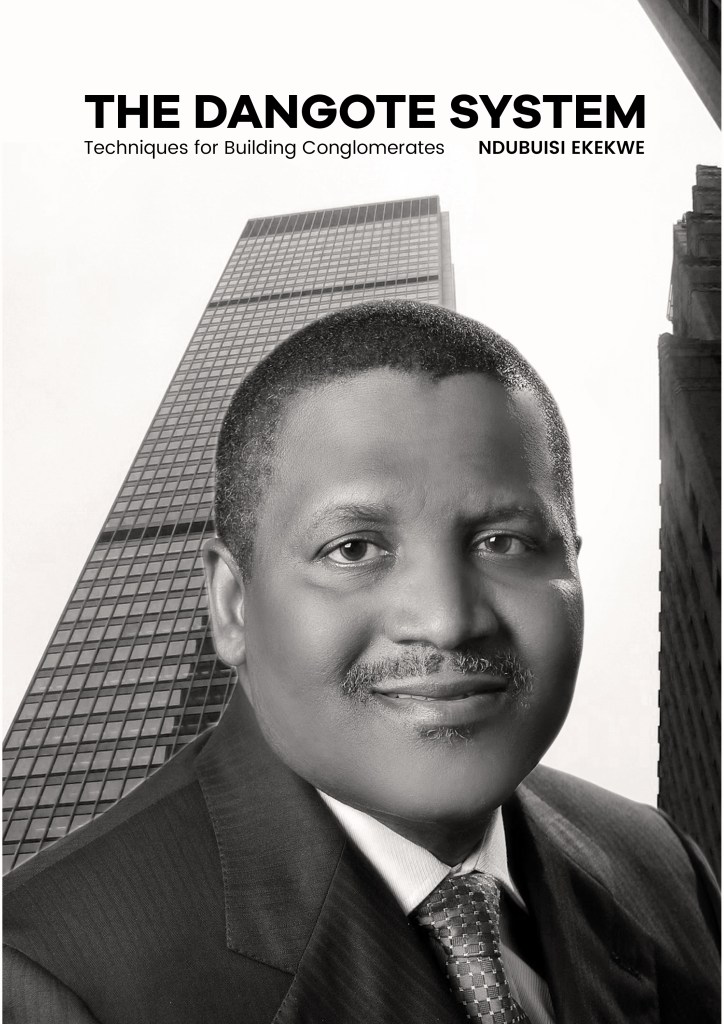
“The Dangote System” – A New Book from Ndubuisi Ekekwe

0

From the critics:

“This book is a very amazing piece. It presents concise, well thought-out and very clear insights on how to build companies with focus on solving problems not many people can solve and consequently, have government’s attention and support. Thank so much for this Prof.”

“This book is a worthy read to all aspiring, low-fly and high-flying entrepreneurs, including those envious of the privileges that Dangote Empire has enjoyed. Noteworthy to say, I doubt Mr Aliko Dangote himself understands these privileges as a Conglomerate Tax (reward for helping Government out on high-pains by moving upstream) and not benefits of tribalism, feudalism, and/or Northern Nigeria cabalism”.

Have you read “The Dangote System” by Ndubuisi Ekekwe? Begin here

Comment on LinkedIn Feed

Ndubuisi Ekekwe sir, it would have been lovely to have the man dangote do the forward for the book. It will make perfect “brain”

That would be very bad. That is not how professors work. If I do that, I am no more reporting facts, from my angle. It means, I am singing praise since there is no way he would not influence the contents. We do not need to coordinate with any human. Dangote may not even like the book. But provided it is fact-based and relied on public data, I am fine. This book is not really about Dangote, it is simply a case study for our members to understand how to build companies. I do not need any Foreword from any human to explain that.