DD
MM
YYYY

PAGES

DD
MM
YYYY

spot_img

PAGES

Home Blog Page 6193

The Malian Mutineers and the Power of Protests

0

The president of Mali, Ibrahim Boubacar Keita, resigned this week after he was detained by military officers. Mali has been rattled by mass protests against corruption and escalating insecurity in the country. Since 2012, militants have made Mali largely ungovernable. This resignation mirrors Sudan’s  Omar al-Bashir who lost power over bread after mass protests. Sure, the style was different. The mutineers, going with the name the “National Committee for the Salvation of the People,” have called on Mali’s civil society and political movements to come together towards creating an ecosystem for a political transition. 

Meanwhile, Nigeria, the superpower in the region, has rejected the coup and has requested an immediate restoration of democratic system. Of course, for months now, Nigeria has been unable to stop the protests in Mali through its emissaries, coordinated by former President Goodluck Jonathan. So, we will be watching if Malians return to work after the boys left the barracks for the presidential villa.

The Nigerian government has called for the immediate and unconditional restoration of constitutional order in Mali following the coup that ousted President Ibrahim Boubacar Keita.

The Minister of Foreign Affairs, Geoffrey Onyeama, made the call on behalf of the Nigerian government via his verified Twitter handle @GeoffreyOnyeama on Wednesday.

Mr Onyeama said Nigeria also welcomed the urgent activation of the ECOWAS Standby Force.

“The Nigerian government unequivocally condemns the coup d’état that took place in Mali on Tuesday and demands the immediate and unconditional restoration of constitutional order.

‘We welcome the urgent activation of the ECOWAS Standby Force,” Mr Onyeama said.

No one knows tomorrow for Mali. But it is evident that protests can bring change. I am not sure these soldiers would have done what they did without the citizens marching on the streets. Yet, it is not yet uhuru as counting on soldiers could be an optical illusion. But here, with the government and the main opposition party severely lost on power tussles, these soldiers could provide an umbrella for a new chapter. The key would be to task them to finish this transition process in months.

Ralph Mupita Anointed MTN’s New CEO When Rob Shuter Steps Down in Days

0

MTN Group today announced that the current group CFO of MTN Group, Ralph Mupita, has been appointed as the new group president and CEO with effect from 1 September 2020. Ralph has served as the MTN Group CFO since April 2017 and has played a critical role in the development and execution of the group’s strategy, capital allocation processes, and financial performance as well as in the resolution of a number of complex regulatory matters.

MTN Group chairman Mr Mcebisi Jonas said Mupita was chosen for the role because he has the ability to fill the group president and CEO position.

“After a rigorous and extensive search process, we are pleased to have appointed someone of Ralph’s calibre, experience and ability to fill the group president and CEO position.

“Ralph’s experience as the group CFO, strong knowledge of our businesses and markets, as well as successful background in financial services, M&A and emerging markets, place him in an excellent position to lead the growth and sustainability of the business going forward,” he said.

Ralph is a graduate of the University of Cape Town with a degree in Engineering and an MBA. Prior to joining MTN Group, Ralph was the CEO of Old Mutual Emerging Markets for five years, a business that provided financial services to individuals and corporates across 19 countries in Africa, Latin America and Asia, managing over R1 trillion of customer assets under management at the time.

Commenting on his appointment, Mupita said it has given him the opportunity to drive growth and unlock value for shareholders using the digital space of African continent.

“Leading a business with MTN Group’s history, scale and socio-economic impact is a privilege and honour, and I look forward to working with the group board and executive committee in driving growth and unlocking value for shareholders and broader stakeholders.

“MTN Group is well positioned to take advantage of the digital acceleration shifts and opportunities across our markets, and we are well placed to play an important and leading role in digital and financial inclusion of the African continent, working with our stakeholders and partners,” he said.

The current group president and CEO, Rob Shuter, will step down from his executive responsibilities on 31 August 2020 and will thereafter support Ralph as required until the end of his fixed-term contract early next year.

Shuter’s result statement shows that Mupita is stepping into big shoes. Under Shuter, the MTN Group delivered commercial momentum across its operations and yielded strong financial results.

The telecom giant added over 18 million customers to reach more than 251 million, with an increased data users that jumped from 17 million to over 95 million. In the fintech area of its business, Shuter pioneered a record 7 million to 35 million users’ growth.

MTN has, during his time, introduced many products such as the instant messaging platform Ayoba, which now live in 12 markets with two million monthly active users. And there’s MoMo, the payment platform launched in South Africa and Afghanistan. The product received super-agent license in Nigeria and registered more than 100,000 agents before the end of 2019.

The Group also delivered R14 billion of asset realizations within the first 12 months of its programme, and MTN Nigeria got listed on the Nigeria’s Stock Exchange. Shuter’s leadership addressed many business concerns affecting MTN, including the AGF tax matter in Nigeria, relationship with stakeholders and employee sustainable engagement which made it the best company in 2019.

On the financial growth, the telco’s revenue increased by 9.8% to R141.8 billion, and Earnings Before Interest Tax Depreciation and Amortisation (EBITDA) expanded by 13.6% to R53.4 billion. The holding company leverage ratio improved to 2.2x, and the capex intensity was reduced from 19.3% to 17.5%, indicating greater efficiency in deploying assets.

The strong earnings performance drove the operating cash flow to 18% increase and pushed the ROE from 11.5% in 2018 to 14.3% in 2019 on an IAS17 basis.

The result was attributed to double-digit growth in service revenue by both MTN Nigeria and MTN Ghana, and was driven by improved 4G services.

“On the financial side, we delivered service revenue growth of 9.8% with an acceleration in the second half. Our EBTDA margin improved and reported headline earnings per share grew 62%. Our network rollout brought a further 69 million people into 4G coverage whilst reducing capex intensity. Improved cash flows during the year supported stable balance sheet ratios,” report statement from Shuter said.

With this trajectory, the stakes are so high for Mupita, even as environmental and monetary policies become more challenging in Africa.

The Web Is Now Eating Global Commerce

1

Three notes:

  • “Target Corp. posted the strongest quarterly growth in its history, including a near tripling of digital sales, as coronavirus concerns fueled demand for services that let shoppers pick up goods in parking lots or skip trips to the store. Like rival Walmart Inc., Target has benefited from being able to stay open throughout the pandemic as well as selling groceries and other household staples. Online comparable sales rose 195% from a year ago, driven by same-day pickup and delivery services”, writes Wall Street Journal.
  • Some of the biggest retailers are cashing in as the pandemic fuels a surge in at-home purchases. Target just posted its strongest quarterly growth in its history as its digital sales nearly tripled. Walmart meanwhile recorded its biggest ever climb in online sales, with its U.S. e-commerce sales rising nearly 97%. As customers spend more on their food and homes without entering physical stores, big chains such as Target, Walmart, Home Depot and Amazon are among the biggest beneficiaries, notes The Wall Street Journal (LinkedIn notes).
  • Amazon is adding 3,500 corporate jobs and expanding offices in six major cities. The roles will be based in offices in New York, Phoenix, San Diego, Denver, Detroit and Dallas. Amazon has purchased a New York City Fifth Avenue building from WeWork for more than $1 billion, The Wall Street Journal says, citing anonymous sources; it’s set to open as an office in 2023. Amazon’s Workforce Development VP recently said the company “expects much of its staff to one day return back to its offices.” (LinkedIn)

Looking at these three notes, we can conclude one thing: online sales in the developed economies have reached an inflection point. And if nothing changes in the next six months, physical sales are going to make way, permanently. The African economies which could have benefited from this redesign of commerce are hampered by infrastructural challenges which continue to stymie the ability to deepen logistics, necessary to unlock ecommerce and broad online sales. Notwithstanding, online sales is no more the “future”, it has come right now. Prepare your e-store, no matter what you do, because the future of commerce is online.

2020 Global Most Cited Journals: Nigerian Journals Not on Top 100 List

0

In line with its tradition of releasing a global report that details the most cited academic journals in the world, Google, the owner of Google Scholar released this year report in June, 2020. The report, which has maintained the name “Google Scholar Metrics” in the last few years provides “an easy way for authors to quickly gauge the visibility and influence of recent articles in scholarly publications.”

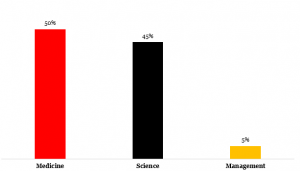
Examining the report, our analyst discovered that Nigerian journals did not make it to the top 100 in the world. Finding also reveals that Nigerian medical and science-oriented journals dominated the top 10, when the ranking is considered within the Nigerian context. The report indicates that the Nigerian Journal of Clinical Practice, a quarterly peer-reviewed international journal published by the Medical and Dental Consultants’ Association of Nigeria, is the most cited Nigerian Journal between 2015 and 2020.

Our check reveals that “the journal is registered with the following abstracting partners: Baidu Scholar, CNKI (China National Knowledge Infrastructure), EBSCO Publishing’s Electronic Databases, Ex Libris – Primo Central, Google Scholar, Hinari, Infotrieve, National Science Library, ProQuest, TdNet, African Index Medicus and Wanfang DataThe journal is indexed with, or included in EMBASE/ Excerpta Medica, MEDLINE/Index Medicus, SCOPUS, Science Citation Index Expanded, Web of Science.”

Check further shows that the first publication of the Journal was in 2005. As of August, 2020, a total of 2,320 articles have been published by the Journal. An article written by BM Musa, S Bussell, MM Borodo, AA Samaila and OL Femi, and titled “Prevalence of hepatitis B virus infection in Nigeria, 2000-2013: A systematic review and meta-analysis” has been cited 165 times. This citation made the article the most cited since 2015, according to the report.

The only non-science and medicine journal is Nigerian Journal of Business Education (NIGJBED), the official Publication of the Association of Business Education of Nigeria.

Optimizing Business Education for National Development written by Oladunjoye TG, a lecturer at the Department of Business and Entrepreneurship Education College of Education, Kwara State University Malete, Ilorin, Kwara State, is the publication’s most cited article since 2018. It has been cited 15 times.

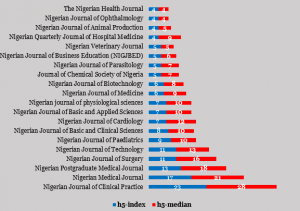
Looking at the metrics used by the Google, we found h5-index and h5 median. Our check indicates that “H5-median is based on H5-index, but instead measures the median (or middle) value of citations for the h number of citations. A journal with an H5-index of 60 and H5-median of 75 means that, of the 60 articles with 60 or more citations, the median of those citation values is 75.”

From the emerging insights, our analyst asked that where are Nigerian non-science and medical journals in the global space? Our analyst observes that the inability of the journals to appear within the Nigerian context could be linked with the fact that a number of the journals do not have an online presence. And, without an online presence, it would be difficult for academic and non-academic researchers to cite their articles.

Exhibit 1: Top Nigerian Journals by Discipline

Source: Google Scholar Metrics, 2020; Infoprations Analysis, 2020

Exhibit 2: Top 20 Nigerian Journals (Most Cited between 2015 and 2020)

Source: Google Scholar Metrics, 2020; Infoprations Analysis, 2020

Apple Is A $2 Trillion Company

3

Apple is now worth $2 trillion. That is an American history. Saudi Aramco remains the first global company to hit that mark. Of course, Apple is the first private entity in the world to reach that mountaintop.

Among its many accomplishments — the iPhone, the iPad, iTunes, the App store — Apple can now boast of one more: It is now worth more than $2 trillion, making it the first company in the United States to reach that milestone.

The iPhone maker’s stock briefly hit the $2 trillion mark Wednesday. Shares have surged almost 60% this year and are at an all-time high. Apple, currently trading at nearly $470 a share, is about to become more affordable for average investors to purchase, too.

The company’s stock will split four-for-one at the end of the month, which will cut the price of a single share to about $117. The value of Apple remains the same since the company will simply have more shares trading at a lower price.

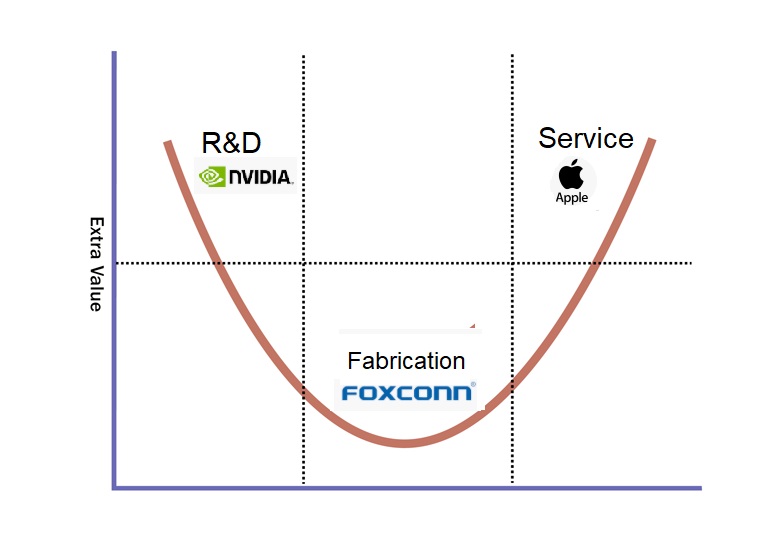
Apple has captured a lot of values when you examine its positioning in the smiling curve. It plays at both edges of the smiling curves while partners pick the center.