DD
MM
YYYY

PAGES

DD
MM
YYYY

spot_img

PAGES

Home Blog Page 6201

UI VC Selection: How Vacancy Advertisement Gives Male Professors Edge Over Female Professors

7
University of Ibadan, a federal university

From the developing countries to the developed ones, the need to ensure gender equality remains issues of national and global importance. Several reports have indicated that some countries are not likely to bridge their gender gap by 2030, the year most countries are expected to realise goals and targets related to gender imbalances in the Sustainable Development Goals Agenda 2030.

The issue of gender inequality cuts across all aspects of every society. In business, social setting and educational institutions, men are being favoured in terms of positions habitation and expressing views than womenfolk. In Nigeria, the issue is more complicated when one examines it from the cultural and religious perspectives. Some norms and values of the ethnic groups still prioritise male children more than female children. Some elements in religions are not helping the matter too. The Global Gender Gap Index has placed Nigeria on 146th position out of 152 countries ranked for gender gap bridging for 2020. Individual index scores show that Nigeria is placed on 128th position as a country that ensures political empowerment for women.

However, this piece is not aimed at revealing what and how Nigerian stakeholders have worked on reducing gender inequality and expected to close the gap in the future. The concern of the article is how University of Ibadan’s Registry Office constructed vacancy advertisement for the position of Vice Chancellorship. This piece is in continuation of our analysis of roads to the selection of new Vice Chancellor for the Nigeria’s oldest University as the current occupant’s tenure ends in November, 2020.

In May, 2020, Mrs Olubunmi O. Faluyi, the Registrar and Secretary to the University Council released vacancy advertisement message to the public, calling applicants for the Vice Chancellorship position of the University. The message is reproduced in this article and analysed further using a critical gendered lens with the intent of revealing academic leadership ideals that resonate with masculine and feminine polarity.

To bring out the needed insights for discourse, our analyst coded the message using existing principles and assumptions of critical gender equality theories. Efforts were made to expose wordings that reflect masculine and feminine leadership ideals. When we found occurrence of masculine leadership wordings more than feminine leadership wordings, our analyst concluded that the University seems not be ready to allow more female professors as contenders. This is premised on the fact that the content of the advertisement [how words are used] casts doubt on the University’s agenda on gender mainstreaming started some years ago.

Our expectation of seeing words that balance both masculine and feminine leadership ideals was not met. It emerged that the inclusion of masculine words more than feminine words made the position seem less appealing to female professors, thereby limiting the applicant pool for the position. Our analyst posits that meritocracies can only work when everyone irrespective of gender disparity has a fair opportunity to compete.

The University’s Vision

The Vision of the University is, “to be a world-class institution for academic excellence geared towards meeting societal needs”, therefore, it intends to be ranked among the best Universities world-wide, in keeping with the Mission statement:

  1. To expand the frontiers of knowledge through provision of excellent conditions for learning and research.
  2. To produce graduates who are worthy in character and sound judgment
  3. To contribute to the transformation of society through creativity and innovation
  4. To serve as dynamic custodian of society’s salutary values and thus sustain its integrity

The total student population currently stands at 41,743 and this comprises:

  1. 18,122 Undergraduates
  2. 15,024 Postgraduates
  3. 8,597 Open Distance Learners

There are 15 Halls of Residence which provide accommodation for about 30% of the population of students in the regular studies mode. The University has a total staff strength of 5,339 with 1,212 housing units for both senior and junior staff.

The University of Ibadan is, therefore, a truly complex organization. Its governance is based on the Committee System, all the Boards and Committees report to Council and/or Senate. In order to carry out its main functions of teaching, research and community service, the University has been providing to a large extent, basic services like electricity and water supply, security, health facilities and other municipal services to its staff and students.

Staff salaries and emoluments currently are in aggregate of about Thirteen Billion Naira per annum. Through its alumni and alumnae, the University of Ibadan has, in the past seven decades contributed significantly to the political, industrial, economic and cultural development of Nigeria.

The Candidate

The candidate for the post of Vice Chancellor is required to possess a good University education and should be a proven, successful manager of human and material resources. Specifically, the candidate shall be expected to:

  1. be a highly distinguished scholar of the rank of Professor, with a minimum of ten (10) years experience on that level and demonstrate ability to provide academic and administrative leadership for such a well-established institution;
  2. be a person of proven integrity;
  3. be not more than 65 years old as at the date of possible assumption of duty on 01 December, 2020;
  4. command the respect of the national and international academic communities through his/her track record;
  5. strengthen the bridges between staff, students and other members of the University community;
  6. be a person with a clear vision for the development of the University
  7. enjoy excellent physical and mental health;
  8. attract the much-needed funds into the University.

The Critical Insights

Despite being analytical in the construction of the message and confident about the kind of Vice Chancellor the University wants, the Registrar employed masculine words (63.63%) more than feminine words (36.36%). This connotes images of a strong and charismatic masculine leadership style. As stated earlier, this is against the University’s gender mainstreaming policy, which aims at addressing gender issues related to teaching, learning, research and service.

Beyond this, it is also not in line with the current Vice Chancellor’s priority [Professor Abel Idowu Olayinka’s the eighth priority is to promote gender mainstreaming by creating incentives to attract more female academics, including early career researchers]. Our checks show that male Professors have been in a Vice Chancellorship position over the years of establishing the University. According to the existing information, few female Professors have held the position of Deputy Vice Chancellor, especially in the areas of administration, academics and research.

Exhibit 1: Sentiments in the Vacancy Advertisement
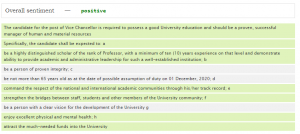
Source: 2020 UI’s VC Vacancy Advertisement, 2020; Infoprations Analysis, 2020

Exhibit 2: Masculine Wordings versus Feminine Wordings

Source: 2020 UI’s VC Vacancy Advertisement, 2020; Infoprations Analysis, 2020

Exhibit 3: Proportion of Male Contenders to Female Contender
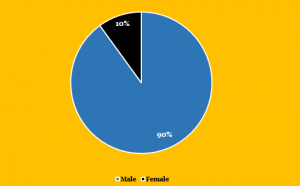
Source: Contenders, 2020; Infoprations Analysis, 2020

The Big BVN’s Unification in Nigeria

6

The new Central Bank of Nigeria (CBN)’s Global Standing Instruction (GSI) policy is a big unification in the Nigerian lending ecosystem. The CBN has three core reasons for this policy, and they include facilitating an improved credit repayment culture, reducing Non-Performing Loans (NPLs) in the banking industry, and watch-listing consistent loan defaulters. The following types of accounts qualify for GSI: Individual Savings, Current, Domiciliary , e-wallets and investment/Deposit Accounts.

Thankfully, corporate accounts are not included as that would have resulted in a homo sapiens-zation of Nigerian companies where companies become human elements on lending transactions. Yes, every company bank account in Nigeria possibly has a BVN (Bank Verification Number) associated with it and including corporate accounts in GSI would have been troublesome! Premium Times explains the GSI.

Under the GSI, it will no more be possible for a bank customer to take a loan or credit from one bank and refuse to pay back, while continuing to maintain several other accounts in other banks with enough credit balance that could have paid back the debt of the first bank.

For instance, with the new policy, if a bank customer or account holder is granted a loan or credit by a bank (say GTB), and defaults in paying back when the facility becomes due in line with the agreed GSI repayment mandate, GTB can contact any other bank(s) in the country where the defaulting customer holds an account(s) with credit balance that is enough to offset the full value of the loan or credit and recover the loan or credit from there.

For instance, if a customer takes a loan or credit from GTB and defaults in repaying according to agreed repayment schedule, GTB can contact Zenith Bank, Access Bank and First Bank, if the customer has accounts with sufficient credit balances in those banks, and the accounts are linked by his or her bank verification number (BVN), to recover the full value of the loan or credit without any further recourse to the defaulting customer.

Pitching Football to Nollywood Content Writers

0

I have been doing some Nollywood reflections in some of my writings going back to 2010. Interestingly, and rather separately, I have also been intrigued by the paucity of research on African football. In this article, and prompted by recent developments, I am sharing my next project – i.e. the fusion of Nollywood with African football! This is why. 

Nollywood

I have written, arguably, extensively on the subject matter of Nollywood in the last decade. Starting with my 2010 paper on “The Nigerian movie industry “Nollywood”–a nearly perfect marketing case study,” through “51 Iweka Road (Onitsha, Nigeria): could this single African address redefine business cluster development?,” to more recently, “The Impact of New Media (Digital) and Globalisation on Nollywood.”

Football

In reflecting on my studies on football with a specific focus on African players, and more recently football leagues, I did call out Asamoah Gyan in my previous Tekedia article celebrating an unsung hero.

More recently, an article by the erudite professor Simon Chadwick has reinforced the need to get this viewpoint out to all concerned parties. Indian sport remains a great enigma: a Bollywood-style epic yet to be shown to the world, drives the message home. Just like I pointed out in my paper on Re-branding the Nigerian Professional Football League, Professor Chadwick’s recent article points out the need for Indian Football thus:

Popular and powerful at home, India’s sport has minimal reach or impact overseas. They are world-beaters at cricket but fail to set the world on fire at Olympics.”

Another interesting commentary that resonates with my current proposition to Nollywood reads thus: 

It is no coincidence then that Indian sport’s biggest commercial phenomenon, the Indian Premier League (IPL), brings together two of the country’s great passions: cricket and entertainment.”

Having been deeply in love with cricket for centuries, India nevertheless seems to now be falling in love with football. Although football has long been popular, the recent formation of the Indian Super League has brought both a new focus upon, and an impetus for, the development of the country’s football product.”

You can see the Indian disease (similar to the Dutch Disease) being played out in the following commentary:

So why isn’t India taking its rightful place as a world sporting giant? Cynics point to “cricket fatigue”. Others believe that young Indians are more interested in what the rest of the sporting world has to offer than what is available at home.”

That was the same point I made in my article seeking brand ambassadors for the Nigerian Premier League.

It is clear that broadcast content is typically targeted at Indian fans and consumers. Indian sport is essentially inwardly focused, denying the country opportunities to build revenues from overseas sources, project soft power.”

Analysis shows that many team owners are drawn from a celebrity elite, with multiple examples of big-name cricketers and Bollywood celebrities involved in team ownership.”

Indian sport in its own right is nothing short of a Bollywood-style epic, but it is yet to be shown to the world.”

The Nigerian Olympic Team have only just qualified for a place in the Olympics semi-finals after beating Denmark 2-0. The team went on to play Germany for a place in the medal tables. The last time ‘The Dream Team’ (the Nigerian Under 23 or U-23 Team) came close to glory at the Olympics was in 1996 when they beat behemoths, Brazil and Argentina. I also pointed out that my recent publication on the Nigerian Football Federation and the sidelining of the Domestic League in that country has become a self-fulfilling prophecy for five key reasons. 

  • First, Giovanni Infantino, President of FIFA, visited Nigeria at the same time as the recruitment drive of English premier league teams of Nigerian internationally ‘unknown’ players from the domestic leagues and junior national team.
  • Second, Nigeria beat both Brazil and Argentina to clinch the Gold medal at the 1996 Olympics, a feat the ‘DreamTeam’ (i.e. Nigeria’s Olympic Team) wish to leverage upon in Rio2016.
  • Third, Football counts amongst Nigeria’s exports to Western Europe going back to the days of Kanu Nwankwo, Jay Okocha and Rashidi Yekini amongst others. Not to mention the likes of late Coach, Stephen Keshi of the National Team, and his team mate Samson Siasia, once coach of the U-23 Team).
  • Fourth, having turned up late following some hiccups in Atlanta, the ‘Dream Team’ beat Japan 5-4 even before the opening ceremony in Copacabana got off the ground.
  • Fifth, the ‘Dream Team’ qualified for the semi-finals in Rio 2016, having walloped Denmark 2-0 on 13 August 2016.

However, the question remains as to where these former players that made Nigeria proud on the international stage? My paper questions the roots of these players and their role in branding the domestic league in that country through brand associations and brand ambassador networks. 

A recent conversation on entrepreneurship in Africa and the role of domestic football within that discourse took me back to this post FIFA2010 article. It highlights entrepreneurship, stadium development, and regional development, taken from the purview of South Africa but with implications across the region. 

In a recent Tekedia post, I focused on a Ghanaian household name, Asamoah Gyan, who having plied his trade from 2003 with Ghanaian Premier League club Liberty Professionals, before his adventures in Europe – starting with ‘Serie A’ club Udinese before joining the French ‘Ligue 1’ club Rennes in 2008, and the English Premier League club Sunderland in 2010. I also articulated the move outside Europe – notably the UAE Pro-League in 2011, the Chinese Super League in 2015, and Kayserispor in the Turkish league in 2017. 

Bringing it Together – The “Woods” and Football

What better way can we bring the discourse together than highlighting that Gyan, after his European adventures, also moved to Northeast United FC in the Indian Super League – a club owned and operated by Bollywood actor John Abraham – representing the 8 states of North East India: Assam, Nagaland, Manipur, Meghalaya, Sikkim, Arunachal Pradesh, Tripura and Mizoram.

Now the fusion of football and film is getting clearer. So back to my proposition. Where is the connection and potential for film and football? Let us consider just one out of many football themed movies – Bend It Like Beckham. Written by Gurinder Chadha, Guljit Bindra, and Paul Mayeda Berges, this 2002 movie features the daughter of an Orthodox Sikh, who rebels against her parents’ traditionalism and joins a football team.

To wrap up, here is my pitch for Nollywood. Celebrate African football at the domestic level. This can be achieved through a range of possible initiatives such as following the lives of domestic changemakers, upcoming stars and stadium showcases. You do not have to wait until they have made a mark in Europe or other international stages.

We Received Full Scholarship Funding for 20 Founders for Tekedia Mini-MBA

0

Good People, we received 20 full scholarship funds for 20 founders in Tekedia Mini-MBA (Aug 10 – Dec 3). The donor is David Onaolapo who has already sponsored 20 people in his private WhatsApp group.

Any founder interested, write to my team from your company email. If you do not have a website, give them your CAC number and link of registration to CAC public search. We truly want only Founders for this. We did an experiment in a previous edition and have noticed that some we gave scholarships have hired 2 or 3 extra people. So, we want only those doing something and can apply what we are teaching immediately in their companies, young or old, and in any sector.

That does not mean non-founders cannot get help. We continue to assist but this one will go to Founders only.

https://www.tekedia.com/mini-mba-3/


Debating MultiChoice (DStv. GOtv) Pricing in Nigeria with Civility

2

Good People, let us debate ideas with civility and stop the personal attacks in our community. The piece on DStv has generated many unproductive comments, and we need to make our points without insulting people. Reading the comments on our website and LinkedIn, my conclusion is that we are not advancing the debate on DStv, GOtv and the broad PayTv in Nigeria. That someone has a different opinion from yours should not result in any insult. Let us focus on the points and leave the ad hominem out. Thanks.

In Nigeria, we need to build transnational companies with capacities to advance the wellbeing of Nigerian citizens. South Africa has done well despite how we feel about our “giant of Africa” natural baptism in Nigeria. For a nation of about 57 million budgeting close to US$125 billion when the giant is struggling with $29 billion for 200 million is something that should make us humble. And when you add that Nigeria’s $29 billion budget has to be super-funded via loans, the reality is clearer.

I am not saying you cannot push for DStv to buy $100 and sell $10 in Nigeria, I am simply asking us to make that argument with civility. I am happy here because Real Madrid lost yesterday. And Juventus lost. I mean, what again can I ask for in a weekend of sports? Possibly, Barcelona will reach the mountaintop in the Champions League.


Nigeria Strikes The Perceived Choiceless MultiChoice (DStv, GOTv)