Good People, we are bringing an expert to develop a session on “Understanding Tax Treaties and Their Benefits”. He is a Deputy Manager with the Federal Inland Revenue Service (FIRS, Nigeria), a barrister at law who holds a master’s degree in International Tax Law from University of Melbourne, and he knows so much on emerging digital tax ordinance. Emmanuel Eze has won a continental tax essay competition organised by the African Tax Administration Forum (ATAF). He will help our Tekedia Mini-MBA community to understand tax treaties and how we can use them to advance our business missions.
Simply, if you run a company in the fintech, logistics, etc domains across borders, there is a chance you can be subjected to multiple taxation. What this program plans to do is to educate companies that there are treaties which they can use to avoid that. In other words, you avoid being subjected to multiple taxation as you scale outside your home nation.
Most Nigerian startups are paying taxes as they scale across ECOWAS which under extant tax treaties they are not supposed to pay. But because they are not informed, they just pay. We are happy that an expert from our government will lead a session to help innovators know when they can say NO. The same applies in continental Africa in this age of AfCFTA: understand the treaties and spare wasting that money.
The Nigerian Postal Service (NIPOST) is one of the main components derailing Nigeria’s economic advancement especially in the rural areas. With operational paralysis of NIPOST, rural and urban Nigeria have been disconnected. In my village Ovim (Abia state), we built a better post office than the one in the state capital, knowing that having a local and functioning postal service would help our community. It has always been the strategy: build schools, police station, etc with your money, and hand them over to the government.
But for the Ovim post office, while it was easy to build structures and offer accommodations to NIPOST staff, running logistics was another story. Today, that post office which was commissioned by Postmaster General of Nigeria in the presence of Ovim luminaries like Admiral Kanu, General Nwachukwu, Justice Johnson, and Prof Ogbonna, is gone.
NIPOST was not out-competed by anyone and changes in communication – indeed email – was not the fatal blow. NIPOST simply gave up because Nigeria failed to reform its systems. That one company is a regulator and an operator, taxing its competitors, makes no sense in a modern market system. Operators are expected to contribute 2% of their annual revenue to NIPOST via the postal fund which does nothing of value to Nigerians. Which company can survive in a tight margin business like courier and logistics?
We are still trying to get used to STAMP Duty where you buy stamps for sending electronic money to others. Thesepolicieswill not drive innovation. Simply, NIPOST does not need to function to make money!
Mr Yusuf also noted that citizens should not be compelled to patronise NIPOST irrespective of the size or weight of an item as stated in a courier regulation.
He referred to the stipulation that says: ”All courier items/articles such as Right Issues, Shares Certificates, Statement of Accounts, Cheques, Letters or Offer documents, etc weighing below 0.5kg brought to a courier/logistics service operator shall be recorded and referred to the nearest Post Office of the Nigerian Postal Service for processing and delivery.
“Failure to do so will attract payment to Nigerian Postal Service of a penalty of 90 per cent of the amount charged on the item by the erring Operator.”
He described it as an unfair provision and an infringement on the rights of citizens and in conflict with the principle of fairness.
NIPOST’s problem is not recording losses, but the fact that it is not working. Most postal systems around the world these days are strategicloss-makers. Yes, “the United States Postal Service (USPS) announced an annual loss of $8.8 billion for fiscal year 2019, more than double its annual loss for FY18. This loss, the largest on record, marks the 13th consecutive year the USPS has finished in the red.” Yet, if you examine the period when the USPS lost this amount of money, businesses actually expanded in the core domains it served. Largely, USPS losing money was not necessarily a bad thing as its functions were critical for most of those companies to thrive.
Possibly, for every $10 billion lost by the U.S. Post, it could be adding excess new $200 billion of value in the economy. For the United States, in general, that is a net positive. The USPS saw marginally revenue increase despite the match to global digitization, implying that it was powering core elements of that new redesign. Simply, Nigeria needs to decide the role NIPOST will play in our economy and that means reforming it. What we have now does not make sense.
Samsung Electronics Co Ltd is seeking a way back to India market as anti-China sentiment continues to grow. A military conflict in June between China and India stirred anti-China sentiment that has affected its companies business presence in India.
As the anti-China sentiment escalates, non-Chinese companies are positioning to take advantage of the situation. Samsung is the only non-Chinese player in India and has seen an opportunity to penetrate the smartphone market where Chinese companies dominate.
Following the June conflict, India banned 59 apps of Chinese origin,particularly TikTok. The ban opened the way for indigenous apps and renewed the interest of American companies in doing business in the country.
The development seems to have stirred Samsung to fight for a leading position in India’s smartphone market even though it is dominated by companies from China that have won consumers with cheap prices.
Though Samsung still has a huge market in India, it has for long lost the smartphone market to China. Counterpoint, a tech researching firm said that India accounts for some 7.5% billion in annual retail smartphone revenue for Samsung, which makes it its second biggest market after the United States.
Reuters reported that Samsung recorded 26% market share in the second quarter to secure the No. 2 spot behind Xiaomi’s 29%, which leads the smartphone market in India. The report noted that the South Korean tech company’s diverse and inhouse supply chain helped it to beat product delays that affected other companies due to COVID-19 lockdowns.
It has been over three years since Samsung lost its dominance in India to Chinese companies. Its bounce back strategy seems to rest on its ability to source phones components internally.
Samsung has a mega mobile phone manufacturing plant in New Delhi, where it tests new devices and assembles them for export. With the manufacturing power, it has been able to curtail cost of production that took a toll on its rivals amidst the pandemic.
Reuters reported that in May, Samsung and Facebook partnered to train over 200,000 brick and mortar stores selling its phones to use social media for sales and marketing.
Xiaomi and Oppo, the leading Chinese brands in India were severely hit by the disruption of the global supply chain, following lockdowns induced by coronavirus. However, Samsung stayed in business through local production, online sales and delivery.
Samsung is building on this advantage, using its ability to manufacture internally, to fight for its place in the Indian market. It is hoping that making phones locally will cut the cost that has over the years, driven consumers to Chinese companies.
Since June, it has launched seven new smartphones, three of them cost $133,63 (less than 10,000 rupees), including its cheapest Android offering at $75, according to Reuters.
A source familiar with Samsung’s strategy in India said coronavirus has forced many online activities in the country, and therefore necessitated low budget phones.
“The COVID crisis has pushed people to use smartphones for everything from online education to digital payments to even connecting with friends on video calls. That’s why these budget phones are focused on the mass market,” the source said.
As part of its strategy, Samsung initiated installment-payment for its customers and incentive schemes designed to attract more consumers to its base, including offering students discounts on some devices.
But while Samsung appears to be gaining ground, there is still a mountain of challenge ahead of it. Although there is growing apathy toward Chinese companies, competition is still ripe. Xiaomi and Oppo still have a base of loyal customers who don’t care about what the Chinese and Indian governments are doing at the border. The companies have won them over through cheap phones and hope to use Prime Minister Narendra Modi ‘Made in India’ campaign to beat the anti-China sentiment.
However, Samsung has a brand reputation that Indians trust, and would choose over Xiaomi and the others if the prices get close.
“Samsung is India’s No. 2 smartphone brand after Apple by image. So a phone priced between 6,000 rupees to 15,000 rupees from Samsung is very well placed today to capture market share from Chinese rivals,” said brand strategist Harish Bijoor.
Apple devices are out of the contest due to their costs, and the company is not considering lowering the price to woo customers. The cheapest iphone in India costs about 31,500 rupees, while the cheapest Xiaomi is around 7,500 rupees. So the competition is between Samsung and Chinese companies.
Whether on physical or online sphere, Nigerians are one of the people in the world who usually express their feelings on issues and needs of national importance. Since the country returned to democratic system of governance in 1999, social and public analysts, including politicians have continued to discuss varied socioeconomic needs and challenges.
Topics of the Discourse
For some days now, the Nigerian society has been discussing the possible exit of Shoprite on different platforms. Our check reveals that the discussion remains intense on Twitter than Facebook. According to many sources, Twitter is a social networking community that enables people and organisations to interact, reflecting a diverse and rapidly growing global social networking community.
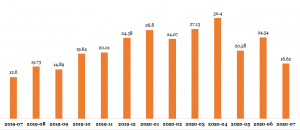
In his description of the Nigerian Twitter community, Jack Dorsey, co-founder and Chief Executive Officer, says “in recent years, there has been barely any social media platform contesting with Twitter in hosting Nigerian conversations — whether protests, rants or energising social movements.” Looking at the yearly percent increase in the number of Twitter users, our analyst believes that the Twitter CEO is right. From 12.6% in the use of the social networking site in July, 2019 to July, 2020, the Nigerian community is indeed growing.
Exhibit 1: Monthly Percent Increase/Decrease in Twitter Users
Adding to the discourse through article publications on Tekedia, Professor Ndubuisi Ekekwe has made us understand why the company is leaving Nigeria. For instance, he credited the possible exit to the country’s currency weakness in the global economy not to the physical or online competitors but open markets. These factors are not quite different from what Nigerians in the Twitter community discussed between August 4, 2020 and August 5, 2020 (Time: 9:03am on August 4, 2020 to 9:49am on August 5, 2020).
From a total of 1,163 tweets mined and analysed by our analyst, it emerged that within the market factor, Nigerians [including businesses] believed that the company’s failure to understand the Nigerian market dynamics adequately before entering is the main reason for the exit. Tthey also pointed out the fact that most Nigerians, especially those at the bottom of the pyramid prefer buying goods at the open markets to going varied outlets of the company.
In their conversation, they did not spare the effects of high prices, currency devaluation and corruption. According to them, Shoprite’s price tag on majority of goods is outrageous considering what is obtainable in the open markets. For example, one of the members of the community hinted that it is out of the Nigerian context to set a price of N500 or N1000 for two or three corns that can be bought from the open markets at N100 or less than N200.
In our engagement with the Tweets, our analyst also found that the discussion was also on the dwindling place of the country’s currency in the global market and many years of corruption in public and private life that make some people at the upper-class income category having access to money freely. The accessibility, according to the people in the community, largely helped Shoprite in its early days in Nigeria.
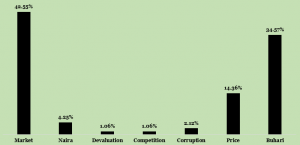
Once again, the conversation on the exit afforded the studied 1,163 users opportunity of discussing leadership issues using different perspectives. Some of them believed that the leadership style and capability of President Muhammadu Buhari should be questioned while some were of the view that President Buhari’s stance on fighting against corruption could be attributed to the reduction in patronage and revenue of Shoprite across its outlets. According to our data, we found occurrence of discussion on open markets, Naira devaluation, competition, corruption, price and Buhari [linking to good and bad leadership] 376 times during the two days.
Price: @cchukudebelu Why shop in ShopRite when u can shop rightly at Igbudu market at reduced price
RT@LadiSpeaks: Local supermarkets Local supermarkets How many Nigerians can buy Shoprite? How many Nigerians are willing to take the risk? Maybe only 10 and all of them are in the APC so… Nobody cares
Naira Devaluation:RT @kinmoju: @OkporEmeka with the devaluation of the naira, imported items from SA which ShopRite sells will be too expensive compared with local alternatives thereby impacting their sales figures economy it bites seriously
Corruption:RT @oloye__: Everyone that goes to ShopRite is corrupt and benefited from the 16 years of corruption under PDP. Go to the kiosk on your street. We must kill corruption before it kills our indigenous businesses.
Market: RT @AyoBankole: Again, I have always said most investors overestimate the Nigerian market. Even most analysis on Shoprite exit are emphasizing on Nigeria being the most populous African country. We often forget that over 70% of us live in poverty. And only Lagos holds a real economic promise.
Buhari: RT @keljykz2: Nigeria has been destroyed by this man…Muhammadu ‘destroyer’ Buhari. Same as in 1986…Shoprite is leaving. Air peace is firing pilots and insecurity is at its peak. Keep hailing Mr. Destroyer in chief. Fabrizio/ Willian/ bbnaijalockdown/ the nun/ Martinez/ MUFC https://t.co/6iUxZxWbMb
RT @fattylincorn01: Even those thieves that went on a looting spree @Shoprite_NG are now blaming @MBuhari for @Shoprite_NG woes. SMH
Clustering, Networking and Interaction
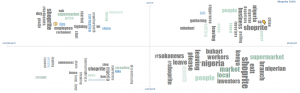
Beyond the topics of the discourse, our analyst explored classification and the kinds of network relationship and interaction that existed during the two days. From the analysis, we discovered that 696 citizens were in Cluster A [the cluster that vehemently pursued the topics in their conversation with others]. In the Cluster B [the less active group in terms of discussing the topics] had 467 citizens.
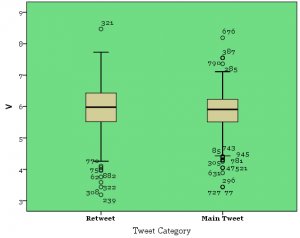
In our analysis, we discovered that people who fell to the Cluster A (Main Tweets) had influence over those who fell to Cluster B (Retweets) [see Exhibit 4]. In Cluster A, a citizen with the National Identity Number 676 had superior ability of interacting with others within the Cluster. Further analysis indicates this citizen retweeted @ekomiamiblog’s tweet, which says “ShopRite Denies Leaving Nigeria https://t.co/RG46QIhEAh Willian#bbnaijalockdown2020 Buhari Spar.
Good People, if you signed up for Tekedia Mini-MBA (Aug 10 – Dec 3), you ought to have received your login details by now. Our team sent them this afternoon. I welcome everyone and hope to embark on this academic excursion which begins Aug 10 together. If you have not joined, do so today here.