DD
MM
YYYY

PAGES

DD
MM
YYYY

spot_img

PAGES

Home Blog Page 622

OpenAI Is Building a Massive Data Center In India Amid Trade tensions with the U.S.

0

OpenAI, the company behind ChatGPT, is expanding its footprint in India with an ambitious plan to build a massive data center and expand access to artificial intelligence tools.

According to Bloomberg, the company is in talks with local partners to set up a data center with a projected capacity of at least 1 gigawatt, a scale that would make it one of the largest AI-focused facilities in Asia.

The move comes after OpenAI formally registered as a legal entity in India and began assembling a local team. In August, the company confirmed plans to open its first office in New Delhi later this year, acknowledging India’s role as its second-largest user market. While the precise location and timeline for the proposed data centre remain undisclosed, speculation is mounting that CEO Sam Altman could unveil more details during his scheduled visit to India in September.

The data center project would be a significant part of “Stargate,” the private-sector AI infrastructure initiative announced in January by US President Donald Trump. Stargate has drawn heavyweight backers including SoftBank, OpenAI, and Oracle, with investments projected to reach as high as $500 billion. If materialized in India, the facility would not only support OpenAI’s global infrastructure but also place India at the heart of the emerging AI arms race in Asia, a region where China, South Korea, and Japan are already investing heavily in advanced computing power.

Alongside infrastructure ambitions, OpenAI is simultaneously investing in India’s education sector through a large-scale digital inclusion programme. Just last week, the company unveiled a major initiative to distribute 500,000 free ChatGPT licences for six months to students and teachers across the country. The licenses will cover government schools from Classes 1 to 12, engineering and technical institutes, as well as K-12 educators.

Leah Belsky, OpenAI’s vice-president of Education, framed the initiative as a step towards using AI to augment—not replace—human teaching.

“We believe AI has the potential to transform education for students. AI can be a personal lifelong tutor and learning agent. For educators, AI can free up time for them to focus more on the core part of teaching,” Belsky said at a media briefing.

Branded as the OpenAI Learning Accelerator, the programme is an “India-first” effort. Belsky stressed that the initiative is not a monetization play but a groundwork for long-term engagement.

“The focus for now is access and training,” she said, adding that the company’s larger goal is to learn how Indian educators adapt ChatGPT to their classrooms and then replicate those lessons globally.

Distribution of the licenses will be carried out in partnership with the Ministry of Education, the All India Council for Technical Education (AICTE), and schools under the Association for Reinventing School Education (ARISE).

OpenAI’s twin strategy in India—building foundational infrastructure through a possible gigawatt-scale data center while simultaneously embedding its tools in classrooms—reflects both the scale of its ambitions and the geopolitical backdrop against which they are unfolding. The Stargate project itself has been pitched in Washington as a counterweight to China’s rapid AI progress, and India, with its vast population of young tech-savvy students and relatively cheap power resources, offers an ideal testing ground.

However, OpenAI’s India expansion is unfolding against a complicated geopolitical backdrop. Trump has repeatedly urged American tech giants to keep their operations and capital investments inside the United States, warning that moving critical infrastructure abroad could undermine jobs and national competitiveness. Apple, which has been scaling up its iPhone assembly operations in India, has often been cited by Trump as an example of US companies “shipping jobs overseas” instead of investing more domestically. How the Trump administration, which threatened to impose tariffs on Apple devices made in India, will respond to OpenAI building large-scale AI infrastructure abroad remains uncertain.

The development also comes amid an ongoing tariff spat between Washington and New Delhi. The Trump administration has taken a tougher line on India’s trade policies in recent months, raising concerns about market access and tariffs on American goods. Against this backdrop, OpenAI’s move to deepen its physical footprint in India could complicate policy discussions between the two countries.

However, by linking national-scale infrastructure to grassroots education initiatives, OpenAI seems to be betting that India could become not just a consumer of AI but also a hub for training the next generation of AI-literate workers—an essential step in competing with global rivals in what has become one of the most consequential technological races of the century.

Airtel Africa Bets Big on Fintech With Planned Mobile Money IPO Listing in 2026

0

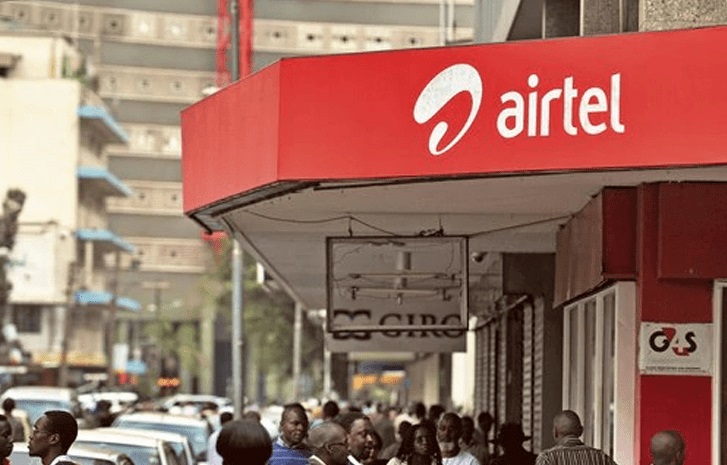
Airtel Africa is doubling its fintech ambitions with plans to list its fast-growing mobile money business publicly in 2026.

According to a Bloomberg report, the company has tapped Citigroup Inc. as advisor for the initial public offering (IPO), a move that could value the unit at over $4 billion. The telecom giant is currently meeting investors in Dubai, underscoring its commitment to list the unit in the first half of next year, according to the company’s spokesperson.

“We will list next year. We will continue to bring additional countries into the envelope. We are still a year from that IPO,” said Olusegun Ogunsanya, managing director and chief executive officer of Airtel Nigeria, according to Businessday.

With more than 45 million customers and an annualized transaction value of $162 billion, Airtel Money has emerged as a major force in Africa’s booming digital payments sector, positioning the telecom giant to unlock new value in the continent’s rapidly evolving financial services landscape.

Mobile money revenue for Airtel Africa increased to $731 million between April and December of 2024 from $631 million in the corresponding period of 2023. In the 2024 financial year (ended March 31), Airtel Money recorded $112.3 billion in transaction value, a 38.2% increase in constant currency compared to 2023.

Revenue from mobile money services reached $837 million, up 21.4%, with a net profit contribution of $405 million, reflecting a 27.6% increase. For the nine months ending December 2024, mobile money revenue grew by 29.6% year-on-year to $731 million.

The mobile money customer base grew by 20.7% in 2024, reaching 38 million users, which represents 24.9% of Airtel Africa’s total customer base. By December 2024, this number increased to 44.3 million, an 18% rise, driven by expanded distribution networks, including exclusive Airtel Money branches and kiosks.

Airtel Money is the most profitable segment of Airtel Africa, with a 48% net margin ratio and significant free cash flow, outpacing traditional telecom services in profitability. This has spurred investors’ interest in the mobile Money in recent years.

In 2021, TPG Inc. injected $200 million at a valuation of $2.65 billion, followed by $100 million from Mastercard Inc. Qatar’s sovereign wealth fund also acquired a stake that year.

Airtel Africa’s broader growth strategy has been underpinned by significant infrastructure investments. In its July 2025 annual report, the company noted the rollout of 2,300 new sites, bringing the total to 37,579, alongside 2,700 km of additional fibre network, expanding coverage to 79,600 km. Its 4G population coverage rose to 74.7%, up 3.4% from the prior year.

CEO Sunil Taldar emphasized the group’s financial services ambitions.

He said, We see significant potential to advance financial inclusion across Africa. The continued growth of our mobile money portfolio and expansion into enterprise and digital payments have helped boost annualized transaction value by 35% to $162 billion.”

The Airtel Money IPO in 2026 is poised to be a transformative event, enabling Airtel Africa to strengthen its financial position, enhance Airtel Money’s competitive stance, and drive financial inclusion across Africa.

While it offers significant opportunities for growth and investor returns, success will hinge on navigating regulatory challenges, managing currency risks, and outpacing established competitors.

The IPO, if completed, will mark a major milestone in Airtel Africa’s efforts to monetize its mobile money business and strengthen its presence in Africa’s booming fintech landscape.

Notably, Africa’s young, tech-savvy population is fueling rapid adoption of digital financial services, positioning Airtel Money as a key player in the race to serve Africa’s growing demand for financial inclusion.

Growth Journey and Winning Markets – Ndubuisi Ekekwe

0

In the Igbo Nation, the elders will say “when a man prepares food for his kinsmen, and they show up, it is a huge respect”. Good People, for the 17th time, Tekedia Mini-MBA continues to attract learners and professionals who come to “eat” our “food” of  business knowledge. Thank you. As we round up this edition to kickstart the next edition in two weeks, I will be leading all the live sessions this week. Our first Graduation Lecture is titled “Growth Journey and Winning Markets”.

Your business growth journey commences with the articulation of a core value proposition and the validation of a product-market fit. This initial phase is less about scale and more about establishing a foundational ‘moat’—a unique and defensible competitive advantage. As we learnt in Tekedia Institute, this moat may not be capital, which can be replicated, but rather a superior intellectual property, a robust network effect, or an unassailable supply chain.

Growth, therefore, is not merely the expansion of sales but the deepening of this competitive advantage, a strategic move to secure an enduring position. Without this underlying strategic anchor, rapid growth can prove to be a liability, as it scales up inefficiencies and exposes the business to competitive threats, akin to building a skyscraper on a foundation of sand.

Winning markets is the ultimate destination of a purposeful growth journey. This victory is not about monopolistic control but about establishing a dominant and resilient presence within a specific market segment. It requires an acute understanding of the market’s operating system—its regulatory environment, consumer behavior, and infrastructural nuances. For instance, a fintech firm seeking to win in Nigeria must navigate a complex blend of formal and informal economies, where digital solutions must coexist with and often leverage traditional financial habits.

Co-learners, the journey to win is a perpetual loop of adaptation and innovation, where firms are not only reacting to the market but actively shaping it through new business models and technological applications. In class today, I will explain why we have the capabilities needed to GROW and WIN, professionally and entrepreneurially. Zoom link in classboard.

Tue, Sep 2 | 7pm – 8pm WAT | Growth Journey and Winning Markets – Ndubuisi Ekekwe | Zoom Link

XRP Price Prediction: Ripple Set for Fresh Highs at $8 in 2025 as Little Pepe (LILPEPE) Offers 25x Profit Potential

0

The cryptocurrency market is entering an explosive new phase as institutional adoption collides with retail speculation. Among the tokens leading this charge, Ripple (XRP) has regained momentum after years of regulatory uncertainty, while an Ethereum based newcomer, Little Pepe (LILPEPE), is quickly establishing itself as the meme coin to watch. With XRP projected to surge toward $8 and LILPEPE offering potential 25x returns, these two tokens represent different sides of the same opportunity: blue chip stability on one hand, and early stage asymmetric growth on the other.

XRP is Preparing to Test $8 Highs in 2025

Ripple’s long legal battle with the SEC has officially moved into the rearview mirror, restoring confidence in XRP’s long term trajectory. Currently trading around $2.95 with a market capitalization of $175.8 billion, XRP is still well below its all time high of $3.80. Analysts suggest that if liquidity from institutional corridors combines with retail flows during the peak of the bull cycle, XRP could break through its former resistance levels and establish new highs at $8. That target would more than 2x gains, positioning XRP as a reliable performer for those seeking a relatively lower risk entry compared to smaller cap assets.

Technical indicators support this outlook. On chain activity has risen, wallets with more than one million XRP have expanded their holdings, and transaction volumes across Ripple’s payment corridors are climbing steadily. Taken together, the data suggest that Ripple is primed for a breakout that will finally deliver on the long standing expectations of its community.

Little Pepe Brings Meme Coin Energy With Technical Infrastructure.

While XRP offers regulatory clarity and established utility, Little Pepe (LILPEPE) represents the speculative side of 2025’s bull market. LILPEPE is combining meme culture with blockchain innovation. The project is developing a Layer 2 blockchain on Ethereum, designed specifically for meme tokens. This network will feature low transaction fees, sniper bot protections, and a Meme Launchpad, ensuring safer and fairer meme token launches in the future.

The presale momentum underscores demand. Now in stage 12 at $0.0021, LILPEPE has raised more than $23.1 million and sold over 14.6 billion tokens. These numbers place it among the top performing presales of the year. Its credibility is further supported by a CertiK audit, a CoinMarketCap listing, and confirmation of two major centralized exchange listings post-presale. These milestones establish LILPEPE not only as a meme coin with viral potential but also as a project with real infrastructure and security measures that whales can trust. Adding to its visibility, the project is running a $777,000 giveaway, where 10 winners will each receive $77,000 worth of tokens. This campaign has kept LILPEPE trending, drawing in thousands of retail participants eager to catch the next breakout.

Why 25x Growth is on The Table for LILPEPE

At its current presale valuation, the upside potential for LILPEPE is staggering. The token could climb toward $0.06, representing a 25x rally from today’s price. If hype and adoption mirror what Shiba Inu or Pepe Coin achieved during their viral phases, speculative targets could be even higher.

What sets LILPEPE apart is that its growth is not dependent solely on memes or retail speculation. The infrastructure narrative, Ethereum Layer 2 capabilities combined with meme specific tools, ensures that it can continue building beyond the initial hype. This gives LILPEPE a stronger foundation than most meme projects, which often fade after their first pump.

Conclusion: XRP Provides The Stability, While LILPEPE Delivers The Asymmetry

In the race for gains during the 2025 bull run, XRP and LILPEPE form a compelling pair. XRP offers the stability and predictability of a top 10 asset with regulatory clarity, institutional adoption, and a clear path toward $8. On the other side, LILPEPE provides the asymmetric opportunity of an early stage meme coin with real infrastructure, a viral community, and the potential for 25x profits from its current presale price. Together, they capture both sides of the crypto market’s identity: the proven utility of long standing projects and the explosive potential of new cultural phenomena. For investors positioning ahead of the bull run’s next leg, Ripple and Little Pepe may be the combination that delivers both safety and spectacular growth.


For more information about Little Pepe (LILPEPE) visit the links below:

Website: https://littlepepe.com

Whitepaper: https://littlepepe.com/whitepaper.pdf

Telegram: https://t.me/littlepepetoken

Twitter/X: https://x.com/littlepepetoken

Shiba Inu vs. PEPENODE: Which Meme Coin Has the Real 100x Potential?

0

New projects launch every week in the meme coin sector, and honestly, most of them vanish before you’ve even figured out how to pronounce their names.

And then there’s Shiba Inu, the old reliable that’s weathered a few crypto storms, and there’s PEPENODE, the fresh project that’s doing something pretty different from the usual meme coin playbook.

Both have their fans. Both promise big things. But here’s the question that keeps crypto enthusiasts up at night: which one actually has the juice for those legendary 100x gains?

What’s SHIB Really About These Days?

Shiba Inu used to be just another Dogecoin copycat, but those days are ancient history now. The project has come a long way since then. The team has built something that looks more like a proper crypto business now. They’ve got ShibaSwap for trading and staking.

There’s Shibarium, their own blockchain that makes transactions cheaper and faster.

The SHIBArmy community stays pretty active on social media. These folks have stuck with the project through bear markets and bull runs alike. That kind of loyalty doesn’t happen by accident. The token burns some supply with each transaction, which sounds good in theory. Less supply could mean higher prices, assuming demand stays strong.

SHIB now offers staking rewards, NFT collections, and governance voting through their BONE token. It’s not just about memes anymore. The project has real utility, even if it started as a joke. But here’s the catch – SHIB’s market cap is already massive. Getting 100x returns from here would need some serious market magic.

PEPENODE’s Gaming Twist on Crypto

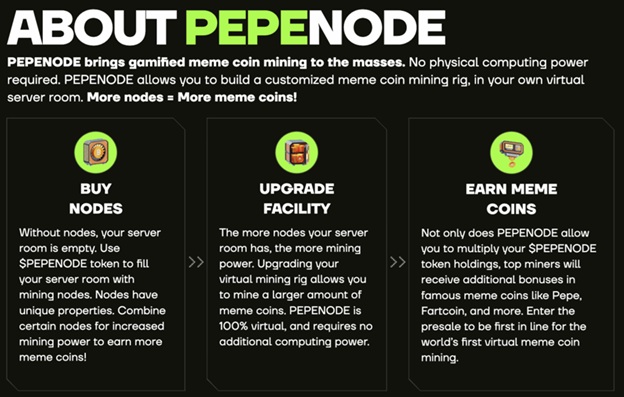
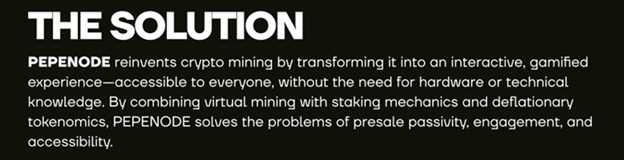
Now PEPENODE comes along with something completely different. Instead of just holding tokens and hoping for the best, users get to play a mining game. No real mining equipment needed. No electricity bills. Just virtual nodes that you can buy and upgrade.

Think of it like a crypto version of those mobile games where you build and upgrade stuff. Users purchase virtual miner nodes and facilities to boost their mining power. The more you upgrade, the more tokens you can earn. It’s hands-on crypto participation rather than passive waiting.

Here’s where it gets interesting for token economics. About 70% of all tokens spent on upgrades get permanently destroyed. Gone forever. This burning happens as people play the game, not just during regular transactions. Plus, there’s a referral system that gives you 2% of whatever your friends earn. Not bad for just sharing a link.

The project also offers staking with estimated rewards over 3500%, though these high percentages usually come down as more people join in.

Size Matters for Big Gains

Let’s be honest about market dynamics here. SHIB already sits on most major exchanges. It has name recognition. Celebrities have tweeted about it. Your neighbor probably owns some. This mainstream acceptance brings stability, but it also means the explosive growth phase might be over.

PEPENODE starts from a much smaller base. The presale price of $0.0010325 gives early participants a chance to get in before the masses discover it. Smaller projects have more room to multiply in value.

The staking setups tell a similar story. SHIB offers steady returns through established pools on ShibaSwap. Nothing too crazy, but predictable. PEPENODE promises those eye-popping staking rewards that make people do double-takes.

Visit PEPENODE Presale

The Tech Behind Each Project

Both tokens run on Ethereum, so they work with your existing wallets and DeFi apps. SHIB has built additional infrastructure with Shibarium to handle more transactions at lower costs. PEPENODE uses Ethereum’s energy-efficient Proof-of-Stake system to keep things green.

The real difference shows up in what users actually do with these tokens. SHIB holders can vote on project decisions, buy NFTs, provide liquidity, and participate in various DeFi protocols. It’s like a Swiss Army knife of crypto utilities.

PEPENODE focuses mainly on that gamified mining experience. Virtual miner nodes simulate the mining process and generate rewards based on how much users participate and upgrade their setups. Future plans include adding more meme coin rewards and NFT features.

Getting In Early vs. Playing It Safe

SHIB has survived multiple crypto winters. It’s proven it can handle market crashes and regulatory uncertainty. The token moves with broader market trends now, which means less volatility but also less chance of those moonshot gains.

PEPENODE’s presale phase creates different opportunities. Early participants get access before public trading begins. The team plans DEX and CEX listings for Q3 or Q4 2025. New listings often create price spikes as fresh liquidity enters the market.

The presale includes anti-bot measures and fair distribution mechanisms. This helps regular people compete with automated buyers who usually dominate public launches.

Anyone curious about PEPENODE can join the ongoing presale at $0.0010325 per token. The process accepts ETH, BNB, USDT, or even credit cards through wallets like MetaMask, making it pretty simple for most crypto users.


JOIN THE PEPENODE ($PEPENODE) PRESALE NOW


Website    |    (X) Twitter    |  Telegram