DD
MM
YYYY

PAGES

DD
MM
YYYY

spot_img

PAGES

Home Blog Page 6239

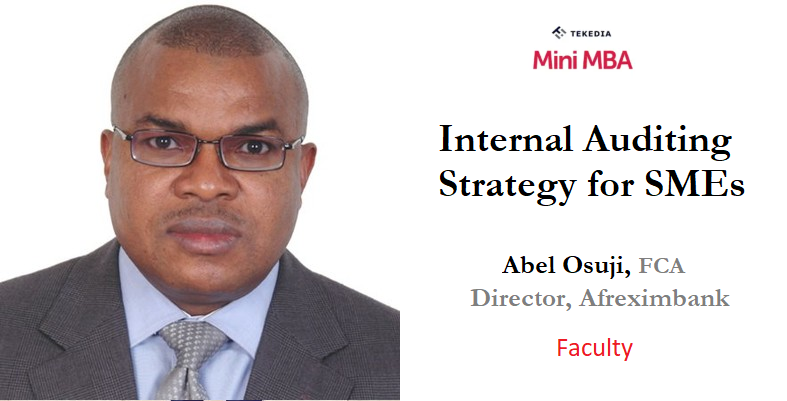
A Fellow of Chartered Accountants To Teach Auditing Strategy in Tekedia Mini-MBA

0

He is a Fellow of the Institute of Chartered Accountants of Nigeria (ICAN), the zenith of the accounting profession in Nigeria. He is an experienced director of internal audit & risk control with a demonstrated history of working in the financial services industry. He is skilled in enterprise risk management, internal audit, banking, accounting, and internal controls. He has worked with SMEs and understands all domains of audits for growing businesses.

A Certified Risk Analyst (CRA) with BSc in Accounting, MBA from University of Lagos, and MSc Economics from ESUTH Enugu. He worked in EY, and today he is the Director Of Internal Audit & Risk Control at African Export-Import Bank (Afreximbank).

Abel Osuji, a Tekedia Institute Faculty, will lead a session on Internal Auditing Strategy for SMEs in Tekedia Mini-MBA. Through this session, he will educate our communities on how SMEs can develop effective audit regimes in their firms. Register and attend his class.

https://www.tekedia.com/mini-mba-3/


Nigerians Not Attending U.S. Universities That Much [Plot]

18

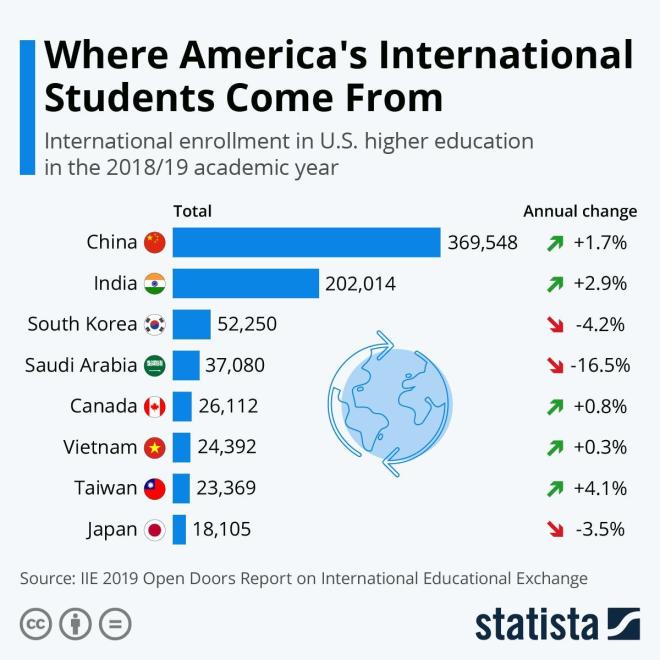
This is the big news for international students: “international students whose classes will take place fully online would be asked to leave the country. ” But check the data (see plot below), not many Nigerians are actually going to the U.S. to study these years. Largely, there are reasons: visas are not being granted by the U.S. embassy in Nigeria, or parents cannot afford the big dollars-school fees which keep rising, or Canada has disintermediated the U.S on preference. But no matter how you look at it, international students have real issues to deal with right now, and those issues are outside their controls. If your school decides to go fully online to keep the majority of the student population safe, you could be flying back to your country, without your diploma! Elections have consequences in this world!

Harvard and M.I.T. have filed a lawsuit against the Trump administration over an order that would remove foreign students’ visas if their coursework is entirely online this fall, according to The New York Times. Earlier this week, the U.S. Immigration and Customs Enforcement (ICE) agency announced that international students whose classes will take place fully online would be asked to leave the country. A number of academic institutions, including Harvard, have recently moved their academic year online to reduce the spread of the coronavirus.

Comment from Francis Oguaju below

One of those unpleasant things that happen when you are outside playing and joking with friends and strangers, and then you wish you had a loving home with caring family to cheer you up, when you run back home.

This is one of the reasons why we should never allow Nigeria to collapse, or let Africa become a continent of despair; so that whenever push turns to shove, you can always have a decent home to run back to.

A slave will never be equal to a free born, irrespective of how brilliant or hardworking he’s, once the scramble for survival begins, your surname will put you where you belong.

Never see your country of origin as your second home, rather see it as your first, even when you haven’t lived there, very important. No matter how great and caring your friends are, your biological family is above them all, because you don’t really need to prove anything to the latter, but they know that you are their own.

Nobody knows if globalisation gospel will still be relevant in another decade, so if you allow your country to disintegrate, you may no longer have home address.

We hope that the international students can navigate the complicated policy successfully and finish their studies.


Rising Through Markets

2
FUTO is a top technical university in Nigeria

I went for a job interview in Analog Devices while a student in Johns Hopkins. When the interview finished, and my future boss was helping me to a rented car, I quickly realized that the company was inside MIT. Really? A company with $billions of revenue was inside a university complex? (ADI has a market cap of $50 billion at the moment.) But wait  – there were other companies in what you may mistake as lecture halls. That is the beauty of America and the strength when universities become beds of innovation. 

That takes me to the massive acres of land in my alma mater – Federal University of Technology, Owerri (FUTO). Imagine if companies are occupying those empty lands. Besides the academic quality, the biggest innovation in American education is the fusion of markets and universities. 

Nigeria needs to copy that. It has to be organic: a symbiotic value creation for schools and companies, and Team Nigeria wins. Nations rise through markets; Nigerian universities must lead from within.


The Restless Uber

1

Uber is indeed restless: it has become a grocery delivery company. Note, I did not write “meal delivery” as in Uber Eats. Yes, Uber can help you deliver groceries now. Uber is looking for a path to profitability. The challenge Uber has is typical: aggregation on physical-element business, unlike what Twitter, Facebook, Google, Instagram and Tik Tok do, is challenging. The distribution cost does not tend towards near-zero without affecting the fixed cost, optimally (see plot below). The implication is that making money on what Uber does is harder when compared to the aggregation models of Facebook and Google. Yes, software can eat the world, but that does not mean that making money doing so is guaranteed!

Uber is moving into the grocery delivery business, offering the new service in Toronto, Montreal and more than a dozen Latin American cities ahead of a U.S. launch later this month. The Uber and Uber Eats apps will allow users there to order groceries from local stores, receiving them in “as little as one to two hours,” according to an Uber product exec. Uber sees groceries as an extension of its food delivery service, which has gained in popularity over the pandemic.

Image result for transaction, distribution cost tekedia

Uber recently announced plans to acquire Postmates as it looks for that stability that comes with profitability. Here, the motivation is economies of scale: combining Uber Eats with Postmates can provide better margins in a very competitive market.

Uber is set to buy food delivery service Postmates in a $2.65 billion deal, the companies have confirmed. The tie-up ?— earlier reported by Bloomberg ?— could help Uber’s food-delivery service, Uber Eats, to compete against rival DoorDash, following Uber’s failed bid for GrubHub. Demand for food delivery services has grown during the pandemic, although profitability has remained a challenge, prompting delivery app companies to consider tie-ups to increase scale.

The MultiChoice (DStv, GOtv) Evolution, And Why Showmax Pro Mutes Nigerian Regulators

1
DSTv court

I have called it Fish Bait Acquisition Construct: they give you something free, and you come for it, and in days, they swallow you. Netflix is using MultiChoice (operator of DStv and GOtv) as a distributor of its content in Africa. That makes sense, as not many Africans have the money to pay for bandwidth to binge. But while that redesign is happening, MultiChoice is plotting a huge offense: Showmax Pro, which will offer regular Showmax video-on-demand in addition to live TV like music, news and  sports from SuperSport. That means, you can get  all Premier League, Serie A, La Liga, boxing, IAAF Athletics, etc online. The product launched yesterday.

With this playbook, DStv takes it to Netflix, knowing that most people will come for live sports, and in the process provides viability in the boring Showmax. More so, by distributing live sports online, MultiChoice will reduce its marginal cost when compared to selling boxes for satellite TV with the associated human labour required for setting up the systems. 

This is an evolution for MultiChoice and can in principle leave Nigeria while still serving Nigeria! Yes, it does not need to be in Nigeria to sell online content since Netflix is growing its base in Nigeria with no physical presence in the nation. Yes, take it to the Nigerian regulators: we can run this from South Africa via Showmax Pro if you continue to clip us, and our customers will get all via the web.

Of course, MultiChoice is not leaving but with this online live sports, it can build a business of the future which no regulator can clip easily. Simply, pay for African TV rights license and leave a physical presence in any country that does not want to accommodate it, and serve the citizens via the web.  Forbes explains the pricing.

African video service Showmax is launching a live sports streaming service in Kenya and Nigeria that includes football matches from the UK, Italy and South Africa. Sports, especially soccer, is a major drawcard for television viewership globally, but especially in football-mad Africa.

Showmax already offers a streaming service of entertainment, music, and news; but is tapping into the soccer content from SuperSport, the sports arm of its parent company, MultiChoice.

Supersport is a decades-old sporting service, that is akin to Africa’s ESPN or Sky Sports, and is included MultiChoice’s DStv satellite service. Sports and news are seen as the strong remaining drawcards for subscription services, so it shows MultiChoice is thinking strategically. Including live sport in the offering, after live news started earlier this year, is a smart play to enhance the value of a Showmax Pro subscription while holding off Netflix.

Showmax Pro, which will cost from $8 a month in Nigeria and $10 in Kenya and offers a mobile option too, will start streaming on 7 July. The football offering will include all the games from the UK’s Premier League, Italy’s Serie A and La Liga, and South Africa’s Premier Soccer League.

Showmax Pro could see positive traction as Google Loon begins commercial operations in Kenya. Possibly, we will expect broadband costs to drop in Africa as a result of Google Loon as the service deploys across the continent.

Alphabet’s Loon division, which uses floating balloons to provide internet, has today launched its first commercial service in Kenya. In a blog post announcing the news, Loon’s CEO Alastair Westgarth said that the 4G LTE service will be provided to Telkom Kenya subscribers via a fleet of around 35 balloons, covering an area of around 50,000 square kilometers across western and central areas of the country, including its capital, Nairobi.

It’s a significant step for Loon, which started as a moonshot project in Alphabet’s X division before being spun out into its own company in 2018. The company’s balloons have already provided internet connectivity in the wake of disasters, like in Puerto Rico in 2017 after Hurricane Maria or in Peru after an earthquake in 2019, but never as part of a large-scale commercial deployment.

MultiChoice (DStv, GOtv) Challengers and the MTN Factor in Nigeria