DD
MM
YYYY

PAGES

DD
MM
YYYY

spot_img

PAGES

Home Blog Page 6282

Share What You Are Learning At Tekedia Mini-MBA

0

Yesterday, Lekan Akande Olokunde, FCA shared a page summary for Innovation Lessons (5in5), one of the 3 sub-themes in our Week 1 of Tekedia Institute Mini-MBA. Week 1 is focusing on Innovation & Growth with three faculty handling each of the 3 sub-themes. He has studied the 2.5 hours of video and summarized the message in a page. For our very busy members, this would be helpful.

Also, he also created an amazing calendar for our schedules; that would go to the Board later today. We would be sharing his page summary also.

Please if you do have yours (summary, analysis, etc), share with Admin for the community. Let’s co-learn and co-share. I understand the MVQ has resonated well.

We continue to welcome the World; REGISTER.

https://www.tekedia.com/mini-mba-2/


Tekedia Mini-MBA Participants Organizing in Social Media Groups

2

Good People, we have received many requests for permission to use Tekedia Mini-MBA to set up social media groups as our community members work on Challenge Assignments and discuss projects within the Community Circle. This is to note that such is expected as it is within fair use of the brand. I have seen the WhatsApp group in the Discussion area of Week 1,  which focuses on discussing the lectures. Certainly, we cannot join all but feel free to reach out to Admin anytime you think you need support.

Go ahead and form your communities: no need to seek any permission.

Experience: The Third Layer in Product Development Stack

0

Every Product development stack is made up of 3 Distinct Layers; The First Stack is the Technology Stack, this is the stack that powers the product’s operation. In a car, this could be the combustion engine, and the technology that powers other parts of the car’s operations; sensors and whatnot.

The Second Stack is the Product Stack, this is the stack that defines the product itself, the Design of the product, its features e.t.c. in a car this could be the Exterior and interior design of the car, keyless entry and key less go, The Dashboard screen e.t.c.

The Third Stack is the Experience Stack, this is the stack that defines the experience your users glean from your product that they find meaningful. If you have ever seen the Value Proposition Canvas, this is the part where we talk about the Gains of your customers. This is the underlying experience your users find meaningful about your product. So back to our example of a car, the Experience stack of a car, for example, a Mercedes or a BMW could be the perception people have of you when they see you driving in one, as against the perception they have of you if you were driving Let’s say a Toyota (I have nothing against Toyota, they’re an awesome brand), or maybe it’s the feeling of luxury you get when you drive a Rolls-Royce or a Lamborghini, or any other exclusive car. The Experience stack is ultimately one of the most important layers in the Product Development stack, and I’ll tell you why.

So let’s use a human being, for example; Human beings are made up of Bones(the foundational layer), Flesh, and Body parts (the Operational layer) and Skin, hair (The Aspirational Layer).

To the best of my knowledge, none of us falls in love with Skeletons, or Flesh on Skeletons, we all fall in Love with Complete People.

Making a clearer comparison, we can say Technology is like the Skeleton, your Product itself is like the Flesh on the Skeleton, but Your Experience, the real value proposition, the real competitive advantage you have is the Skin and the external parts of the body.

Market The Experience

When you market a product, market the experience, because that’s the real selling point. Your Experience is what stands you out from the competition in your field, your experience is your unique value proposition.

Human beings are aspirational in nature, therefore tapping into that trait by investing into your experience is a strategic move that pays long-term dividends.

80% of the time, you really don’t need the latest iPhone or Samsung, especially if you use last year’s edition. Yet people will go into debt, use their credit cards, or even pay instalmentally for a phone that has very little feature difference from the last model. They don’t necessarily buy because of the specs, they buy because of the feeling they get, or expect to get from using the latest high-end gadget. That my friends is the Aspirational layer, that is the Experience Layer of the Product Stack, the key layer that can actually make or break a Business.

Create your Own Experience Stack

Experience stacks are created in two ways; Deliberately through marketing and Branding, or experientially through use. So, for example, Toyota may not be seen as a high-end car brand in some parts of the world, but in some parts of the World, it is seen as a durable car that can withstand bad roads, especially in developing nations where bad roads are predominant, it is also seen as a common car, and therefore its parts are easy to find, and hence maintenance is easy.

This is part of Toyota’s Experience Stack. You may not realize now, but these are some reasons people would choose to buy a Toyota over a high-end brand. Although Affordability may be a concern too, ultimately the perception that this car is good and easy to fix and maintain, plays a key role in building Toyota’s experience stack.

Another Example could be in Nigeria. The most predominant Smartphone brands are the three children of Parent company Transsion Holdings; Tecno, Infinix and Itel. But they aren’t the ones i want to talk about, there’s another company gradually making inroads into the Nigerian Smartphone Space, Oppo. Although they aren’t the first Chinese company entering the Nigerian market, their strategy is different. Unlike Tecno, Infinix and Itel, who primarily sell products that are affordable, but carry supposedly high-end Specifications, the Oppo brand is going the other way to target the High-end Smartphone market that is those willing to cough up around #120,000 to #190,000 ($300 – $500) for a Smartphone, the market reserved for second hand iPhone buyers and Samsung Adherents. The Strategy is to push their Products (the Reno Lineup) at those price points and remain consistent. I expect them to soon begin running ads that promote and push the idea that they deserve to operate at that price point, ads that promote the idea that they’re a luxury brand of some sort.

Experience layers are built in these two ways; Deliberately through marketing and branding, and through Product use.

If an Alien (they don’t exist) landed on the earth from Mars, and saw a Rolls-Royce, would he classify it as a luxury car? Probably not, we see it as a luxury car partly because of marketing. The Alien hasn’t opened a Facebook account yet, or joined YouTube, or watched a Music Video. When he’s done with all that, he’ll begin to see the Rolls-Royce indeed as a luxury car. It’s based partly on marketing built perception.

Investing in your Experience Layer is a valuable investment for both Startups and more Established companies because the Technology layer is ubiquitous, except in certain cases (or if you’re in the B2B space), you really can’t market the Technology because people really don’t care all that much. That’s why a lot more people know how to drive a car, than those who understand the working principle of the combustion engine. The Product Layer can also be replicated, you could actually have a competitive advantage here, but your competition can as well copy what you’ve done and spice it up a little.

The Experience layer is a lot more complex, it takes time to build, and time to disrupt. Your competitive advantage is built here, especially when your competition doesn’t have an idea what an Experience layer is, and how to build one.

Conclusion

The Experience layer is the third layer in the Product development stack, and ultimately one of the most important ones.

If you want to build a strong and firm product with a unique value proposition, you need to invest in your Experience Layer.

P.s: If you would like to talk more about investing in your Experience Layer, Connect with me on LinkedIn, and shoot me a message.

Everyone can be a Genius, we just need to understand the process. My new text messaging course on Applying design strategy (Thinking like a designer, 6 ways to be creative and birth innovation) is Live for the price of a McDonald’s big Mac and a Drink ($6). To join our mailing list (we promise not to spam you) to get more information, click.

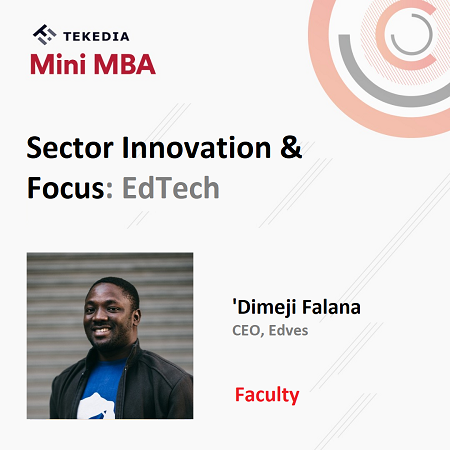
Edves CEO To Lead Session On EdTech In Tekedia Mini-MBA

0

He is the CEO & Cofounder of Edves, a leading education technology (EdTech) startup in Africa. Teachers and school leaders from over 400 schools use Edves software to automate their operations, from student enrolment to graduation. Edves won the Best Prize Transforming Education at the Seedstars World Summit 2018 in Switzerland.

Recently, he was selected and invited among the top 25 young founders in the world by Westerwelle Foundation in Berlin Germany where he attended the highly-competitive Young Founders Programme April 2019.

‘Dimeji Falana, a Tekedia Mini-MBA Faculty, will lead a session on Sector Innovation & Focus with emphasis on EdTech. Registration and onboarding continue for the second edition of Tekedia Mini-MBA here.


South African Planet42 Raises $2.4m Seed Round Amidst COVID-19 Strains

0

Planet42, a South African startup founded in 2017, has raised $2.4 million in funding to accelerate its growth. The startup which started in 2017 as CarGet was designed to offer access to personal cars. The seed round was led by Change Ventures, followed by other private investors including Martin Villig of Bolt, Ragnar Sass of Pipedrive, Marko Virkebau of MeetFrank, Kristjan Vilous of Katana MRP, and many other companies from Estonia.

Using an automated scoring algorithm, the startup processes client applications based on credit bureau, affordability, and alternative data. The service is targeted largely at the underbanked customers. When an application is made by a client, Planet42 will analyze it to validate the customer’s documents before purchasing the car and renting it to the customer.

According to Disrupt Africa, Planet42 has delivered about 2000 vehicles to clients this way, and the company witnessed eight-fold increase last year.

Eerik Oja, co-founder and the CEO of Planet42 said the startup was developed from the need for personal cars in South Africa, especially for low and middle income earners.

“Having a personal vehicle is a necessity in South Africa, as public transport is underdeveloped while ride-hailing is prohibitively expensive for most. A family car can be a lifesaver, but banks focus on newer, expensive vehicles and only approve 15 percent of car financing applicants. This leaves few alternatives to lower and middle income households.

“We see a huge need for people to improve their standard of living with better mobility, but there is a lack of options in the market to service them. More than 24 million people are credit impaired or have no access to finance in South Africa – that’s well over half of the adult population,” he said.

Oja added that Planet42 is looking to expand beyond the shores of South Africa to other emerging markets with potential of growth as it intends to introduce motorcycles to its fleets soon.

“We want to help people across the world commute with ease, earn and feel secure. No one deserves to be deprived of the opportunities, something as basic as a personal vehicle brings,” he said.

It has been a less progressive year for African startups compared to 2019, but many have been securing the bag of seed funds despite the economic strains stemming from COVID-19 pandemic. In the Q1 of 2019, African startups raised $186.09 million in total.

The Q1 of 2020 has seen African startups suffer a decline of 57% when compared to the same quarter in 2019. The total funding for Q1 2020 amounted to $245.13 million, from 86 announced deals, including funding from accelerators, incubators, grants and prize monies.

In 2019, African startups raised a total of $1.34 billion according to WeeTracker. Nigeria led the investments with $663.24 million, followed by Kenya and South Africa. But Nigeria and Kenya accounted for $1.09 billion (81.49%) of the venture capital raised in Africa.

There was a record of $136.58 million raised in the month February 2020, which offered hope of a better year. But the month of March ushered in with COVID-19 and shattered the hope, as it accounted for just 7 percent of the funding raised in the first quarter.

Investors have been treading cautiously since the outbreak of coronavirus and that has affected the growth of startups in the African continent.

Venture platform founder, Kola Aina told WeeTracker that investors are observing the trends before they make a move, and it is slowing everything down.

“COVID-19 has significantly slowed down fundraising activities globally, so it’s safe to say African startups are also affected by this trend, as a significant percentage of investments come from international VCs. Investors are currently re-evaluating how and where they allocate capital,” he said.

Aina added that African startups should not be in expectation of improvement any time soon, due to the global economic disruption caused by coronavirus.

But Benjamin Fernandes, founder and CEO of Tanzanian fintech NALA said all hope is not lost.

“Funding hasn’t necessarily dried up. For us at NALA, for example, we have had an increase in inbound requests for funding. People know our metrics. So I think people are looking to increase their investment in some companies,” he said.

The uncertainties of the global health crisis has apparently pushed fundraising to the edge and planted seeds of doubt in many investors, but some startups in Africa are still attracting seed funds.

Ralt Ojsaar, partner at Change Ventures echoed the sentiment of Fernandes. He said they invested in Planet42 because they saw a global potential in the startup.

“There are multiple markets in Latin-America, Africa and South-East Asia with similar pain points – poor public transport, limited access to credit, and long commutes. Fintech has the potential to make a huge positive impact on how people get from A to B in these places, and we are proud to back Planet42 in making it a reality,” he said.