DD
MM
YYYY

PAGES

DD
MM
YYYY

spot_img

PAGES

Home Blog Page 6315

Establishing a Meaningful, Impactful Career in Teaching: A Double Sided Approach to Professionalism – A Book Review

3

Let me make a confession before I delve into the review of this book. Some of the areas dealt with in the book are related to my life’s journey. Why? I had the first four years of my post-university life teaching at a secondary school that could be considered as a middle level school in Osogbo, Osun State, Southwest Nigeria. My first salary after the youth service in 2007 was less than N10,000. It rose to N25,000 as a Vice Principal before I quit in 2011. Passion was the other currency that kept me going then. 

So, before I had the courage to drop my resignation letter shortly after my take-home was increased, the safe where I had kept the passion that kept me lively and creative in the classroom had been burgled and the spirit had completely left a career I began two years after I completed my secondary school education as a 17-year-old.  I still love teaching. I am still making an impact and encouraging young men and women to be the best they could be. But back then, there was no iota of interest left in me. I had no choice but to quit. I am glad I did.

Having moved on to become a university teacher and having had the privilege to sit on a board of a secondary school of the same level in the capital city of Osun where I have had course to relate with teachers of diverse talents, varied temperament and orientation, there was no way the book would have escaped my attention. To a large extent, I can clearly relate with the focus of the book penned by this great and innovative storyteller and author – Sodiq Ajala. In all sincerity, I found the title of the book awkward – Double PRO for Teachers: How to attract more income, influence and command respect as a teacher.

But, having read from the front cover to the back cover, I found it as a treasure island for any teacher who, like me, is passionate about teaching, making impact and having influence in the society. The author has successfully shown that it is not only a crime to be a teacher, but also possible to reap the reward of the career both here on earth and later in heaven. It is a book that fundamentally addresses the core problems of teachers who, through societal attitude, have been denigrated and whose self esteem has been injured. The question is how does the book perform all these miracles I have ascribed to it? A journey across the 102-page book is a must. Let us move!

In five chapters, the author presents a well-prepared dish of personal development, relevant skills acquisition and professional practice laced with either personal experience or success stories of others. His background as a management consultant, teacher and superb story teller shines glowingly as he takes the readers on a journey of self-discovery and professional redemption. He opens the first chapter with a story of his life, documenting how he went into teaching and later discovered he was not getting back the value he was investing in the youths that were passing through him in the same quantity. 
His was a familiar story of an average Nigerian graduate. Dude finishes university, serves his fatherland, and then applies for jobs with little or no success. After fruitless efforts, he decides to check the sector that has vacancies all year around- education- and gets employed on a meagre salary that has continued to make the positions vacant. Except the lucky ones who get employed immediately after service year, an average Nigerian graduate will be forced to teach first and use the period to search for better opportunities. 

The opening story whets the appetite and prepares the readers for the distance ahead. The writer, through his experience, states his argument clearly- for teachers to enjoy a life of financial freedom and improved self-esteem, they need to embrace being double professionals. He proposes that teachers could teach from morning till late afternoon and also deploys the mastery of their subject matters as services to organisations that need them at night and weekends. This is the core message he uses the remaining four chapters to explain.  Before closing the chapter, he captures reasons teachers need to be double professionals. The top on the list is meagre salaries while the last of the seven reasons is a wretched lifestyle. He as well states the benefits of shedding the single lens of a monotonous career life. Increase in earnings also comes first while a sense of pride and personal development wraps it up. There is indeed a connection for those who could easily decipher to do so.

As an experienced knowledge management expert, the author proceeds to the second chapter after laying the foundation of his thesis in the opening chapter. Here, he identifies how teachers could be double professionals. He emphasizes relevant skills acquisition, giving nuggets of what could make that easy. He then leads the readers through an easy-to-follow process of self discovery, helping to discover and rediscover the areas they are good at. He identifies seven key areas, beginning with communication and ending with information management. That chapter concludes by identifying the shifts that makes being a double professional possible. These, according to the author, include platform shift, digital shift, the services shift, the exponential shift, stakeholder shift and circular shift. The keys to these shifts are embedded in the inner recess of the book. Find them out!

The third chapter appears to be the climax of the book. This represents the gold mine of the Treasure Island. It is the point where the author has chosen to give more. He identifies the spaces to explore by teachers who are tired of living the wretched life. Like a life coach, the author leads the readers, explains, and demonstrates the spaces where their skills could be displayed for patronage. There are 20 different spaces he lists out for teachers to try and get a second life. Some of these are familiar; others are hidden resources, each with a clickable link that takes the readers for exploration! 

Let it be known that as a Physics teacher, you could still be a research analyst while an Accounting teacher could still be a Revenue Agent. If these are seen as overwhelming, how does one describe the table of different education subject matters, the skills/services they enable to render and key resources needed for a start? This is an indication that the writer is not motivated by anything other than the liberation of people of his constituency (teaching profession) still bound to the old ways of doing things. Aside from this, there is also a link to 25 alternative jobs in education aside teaching. It is resources after resources.

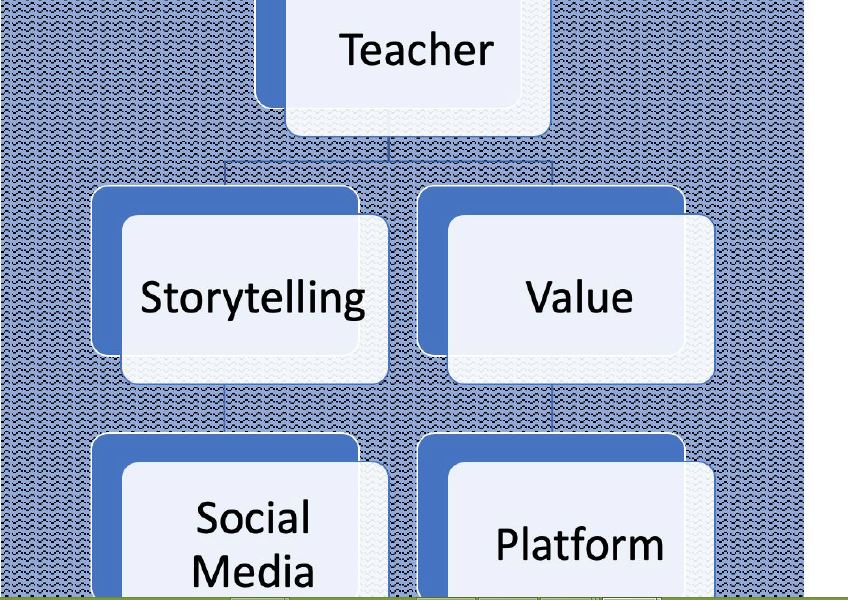
Chapter four takes the baton from its predecessor by further looking at how teachers could position themselves for impact and influence. One tool that the author identifies as indispensable to teachers is the art of storytelling.  As a storyteller, he surely knows his onions. He dishes out knowledge on the art of storytelling, exploring its intricacies, how it works, the benefits and how teachers could use it to their advantage in the course of positioning themselves for a chance at becoming a double professional. He lists out the process and the formulas of telling compelling stories. The author indeed understands the terrain. And again, he does not hold back. One thing that is noticeable from the book is that the solutions proffered are technology and internet-driven. This, as it has been heavily seen in previous chapters, manifests again when he puts forward digital storytelling. He establishes how it works with social media – those platforms that we are all familiar with. 

He then presents the different created platforms on these social media with how teachers in Nigeria and beyond have been leveraging these platforms to curate and narrate the stories of their successes, challenges, breakthroughs and are even making money with their proposed solutions. On Instagram alone, he identifies not less than 7 platforms where teachers are making waves with their own innovations. It does not stop there. On Facebook, there are groups pushing teachers’ interest where intending double professionals could be part of. That chapter pushes the empowerment of teachers to a higher notch. He highlights stories of successful teachers who are double professionals in and out of Nigeria. There are names that one could easily search for on Google. Please check out Henry Anumudu, Atinuke Idowu, Folashade Babatunde and Godwin Kwaghngee. They are ordinary folks doing well with being double professionals, using the tool of digital storytelling. He also gives tips on how to do that. With this, there is no reason to still foot-drag to take the next step. This becomes the focus in the last chapter.

The last chapter is a remedial of some sort. Sodiq Ajala shows a complete mastery of the teaching landscape. The argument here is that no matter the vast ocean of opportunities that presents themselves before teachers, it takes just one thing to make the difference-the mindset. Perhaps, this is responsible for why Nigerian teachers have not been making efforts to change their situation. The author becomes a motivational speaker in the last part, charging the readers to embrace the growth mindset. Again, he deploys storytelling to illustrate what he means by a growth mindset. It is a mindset that is ready to acquire knowledge and skills, not minding the failure and frustrations that come with such ventures. According to the author, the growth mindset is that attitude that pushes you forth against all odds. Such a mind does not pay attention to obstacles, but rather has eyes fixed on the goal.

Concluding this review will not be complete without going back to my opening story where I narrated my first real 48 months of work experience as a teacher. Then, I knew I deserved much more than the value I was offering was fetching me. I desired more than I was getting, but I didn’t have the information that could push me forward. It could be argued that 2011 was 9 years ago and a lot has changed in terms of the opportunities and platforms that were available then and now. However, I need to say that I finished my second degree while at the said school; I know what teachers pass through. They give their best. They get remuneration that is not commensurate with their qualifications. Yet they still suffer societal degradation and are looked down upon. Tell anyone you are a teacher in a private school, your entire life and value is summed up.

Nevertheless, there is one thing that the author advocates – a growth mindset. Whether now or in 2040, individuals would still be taking responsibilities for how far they have gone in the pursuit of their dreams. This means you need continuous self-development, relevant skill acquisition and a broader platform to showcase the know-how and fulfilment, most importantly, the value quotient a person is equipped to offer. So, if you are a teacher and you are as confused as I was on how to drive my life forward, the book to read is Ajala’s Double PRO for Teachers: How to attract more income, influence and command respect as a teacher. Despite the accolades that I have poured on the book, there are glaring blemishes. No work of art is perfect. Nothing is. I have issues with the title. I have said it sounded like the title of an information product. And as such, the structure of the book is also arranged in that manner. Well, it is an e-book.  However, this does not take anything away from the pure golden pieces of life-changing information contained therein.

Facebook Flanks Amazon Revenue, Amazon Expands During Pandemic

1
Jeff Bezos, founder and chief executive officer of Amazon.com Inc., right, speaks as Amit Agarwal, head of India, listens during the opening session of Amazon Sambhav event in New Delhi, India, on Wednesday, Jan. 15, 2020. Bezos got a bitter reception during his India visit this week after the country's antitrust regulator initiated a formal investigation hours before his arrival and infuriated small store owners demonstrated in the streets. Photographer: Anindito Mukherjee/Bloomberg via Getty Images

First, go out and continue building. Amazon has launched Amazon Food, a food delivery service, in India, at the very time when local giants are retrenching as a result of managing the paralysis from Covid-19. This is from Sun Tzu’s Art of War playbook: attack from the flanks and strike enemies, forcefully, even when they are already weakened. Swiggy (what a name, people) and Zomato are challenged as they need investors’ money to run their game plans; Amazon has a forest of money it has for itself. I do expect within the next few quarters, this Amazon’s decision to strike now, to be consequential in market positioning. No retreat – go out and continue building. The human spirit is stronger than any pandemic.

Amazon  is joining India’s online food delivery market just as top local players Swiggy and Zomato  reduce their workforce to steer through the coronavirus pandemic and months after Uber Eats’ exit from the nation.

The e-commerce giant, which has invested more than $6.5 billion in India, today launched its food delivery service, called Amazon Food, in select parts of Bangalore. The company had originally planned to launch the service in India last year, which it then moved to March but pushed it further amid the nationwide stay-at-home order the Indian government issued in late March.

Also, my hypothesis that Facebook Shop has a real chance on Amazon, if it waives the average of 10% commission fees which Amazon charges vendors, was well received. Yet, some members of our community think that the fee could be immaterial, as Amazon has a solid logistics system, and most vendors and buyers will not switch, for Facebook Shop. To address that, I am providing more insights on the basis of my call.

To begin, I do hope that the company which offers the highest composite value, on price and service, to customers, to emerge a winner. The fact is simple: Amazon won modern American retail against physical stores by abstracting local sales tax which it was not required (originally) to collect.   That gave it an advantage and made buying things on Amazon artificially cheaper. 

Think about it, a big television set at a price of $500 on sales tax of 10% will cost $550 in Walmart since Walmart as a physical store would be required to collect the $50 sales tax. But Amazon was not required to collect that tax as part of the U.S. Government’s original incentive to stimulate online commerce. Magically, buying on Amazon would cost you $500. Because of that sales tax, Amazon became very popular as people shopped therein to save money. (Naturally, people were expected to self-report during tax filing and pay the sales tax. Of course, people do not do that).

The Facebook Shop plans to waive the commission fee Amazon collects from its vendors and merchants. If that happens, it means the price they list on Facebook will be cheaper. It is key to understand that a 10% differential is huge and many people can endure some pains to save that money. After all, people waited for 5 days to get their items from Amazon via US Post just to save the sales tax if they had bought from physical stores with immediate delivery. Yes, even if Facebook is not optimized for retail, people will be open to bear some pains to save 10%. That is partly why Facebook Shop is a threat to Amazon commission revenue in the marketplace.

An interesting write up . An average consumer is interested in value and prompt delivery of services. Yes Amazon is currently dominating the logistics globally , however nothing is permanent .

There is huge savings to be made in a 10 % savings in transacting with Facebook vis avis Amazon.
I see a lot of economic sense in saving 10% of gross sale by a publisher who has been selling through Amazon.
Of course 10% of $1 billion is One hundred million Dollars. It’s enough to compensate for other pains.
In the current digitized world any thing is possible and the customers will remain the winners. We are watching!

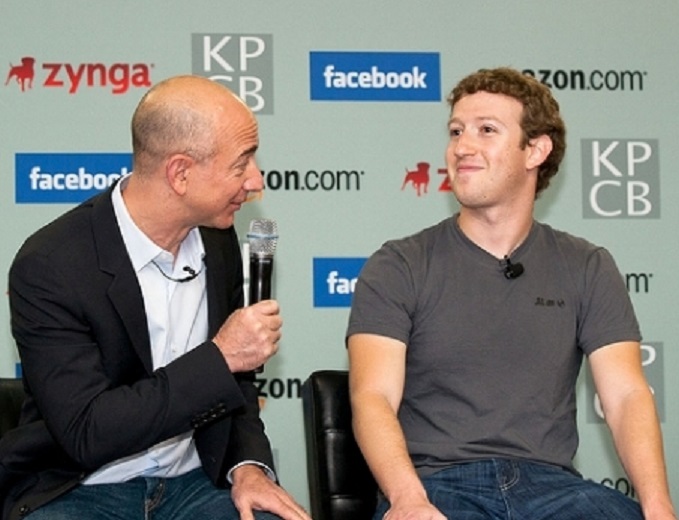
Founders of Facebook and Amazon

All Together

 Amazon won modern American retail against physical stores by abstracting local sales tax (typically 5%) which it was not required (originally) to collect.  To save that sales tax, Americans were open to wait for 5 days to receive purchased items via U.S. Post. If Facebook Shop waives the 10% (average) commission fee which Amazon charges vendors, other things being equal, prices will be cheaper on Facebook. Based on this, I concluded that many people will absorb some pains and even poor service, from Facebook, to save 10% just as Americans many years ago were fine with a five-day wait to save 5%! This  is the premise when I wrote that Facebook Shop could be a threat to Amazon revenue.

Facebook Shop, Instagram Shop, Google My Business Shake African Tech – To Affect Ecommerce, Fintech, etc

The Challenge Before The Open RAN Model

0

RAN stands for radio access network; it includes the antennas and other radio functionalities deployed within a telecom network. Within the telecom industry, the Open RAN was initially touted as a form of advancement in technology to improve efficiency and encourage Innovation. The Open RAN simply means that a telco e.g MTN could purchase and install RAN components from various equipment vendors like Ericsson, Huawei, Nokia etc., and deploy in an interconnected and open platform within its network. Presently, this is not the case as telcos often have to purchase and install proprietary hardware and software, all from a single equipment vendor. That is, hardware purchased from Ericsson will not work interoperably with hardware from Huawei.

The Open RAN has been gaining ground due to the potential for virtualizing and softwarising networking functions within the network. In essence, the telecoms industry is learning from and looking at adapting open platform technologies within the IT industry and hopes to eventually reach a stage where networks can be deployed within the cloud. For instance, in the IT sector, one could easily purchase an HP server and run a software from another vendor successfully and in an interoperable manner with little hitches.

The proponents of Open RAN complain that the equipment vendor market has been heavily dominated by the trio of Ericsson, Huawei, Nokia; as such they suggest that the Open RAN model will open the market to competition and reduce the Capex costs incurred by telcos. They also believe that it would allow for the entry of new and smaller market players who may have developed superior software products that could out beat the trio of equipment vendors (Ericsson, Huawei, Nokia).

As expected, the trio of equipment vendors are not in support of the Open RAN model. Those in opposition to the model suggest that issues like network security, customisation, scalability, enhanced features etc., could hinder the acceptance of this model. How do you test a software version of a RAN without exposing the networks of million subscribers to risks? Some even went as far as saying operators are simply not ready to expose their networks to such risks yet.

On the surface, Open RAN sounds like an evolution in technology within the telecom space, with pros and cons until the US made its stance known on the issue. The US seems to be in strong favour of this model and many seem to believe that the US stance may stem from the fact that it believes that the model may help break Huawei’s dominance in this space. Interestingly, Huawei may not be the only affected player here; Nokia and Ericsson may be hard hit by wide acceptability of this model. Will Europe therefore support or reject the US stance here, as its players may be affected?

Will politics help accelerate or hinder the acceptability of the Open RAN model? Only time will tell.

The Case For Even A Loss-Making Nigerian Postal Service (NIPOST)

0

If you have a business which loses $8.8 billion yearly but supports a $20 trillion economy to function, optimally, via nationwide logistics and supply chain systems, is that really a loss? If you try to avoid the losses, turning that business into an immediate profit-center, you can cut out rural communities from global commerce, and also decimate many  small businesses. Case in point: United States Postal Service.

My question is this: if Nigeria decides to run a postal system that is operationally supreme but loses $500 million a year to cushion a new dawn in ecommerce and business operation, which can generate taxes of at least $1.5 billion, along with a few base points on the GDP, is that a good playbook? If we believe that commerce cannot happen, optimally, without logistics, what are what are Nigeria’s options if we cannot follow the U.S. playbook?

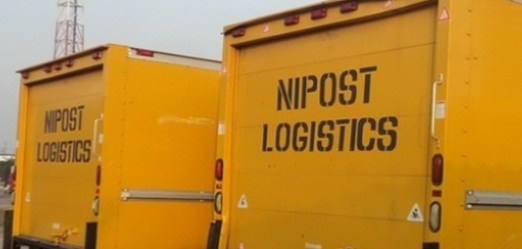
If NIPOST (Nigerian Postal Service) improves, the marginal cost problem will be solved, meaning that ecommerce companies can ship items at better cost margins. Possibly, that would help them compete better with open markets and supermarkets. Yes, if NIPOST takes over the distribution challenges, ecommerce companies will then become unbounded and unconstrained by geography, making them national players. Today, our ecommerce firms are not exploiting the true value of the web since most are focusing on specific cities – you cannot be doing a web business and be restricted to a small locality. So, if NIPOST helps to fix distribution, the ecommerce firms would become more valuable as the scalable advantage has improved.

As I noted when I commented on seeing my book on print for the first time, logistics is at the heart of ecommerce. I had written a book, submitted it to Amazon and waited for the royalties to arrive. I did not even bother to get a print version of this book! Amazon is handling all and selling the book across America and beyond. Amazon does what it does because the United States Postal Service provides deep support to reach any city and location.

If NIPOST can offer that in Nigeria, a new dawn will emerge in the ecommerce sector in Nigeria. Ecommerce companies will simply focus on making sales while NIPOST takes care of the distribution for them. And when that happens, they would have scale which will then make them very competitive on pricing compared with local open markets and supermarkets across Nigerian cities. That trajectory is how the ecommerce sector will blossom in the land.

Beyond Profit-Centers, Strategic Loss-Makers Could Make Nations Better

Beyond Profit-Centers, Strategic Loss-Makers Could Make Nations Better

5

Question from a Tekedia Member: I listened to Tekedia Live and am still trying to understand how the U.S. Post losing money is at least not bad for the economy. Are you saying that the Post cannot operate profitably and still serve?

My Response, broadly…

It brings huge debate: why do we struggle to bring private sector financial efficiency in all domains of government? Yes, make White House to deploy the Apple playbook of operational excellence in the business of serving the citizens. Get Aso Rock, Nigeria’s seat of power, to become a better operator like Dangote Group. 

Obama answered one of those questions many years ago, noting that as the President of the United States, his job was not just to serve only those that could afford iPhone and its apps, but to serve all citizens, irrespective of their income levels. In other words, a President has no market segment or wage bracket to target: its market is the full population of the citizens. To do that, it has to accept some elements of underperformance when looked at from the perspectives of markets. Yes, there is no issue of expired subscription as you cannot kick the people out of the country!

This morning, in Tekedia Live, we had a deep conversation on business, logistics and fintech. I did explain why the United States Postal Service (USPS) is a smart national loss-maker.

Yesterday, the United States Postal Service (USPS) announced an annual loss of $8.8 billion for fiscal year 2019, more than double its annual loss for FY18. This loss, the largest on record, marks the 13th consecutive year the USPS has finished in the red.

If you examine the period when the USPS lost this amount of money, businesses actually expanded in the core domains it served. Largely, USPS losing money was not necessarily a bad thing as its functions were critical for most of those companies to thrive. Possibly, for every $10 billion lost by the U.S. Post, it could be adding excess new $200 billion of value in the economy. For the United States, in general, that is a net positive. The USPS saw marginally revenue increase despite the match to global digitization, implying that it was powering core elements of that new redesign.

Postal Service reported operating revenue of $71.1 billion for fiscal year 2019 (October 1, 2018 – September 30, 2019), an increase of $514 million compared to the prior year.

If you extrapolate that construct, it does imply that any day they make the USPS to become a pure profit-center like DHL, UPS and Fedex, many small businesses which depend on USPS will struggle. If that happens, saving $10 billion could cost the economy hundreds of billions of dollars.

So, it is not everything that should be put in monetary terms. The USPS should of course aspire to be profitable. But if it cannot and still operate operationally efficiently, serving SMEs and Americans, including home offices, its impact will be multiples of whatever it is losing monetarily. Just the taxes paid by the companies on those additional values will cover the losses.

Did you notice a double play strategy here? Lose money on USPS, make up via expanding income and taxes.