DD
MM
YYYY

PAGES

DD
MM
YYYY

spot_img

PAGES

Home Blog Page 6374

How To Pull Nigeria from The Brink – Atiku Abubakar

6

How to Pull Nigeria From The Brink

By Atiku Abubakar

On Monday, April 27, 2020, British oil and gas giant, BP, became the latest in a growing number of energy firms to declare a massive quarterly loss. Their loss was in the region of $4.4 billion dollars. Bear in mind that this was a conglomerate that posted a $2.6 billion profit in the corresponding quarter of 2019.

The challenges that are already engulfing the oil and gas sector will continue to plague that industry for at least the rest of the year, and may reach apocalyptic levels sooner than we expect.

As I write this, there are hundreds of crude oil laden ships, all filled up, with nowhere to berth, and accruing daily charges of an average of $30,000.

We have also seen crude oil prices plunge to record lows, to the extent that some variants of the product have been given out for free, or worse still, producers have paid storage facilities to take their products.

As at today, Nigeria is pricing its very low sulphur sweet crude at $10 per barrel, yet buyers are balking. Our sweet crude is becoming a little bitter.

I had earlier warned that Nigeria needs a Strategic Reserve to store unsold crude. Now, we have so much crude and no one to buy it, nowhere to store it, and little idea what to do with it.

Barely three years ago, I had also alerted that the “crude thinking” promoted by our dependence on crude oil will lead to a rude shock.

“If you are still talking about oil, you are in the past. As far as I am concerned, the era of oil is gone. If you want to believe it, believe it. If you do not want to believe it, you will see it. It is crude thinking to continue to talk and base development projections on crude oil”, I had said at a public event in the nation’s capital.

We must face the fact that reliance on crude oil is failing Nigeria and other mono product economy crude oil exporters. Now is the time for Nigeria and her contemporaries to cure their addiction to sweet crude. For far too long we have grown high on our own supply, to the extent that we have neglected almost every other sector of our economy.

This present rude awakening should be seen as a blessing in disguise — a blessing that compels us to take those drastic actions that will free us from the crude oil trap.

We need to diversify our economy, and yes, it is easier said than done, but that does not mean it is an impossible task.
Prior to Nigeria’s October 1, 1960 independence from Great Britain, not only were we a nation self reliant in food production, but we also exported food to other countries, earning precious foreign exchange in the process. Who can forget the great groundnut pyramids in Northern Nigeria?

For example, in 1957, agriculture formed a whopping 86% of our export revenue. By 1977, agricultural exports had dwindled to 6%, and today, the figure is less than 3%.
How did our country go from being a net exporter of agricultural products to a net importer of food products?

How did we go from a country that could feed itself to one that desperately depends on foreign imports for survival?

The answer to these questions is leadership focus.

During elections, Nigerian politicians spend a significant amount of their campaign time discussing how they will manage the nation’s resources. However, the fundamental difference between a leader and a manager is that while a manager focuses on managing existing resources, a leader sets out a creative vision which the country must follow to chart a course to political and socio-economic greatness.

Certainly, what is abundantly clear is that Nigeria is never going to become an industrialized nation by selling more oil, even if the oil market recovers. The lessons from Venezuela’s current predicament come to mind. If oil and gas could have saved any nation, that nation would be Venezuela. Unfortunately, Venezuela is bankrupt and insolvent.

Saudi Arabia, despite its huge reserves and a highly publicized listing of Saudi Aramco, is feeling the pinch and working rapidly towards its Vision 2030, which requires Saudi Arabia to diversify from its dependence on Oil. Other prudent countries facing the same predicament are doing the same.

Oil economies need to learn a thing or two about economic diversification from the United Arab Emirates. Despite being a young nation, the leadership of the UAE has managed to diversify the economy of this country from an almost complete reliance on oil in the 1970s, to a country where 72% of the GDP comes from the non oil sectors of the economy such as aviation, tourism and services sectors.

In Nigeria, our diversification should embrace agriculture as the primary sector earmarked for development, because agriculture is a low hanging fruit, is key to ensuring food subsistence, and with the recent signing of the African Continental Free Trade Area agreement (AFCTA), which favors Nigeria’s economy greatly, Nigeria can take advantage of this to become an agricultural powerhouse in Africa.

For example, Africa has the lowest intra regional trade amongst the seven continents. Indeed, 68% of Europe’s trade is within the continent. However, Africa does more trade with non African nations than we do amongst each other. Our intra-continental trade is an abysmal 18%. This must change and Nigeria is key to altering this sad state of affairs.

Within the Agricultural sector, the African continent in 2014, earned $2.4 billion from the export of coffee to Europe. That sounds impressive. However, one country alone, Germany, made $3.8 billion from re-exporting Africa’s coffee in 2014. This trend continued into 2015, 2016 and has not changed to date. What is it that Germany does to add value to the coffee, cocoa, and other produce that they buy from Africa that we cannot do in Nigeria? Nigeria can easily become a value-added re-exporter of African coffee to the world.

Ditto for tea, cocoa, wheat, sugar cane, and other cash crops. There are none of these products that I have mentioned that Nigeria cannot either grow in commercial quantities or add value to, in the same way other industrialized economies are doing.
I should know because I am already practicing what I am advocating. I have multiple profitable farms and other businesses in the agricultural value chain.

With about 60% of its land assessed as arable, I truly believe that Nigeria is capable of becoming the food basket of the rest of Africa, and in the process, it can capture a sizable portion of the $48 billion that goes towards food imports in Africa. That money should be circulating within Africa, strengthening our currencies, growing our GDPs, and enriching our people.

I was in Benin Republic recently and I was informed by one of the most successful industrialists in the country that Benin buys its cement from China. Why should a country that shares land borders with Nigeria have to import cement from China 7000 miles away, when Dangote cement is perfectly able, and I am sure willing, to provide the same product at a competitive price?

Is this not what the AFCTA agreement is meant to promote? Why would Nigeria maintain an insane policy of border closures at a time it desperately needs them open to promote trade?

Now is the time for Nigeria to make those hard decisions it has postponed for far too long otherwise the alternative is an apocalyptic scenario we would rather not entertain.

We must, as nation, begin to invest our resources wisely in order to maximize dividends. We must liberalize our land tenure system to make it possible and easy for some of the 27 million unemployed Nigerians to become farmers, even as sharecroppers.

Last year, Ethiopia mobilized its 100 million strong population to plant 350 million trees in 12 hours (a world record). Nigeria can similarly mobilize its population of twice that number to plant billions of cash crops through the planting season. It is possible. I have repeatedly charged my farm associates to sow seeds and they have done so successfully.

When the huge opportunities of agriculture are combined with a rejuvenated manufacturing and MSMEs sectors, then a new era of sustainability and prosperity beckons for Africa.
Nigeria is at the lowest point we have ever been as a nation. We have over indulged on seemingly cheap loans and have quadrupled our foreign debt in just four years. Taking more of such loans will just sink our country deeper and deeper into a quagmire. What is certain is that we can not continue with things the way they are now, except we want to ensure an implosion of our dearly beloved nation.

We must cut our coat, not according to our size, but according to our cloth. Our Presidential Air Fleet of almost 10 planes should go. Our jumbo budgets for our legislature must go. The planned $100 million renovation of our Parliament must be cancelled. We cannot be funding non necessities with debt and not expect our economy to collapse. Our civil servants must come to the realization that Nigeria cannot sustain its size and profligacy. The same cost saving measures must be adopted by the states and councils government.

From henceforth, our energies, resources and focus, must be on how we can diversify our economy, not on how we can increase our expenditure.
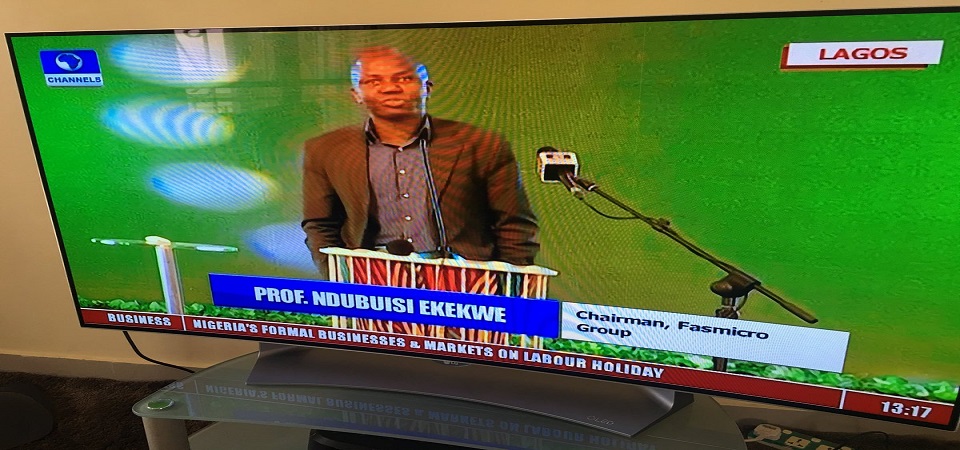
That Platform Speech – Ndubuisi Ekekwe On National TV

1

Today is May 1 – the Labour Day. Last year, Nigerians welcomed me into their homes via the Platform. The pandemic has affected the 2020 planning. Please take time and watch the video again. That message on a national TV has more potency today: it’s not that you and I have risen, but that all is rising.

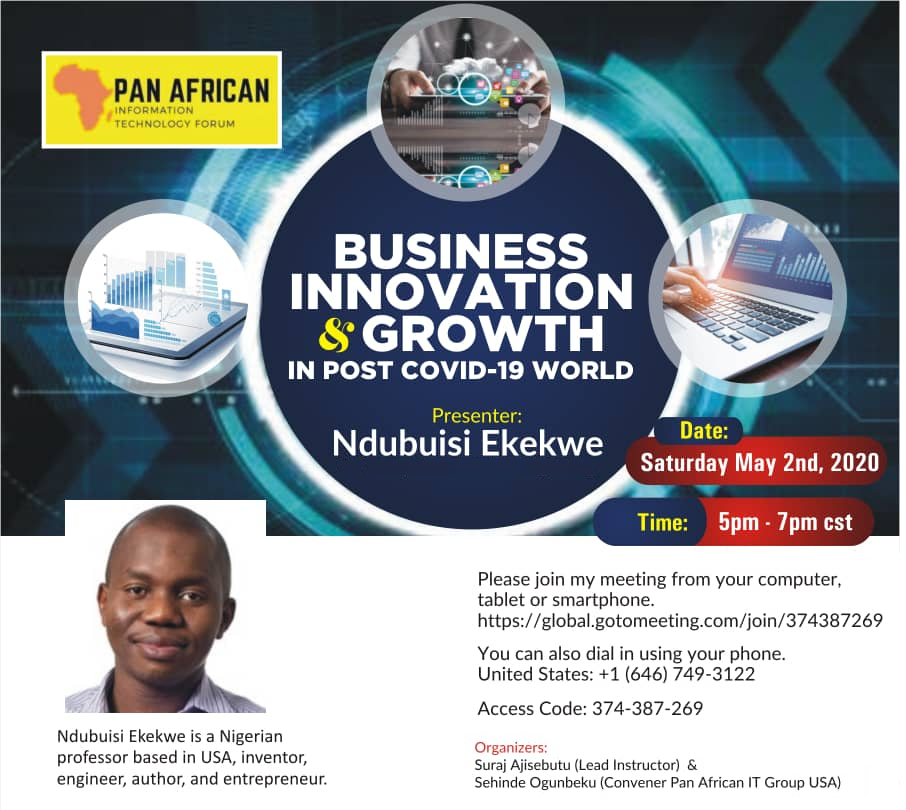
Ndubuisi Ekekwe To Speak in Pan African IT Forum Tomorrow – 6pm NYC Time (Webinar)

2

Tomorrow (Saturday), 6pm New York time, I will speak before eminent professionals of The Pan African Information Technology Forum with headquarters in Houston, Texas.  My topic is Business Innovation & Growth In Post Covid-19 World. Join us if you can using this link https://global.gotomeeting.com/join/374387269


Tekedia Mini-MBA (June 22 – Oct 22, 2020)

92

Registration has ended for edition 2, register for next edition 


Invent, innovate and drive organizational transformation, performance, and growth. Capture emerging opportunities in changing markets while optimizing innovation and profitability. Digitally evolve your business or functional area, turning digital disruption into a competitive capability and advantage. Master the concepts of building category-king companies, and thrive. 

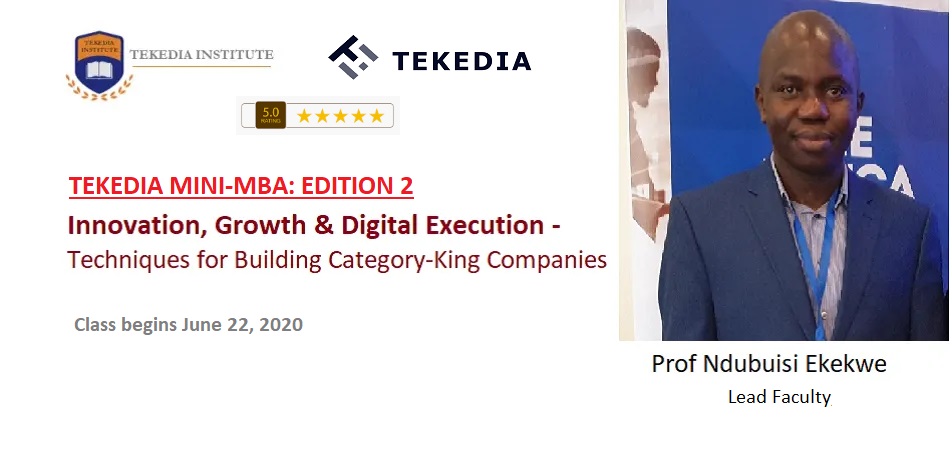
After the highly successful first edition of Tekedia Mini-MBA, we have launched the second edition. I invite you to register ($140 or N50,000 naira) . This program is a 4-month weekly program, beginning June 22, 2020 to end Oct 22, 2020. It will comprise videos, flash cases, written materials and webinars delivered online. When we finish, we will issue a certificate from the Tekedia Institute USA.

Register and join us. You will emerge transformed with tools and capabilities that engineer confidence, performance and growth.  Accelerate your leadership ascent with us and have access to speak with me on your career and professional development! More so, we have new courses and will be using a new global faculty team to deliver them. Also, we are providing capabilities to grade participants’ Labs besides feedback we provide in the Discussion boards.

Tekedia Institute offers innovation management 4-month programs, optimized for business execution and growth, with digital operational overlay.

How To Register: 

  1. PayPal: follow this link and pay $140 US dollars. It supports most global currencies.
  2. Bank transfer (Nigerian naira): Pay N50,000 into any of:
    • GTBank 0114016493
    • UBA 1019195493
    • Account owner: First Atlantic Semiconductors & Microelectronics.
  3. Flutterwave: follow this link (naira) or this one (USD) to use your Verve, Visa, Mastercard, Amex, etc cards across Africa and beyond.
  4. Automatic Access: Pay via this Tekedia link for self-automatic enrollment with username.

After payment, email tekedia@fasmicro.com with participant’s name and email to complete the registration.

Add extra (optional) $30 or N10,000 if you want us to review and provide feedback on your labs.

Early Bird Registration Benefits Do NOT END (you get the benefits anytime you register)


Video presents overview of Tekedia mini-MBA


Theme: Innovation, Growth & Digital Execution – Techniques for Building Category-King Companies

Introduction

Over the last few decades, digital technology has emerged as a very critical element in organizational competitiveness. It has transformed industrial sectors and anchored new business architectures, redesigning markets and facilitating efficiency in the allocation and utilization of factors of production. The impacts have been consequential: nations like Nigeria are moving towards knowledge-based economic structures and information societies, comprising networks of individuals, firms and states that are linked electronically and in interdependent relationships. In this program, we will examine this redesign within the context of fixing market frictions and deploying growth business frameworks in a world of perception demand where meeting needs and expectations of customers are not enough.

Program Time: June 22, 2020 – Oct 22, 2020

Venue & Format: Online via videos, articles, webinars, and flash cases. Program is self-paced which means you consume the materials at your own time and pace.It is completely online. You will have something to complete within 7 days. You decide when you do that within the window. Where you live or your time zone would not be an issue as program is not live-delivered.

Cost: US$140 (N50,000 naira) (20% discount for bulk registration of at least four). We have payment plan, i.e. installment payment plan.

Program Structure: The program structure is presented below; we will add the current faculty in coming days.

TEKEDIA MINI-MBA CURRICULUM
Theme: Innovation, Growth & Digital Execution – Techniques for Building Category-King Companies
Week Focus Components
1 Growth and Innovation of Firms – Prof Ndubuisi Ekekwe Reading (R), Flash Case (F), Video (V), Challenge (C)
2 Business Playbook, Manual and Execution – Prof Ndubuisi Ekekwe

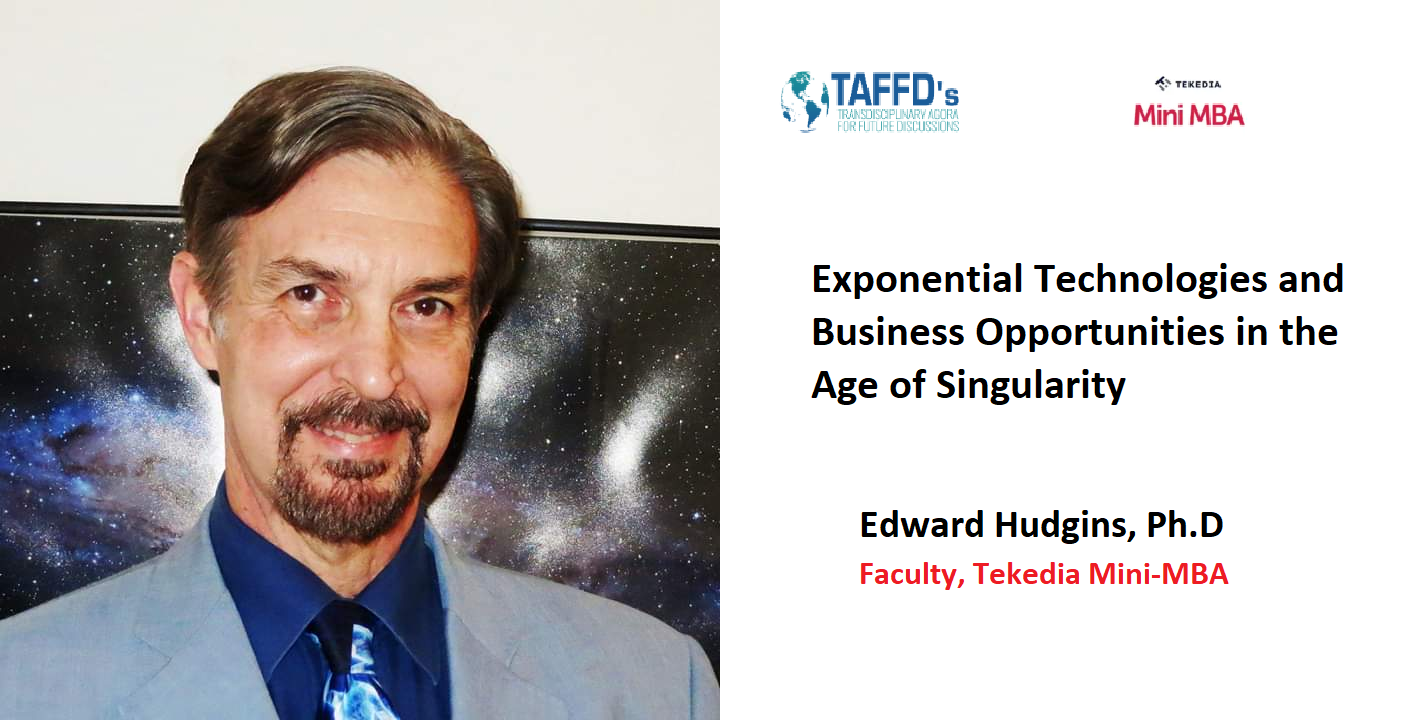
Exponential Technologies and Business Opportunities in the Age of Singularity – Transdisciplinary Agora for Future Discussions, Inc (TAFFD), Georgia, USA . TAFFD team developing session: 

Edward Hudgins, PhD
Chogwu Abdul, PhD
Gennady Stolyarov II 
Brent Ellman

R, F, V, C
3 Modern Business Models and Growth  – Prof Ndubuisi Ekekwe


Reading, Flash Case, Video, Challenge
4 New Technologies, Growth, Disruptive Innovation

–         Cybersecurity – Adetokunbo Omotosho, CEO, Infoprive

–         Blockchain – Franklin Peters, CEO, Bitfxt

–          AI &  Cloud – Wale Olokodana, Azure Business Group Lead, Microsoft

–          Data Management, Big Data & Analytics – Dr Adewole C. Ogunyadeka, esure Group Plc

Reading, Flash Case, Video, Challenge
5 Effective Organizational Change Management, Omowunmi Adenuga-Taiwo (most recent role as a Strategy Consulting Manager with Deloitte)


Stimulating New Markets Through Innovation And Perception Demand – Prof Ndubuisi Ekekwe

Reading, Flash Case, Video, Challenge
6 Investing and Fundraising – Victor Ndukauba, Deputy Managing Director, Afrinvest West Africa


Personal Finance and Wealth Management – Japheth Jev, CIMA(UK), CGMA, ACA, Japheth Consulting


Sector Innovation and Focus: Case Studies

– Logistics – Samuel Akinniyi Ajiboyede, CEO, Zido Logistics

– Ecommerce – Olufemi S. Aiki, Co-Founder, Foodlocker

– Fintech – Olugbenga GB Agboola, CEO / Co-Founder, Flutterwave

– EdTech – ‘Dimeji Falana, CEO, Edves

– Agtech –  Ndubuisi Ekekwe, Founder, Zenvus

– HealthTech – Enoh John, CEO, Lafiya TeleHealth

– Supply Chain – Ayodele Adenaike, COO, GIG Logistics

Reading, Flash Case, Video, Challenge
7 Sales Management, Marketing and Growth – Moby Onuoha, Queen’s University

Supply Chain Management, Global Partnership & Contracting – Adebayo Adeleke, ex-Chief of Contracting and Deputy Chief, Business Operations Division, US Army

Lab #1 – Tekedia Institute

Reading, Flash Case, Video, Challenge


Instruction { Report Output}

8 FMCG New Product Launch and Product Strategy – Mohammad Ibrahim, Managing Partner, Stochastic Institute

Effective Supply Chain Management –
Luiz Paulo Silva Barreto 

Execution – Business Objectives and Technologies, Nnamdi Onyebuchi, CEO, Weco Systems Group 

Reading, Flash Case, Video, Challenge
9 Media, Communications, and PR – Grace Akinosun, CEO, smepeaks


Branding and Advertising – Akachi Ngwu, Executive Director/COO, Luzo Digital Network & Media


Product Design and Packaging – Kemisola Oloriegbe, Manager, Nigerian Breweries Plc

Reading, Flash Case, Video, Challenge
10 Business Process and Leadership –  Prof. Ayodeji Oyebola, Saint Mary’s University of Minnesota


Process Improvement and Operations Management – Rasheed T. Adebayo, Operations Manager, Schlumberger


Quality and Asset Management –Michael Odigie, Vice President Technical Services, Delek Logistics

Reading, Flash Case, Video, Challenge
11 Digital Transformation, Innovation & Strategy – Jude Ayoka, Manager, Access Bank Plc


Leading and Managing Teams, Stakeholder Management with NICER Model  – Dr. Chisom Ezeocha, Project Delivery Manager, Shell

Reading, Flash Case, Video, Challenge


12 Accounting, Building Sustainable Enterprises – Ndubuisi Umunna (ACA), Head Finance Accounts & Admin, Royal Exchange

Risk Management –  Akeem Rasaq, Head Of Risk Management, Chapel Hill Denham

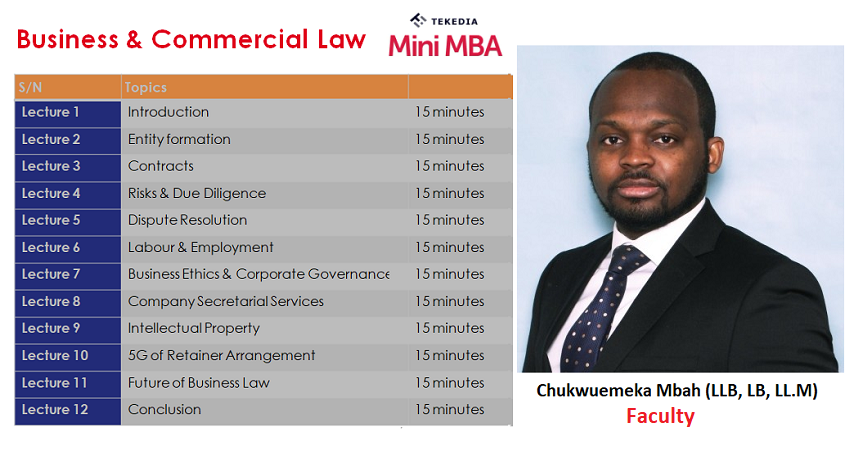
Business & Commercial Law  – Chukwuemeka Mbah (LLB, BL, LLM) Law, Manager, Sherwin Williams

Reading, Flash Case, Video, Challenge
13 Lab #2- Tekedia Institute

Special Series on Winning in Business (all videos) – Prof Ndubuisi Ekekwe

•              Session 1 – Readiness for The Frictions of Nations

•              Session 2 – The Six to Unlock Values in Markets

•              Session 3 – The Two Critical Playbooks

•              Session 4 –  Mechanics of growth & Investment Options

•              Session 5 – Finding the Edges and Market Opportunities

•              Deep Conversations – Answers to Big Questions


Sustainability Strategy and Social Innovation – Temitayo Ade-Peters, CEO, We For Good

Instruction {Report Output}

Video

14 LIVE SESSION: Building Your Business Financial Models (templates included) – Michael Olafusi, Financial Analyst Fellow, Brightmore Capital; Lead Consultant, UrBizEdge

Human Resources Management .- Adora Ikwuemesi, Director Kendor Consulting

R, F, V, C


R, F, V, C

15 Auditing, Forensics, Policies and Controls – Yusuf O. Sanni (ACA), Chief Internal Auditor, BUA Cement Plc


Contracting, Negotiation and IP – Jeff Chineme Maduka (LLB, BL, LLM), Snr Legal Manager, American Tower

R, F, V, C
16 Driving Profitable Growth, Marginal Cost, Scaling – Prof. Ndubuisi Ekekwe


Effective Financial Planning and Management – Okpaise Kenneth, Financial Advisory Manager, AIICO Insurance Plc


Capital Market Operations – Azeez Lawal, CFO, TrustBanc Group

R, F, V, C
17 Lab #3 – Tekedia Institute


Innovation Lessons: 5in5 (5 Firms in 5 Sectors) – Africa/Global – Aderinola Oloruntoye, Dean, Workforce Group


Disruptive Sustainability Innovation for Long Term Business Growth – Eustace Onuegbu, President, incsr.org

Instruction {Report Output}


R, F, V, C

18 Effective Project Management – Taiwo Abraham, Project Manager, Horizant 

The Call to Execution (Summary) – Prof Ndubuisi Ekekwe

R, F, V, C

Reading , Video

Report , Closure
Lead Facilitator: Prof. Ndubuisi Ekekwe

*(All Saturdays have Discussion Webinars of one hour; the contents would be recorded for replay). **In some names (law, accounting, etc), we have to put the professional titles due to the regulatory nature of the fields.

Testimonials on Tekedia Mini-MBA


Career Week: To Transform Workers into Leaders and Innovators

Our Career Week (Nov 2-6 2020) is not designed for finding jobs. Rather, it is structured to TRANSFORM workers, founders & entrepreneurs into business leaders and champions of innovation in their companies. The sub-theme is Nurturing Innovators: Career Planning & Resilience During Disruption. It will be packaged under the Tekedia Mini-MBA theme of Innovation, Execution & Growth. Our knowledge experts for the Week include human resources experts and leaders from MNCs and startups, across industries and global regions:

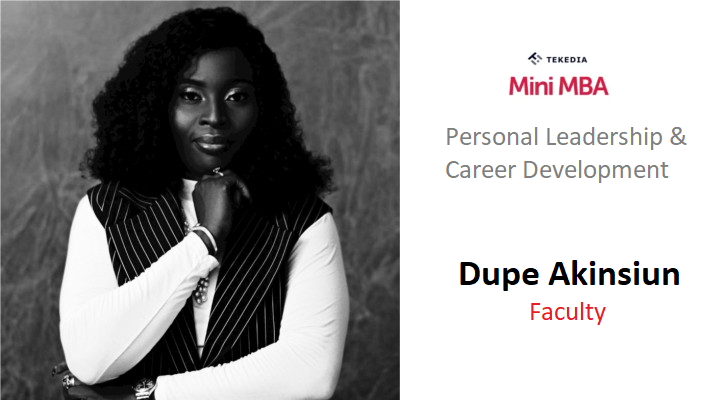
  • Dupe Akinsiun – Head, Leadership & Capabilities Center, Coca Cola HBC
  • Nnenna Jacob-Ogogo – Head, Alpher, Union Bank
  • Precious Ajoonu  – Manager, Jobberman
  • Bukola Kogbe, Regional HR Director – Africa, Barry Callebaut
  • John Wesey – CEO, Psyntech
  • Dr Akanimo Odon – CEO,  Envirofly Consulting UK 
  • Antonia Adeyemi, CIPD – Managing Director,  StatsXperts Consulting
  • Dapo akinloye – COO, Emerald Zone, ex-HR Head, Lafarge CBG
  • Dr. Fatai Olajobi – Partner, Neo-Neurons Concept
  • Dotun Jegede, Senior Partner, Dee Bee Consulting
  • Elizabeth (Ayeni) Nyah, Human Resources Business Partner, VDT Communications 
  • Ezra Anajonu – CEO, Save’N’Fflex
  • Capt. Ola Olubowale – Manager, Viva Energy Australia
  • Abraham Owoseni.com – Principal Consultant, MindMould

Video presents overview of weekly session

Target Audience: This program is designed for professionals across functional areas like sales, marketing, technology, administration, legal, strategy, finance, etc across all business sectors and domains.

Learning Objectives: To innovate is to set a new basis of competition in an economy, business sector or market. Most times, it results to disruption. This program is designed for private (large, SMEs, startups) and public institutions. Participants will:

  • Master the mechanics of digital growth – the reward of innovation – through frameworks, cases and evolving strategies.
  • Understand how to undergo digitization journey that is fully aligned with corporate objectives through measurable and realizable benchmarks.
  • Acquire business capability tools that do not just RUN their firms but can TRANSFORM them.
  • Design corporate growth experiments in Lab sessions based on One Oasis Strategy, Aggregation Construct, Double Play Strategy, Accumulation of Capability Construct, and more.

Facilitator:  Prof Ndubuisi Ekekwe invented and patented a robotic system which the United States Government acquired assignee rights. Dr Ekekwe holds two doctoral and four master’s degrees including a PhD in engineering from the Johns Hopkins University, USA. He earned undergraduate degree from FUT Owerri where he graduated as his class best student. While in Analog Devices Corp, he co-designed an accelerometer for the iPhone. A recipient of IGI Global “Book of the Year” award, a TED Fellow, IBM Global Entrepreneur and World Economic Forum Young Global Leader, Prof. Ekekwe has held professorships in Carnegie Mellon University and Babcock University, and served in the United States National Science Foundation Committee. The South African press called him “a doctor of innovation” for helping organizations on the mechanics of business innovation, strategy and growth. Since 2009, the Chairman of Fasmicro Group which controls many startups and entities has been writing in the Harvard Business Review.

Reliance Infosystems Sending 40 Staff To Tekedia Mini-MBA, Enjoys Group Benefits

Support of Tekedia Non-Resident Fellows

The Founders’ Question – And Unveiling of Tekedia Non-Resident Fellows

Our sample certificate which will be awarded to participants


Tekedia Mini-MBA Corporate

Tekedia Mini-MBA Corporate is a customized version of the general Tekedia Mini-MBA. It is  designed for private and public institutions by sector, phase of growth and organizational structure. It focuses on the same theme of innovation, growth and digital execution. But unlike the 4-month general Mini-MBA, the Corporate vision goes for 6, 8,10 or 12 weeks. Email for a quote.

More Features of Edition 2

Besides the core features of our program, we have the following for the Tekedia Mini-MBA.

  • Tekedia Innovation Summit: An annual physical summit at no extra cost to participants of Mini-MBA in the specific year, in Lagos. The summit will also be webcasted.
  • Co-Innovation Idea Circle: Offers the ability for members to share product and service ideas, and get feedback from the Mini-MBA community.
  • Funding Club:We have a partnership to help participants from start-ups and established companies connect with investors, rewarding market innovations.
  • Partner Marketplace: Opportunities for member-firms to offer free products and services to the community as a way of getting some of their products before users and potential customers. These services could include web hosting, product samples, books, business legal services, etc.
  • Innovation Book:During the planned 2020 Summit, we will unveil a book – Innovation for Growth: Techniques for Building Category-King Companies.


Email: tekedia@fasmicro.com


Selected Testimonials

“Sir, I am overjoyed. I just received a promotion. On Thursday, I sent to my CEO a Covid-19 Continuity Plan, using the template you made available in Tekedia mini-MBA class. Early today, management asked me to present it via video. Ten minutes ago, I received an email from Head Admin that management wants me to execute that template, and they also promoted me. I am also getting a refund for my personal investment on this training. I want to say thank you to all the faculty for this service.”

  • A participant received funding after using ideas from our session on fundraising.

“I discarded my business plan and used the Week 1 business canvas on the Challenge Assignment. Today, I am happy to share that less is indeed better: we received $25,000 from an investor. I want to thank all the faculty especially Mr. Azeez Lawal. His course on Fundraising with African sense is the best ever. I also thank you for a statement in one of the class videos, “Your customer can be your investor. Believe this… the best investors are customers”. This investor is a customer and we will begin by serving his company even though we are a separate company.”

We continue to profile our Faculty and Courses on Tekedia homepage


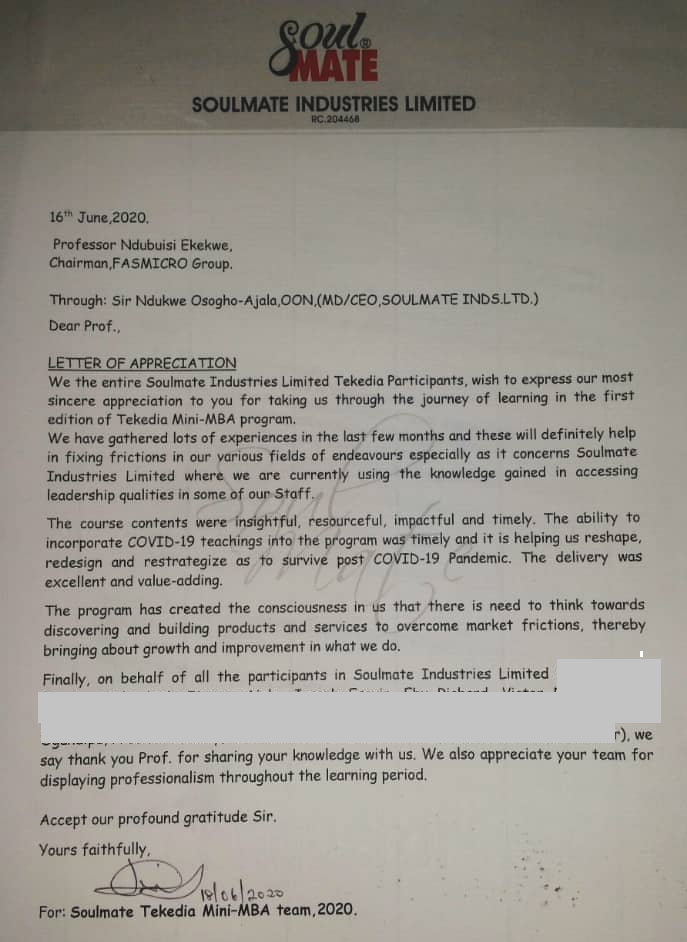
Testimonial from Soulmate Industries Ltd

Free for all Mini-MBA edition 2 participants

The Strategic Value of Facebook Messenger Room Video Meeting

0

I know you’ll succeed on a massive scale, that’s if only you know this.

Success in single means success in multiple. That’s what Dr. Tension told me a few months ago. I struggled to understand what he really meant.

I will ask you to meditate on it and tell me what he meant by ‘Success in single is success in multiple’.

Anyways, as a curious person I asked him what he meant by those complex and vague lines.

He started to tell me about some fantastic stories of great companies and their founders.

Let’s talk about Facebook inc and its founder Mark Zuckeberg. This guy actually had the idea of online socialisation. At that time he was pursuing a degree program in Harvard.

It may also be true that aside from the online socialisation idea, he had other plans to pursue plus his education at that time.

Look, he forgot other things and focused on the realisation of the Facebook dream. He devoted his time and effort to build the company. He only had a promising social media site without messenger, WhatsApp and Instagram.

What happened next? He succeeded in building Facebook into a million dollar worth company. That’s what I mean by success in singles.

Then he proceeded to pursue other goals such as acquiring other similar companies such as WhatsApp, Instagram and he built other features such as Messenger on Facebook. That’s what I mean by success in multiple

Truly, great entrepreneurs of today actually had success in one pursuit and the chain reaction was always success in other pursuits.

That’s the way to go by pursuing one first when you succeed you’ll have the capacity, experience and resources to pursue multiple dreams.

That’s why this analysis is about a new innovation on Facebook called the Messenger Room.

We shall draw many insights from the business strategies of Facebook which will be of immense help to your business and career.

The Facebook Strategies for Messenger Room Videoconferencing

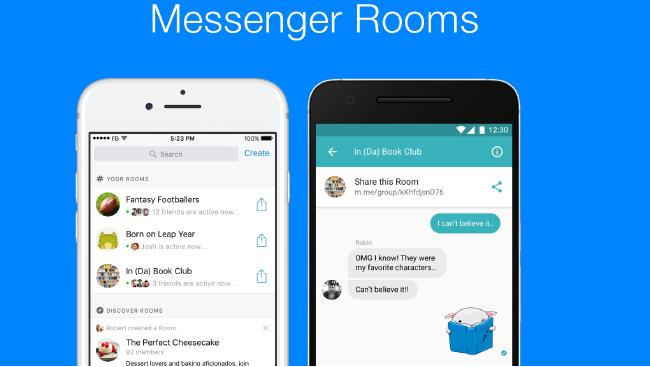
The new feature launched by  Facebook which forms an integral part of the Messenger is called Messenger Room. The messenger room is Facebook’s innovative response to the videoconferencing competition in the tech industry.

The Messenger Room is a feature on messenger that can be used for hosting free video meetings for both Facebook users and non users.

Here are the strategies that Facebook is leveraging on to develop this new value proposition on Facebook.

Already existing market

According to Statista an estimated 1.73bn people use Facebook on a daily basis. That’s absolutely mind blowing as digital businesses thrive on traffic. This is not just users to Facebook instead it is its core asset and infrastructure.

On Facebook we have messenger, WhatsApp and Instagram. Users can chat, upload both images and info graphic materials, call and do video calling etc.

The video, audio functions on messenger and WhatsApp are actually potential markets of video products to be explored by Facebook.

So, there is an already existing market for the video meeting feature. It’ll be easier to host meetings on Facebook than on other places since almost everybody is on Facebook. All they need to do is to join without downloading a new app.

Second Mover Advantage

I used to believe in what is called the first mover advantage until I noticed that sometimes the second mover advantage can be a very beneficial strategy in business too.

The second mover advantage is the advantages and benefits you have when you learn from  the mistakes, loopholes, milestones and limitations of the first movers in the market.

This is exactly what Facebook is doing. In this time of coronavirus pandemic, zoom has been the videoconferencing market leader.

The Zoom application has some technical and security flaws. This had brought massive criticisms and negative reviews to the business.

According to Mark Zuckerberg in a livestream while launching the feature said that the  company has been “very careful” and tried to “learn the lessons’ ‘ from issues with other video conference tools in recent months.

Second mover strategy allows an entrepreneur to leverage on the research, knowledge and limitations of the existing players in an industry for his business innovation.

Freemium Strategy

In one of my analyses I wrote why freemium is not strategically free. As you know already that some of the big tech companies leverage on freemium as means to an end.

Facebook is completely free to use provided you have an account with them. Instagram  and WhatsApp too are also completely free to use provided you have the mobile applications and you are registered.

The aim of freemium for Facebook is to mine data for their advert revenue model which is how the business makes money.

So, the same strategy is applicable to the  messenger room. The service is free for 50people meeting and it’s unlimited time. It can be used for free by Facebook users and non Facebook users.

With this Facebook users will increase and the service will also record high usage.

An Expansion of Already Existing Niche

Bringing people together online  to achieve a particular goal has been the business of Facebook since the first day the platform was launched.

So, with a messenger room, Facebook will succeed in bringing people together for the purpose of holding meetings virtually.

Entrepreneurs are people that are really needed in every economy because of one simple thing they do which is solving problems through innovation thereby keeping the fabrics of the economy running.

We can see how entrepreneurs are developing solutions to help businesses, teams and individuals stay in touch virtually which is a response to the social distancing measure for covid-19 containment.

Truly, success will be massive in scale when we learn to succeed first in one thing.

You may also be interested in How the  Zoom business model fits the coronavirus economy.