DD
MM
YYYY

PAGES

DD
MM
YYYY

spot_img

PAGES

Home Blog Page 6439

Researching COVID-19: How Scholars Induced Global Interest in the Virus

0

The global spread of Coronavirus has shown that political and business leaders have huge responsibilities in the new decade towards sustainable living for all. Since the first case of the virus was reported in Wuhan on December 21, 2019, the world has been tested with varied challenges and still undergoing a lot in business, social participation and household living.

From the ordinary citizen of the world to the governments, businesses and professionals, especially health workers need to come to their rescue. The virus, which has symptoms such as fever, shortness breath, severe cough and pneumonia has infected hundreds of thousands and killed thousands in China, the epicentre of the outbreak and in Italy, Iran and other countries.

According to March 9, 2020’s data, 111,637 were the confirmed cases, while 62, 518 people were reported as recoveries. On the day, 3,898 deaths were reported as cumulative figures since December 21, 2019. Our analysis shows that the confirmed cases and deaths connected by 99.7%, while it was 99.2% for the cases and recoveries during the period.

Much has been said and reported about the virus. We also believe that concerned stakeholders will continue to consider the virus for public and policymakers’ agenda in the next months. With this, our analyst examined the place of the global academic community from October, 2019 to March, 2020. Specific attention was paid to academic publications and real time data for better understanding of what scholars have done before the first case was reported and within the first case till date.

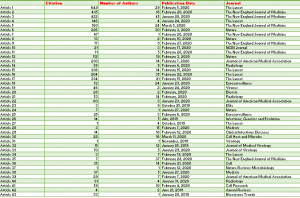
Google Scholar and ProQuest Central Academic Databases were the sources of the data for the analysis and insight development. Coronavirus and Coronavirus 2019 were used as the keywords for the retrieval of academic publications from the databases. On the Google Scholar, we analysed the first articles that were extracted from the first 5 result hit. This led to analysis of 43 relevant journal articles [see Exhibit 3]. Five hundred and four scholars wrote the articles. These articles have been cited 4,194 times by other scholars. On average, our analysis indicates that 11.72 authors per article, while average citation was 97.52 times. Looking at the severity of the citation (142.630 standard deviation), analysis suggests the degree to which collaboration among scholars can help in increasing public knowledge and understanding of a global outbreak of a disease. The inclusion of the keyword (Coronavirus 2019) gave us 875 scholarly publications between 2019 and 2020 [see Exhibit 4].

Exhibit 1: Link between confirmed cases and deaths
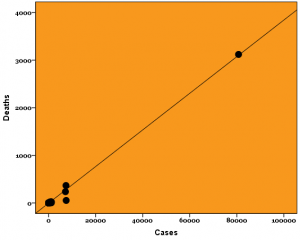
Source: World Health Organisation, 2020; Infoprations Analysis, 2020

Exhibit 2: Link between Confirmed Cases and Recoveries
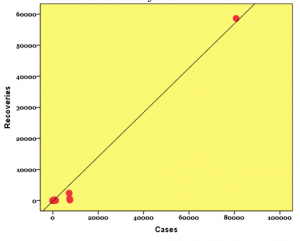
Source: World Health Organisation, 2020; Infoprations Analysis, 2020

Exhibit 3: Select Journal Articles

Source: Google Scholar, 2020; Journals, 2020; Infoprations Analysis, 2020

Exhibit 4: Academic Publications 2019-2020
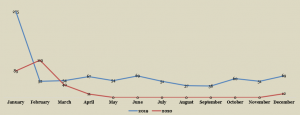
Source: ProQuest Central, 2020; Infoprations Analysis, 2020

The Reasons and Discoveries

Beyond the demographics of the publications, our analyst is interested in understanding the justifications for carrying out the studies that led to the publications. The Analyst also finds out the main results from the first 5 publications with the highest number of citations. These publications were considered because the Analyst is curious about the intent of other scholars who cited the publications and the place of the number of authors in fueling the public knowledge seeking about the virus through the Internet, especially searching evidences that establish containment and mitigation strategies.

Clinical features of patients infected with 2019 novel coronavirus in Wuhan, China is the first article on the Google Scholar Database with 649 citations. The article was authored by 29 scholars and published on February 5, 2020. Majority of the scholars are affiliated with universities, centre for diseases control in Asia, Europe and America. Using the cluster of pneumonia cases in Wuhan, China, the scholars report the epidemiological, clinical, laboratory, and radiological characteristics and treatment and clinical outcomes of these patients.

The second article titled A Novel Coronavirus from Patients with Pneumonia in China, 2019 was carried out based on the identification of a novel CoV (2019-nCoV) in hospitalized patients in Wuhan in December 2019 and January 2020. “Evidence for the presence of this virus includes identification in bronchoalveolar-lavage fluid in three patients by whole-genome sequencing, direct PCR, and culture. The illness likely to have been caused by this CoV was named “novel coronavirus-infected pneumonia” (NCIP). Complete genomes were submitted to GISAID. Phylogenetic analysis revealed that 2019-nCoV falls into the genus betacoronavirus, which includes coronaviruses (SARS-CoV, bat SARS-like CoV, and others) discovered in humans, bats, and other wild animals.”

Early Transmission Dynamics in Wuhan, China, of Novel Coronavirus–Infected Pneumonia. This is third most cited article, according to our mined data. The scholars analysed “data on the first 425 confirmed cases in Wuhan to determine the epidemiologic characteristics of NCIP. Among the first 425 patients with confirmed NCIP, the median age was 59 years and 56% were male. The majority of cases (55%) with onset before January 1, 2020, were linked to the Huanan Seafood Wholesale Market, as compared with 8.6% of the subsequent cases. The mean incubation period was 5.2 days (95% confidence interval [CI], 4.1 to 7.0), with the 95th percentile of the distribution at 12.5 days. In its early stages, the epidemic doubled in size every 7.4 days. With a mean serial interval of 7.5 days (95% CI, 5.3 to 19), the basic reproductive number was estimated to be 2.2 (95% CI, 1.4 to 3.9).”

First Case of 2019 Novel Coronavirus in the United States. The authors report “the first case of 2019-nCoV infection confirmed in the United States and describe the identification, diagnosis, clinical course, and management of the case, including the patient’s initial mild symptoms at presentation with progression to pneumonia on day 9 of illness. This case highlights the importance of close coordination between clinicians and public health authorities at the local, state, and federal levels, as well as the need for rapid dissemination of clinical information related to the care of patients with this emerging infection.” A novel coronavirus outbreak of global health concern.  This article focuses the demographical details of the first victims.

Scholars as Advocates

From the reasons and discoveries, it has emerged that the scholars who authored the articles had the intent of helping other stakeholders such as ordinary citizens, businesses and governments in knowing evidence-based information that could be leveraged for containment and mitigation purposes. In addition to this, our analyst notes that extensive citation of the scholars who authored the 43 articles show that their conversations on the spread of the virus worth joining, indicating conduct of more researches on the disease. According to Google Scholar data, journals started publishing articles on October 2019 on the virus [see Exhibit 3], while publication started in January, 2019, according to ProQuest Central [see Exhibit 4]. We examined these periods along with the public interest in the virus. In this, we specifically focused on data generated between October, 2019 and March, 2020 (Google Scholar Academic Database).

Analysis reveals that the number of authors of the articles connected with the public interest in the virus in October, 2019 by 17.7%, November, 2019 by 24.4% positively. We attained negative connection between the authors and the interest in January 2020 (-25.2%), February, 2020 (-35.2%) and March, 2020 (-43.6%). While it was a negative linkage for the authors and the interest in October and November, 2020, our analysis reveals positive connection of the citations with the public interest in the months (October, 2019=8.4%) and (November, 2019=11%). These results imply that the collaboration (more than one author) started having significant impact in public information search in January, February and March, 2020. It also signifies that the number of authors and citations were not enough to support the public level of information search on the virus using academic sources in October and November, 2019.

Actually, public interest was higher in November, 2019 (1,922) than in October, 2019 (1,814). Analysis reveals a total of 703, 1,040 and 696 cumulative interest scores for January, February and March, 2020 respectively. Our model (authors-public interest in coronavirus) indicates that the number of authors explained 21.8% (395.452) public interest in the virus in October, 2019 and 30.8% (591.976) in October, 2019, which is the highest variation. Despite that the number of authors improved public interest in the virus in January, February and March, 2020, lowest variations were recorded for the months [see Exhibit 6].

Exhibit 5: Academics Linkage with Public Interest about Coronavirus
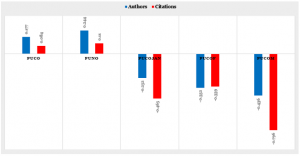
Source: Google Scholar, 2020; Journals, 2020; Google Trends, 2020; Infoprations Analysis, 2020

Exhibit 6: Academics Variation in Public Interest about Coronavirus
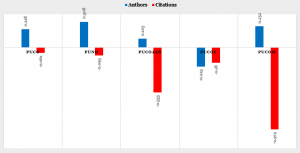
Source: Google Scholar, 2020; Journals, 2020; Google Trends, 2020; Infoprations Analysis, 2020

Did the Scholars Hold the Public Interest?

To understand the degree to which authors hold the public attention during the period of searching and within the cumulative interest scores reported earlier, we did a pairwise analysis and found that on an average of 12 authors for October and November, 2019, public interest was on an average of 62 normalised public interest score accordingly. When it was an average of 18 authors, our analysis shows that public interest was an average of 77.33 score.

Exhibit 7: Scholars Holding People Who Searched for Academic Publications
Source: Google Scholar, 2020; Journals, 2020; Google Trends, 2020; Infoprations Analysis, 2020

Strategic Options

The insights in this piece have many implications for the concerned stakeholders. The insights have suggested that stakeholders need to explore academic sources more for better understanding of the containment and mitigation messages. This is imperative on the basis that scholars in medicine and health related fields have been saddled with the responsibilities of conducing evidence-based research on various diseases and health conditions for quality living of all. Scholars from Africa and Latin American and Caribbean also need to join the ongoing discourse on the virus, while governments in these continents should provide enabling environment for academic and independent researchers.
The Bill to Ban the Import and Use of Generators in Nigeria Passes First Reading in the Senate

0
generators Nigeria

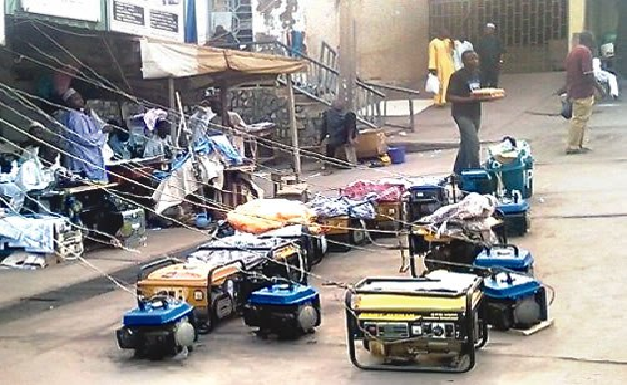
A Bill seeking to ban the use of generators in Nigeria has passed the first reading in Nigerian senate. The Bill which is entitled, Generating Set (Prohibition/Ban) Bill 2020 is sponsored by Senator Muhammad Bima Enagi representing Niger South senatorial district.

The Bill was a subject of deliberation in the senate’s plenary on Wednesday, seeking to prohibit the importation of power generators and their use in Nigeria, except for essential areas like medical services, Aviation, Railway, escalator, Research institute and other services that require 24 hours power supply..

According to the bill, anyone who imports or engages in generator sales venture shall be guilty of an offense and will be liable on conviction to a term not less than 10 years imprisonment.

Below is the excerpt of the Bill.

A BILL FOR AN ACT TO PROHIBIT/BAN THE IMPORTATION USE OF GENERATING SETS TO CURB THE MENACE OF ENVIRONMENTAL (AIR) POLLUTION AND TO FACILITATE THE DEVELOPMENT OF THE POWER SECTOR

Sponsor: Senator Bima, Muhammad Enagi (NigerSouth Senatorial District)

ENACTED By the National Assembly of the Federal Republic of Nigeria

Prohibition/Ban on importation generating sets

Any person who

  1. a) Imports generating sets; or

(b) Knowingly sells generating sets shall be guilty of an offence and be liable on conviction to be sentenced to imprisonment for a term not less than ten years.

Provided that this subsection shall not apply to the importation or sale of any generating set to be used for essential services.

Ban Excludes Essential services

(3) The ban/prohibition of generating sets shall not include generating sets used for essential services which include:

(i) Medical purposes (hospitals and nursing homes and healthcare facilities), (ii) Airports,

(iii) Railway stations/services,

(iv) Elevators (lifts)

(v) Escalators,

(vi) Research Institutions, and

(-vii) such facilities that require 24 hours electric power supply:

(b) Approval for exclusion shall be obtained from the Minister in charge of Power who shall brief the Federal Executive Council quarterly on approvals granted.

Ban on Use

All persons are hereby directed to stop the use of electricity generating sets which run on diesel/petroI/kerosene of all capacities with immediate effect in the country.

Meaning of Generating Sets In this “Bill” generating set (Generator) meansA machine that is used for producing electricity.

Short Title

This Bill may be cited as the Generating Sets (Prohibition/Ban) Bill, 2020.

Explanatory Memorandum

This Bill seeks to ban the importation and use of generating sets (generators) in the country and to curb the menace of environmental pollution which leads to potential health hazards it poses to the whole nation.

Reactions to this development have been scornful. Nigeria depends mainly on power generators to facilitate services that need electricity: From private businesses to public offices, the functionality of machines and work tools has been powered by generators.

In a country barely generating over 3,000 megawatts of power, it is baffling to the people that the lawmakers would come with such a bill. In the 2019 budget, the 1, 358 generator-related expenses gulped millions of naira. So far in 2020, about N49 million has been spent running generator-related services for Aso Rock and its environs, and there is no end in sight since power generation keeps fluctuating and dropping low year after year.

Though the alibi for the bill is to curb the menace of environmental pollution, Senator Muhammad Enagi did not offer provisional alternative that will alleviate the economic losses the Bill will cause if it becomes an Act. Moreover, Nigerians are saying that vehicles are also major contributors of air pollution, but the senate has thrown the bill to for electric vehicles out, saying it would hurt the oil industry.

The sustainability of industries in Nigeria has depended on generators. Without a choice, many companies are running generators around the clock: from banks to the printing press to a barbing salon, even the Power Holding Company of Nigeria (PHCN) depends on generators for their offices’ electricity supply.

On average, Nigerian businesses spend N3,000 ($9) daily fueling generators, a bill they really don’t like paying but have no choice. In 2019, Nigerians spent a staggering $12 billion on generator-related expenses and it’s not something to be proud of.

In many states in Nigeria, street lights are powered by generators, as it is with every other development that needs electricity to function.

Dissenting voices have called on the senate and the federal government to prioritize providing Nigeria with steady power supply instead of spending time trying to aggravate an already bad situation. They said the importation and use of generators will stop voluntarily when there is constant electricity.

The EkoCab As Explained by the CEO, Segun Cole

0

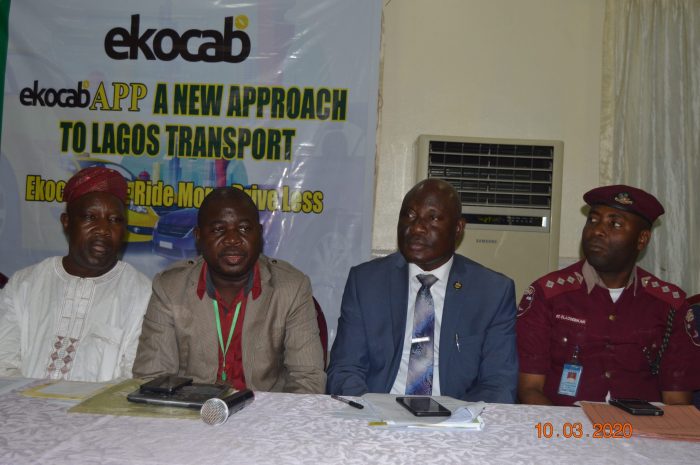
The launch of EkoCab has generated more chaos and anger than the supposed cheers. Lagosians have been trooping to the App stores to give the App low rating so that it could be removed from the stores.

The anger emanates from the perceived oppression of ride-hailing businesses in the state. The recent okada ban and the incessant reports of oppression of Uber and Bolt drivers by the officials of Lagos State Government.

It is believed that the clamp down by the state on the ride-sharing companies has been intentional, that it appears more like a retribution from the state government because the companies are on gig economy. And moreover, the state government has ulterior motive to start a ride-hailing company of its own.

For these reasons, Lagosians didn’t find the launch of EkoCab funny and have vowed  to immobilise it.

But on Wednesday, Segun Cole took to Twitter to explain the new taxi and those behind it. Read his statement below.

“I am Segun Cole. CEO Ekocab. I know this is so 2000 and late, but better now than never.

“I have been a policy Consultant on New Mobility to State Governments. Advising them on how to better Regulate the Industry and proffering solutions.Sometime back 2015, Uber refused to be Categorized as a Transport Operator, called themselves a digital App connecting riders and drivers only. They created this messaging Architecture and it was established Globally.

“Lagos State wanted to better understand their Operations and bring them under the Tax Infrastructure. We advised them to set up a Sandbox framework, while collecting data to help them study the Operations. They did. On the Other hand, local taxis, including Metro/Red and the rest were complaining of diminishing profit margins and source of Income. The argument was that, this was their major source of Income, unlike Uber drivers that did this as part time mostly.

“So we advised the Regulators to tell these other players to go develop their own Tech, so the Regulators can then draft regulations that regulate all Digital Apps, whether uber or owned by players that owned Cars. Just One problem, the Technology was expensive. That’s when I offered to develop this App, that Onboarded all drivers from all other players that can’t afford to develop their own App. It was the M-a-a-s model.

“The Government agreed and Introduced us to these players. First of them are the yellow taxis. We wanted to give them a fighting chance, help them Upgrade. We understand it’s going to take more than just technology, so we trained and also did Culture Re-orientation for them. We only trained 100, that we’re tech savvy and Cars that met the standard(AC +).

“Most of these Cars are Unbranded, the media only took pictures of yellow pick up backs.

To put this in proper context, Ekocab is open to private Cars. It’s two offerings; local and private Cars. A Step beyond Uber’s model.

“We ran successful pilot tests around surulere last year. I have been involved in every Stakeholders engagement with the Government. This has nothing to do with any clamp down on Uber/Bolt. I took advantage of the timing like any Business person would do. Bolt/Uber, heck even fahim Saleh of GoKada are my friends.

“Why are think there is pressure from some Corners of Ekocab is that, we are going to be providing the Regulators a Dashboard to better Track Commuter Traffic Patterns, to better help solve traffic problems. This Mobility data would also provide information like accidents rates, speed rates, and e.t.c

“This doesn’t sit well with some folks, because this can also reveal some information that would expose shady activity. Away from Mobility data. Our prices are certainly Cheaper, and our 12% Commission is lower than what’s available. I plan to incorporate Boats, EV logistics and food delivery services. The name would change eventually to Incorporate the Vision. This has been bootstrapped with our money and sweat. We haven’t had a dime from any Investors. We did this on purpose, demon Investors everywhere.

“For Online Media presence and controlling the narrative, yes i agree, i have scored F9. Those that covered the launch on twitter, deliberately left out the fact where we announced the app would be going live on the 17th. We wanted to make sure demand met supply.

“This is a Nigerian Company, Owned by Nigerians. I am a Lagos Isale eko boy. I wanted to show that a Nigerian company can give other Nigerian entrepreneurs hope when placed against foreigner Companies with billions of dollars. I am not against Uber and Bolt or Opay, the road is Big enough (We all contribute to congestion though) I wish every player the best.

“I can’t Speak for the Government, what i can say is this, this isn’t Government Owned, no powerful person in the Government owns this. Lobbying isn’t Illegal. Every player should be deliberate about collaboration with Regulators.

Do a quick research, globally, the regulatory landscape is changing fast, in California and London, independent contractors have been reclassified as employees.

“I am a Member of NUMO(New Urban Mobility Alliance) I can suggest to local and foreign Regulators to borrow from the playbook of over 254 Cities. The point is this, At Ekocab, we want to take things further. There’s barely a Company that’s not selling Users data. Ekocab Mobility Data that doesn’t invade privacy and trade secrets would be sold and profits shared with our drivers. The Data that’s generated is done on Lagos Infrastructure and first belongs to Lagosians before its Ekocab or any company. This is Our Mission. Finally, I Am Open to going on Air or doing Interviews. Let’s Clear this up.

“I understand people are angry about the whole Okada Ban, my Company has nothing to do with this. Heck I used this Apps. I can barely survive without them. I went as far as engaging the Government to Overturn the Ban, and drawing from policies used in Regulating Asian Ride-hailing Apps. I also suggested, that when the players are back, they provide annual economic impact reports. What I am currently working on holistically with Ekocab, is a “Future of Africa Mobility Lab” that brings all Micromobility players and TNCs together, collaboration is the future.”

However, this explanation has fueled people’s anger more than it has calmed it.  It is believed that Ekocab is a government owned enterprise that the state has planned to set up before now, and is using Mr. Cole to front it to cover the cynicism behind it. However, the perception of the Ekocab is likely going to impact the startup negatively.

The Dethronement of Sanusi Lamido Sanusi: Checking the Digital Thermometer

0

Tuesday, March 10, 2020 was a very rough and tough day across Nigeria. Both the online and offline sphere was agog with the news of the dethronement of the former Emir of Kano, Mallam Sanusi Lamido Sanusi. Nigerians were shocked when it filtered in that the erstwhile Emir was not only relieved of his duties but was also banished to Loko, a town In Nasarawa State.

With a bubbling number of youths who would ordinarily hit the internet, the online sphere became an information haven of some sort for the young Nigerian digital natives who wanted to know more about how and why a king of that status was simply removed by the Kano State Government. Since the remove close to 24 hours ago, a lot has been generated online. From videos, texts, graphics and audio materials, a lot of was thrown into understanding the circumstances of the removal of one of the most intellectual monarchs in Nigeria. From Facebook to Twitter to Whatsapp statuses, angry and obviously sad Nigerian youths kept showing their feelings about the former CBN governor deposed on the allegations of disregard for state authority and the Kano Emirate norms. This piece seeks to examine the online activities of the Nigerian internet users in making sense of the sack, the circumstances and the personality involved.

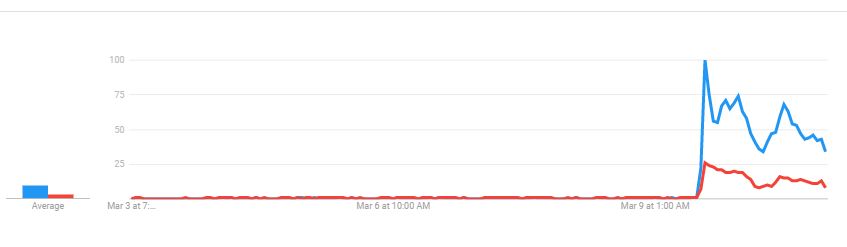
From Google Trends, it was Sanusi Lamido Sanusi all the way

When checked to understand what people have been searching about the issue, analysis shows that Nigerian internet users have been looking for both Sanusi Lamido Sanusi and Umar Ganduje. The two are like the hero and the villain in the fiction of the incident that happened on Tuesday. From Kebbi to Kogi, the interest was high as people sought to know more about Sanusi and Ganduje. The first five northern states to show 100% interest in the deposed king included Kebbi, Zamfara, Sokoto, Taraba and Kogi. For searchers from those states, they really wanted to understand the personality of the former Emir.

Benue, Ekiti, Ondo, Bayelsa and Cross River states were the last five of ten states that indicated serious interest in the former CBN Governor. The first five related search queries included “ganduje”, “sanusi lamido dethroned”, “sanusi dethroned”, “sanusi lamido and ganduje” and “aminu bayero”. There are implications of this search trend. Those who hit the internet with those search queries were trying to make sense of the whole scenario from the people involved and the event. While looking for “sanusi lamido dethroned and sanusi dethroned” implies that the searchers comb the internet to get the fact and the main gist of the story, placing sanusi and ganduje side by side in searches is an indicator of trying to understand the people involved. The last search query “aminu bayero” also pointed to the curiosity in understanding Sanusi’s replacement.

The Sanusi Lamido Sanusi/ Umar Ganduje Search Charts

Source: Google Trends, 2020


On the Street of Twitter, Emir Sanusi’s Bird flew higher

On Tuesday, 10 March, 2020, issues surrounding the dethronement of the ex-Emir were on the trending list with about 14,300 tweets generated. The Guardian Nigeria was leading the list. However, as at  Wednesday, 11 March, 2020, the hashtag has changed to #freesanusinow. Perhaps, the change of mood on Twitter was enhanced by the press statement made by Mallam Sanusi’s lawyers, the campiang is getting louder on Twitter for the deposed monarch to be released. In a tweet by the Socio-Economic Rights and Accountability Project (SERAP), the rationale behind the arrest and banishment of Sanusi was questioned. SERAP tweeted “We strongly condemn the arbitrary arrest and detention of dethroned Emir of Kano, Muhammad Sanusi II. He has a constitutional right to liberty and freedom of movement. Nigerian authorities must immediately and unconditionally release him. #FreeSanusiNow.” Following this call is another Nigerian tweeting Moshood MKO tweeting @mkoaabiolar, he said “ being Emir isn’t a must, but Mr. Gandollar, Sanusi freedom isn’t negotiable. Infact, it a big slap @PoliceNG and StateDeptDSS to allow a msicreants like Ganduje detain a responsible man like Sanusi unlawfully without any court order. #FreeSanusiNow.” Another Nigerian twitterati, Olakunle Ezekiel, tweeting @olakunleezekiel also condemned the banishment of the ex Emir. He  tweeted “dethroned nd still abusing his fundamental human right…how callous and wicked can Ganduje get??#FreeSanusiNow nd let him contest 2023 Presidential Election”.

Comrade Deji Adeyanju tweeting @adeyanjudeji waxed philosophical in his demand for freedom for Mallam Sanusi. He tweeted “ Today as always, men fall into two groups: slaves and free men. Whoever does not have two-thirds of his day for himself, is a slave, whatever he may be: a statesman, a businessman, an official, or a scholar.”- Friedrich Nietzsch. As the #FreeSanusiNow get louder on Twitter, it is hoped that the frictions in the conflict get ironed out and hurt souls get healed.

Paga Partners with Visa As It Pursues A Global Playbook

0

Paga, a Nigerian mobile money and payment services startup has announced its partnership with Visa to expand its services and give subscribers a wider network. In a statement issued on Medium, the Fintech said the partnership is aimed at accelerating services toward global reach, and to give account holders the ability to make transactions using an already established platform with global network.

“We are pleased to announce our strategic partnership with Visa to enable Paga and Visa work closely in accelerating secure and convenient mobile payments for merchants and consumers in markets where Paga operates.

This partnership is in line with Visa’s goals to drive alternative payment channels, in this case, mobile wallets, within its global ecosystem. For Paga, partnering with Visa is one step further in our global expansion plans. Now, all Paga account holders will have access to Visa credentials (physical and virtual cards) tied to their Paga accounts and thus the ability to transact anywhere in the world where Visa is accepted,” the statement said.

Paga said that the partnership involves new innovative initiatives that will be introduced soon: Merchant acceptance solutions which include QR codes and NFC for in-store merchant payments, online payments, and international remittances which will be facilitated through Visa platform.

Nigerian Fintechs have been using partnership strategy to expand their services to countries beyond the shores of Africa. Last month, Interswitch announced its partnership with American Express. The two companies were aiming to leverage on each other’s audience to expand their services. It appears that other Fintechs in Nigeria are following the same pattern.

Speaking on the partnership, Paga’s Founder and Group CEO Tayo Oviosu said Visa has become their ideal choice of partnership because they have common goals, and together they will make a great team in providing services to the underserved.

“We are excited to partner with Visa, a leader in payments globally, as they are constantly building world class solutions for consumers and businesses. Our goals are well aligned. As we scale our wallet across emerging markets such as Nigeria, Mexico, and Ethiopia, partnering with Visa to give both consumers and businesses, who have been underserved, access to Visa’s global network made sense to us.

“Furthermore, it was clear to us in all our engagements the alignment of our goals towards solving the issues of cash, digitizing cash transactions and delivering financial services using new and innovative approaches. We are very happy to have signed a long-term relationship with Visa,” Oviosu said.

Part of the innovation that the partnership will facilitate is to give merchants who use Paga’s payment collection suite the ability to accept non-card based payments from customers from around the world, as long as they original banks offer Visa services.

Paga believes that the new approach will change a lot of things, improve customer service, usher in a new experience that will in the long-run yield growth in sales.

Visa also expressed confidence and excitement about the partnership. Visa’s Vice President, Head of Strategic Partnerships, Fintech & Ventures for Central Europe Middle East and Africa Otto Williams said the development will result in speed and convenience beyond borders.

“We are excited to have Paga plug into our network, as a company we remain grounded on the principles of partnership, innovation, trust and openness. This development ushers in a new era of speed and convenience beyond borders.

“It also allows us to continue working towards innovating robust platforms through which merchants using paga’s payment collection suite can benefit from international money transfers and the growing eCommerce industry,” Williams said.

The statement reveals that Paga will join Visa Fintech Fast-Track Program as part of the deal. The program gives fintechs easy access to the global Visa payments network. The fintech fast-track program also provides support to players in the payment industry who are developing new commerce experiences by opening up Visa’s network to allow them facilitate financial services beyond their immediate environment.

Moreover, the fintech fast-track program includes eased access to Visa’s payment capabilities and its streamlined processes. This strategy affords companies the opportunity to grow in phases no matter the size of the company.

Paga is a mobile platform that allows its users to transfer money electronically and make payments through their mobile devices. Paga acts as a mobile wallet where any user equipped with a mobile device can conduct transactional activities using their device. It was founded in 2009 by Tayo Oviosu and publicly launched in 2011.