DD
MM
YYYY

PAGES

DD
MM
YYYY

spot_img

PAGES

Home Blog Page 6490

The Problem is EXECUTION, Not Your Competitors!

2

Most times, competition is not your main enemy as you build that start-up or the product. Your main enemies are the internal elements in your company which could affect flawless execution. Do not fret morning and night about competition because ideally for an African start-up, you do not have many competitors!

Yes, most of our industries are still at infancy with the incumbents largely operating at sub-optimal levels. So, when you focus on competition, you lose sight to think how to innovate and make great products. (You should be aware of competition, but do not think they are there, to snuff life out of your business. That is not the case.)

Failing as an African start-up or a product is not necessarily because any competitor took you down. The likely major reason is that you could not execute to fix that friction you have established that company or product to solve. For the solar companies that went under, they did not die because of electricity DISCOs (distribution companies), since the DISCOs are still not distributing enough electricity. Those logistics start-ups that went under did not collapse because of competition as our logistics systems in Africa are still at infancy. The farms did not collapse because we suddenly have excess produce capacities from big farms. Largely, failing as a start-up, in Africa, has nothing to do with excessive competition: it is a product of inability to execute. (I am hoping you do not plan to start another Facebook to make a case that competition does kill!)

So, as a founder or product champion, give yourself a break and focus on the real business: building great products and a fantastic company. Do not allow another new fund-raise by a perceived competitor to stress you. Do not allow another new city expansion by the same competitor to stress you. Do not allow another hiring of a Vice President to stress you.

But worry if you are not serving your customers and improving your products. Get back to work and stop being fixated on competition. Sure, you do need to be aware of competition but it does not need to stay in your face as you pursue your mission. You may see big buildings and expensive cars driven by (incumbent) executives, but if you check well, the market has not been scratched.

Pulse: Consider the insurance sector in Nigeria where we still have only single-digit market penetration (Vanguard has 0.4%.) There could be “competition” but if you are really innovative, you can create a new basis of competition and disrupt the market. Not doing well in the insurance sector cannot be due to competition, rather your inability to at least move the penetration to say 30% from the current single-digit. So, any failure in the Nigerian insurance sector is really an execution failure, not competition related.

[culled from Tekedia Mini-MBA Week 2 Lecture materials]

U.S. Considers Cutting Huawei off from Global Chip Supply

0

As the trade dispute between the US and China rages on, Huawei has continued to take the center stage of the US offensive attacks from many angles. Reuters reported that the US Government is considering reviewing its regulatory rules to enable it shut supply of chips to Huawei from other companies such as Taiwan’s TSMC.

Huawei has been trying to stay in business on little options since it was ousted from the US in May 2019, owing to the risks that its tech activities pose to the US national security. The Chinese company has been accused of being a spy agent for the Chinese Government using its telecommunication technology to obtain secret information about other countries.

The US has been wary of Huawei’s activities even outside its shores. Last month, the Trump administration warned the UK Government that it would stop intelligence sharing partnership if London allows the Chinese tech giants to get involved in its 5G roll out.

The British government in a defiant move announced that Huawei will be allowed to account for 35% of the kit in a network’s periphery that includes radio masts. But the deal excludes any chance of Huawei supplying sensitive network materials (core). And the company will not be allowed to operate near military bases and nuclear sites.

UK’s partnership with Huawei has opened the door for other European countries to accept the Chinese company’s partnership in their 5G roll out.

The US appears to have a plan B in keeping the tech giants out of global influence. The new attempt to stop the Chip supply partnership between Taiwan’s TSMC, the world’s largest contract chipmaker, and Huawei, the world’s no. 2 smartphone maker, is the latest attempt by the Trump’s administration to keep Huawei out of business.

Sources familiar with the matter said the new regulation will stop chips shipment to Huawei, which would be a big blow to both the Chinese company and TSMC, a big player in the chip making industry. TSMC has been a major supplier of chips to Huawei’s HiSilicon unit and mobile phone rivals Apple Inc and Qualcomm Inc.

The new commerce sanction involving Huawei is said to be among several options on the consideration table at the high-level meetings to be held this week and the next in Washington. Sources said the chip proposal has been drafted though its approval is far from certain.

“What they’re trying to do is make sure that no chips go to Huawei that they can possible control,” a source familiar with the matter told Reuters.

However, the process of blocking sales of chips to Huawei comes with a price: The already existing Foreign Direct Product Rule that places some foreign-made goods using US tech ideas under US regulation must be altered. The new draft proposal means the US Government would force companies using US chip making equipment, ideas or license to obtain license before they could supply to Huawei.

China has deeply relied on US chip making companies for years, like KLA, (KLAC.O) Lam Research (LRCX.O) and Applied Materials (AMAT.O) according to a report from China’s Everbright Securities.

“There is no production line in China that uses only equipment made in China, so it is very difficult to make any chipsets without US equipment,” said the report.

The latest trade deal signed by the US and China does not allow China to steal ideas from the US. So to keep the trade agreement, Chinese companies will be forced to play along the rules of the new draft if approved. But US allies around the world are likely going to be spiked by it.

Huawei has been struggling by expanding its reach. China is also trying to assert technological independence by investing billions of dollars into research for its software and chip development.

The future appears uncertain for both the US and China, in case China finds a solution to its software problem, the US tech industry will lose a huge economic interest from around the world. If China fails, the US will continue to enjoy its dominance in the global tech industry and to detect for others according to its own interests.

The US fall out with Huawei has forced some US and foreign companies to seek special licenses from the Commerce Department to do business. China has become the biggest loser, giving in to the US in many fronts due to many of its tech short falls.

How To Create A Good IT Strategy – Winning With Technology

0

Technology, no doubt, is a game changer  – it has transformed the way business organisations relate and compete. Almost every, if not all, industries have been immensely impacted by technology in the 21st century. 

The importance of technology can be seen through the facilitation of new business models, new and differentiated products and services and the reduction in production cost.

It should be noted, however, that despite its goodness and potentialities, technology itself is only a resource and can only add value if strategically deployed. To profit and win with technology, organisations must align technology to the business needs of the organisation. Hence, the need for an information technology (IT) strategy. What then is an IT strategy? An IT strategy is a roadmap that represents how technology deployment supports the other business functions of the organisation in line with the business strategy. Having a clear and well-defined idea of the role technology can play in a business organisation can help guide decision-making in terms of technology choice.

CREATING A GOOD IT STRATEGY

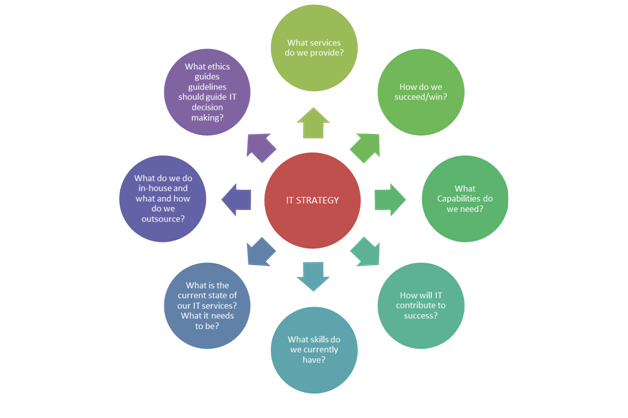
A good IT strategy must provide answers to the following questions below:


  • What services do we want to provide?


Business organisations must clearly define the product or services they wish to produce before IT integration. 


  • How do we succeed/win?


This details the choice of strategy the organisation intends to use, the rationale and how it will be executed. The strategy for creating value could either be through operational excellence, product leadership or customer intimacy. For example, if the organisation’s goal is to win through differentiation, more investment should be channeled towards activities such as research and development (R&D) and new product development that will lead to not just incremental but disruptive innovation. 


  • What Capabilities do we need?


This is dependent on the product or service the organisation has chosen to provide. For example, an organisation that intends to win through operational excellence would require process improvement, low operating cost, big data analytics and strong collaboration.


  • How will IT contribute to success?


The technology types needed to deliver the business needs are outlined, evaluated and the appropriate technology selected. 


  • What skills do we currently have?


Skill inventories should be taken to identify and assess the current knowledge capabilities and gaps.


  • What is the state of our IT services and Architecture? 


Business growth and expansion can sometimes have a negative implication on IT architecture of the organisation which serve as the support. Thus, periodically assessing the state of IT infrastructure and making the necessary improvement if need be would do the business more good than harm.


  • What do we do in-house and what and how do we outsource?


Technology projects vary in size, complexity and expertise. Sometimes, an organisation can choose to execute projects only in specific areas to build dynamic capabilities and core competence, while outsourcing other projects.

  • What ethical guidelines should guide IT decision making?

Ethics (rules of practice in respect single class of action) are important in creating an IT strategy. This is because as technology changes so do the society which raises ethical concern. An organisation should have an IT principle or policy that is responsible, accountable and most importantly, comply with industry best standards.

Nigerians, Get Your National Identity Number (NIN) from NIMC

4

That is the world’s finest fighter – Anthony Oluwafemi Olaseni Joshua – getting his National Identity Number (NIN) from the Federal Government of Nigeria, via NIMC (National Identity Management Commission). I got mine four years ago and did it the old fashioned way, queued and waited for 90 minutes. Though I am yet to get the permanent ID card, the number itself does not expire. I practically have not used it for anything but I did as a sign to help government work. 

Joshua might have received some red carpet treatments for his enrolment, yet, that he did it is the very reason why everyone has to do it. His simplicity, Nigerian-ness and optimism about Nigeria should inspire us to help the government on basic things, as citizens. Joshua is a real king in his game, and there is nothing anyone could imagine why he needs NIN for. But living in the UK, he understands the purpose of having order for societies to function.

NIN is FREE and if you budget 2 hours, in most cities, you will get it. I am not saying that 2 hours is a small time but people need to comply. You do not do things just because they benefit you, but because your actions could improve the society. Our strongest rope is determined by the weakest knot; Nigerians have to help the government especially when things are FREE.

NIN if implemented will advance Nigeria, from education to healthcare. Get yours today!


Autonomous Vehicles Pushing the Next Boundaries of Mobile Robotics

0
Source: Pinterest

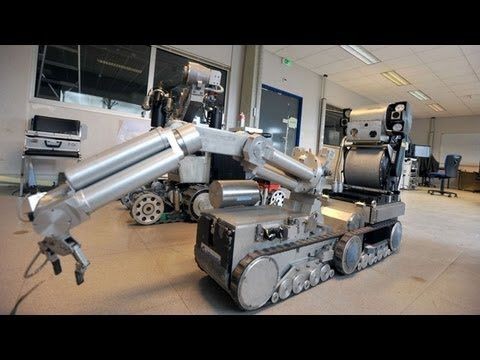
Advancement in Mobile Robotics has gone through a torturous path of seeking applications, which has seen interestingly complex robots maneuver at slow speeds due to their complex intelligence in sensory ability and navigation. DARPA, the United States of America arm of research and development in Robotics has wowed us with very interesting insights in development and application of the intelligent mobile machines, with present focus on walking robots, which can be used in hazardous environments. Yet, the field seemed like it was constantly in a state of only research.

In 2005 when the DARPA autonomous vehicle challenge, with a prize of $2,000,000 was embarked upon, it ushered a new era of research bringing in the ideas of private sector participation, many lessons learnt for the participants, with many going on to become competitors in the field today, such as TORC robotics who just signed an agreement with Daimler for the development of autonomous trucks. Still a lot of work was needed to really break the invisible line separating research and application/deployment which would establish a permanent signature of mobile robotics in our everyday world.

Fast forward a few years and the very notion of our cars, driving themselves, and being termed “driver less vehicles” simply means “Robotic Cars”, the former just being used for the general population who believe anything associated with robots means taking over the world.

Companies like Tesla, Waymo, Torc Robotics, and Zoox are at the forefront of the development, with Tesla primed to be the first to easily deploy with its currently existing infrastructure ensuring it can readily deploy its solution, with just a simple software update to its line of electric cars, in most continents of the world. The beauty inherent in the Robotic cars, is that they have opened up capabilities in mobile robotic navigation which can be deployed at extremely high speeds and still be functional with data collection and navigation. They are pushing the boundaries of the ability of mobile Robotics in other areas and applications which will no doubt lead to massive improvements in many future endeavours.

Source: Electrec

What does the future hold for mobile Robotics? it holds a great things to be imagined, lets hope our “driverless Cars” agree with us on this…….