The year 2020 holds a lot of promise for IT services provision. It’s the start of a new decade, one in which innovative technologies will drive growth at all levels.
For 14 years, Layer3 has helped Nigeria’s businesses and public sector agencies in this direction. Through services like managed security, cloud storage and connectivity, it has offered the country’s biggest organizations the platform to benefit from contemporary technology.
This journey with its customers will continue in the coming months, as Layer3 strives to improve on its service delivery. In the New Year, it will have an impressive record to surpass- a 2019 marked by multiple awards, client successes, and ground-breaking partnerships.
Work on this front is already underway. Last year, the company strengthened its staff by on-boarding new expertise. A notable addition to the team was Shatse Kakwagh, who has joined the organization as its Executive Director. Mr. Kakwagh brings with him a wealth of experience from his previous roles at leading technology firms on the African continent.
There’s also been progress made with cloud and virtual services. In July, Layer3 announced that it had entered the VMware Cloud Provider Program, with the launch of the Layer3Cloud, which runs on VMware cloud provider platform. This partnership allows Layer3 to deliver cloud computing services that meet global standards, at lower costs and with great efficiency.
In this same timeframe, the company was recognized by the London Stock Exchange Group as one of the Companies to Inspire Africa. The group’s report lists Layer3 among a number of dynamic growth businesses carving a path forward for industry on the African continent.
Also in 2019, the company was named the Best Cloud Solutions Provider for the second year in a row at the Beacon of ICT Distinguished Lecture and Award Series. The lecture organizers said Layer3 had been presented with the award for consistently introducing innovative products to the Nigerian IT services market.
These recognitions serve as a guarantee to the company’s customers that it is working to meet their service delivery expectations.
With the increasing demand from Nigerian organizations for various enterprise technologies, there’s a growing call for more IT companies in the country to fill the local content gap that exists in the sector, specifically with data hosting. Layer3 will be scaling up its operations to meet the ever expanding needs in these areas.
As a customer-centric technology firm, we are firmly set on delivering on the promises we make to our clients in 2020, on all points at which we connect with them. They can rest assured that the company’s services will remain a solid foundation on which to build the organizations of contemporary times, and of the future.
Source: Layer3.Cloud – Layer3Cloud helps organizations leverage cloud technology to maximize compute, network, and storage resources. We work with our customers to build secure, fast, and scalable solutions to deliver the integrated cloud experience they have been seeking.
Soulmate Industries Ltd, Africa’s leading indigenous hair-care and body-care manufacturer, is going digital. Since a FUTO graduate formulated the HCP Conditioner (turning a class project into a multi-billion naira conglomerate), a generation of Nigerians and Africans has found a mate, in beauty care! Other products have followed over the years, making the brand a respected player in the industry. The new Olive Oil Mayonnaise is supreme; I paid excess luggage as my wife packed everything Soulmate as we made it back after Christmas.
To the Soulmate fans, something good is coming. Yes, it is huge and amazing. That soulmate will be easier to reach and relate with, at a deeper level, via digital technology. Yes, going digital to serve beauty to customers. When you find your soulmate, it is happiness galore.
Meanwhile, interested in becoming a global or local distributor anywhere in the world, please click to explore more (PDF).
I have spent a lot of time working with this amazing technology company. Run by industry leading experts on cloud and enterprise solutions, it continues to innovate, helping large corporations, SMEs and startups find new markets. In their design center in Lagos, you will find young people doing amazing things on tech. They are taking it further with something amazing.
Wragby, winner of many global technology awards, has developed an ERP solution for Small businesses called wBizManager (Wragby Business Manager), to bridge this gap in the SME market space. wBizManager is an integrated suite of application that manages business processes such as sales, purchasing, accounting, human resources, customer support, CRM and inventory developed for SME.
This is truly SME-ready at less than $3 monthly subscription with 24/7 customer support.
I also want to congratulate Wragby Team for winning 2019 Microsoft Partner of the Year. Please keep my zobo, nkwobi and not-amala!
About wBizManager
The impact of technology on enterprises, large or small, is inescapable. Research shows that adopting critical technologies is one of the foremost factors propelling businesses forward, especially when easily available at a cost effective price.
However, when it comes to SMEs (small and medium scale enterprises), the story is starkly different, especially in our region, as just a few use digital technologies for business growth.
Looking at the key business goals of any SME which include improving revenue growth, increasing employee productivity, and acquiring more customers, all of which can be successfully addressed by technology; but often, the scale of investment for such solutions seems overwhelming, especially since top technology trends are developed for larger enterprises.
Wragby Business Solutions and technologies Limited, a relentless team of acclaimed world professionals, developed an ERP solution for Small businesses called wBizManager, to bridge this gap in the SME market space. wBizManager Solution is an integrated suite of application that manages business processes such as sales, purchasing, accounting, human resources, customer support, CRM and inventory developed for SME.
Some of the key benefits of this solution include the fact that it is cloud Based, cost-effective (subscription is low as NGN 1,000 subscription monthly) and availability of 24/7 In-Country Expert Support.
Wragby Business Solutions and Technologies limited with its pedigree of firsts, remains at the forefront of technological innovations through the consistent delivery of trail-blazing solutions that guarantee their customers optimum productivity.
Several reports indicate that the Nigerian real estate sector grew and also declined in some quarters between 2016 and 2019. In 2016, the sector was one of the sectors that experienced the high impact of recession, which cumulated into worst growth. Through policies and initiatives of the Federal Government, the sector exited recession in Q1 2019 after contracting for 12 consecutive quarters. Unfortunately, it entered stunted growth in Q2 2019 with a 3.84% contraction, outperformed 19 sectors to post worst growth during the quarter.
Beyond the statistics, our conversation with the experts and professionals in the sector has established that communicating products and services using the right approaches, people and materials could enhance the fortune of the sector. They were of the view that players need to key into changing demographics and psychographics of potential organisational and individual buyers. One clear strategy proposed by the experts and professionals is the strategic use of digital platforms. According to them, the world of buying homes and other real estate products including services has been disrupted by the emerging communication technologies. The world is now digitalised and buyers want to experience the digital process towards sustainable value derivation.
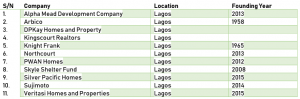
Like other markets, Nigerian players are also employing digital platforms for their products and services marketing. Despite this, there are challenges and issues in the approaches being used to communicate value to the prospective buyers, our analysis reveals. We understood this through the mapping and analysis of 11 companies’ messages on LinkedIn and Facebook in 6 months out of 33 companies initially select. The companies presented in Exhibit 1 are those with the needed content for our analysis during the period. With this, our analyst argues that it would be difficult for the companies without messages to make significant contributions to the understanding and the growth of the sector. The results establish several implications and the need to revisit processes being used for content development and people producing the content.
Exhibit 1: Select Companies and their Characteristics
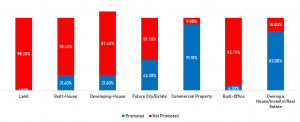
From the analysis, it emerges that Alpha Mead Development Company and Sujimoto mostly marketed future city/estate during the period. Alpha Mead promoted its Green Park and Lekki Pearl Estates extensively, while Sujimoto deployed its marketing resources towards public and prospective homeowners understanding of LucreziaBySujimoto, a project named after Lucrezia De Medici, the “daughter of the richest man in the world” and one of the most prestigious queens of the 15th century Florence.
Examining the most marketed products, we discovered that owning a house or invest in real estate in terms of buying houses for commercial purposes, having commercial property and a place in future cities or estates in Lagos State were mostly promoted by the players at the expense of purchasing land, built houses and offices [see Exhibit 2]. We also found that abilities and capabilities of building houses and other building structure categories were not properly communicated.
Exhibit 2: Dominant Products promoted by the Companies
The Place of Emotions in Wooing Buyers and Investors
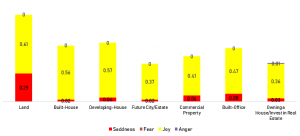
Our team was more interested in understanding digital marketing practices through social and professional media when the data signified that digital marketing personnel of the select players deployed varied emotions in the messages that promoted the products presented in Exhibit 2. It is an established rule that wooing prospective home buyers and investors require proper understanding of their emotions and capitalise on them (emotions) while developing contents because buying real estate products it is highly emotional.
For instance, buyers who are interested in healthy and safe environment will quickly respond to messages that include nostalgia, commitment, humour and happiness. In Exhibit 3, it is clear that the players prioritised happiness in marketing of land, specialised knowledge, skills, expertise and professionalism in developing houses and constructed offices. Surprisingly, they failed to emphasis happiness in the messages that promoted owning a house or invest in real estate products and future cities or estates in spite of having significant messages on them [see Exhibit 3].
Exhibit 3: Emotions in the Messages that promoted Real Estate Products
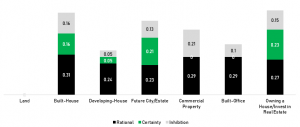
Since emotions play a significant factor in buyer impulse, our expectation was that we would find appropriate language usage, especially appealing to the psychographics of the prospective home buyers. This is premised on the fact that ‘most housing market models are based upon rational choice and optimizing behaviour.’ In this regard, we categorised players language use into three -rational, certainty and inhibition. By rational, we discovered that there are signs that buyers would be perceived as analytical based on the use of words, images among other illustrations that accompanied the analysed messages. The certainty represents the extent to which the players through the marketing personnel were sure of what they marketed, while inhibition signifies the possibility of perceiving the select players as questionable, doubtful, limited, or debatable.
Sieving through the data, we discovered that the marketers were more rational in promoting built houses, offices, commercial property and owning a house or invest in real estate products. Despite being more rational while promoting owning a house or invest in real estate products, our analysis reveals that the level of certainty was better than what was found for future cities or estate promotion (21%). One of the surprising results is the low level of certainty discovered for the promotion of abilities and capabilities of constructing houses, and high level of inhibition found for commercial property marketing [see Exhibit 4].
Exhibit 4: Underlying Language Tones in the Messages
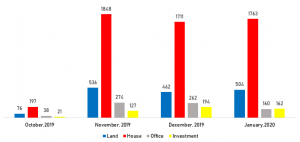
What are the implications of these results on prospective buyers and investors? We explored this further using real time data [see Exhibit 5] along with the 112 messages of the select companies within the period of analysis. We used real time data of the buyers and investors, mined from October 28, 2019 to January 25, 2020 (a 90 day period) to understand the degree to which the dominant emotions (joy and sadness) in the messages facilitated the interest of the buyers and investors in land and house purchase, renting offices and investing in real estate products.
In October, 2019, analysis shows that the reflection of happiness in the messages connected with the buyers and investors’ interest in lands, houses, renting offices and investing in real estate products by 41.8%, while it only facilitated their interest in the products by 17.5%. In November, 2019, the linkage and facilitation reduced to 39.4% and 15.5% respectively. A surge in the connection and causation was found in December, 2019. During the month, the dominant emotions ensured 40.2% linkage with the interest in the products and 16.1% facilitation in them. From January 1 to January 25, 2020, the dominant emotions ensured 45.8% connection and 21% facilitation.
Exhibit 5: Cumulative Public and Buyers Interest in Select Products
Source: Google Trends, 2020; Infoprations Analysis, 2020
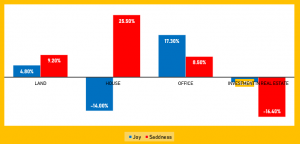
Clearly, the results are positive in three months out of the four months, but when we examined the interest using disaggregated approach (employing daily interest in land, house, office and investment) [see Exhibit 6], we discovered that the construction of the messages with the emphasis on the consequences of not purchasing land, house and renting office with adequate values increased interest in the products considerably than the adoption of happiness-centric approach. Analysis further reveals that the happiness and sadness were not enough to increase buyers and investors interest in real estate investments every day of the period of the analysis.
Exhibit 6: Emotions and Disaggregated Public and Buyers’ Interest
Source: Google Trends, 2020; Companies’ Messages, 2020; Infoprations Analysis, 2020
Strategic Options
As stated earlier, the results have several implications. It is obvious that marketing personnel, most importantly those managing digital platforms need to improve on the frequency of communicating products and the use of emotions and language. The results have also established the place of having what our team describes as POLE, which entails a proper understanding of existing and prospective buyers and investors before constructing messages and institutionalisation of tailored emotions in the right products or services.
In the past, banks felt it was a privilege for anyone to come over to work with them. Yes, provided there was no mechanism to interact and connect at scale, customers would be tethered to their exclusive ecosystems. Of course, the fintechs emerged and are now evolving rapidly across all domains. Now, banking institutions which want to play at the edges of thesmiling curve are finding ways to make their ecosystems the platforms of choice. The massive level of dislocation and disintermediation is huge that some banks now understand that a redesign would be necessary: making things easier for these new species of companies would help, after all.
Ecobank Group wants to begin the party and has launched a fintech sandbox to allow partners and fintech companies in 33 African countries to gain access to its API (application programming interface).By gaining access to the API, these companies would engineer new financial solutions. And if that happens, everything would be in the Ecobank world of commerce in Africa. Flutterwave, Esicia, Callme2Work and Africa’s Talking are companies selected for the pilot. If this type of party advances, thatmy dreamed fintech product will be built to unify African payment ecosystem very soon.
The press release
Ecobank Group launches Pan-African Banking Sandbox Lome, January 27th 2020 – The Ecobank Group announced today the pilot launch of its Pan-African Banking Sandbox. The Sandbox will allow Partners and Fintechs to access Ecobank’s Application Programming Interface (APIs) for the development of innovative solutions for the 33 African countries where it operates.
The sandbox signals a deepening of Ecobank’s commitment to working with African fintechs in furthering digital banking across the continent. This follows the leading Pan African Banking group’s appointment of a Group Senior Fintech Advisor in 2019. With these notable actions, the annual Ecobank Fintech Challenge is evolving beyond a competition to a marketplace of fintech solutions.
The Group CEO, Mr. Ade Ayeyemi emphasises that: “The sandbox is yet another indication that Ecobank firmly believes that digital banking is the future and the future is now. Hence our commitment to lead Africa into the new age of banking.
Group Senior Fintech Advisor, Djiba Diallo stressing the significance of the sandbox noted that “It will create a great avenue for collaboration between Ecobank and Fintechs, give Fintechs the chance to further innovate while developing the capacity of the wider fintech ecosystem on the continent.” Five African Fintechs have been pre-selected for the pilot launch: â— InTouch (Senegal): Provides merchants and businesses with unique solutions to accept different payment providers whilst distributing an extensive catalog of digital services across multiple countries.
Flutterwave (Nigeria): A leader in payments in Africa, providing reliable payments solutions for businesses globally.
Africa’s Talking (Kenya): A unified API platform for software developers in Africa building SMS, USSD, Voice, Payments and Airtime applications.
Callme2Work (Kenya): A one stop platform connecting specialists across a wide range of expertise to clients
Esicia Ltd (Rwanda): A software development and system integration provider – digitizing business processes for institutions across the public and private sectors.