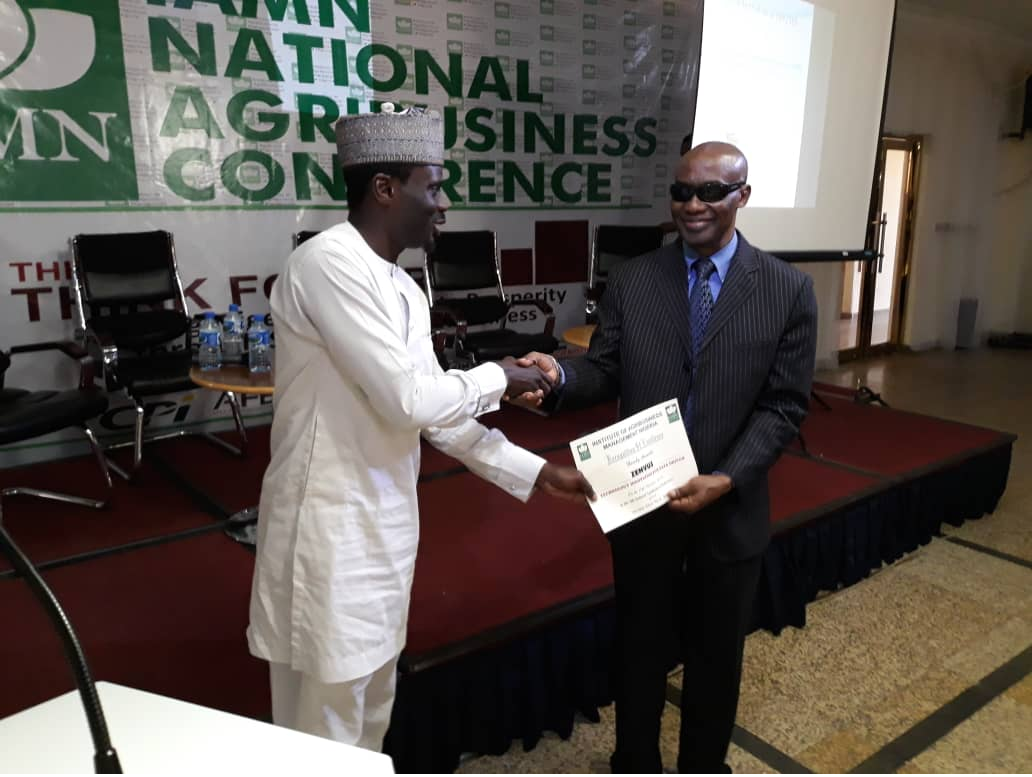
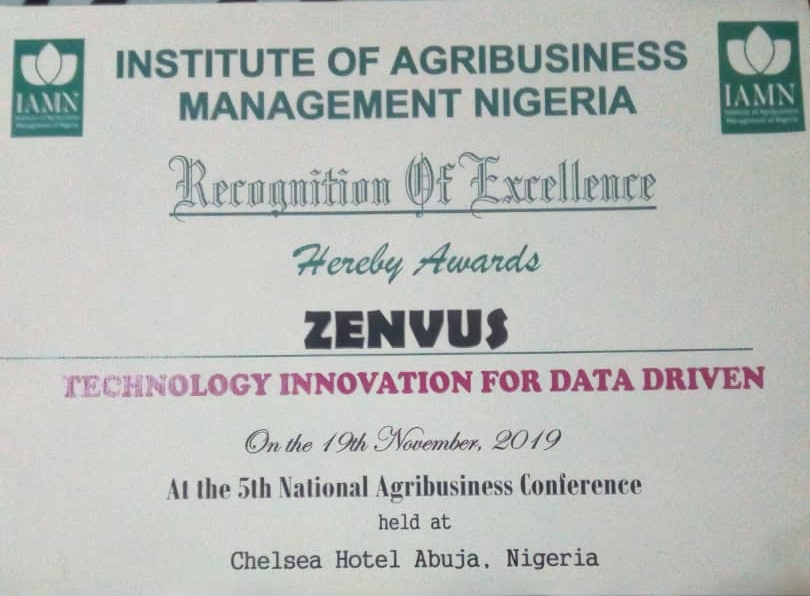
Today in Abuja, Nigeria, the Institute of Agribusiness Management Nigeria awarded a Certificate of Excellence to Zenvus for “pioneering a new agricultural system in Nigeria”. My colleague Mukhtar (on white) received the award on behalf of Zenvus and all of us. And of course, I thank Mukhtar and Fatima for excellence in business execution as both lead our business in the northern part of our nation. Thank you.
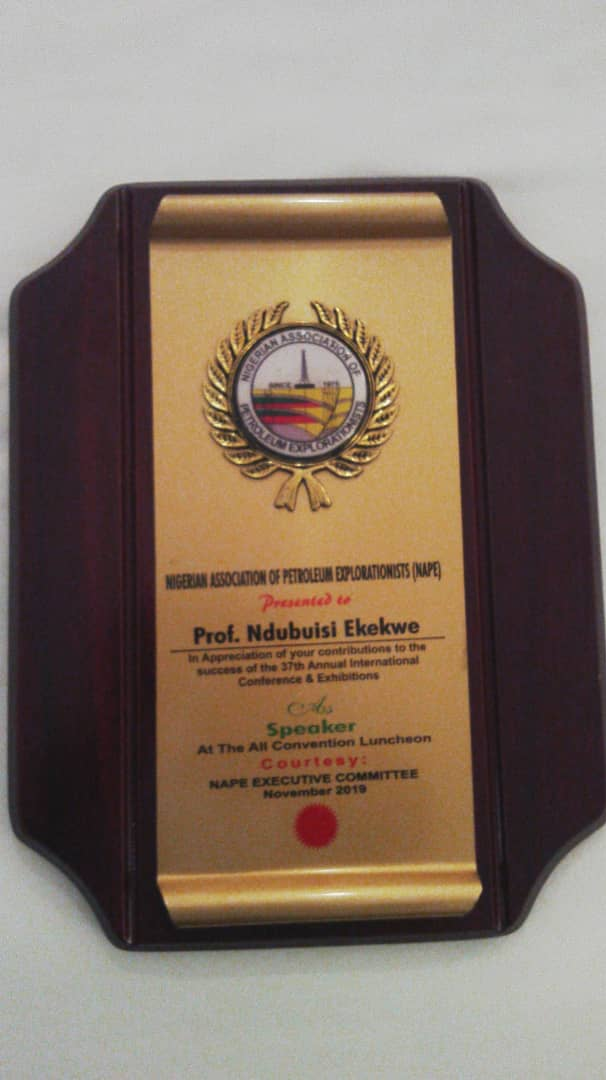
Thank you NAPE for the standing ovation after my speech today in Eko Hotels, Lagos. Thank you Dr. Avuru CEO of Seplat. Thank you Mr. Kyari GMD of NNPC. Thank you NAPE Leadership. And Thank you to all the leaders of our nation’s oil industry for making this village boy feel special. As I concluded in that speech, the oil industry remains the High Priest of Nigeria’s economy, and your market frictions are not really the hydrocarbons, but finding solutions to extreme poverty and underdevelopment in Nigeria, by making sure that all citizens can Rise via shared prosperity. You are the explorationists, and in the abundance of data, Nigerians expect a trip to the mountaintop.
As Chief Strategist of Vetifly, the “Uber for helicopter” startup which is coming to Africa, beginning with Nigeria in Q1 2020, I am building mathematical models using many data sources, structured and unstructured. The calculus and limits they taught me in FUTO have always found applications. But I need more data in one domain: preference on lifting by distance.
I need your help – help me complete this waitlist form (takes 45 seconds) at moveddifferent.ng, if flying a helicopter, ahead on traffic or connecting cities, is something of interest.
To thank you for helping,
My engine could select you for a free lift. Yes, you fly on helicopter free on a debut route.
Your first lift irrespective of the amount would not cost you more than $100.
Use the same email, register on Tekedia, and my team after validation, will give you free access to all exclusive articles, books, etc for one year (click for how). If you’re subscribed, they will extend it by one year. We’re launching 6 books on Jan 1 2020 – a great way to start a new year.
Access to my Mofied AfCFTA Playbook Webinar which is planned in Feb 2020. (Mofied means Mobility Fintech Edtech). This webinar will examine all within the context of the African free trade agreement.
Now, kindly go to movedfifferent.ng and send me the data.
One global change I would like to see solved is the eradication of poverty across Africa especially in Nigeria. In the five minutes you’d have spent reading this article, six people would have fallen into extreme poverty. Think about that for a second, these six people are not just random numbers, they are actual humans who used to be comfortable; they are your cook, your cleaner, the bus conductor and your gateman Musa.
Musa earns a monthly wage of 20,000 Naira and out of that money he’s expected to take care of himself, his wife and four kids in faraway Jigawa State. The derica of rice they used to buy for 600 is now sold for 2000, climate change has affected the yield they get from their farm, and they spend most of their income on malaria and typhoid drugs. Hence Musa can no longer afford basic provisions and now feeds from hand to mouth while going hungry for most days as various things ebb away his little income. His salary can no longer take care of him and his family. Tick tock, Musa is one of the six people that has just fallen into extreme poverty as we speak because their resilience is gone.
About 600 million people across the world live in extreme poverty, more than 70% of that number live in Africa (427 million people) of which 93 million live in Nigeria. I have been very fortunate to work with both the government and international development agencies in creating policies and initiatives that would help us take people like Musa out of poverty so I know first hand what an intentional policy can achieve in helping us reduce our poverty numbers. Last year, the Government approved a National Social Protection Policy that clearly address these challenges.
This policy lays out specific steps to provide Musa’s wife and kids with free healthcare so Musa spends less money on drugs, monthly cash stipends to cater for her and the kids, free education for the kids, Agric inputs for farming to increase their yield and skill acquisition programmes for Musa so he can learn a skill and get a better job asides being a gateman and encourages state governments to set aside a portion of their budget for their poor and vulnerable population. All these through a combination of coordinated efforts from both Public and Private sector. Currently, only two states have adopted the policy (note: adoption does not equal implementation as you still require the appropriate budgetary allocation). Meanwhile, we have seen this same strategy work in Cambodia, Vietnam and India specifically where they lift about 44 people out of poverty every minute.
Hence, I won’t waste time on this article preferring solutions to our poverty malaise when experts have spent time doing justice to this. But in Nigeria, most policies waste away as mere documents if properly implemented, so I was part of a team that carefully designed a policy implementation roadmap for the Nigerian Govt that has been validated by key players across the social development space. I spent time with the poor men of Jigawa, the malnourished children of Taraba, sick women of Zamfara and I saw how targeted social protection programmes improved their lives over time. I know this because I have been involved but so many don’t due to a lack of awareness, education and execution.
In Nigeria, our politics is short-term, this is why governors would rather build roads and empty buildings instead of investing in things like policy or education which take much longer term before the impact can be felt.
If Nigeria is serious about poverty, then it must be looked at as a National Crisis, one whose solution is apolitical. Poverty knows no party delineation, it is not APC or PDP, and if we don’t solve this looming crisis, history will not be kind on us.
With the less than two months to the end of 2019, businesses, governments and individuals have been counting the gains and losses attained during the year throughout the world. For experts and public affairs analysts, there is a need for celebration and reflection on what has been achieved and what has not been attained in line with the socioeconomic and political goals set earlier in the year.
Four years ago, African leaders joined other leaders in the world and agreed to address a number of problems facing people by 2030. They also wanted to have “Africa we want”, a continent where everyone would be more prosperous by 2063.
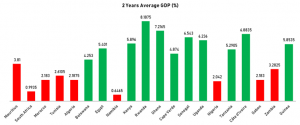
To meet the first agenda, existing information indicates that the continent needs to raise an estimated 11 per cent of GDP per year for the next 10 years to close the financing gap. Attaining the second agenda would largely depend on having the political will to implement the goals and targets of the agenda. As espoused by the analysts, the continent needs the will and adequate resources before sustainable solutions could be created and captured from the continent’s market space of about US$3.4 trillion, and a consumer base of 1.27 billion.
Source: International Monetary Fund, World Economic Outlook April 2019; Infoprations Analysis, 2019
Rumblings of Recession
Though, the governments on the continent have been working out various modalities and initiating programmes towards overcoming numerous socioeconomic challenges hindering its development in the last decade. It, however, appears that the continent would have more issues to contend with in the next decade as trade war continues among some countries, especially between the United States and China, which has been seen as one of the signs of global economic downturn in 2020. Already, the global manufacturing sector is experiencing the heat. The key US manufacturing index hit its lowest point in more than a decade recently. Report has it that the war between the US and China inflicted wound that needs to be healed by the President Donald Trump until his re-election. The failure to get the right solutions would nose-dive the economy early next year because many global companies would continue to have problems in planning their operations with the lowest investment as the main consequence.
The outcome of the consequence would be a global recession in 2020, which has been linked with the weaker growth that would be experienced in advanced and developing countries. The countries such as the United States, Germany, Japan and China with the substantial space acquisition in global manufacturing will experience a slowdown in the sector. China has already reported its worst manufacturing output in 17 years. Hong Kong, the United Kingdom, Italy, Turkey, Argentina, Iran, Mexico, South Korea and Brazil are also expected to have share of the global recession in 2020. According to the United Nations, countries and policymakers need to refocus on jobs, wages and investment. “Finance ministries and central banks should end their “obsession with stock prices, quarterly earnings and investor confidence” and instead focus on job creation, boosting wages and increasing public investment.”
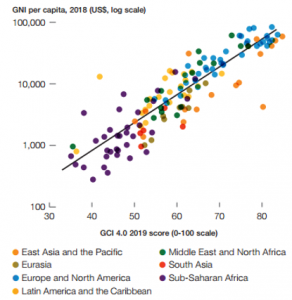
Source: World Economic Forum, World Bank, World Development Indicators, 2019
The lingering question among the experts and public analysts from the Africa and other continents is where would African countries be in 2020. Is the continent ready for the recession? Checks reveal that the continent would not be left out in having the pie of the recession because the countries identified as early places of the recession are the major trade partners of the continent. And that the competitiveness of the economies of most countries remains low since 2015 linked to weaker institutions, ineffective economic policies or programmes and a number of factors.
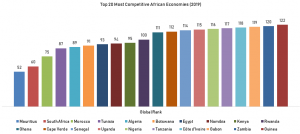
Resonating with the United Nations’ warning on the recession, the competitiveness landscape as painted by the 2019 Global Competitiveness Index indicates more efforts to restore productivity and growth to lift living standards.
“Led by Mauritius (52nd), sub-Saharan Africa is overall the least competitive region, with 25 of the 34 economies assessed this year scoring below 50. South Africa, the second most competitive in the region, improves to the 60th position, while Namibia (94th), Rwanda (100th), Uganda (115th) and Guinea (122nd) all improve significantly. Among the other large economies in the region, Kenya (95th) and Nigeria (116th) also improve their performances, but lose some positions, overcome by faster climbers.”
Source: World Economic Forum, 2019
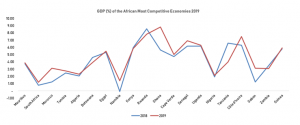
Source: International Monetary Fund, World Economic Outlook April 2019; Infoprations Analysis, 2019
In addition to the United Nations’ proposed remedies to the recession, leaders, businesses and policymakers need to strengthen the global value chain to boost growth, create better jobs, and reduce poverty while robust reforms should not be jettisoned. Africa needs to pursue open and predictable policies, and revive multilateral cooperation. Beyond these, Africa must embrace new technologies within the global value chain to create new products and increase productivity.