DD
MM
YYYY

PAGES

DD
MM
YYYY

spot_img

PAGES

Home Blog Page 6587

“The Sermon On fintech”

0

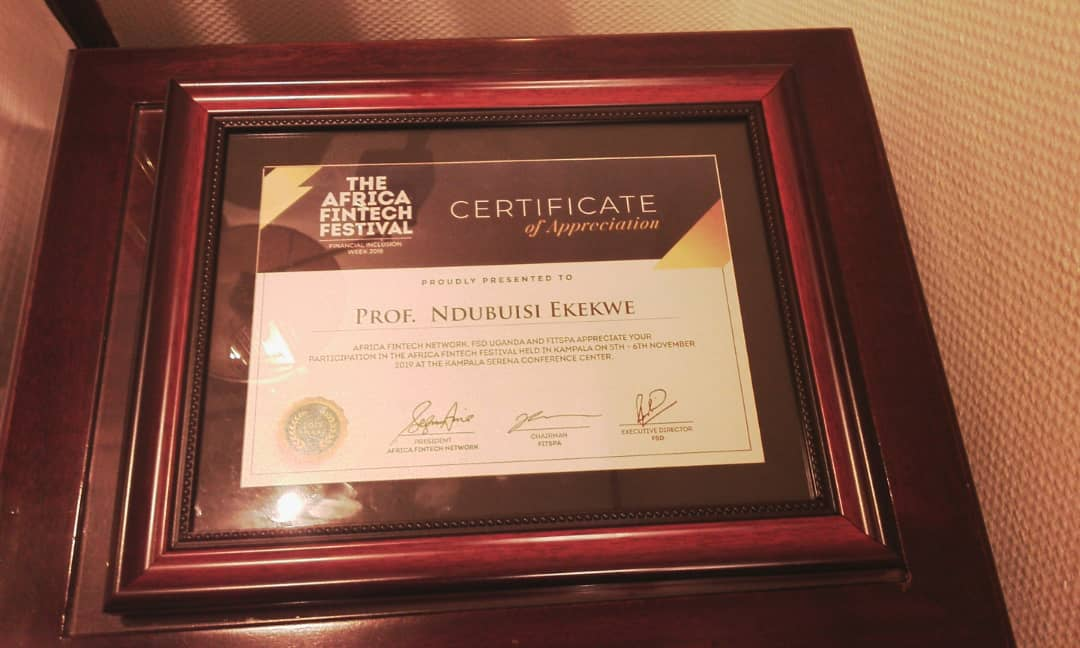
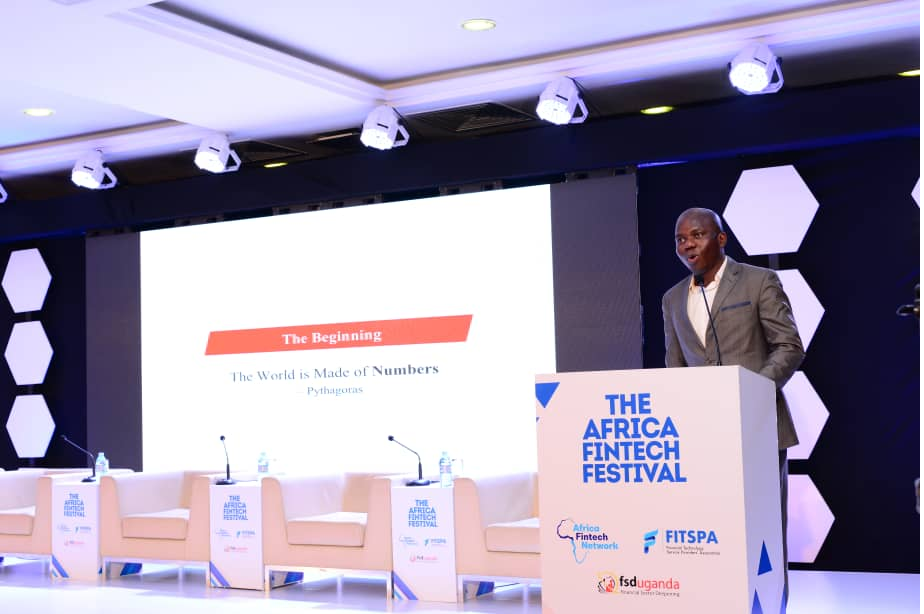
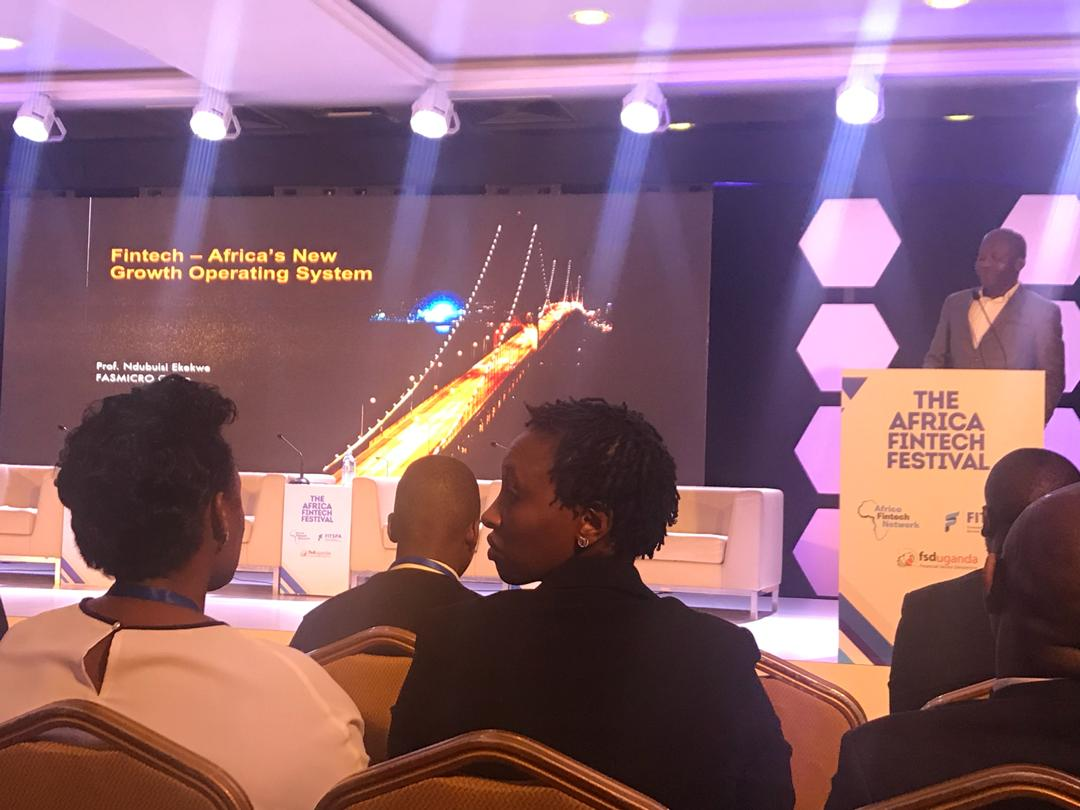
It was indeed a festival of deep business and intellectual conversations, as Africa gathered in the beautiful city of Kampala, Uganda, for fintech. At the end of the festival, I have this one to take home. In the morning, I had presented my speech. As I spoke, I went over time (not typical), but instead of the event moderator stopping me, she showed no signs. And because no one left the room or lost interest, I rewired the presentation with more vibes, on the fly, and by the time it was done, she called it “The sermon on fintech”. 

 Thank you Uganda. Thank you Africa. May fintech bring shared prosperity and the rise of ALL, not just a few!

Four Social Media Startups Winning on Uncommon Ground

0

The social media world has thrived under the dominance of Facebook, Twitter, Snapchat, Instagram, and LinkedIn. Their influence is so loud that you wonder if there will ever be a chance for any other social media startup. But there is a new breed of startups scaling through the domineering wind of the giants by doing things differently. The four of them have figured out what is missing in the dominant social media platforms and leveraged on them to pull a surprise.

TTYL

TTYL, founded by Alex Ma and Austen M, with a startup capital of $2 million, invested by Floodgate Fund, SV Angel, Weekend Fund and Shrug Capital.

TTYL makes an iphone app that aims to change how people talk to each other on the phone. The idea came when Alex Ma graduated from the university and felt he had lost touch with his friends. Although they still talked often, but there was something missing.

“I started to feel like I was losing touch with my friends, even though we were texting every day.” He told The Information that he started calling them randomly, and realized that “how we get into phone calls just hasn’t changed since the landline.”

So Alex teamed up with his brother Austen to build a place where people can feel present with their friends and family when they’re physically apart. And so came the birth of TTYL.

TTYL uses Snapchat’s nascent developer platform to authenticate new users and allow them to add custom Bitmoji avatars to their profiles. Ma said the technique makes more sense given the user overlap between TTYL’s younger target demographic and Snapchat’s. Moreover, he has no intention of selling ads so there is no need to collect people’s information: A reason why he chose Snapchat because it collects little user data. Ma said revenue will eventually be generated through optional in-app purchases or through the sales of physical merchandise.

Squad 

Another startup with a potential to scale the hurdle is Squad. Founded by Esther Crawford and Ethan Sutin, the company has raised $5 million through investors like First Round, Alpha Bridge, Y Combinator and BBG Ventures.

The idea of Squad came when Esther Crawford’s 13 year old daughter complained that she couldn’t see what her friend was doing on her phone’s screen while the two of them were talking on the phone.

So Crawford and Ethan Sutin, set out to create Squad, which lets users see what is happening on their iphone screen in real time while they’re video chatting. Squad is using apple’s software for iphone which gives developers the ability to easily capture what is happening on a user’s screen.

Squad relies on scanning user’s contacts list to suggest new friends while it’s working on developing a new functionality to discover new friends.

Over 200 million minutes have been spent on calls inside the app in 10 months of availability. The company commands a large number of young people who are between the ages of 13 and 22, most of them are based outside the U.S.

Squad also uses Snapchat’s developer platform for quick user authentication and because it has no intention to collect user data or serve ads. Crawford said:

“We’re not interested in an ad-based model. We think that the gaming model is much more interesting, where you have micro-transactions and micro-subscriptions. It aligns users with product development in a much better way. Because we want to build little things that you will actually pay for.”

YOLO

Another one is YOLO, founded by Gregoire Henrion and Clement Raffenoux with an investment capital of $2.5 million by A Capital, Bridgewater Capital, SV Angel and Weekend Fund.

The startup is an anonymous social network for young people where they can pose anonymous questions through their Snapchat stories. About five months ago, the app went up to number 1 on apps chart list, beating the odds where similar apps like YikYak have failed.

Like TTYL and Squad, YOLO leveraged Snapchat to pull a crowd of users in a very short time. The app is planning to add a new feature that includes anonymous, interest-based group chats for users who have a common interest: For instance, a workplace or a high school; using Snapchat’s Bitmoji avatars so that users can be identified by their digital avatar instead of their real names.

But there is a challenge! Due to the anonymous style of the app, content moderation becomes a top priority and the company is taking at it aggressively using artificial intelligence. About 10 percent of the messages sent fail to deliver because they are scanned and found to be offensive or hateful. Henrion said it’s a challenge that anonymity has presented.

“The challenge with anonymity is to create a healthy community, and we are doing that.”

Cocoon

Cocoon is the fourth app on the list, founded by Sachin Monga and Alex Cornell with an investment capital of $3 million funded by Y Combinator, Lerer Hippeau, Susa and Norwest.

Sachin Monga and Alex Cornell were two former employees of Facebook who sought to do things differently. Instead of allowing users to connect to as many people as possible, Cocoon narrowed the connections to closest relationships.

Although the app is yet to go public, Sachin described what they are working on as a digital space for close friends and family. The founders have been researching on a couple of things, from how people use apps to physical spaces like the living rooms, and how people interact in those spaces.

The idea is to create a method quite different from what is common in popular social media platforms that can keep family and close friends in a circle. Sachin said:

“We have a lot of latent desires that I think just, given the way everything shook out over the last 10 years, has sort of been left behind a little bit.”

Business Forecast For Nigeria

0

Business is difficult no matter where you are. It is the same thing in China as it is in Germany. In Nigeria, business is just as difficult as it is everywhere else. However, every local area has its own culture and ways of conducting business. Some businesses will be better run than others and the rules will be different depending on what business you are in and the location. When it comes to doing business in Africa, it can be a lot more difficult because corruption is higher. When it comes to the stock market in that area, it is probably worthwhile to get a finviz stock screener. Something like this will help you immensely and will be responsible for a lot of your success in business.

In Nigeria, stock markets are just like in other places, with a few differences. The most important thing to consider is that Nigeria is a country on the growth path. Having found a lot of oil, Nigeria has taken off and is consistently growing. It is one of the leading growth engines of the continent of Africa and as time goes on there will be a lot more people doing business there. The benefit of this is growth has led to a stock market boom. As the stock market rises and gets better, people are finding that their lives are also coming easy to conduct and they are able to have fulfilling and meaningful things happen to them. As time goes on, this will only get better and better.

Nigerian Business Leaders

Business leaders in the country are also finding out that it is possible to get more money by creating value in the local community and finding people who want to buy their goods and services. The best part about this is eventually things will get to a stage where business leaders and normal everyday people will be able to have a first-world lifestyle. However, the biggest impediment to growth is the freedom to do business in that country. There are 110 countries where it is easier to do business in than Nigeria. As long as this continues, you will be seeing a lot of growth problems as the country struggles with crippling regulation and eventually a recession.

The key challenges for leaders in Nigeria are how to tackle growth while also creating a free economy that can survive and strive. It is still to be seen how they will do this. One thing is certain, they can look to their neighbors to see how they have done and figure out what they can do to achieve the same results.

Oil Industry in the Area

Another factor that has led to Nigeria growing tremendously is oil. Oil has caused a lot of things to go right for Nigerians and will help them in the future. The oil boom has made Nigeria one of the largest producers of oil in the world and things aren’t slowing down. This new wealth is contributing tremendously to how the country grows and how people can live their lives in peace and prosperity. Another huge benefit of what is it has led to an energy boom where people can live more cheaply.

Oil is also something that makes up the modern world. Almost everything we use is synthesized from oil. From the plastics we use to make our products to the energy that powers our home, oil is in everything we do. Even when you have an electric car, it is still made and powered with oil. As the oil economy gets stronger, we will be seeing a lot more out of the country of Nigeria.

What Are the Future Trends

The future is bright for this country as demographically there are a lot of young people and this will lead to a consumption boom. The oil wealth will only grow and eventually it will become enough the power more education and better results. Another aspect to look at is the oil wealth will also lead to many more technical developments in this same area as Nigerians learn how to work and develop their natural resources. All of these things act as a feedback loop making the country stronger for business. The stock market will grow as a result, helping generate even more wealth.

My Problem with Academy on Lionheart And Why Africans Must Not Accept These Double Standards

5

I read all the comments on the Lionheart disqualification. I must confess that everyone is right depending on how you see it. But allow me to have my own perspectives. This is how I see it: most Nigerians are mandated to write TOEFL (Test of English as a Foreign Language) for university admission into North American schools, even though we study from primary to university levels with English language.

I have not watched Lion Heart, but anyone disqualifying a Nigerian movie, for an award, because it has too much English, is an educated illiterate on the history and culture of Nigeria. Like some good Americans, in Walmart, asking me about my country “Africa”, this Academy move demands a movie, to educate the members, about the world. Lion Heart producers and members, relax, you do not need Oscars to validate anything – Netflix had given the awards that matter!

Technically, North America thinks our “English” is not really English and is a “foreign language”. TOEFL was designed for French, Portuguese, Japanese, etc speakers but Nigerians write it because our “English” for admission purposes is foreign. That Nigerian English is alien to North American universities and they want to confirm we can communicate on English; we have accepted it in Nigeria. I wrote TOEFL to get into the American university system. Yes, I wrote TOEFL because my English was like French, but now claiming, for awards, it is like British English is not fair! You have to be consistent in the world of Academy of Oscars, MIT, Harvard, etc.

Then, for the same system to disqualify a Nigerian movie claiming the language is no more “foreign” but authentic English, even though the same Nigerian English was seen as foreign for admission purpose is double standard. Here, you want to make it heads you win, tails you win. Haba?

It is either our Nigerian English is foreign to North America (we will gladly write TOEFL) and Academy recognizes that status – yes, the Nigerian English is like French or Japanese, making it possible for Lionheart to meet the criteria. 

OR the Nigerian English is the authentic American English, and therefore not foreign, meaning that Lionheart does not meet the requirements in the category.  If that is so, American schools must waive the TOEFL for all Nigerian students just as they do for British students coming to study in U.S.

Of course, you will say that universities are different from Academy (the Oscars award people). For me, not really – you have to be consistent on how you treat people! Making Lionheart to be seen as a British or American English firm while denying Nigerian students admission for not being British and American-level English users is something I think is unfair.

Comments on LinkedIn

So ND’s argument is not about the rules of the OSCARS, it is a satire, meant to draw attention to the fact that the same group that is mandated to take TOFEL since English is deemed foreign to them, is now being disqualified because of making a movie in perfectly comprehensible English.

The African Fintech’s Final Destination

0

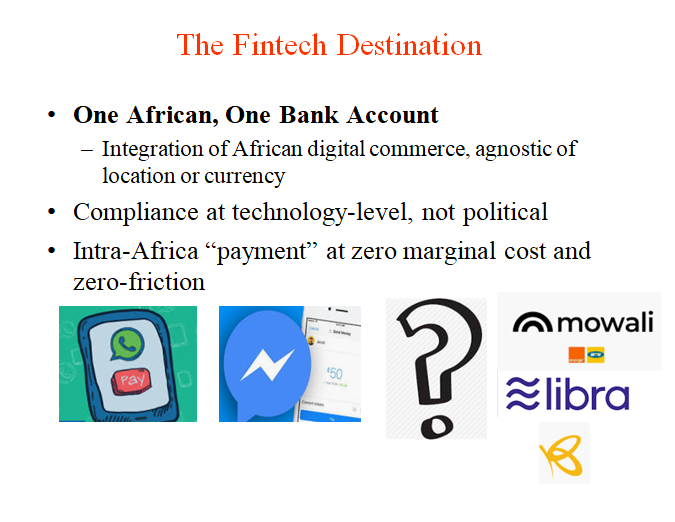
I delivered my keynote speech today in the ongoing Africa Fintech Festival in Kampala, Uganda. It went very well. This slide (below) is largely the final challenge to the community: the Fintech Destination. And you can follow some quotes on Twitter here.

The big question is this: who will do this?