
DD
MM
YYYY

PAGES

DD
MM
YYYY

spot_img

PAGES

Home Blog Page 6634

Obafemi Awolowo University Takes Lead in Open Innovation

0

This is one of the interesting things I have seen in recent times; an academic institution, whose major source of innovation is research or at best, closed innovation, is taking a big leap to transit to an open innovation system. Our education system so far in Nigeria, has been largely characterized by a one-way transfer of knowledge and information, where students have to take-in what the lecturer is saying, and regurgitate back during examination. Yes, our system tests for memory and not intelligence.

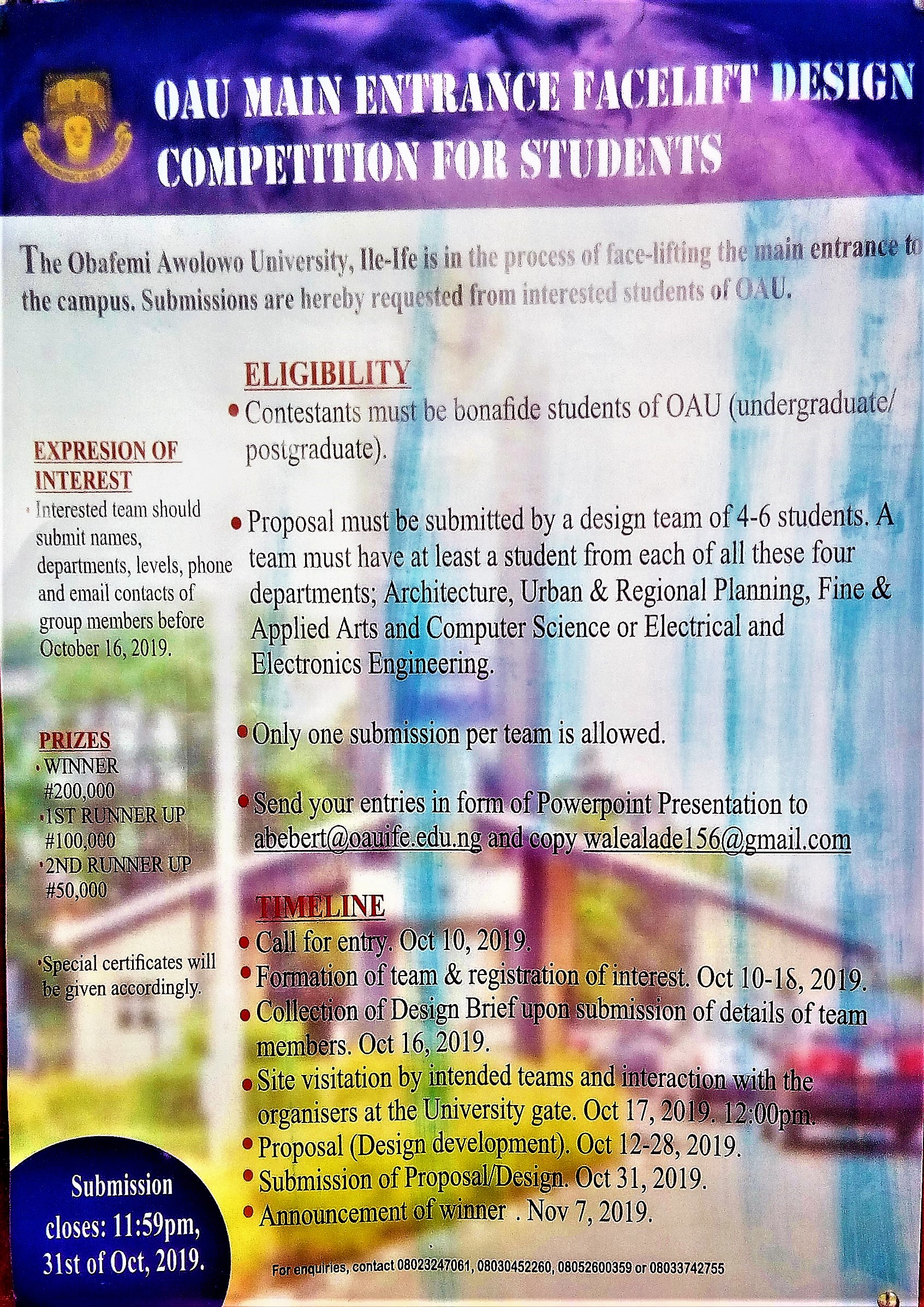
Amazingly here, Obafemi Awolowo University, is in the process of face-lifting the main entrance to the campus, and has thought it so nice, to involve students in the design phase of the project. The school is not just sourcing for ideas, they are also ready to award monetary prizes to winning students. This is a big redesign of our public system of governance in Nigeria, and kudos to the Vice Chancellor, Prof. Eyitayo Ogunbodede, for championing this initiative. Traditionally, this design could have been outsourced, or done internally, with huge sum of budget. Yet, the design will be poorly done, and the funds allocated to the design will be siphoned.

For a university with brilliant professors and design professionals, deciding to go beyond their border of innovation, and make it open source, is a big leap to our public system.  In a world of widely distributed knowledge, an institution, organization or company, cannot afford to rely entirely on their own research. Open innovation is more or less like the antithesis of the traditional vertical integration approach, where R & D activities lead to internally developed products. It is a “distributed innovation process, based on the purposively managed knowledge flows across boundaries”. By integrating a much larger variety of ideas and knowledge into new product and service development, the performance of this process will improve, and the resulting products/services will have a better fit with the customers’ requirements.
The open innovation challenge

Many big corporations such as IBM, 3M, DuPont and Boeing have explored the benefits of external innovation opportunities, transferring major new initiatives from internal resources to those that focus on external networks and communities. Procter & Gamble’s (P&G) approach to R&D is one of the most popular examples of open innovation. To have a greater grasp of external ideas and actors, P&G moved its R&D strategy from concentrating on internal R&D toward “connect and develop”. By this, P&G has opened itself up to a wide range of external sources of innovative ideas. The “connect and develop” model is based on the notion that externalities may often be more valuable than internal ideas, or they can complement the internal ideas to generate great value.

As Obafemi Awolowo University, takes the lead in student-centred design, the Nigeria public sector, must equally transit to an open innovation system, a citizen-centred governance, to develop tailored solutions and policy framework. Citizens are not meant for the electioneering process alone. They must also be involved in co-creation and co-innovation process. This is not new. President Barack Obama did it, with the Open Government Initiative, in the United States. In Canada, The Institute for Citizen-Centred Service (ICCS), was established by the Public Sector Service Delivery Council (PSSDC), and has been playing an important role in enhancing citizen satisfaction with public sector service delivery. Also, in South Africa, The Centre for Public Service Innovation (CPSI), was established by the Minister for Public Service and Administration, with the aim of improving the quality of public service through the development of innovative, sustainable and responsive models.

Nigeria has been 20 years into democracy, and despite this, the government has been employing a dominant top-down approach to governance system. Treating citizens as customers is one of the key elements in transforming public services, and has been considered a core element of the (new) public management reforms globally. Government, institutions and public authorities, must transform from bureaucratic organizations into public service provider, to be managed with a strong emphasis on transparency, accountability, service orientation and perceivable output and outcome devoted to the welfare of the citizens.

Public values must be integrated into the decision-making process, to improve the quality of decisions, build trust in public institutions and create public access to information. The “Change begins with me Campaign” in Nigeria can’t be effective, until democratic power is given to the voices of the masses. Nigerians have the capacity of citizens to pass sound judgment on public policy matters, and provide high quality contributions to the policy processes. Without the right structure, to create an open innovation culture in Nigeria, we will continue to circumnavigate cycle of poor policy, poor implementation and poor standard of living.


“Let there be showers of As”.

0

This morning, teaching in my home grace and hardwork, and faith, I went back to secondary school and the prayer before exams in the Scripture Union. We would meet for a very short prayer before the term meetup is closed. Uzoaku, our then student-leader, would close, proclaiming “Let there be showers of As”. Have a great Sunday.

Father, thank you for grace – the amazing and abiding grace.

I have worked hard this term and I am prepared.

As exams begin tomorrow, qualify me before my teachers.

And as people sleep tonight, and your angels go out to bless, remember me.

May my work shine glory to your Name.

And let people testify of Your glory because of my grades.

My hands are raised up unto the heavens – see them, Father, and bless.

David made his sound with cymbals.

I want to make mine with As in this exam.

Warning Signs for Suicide

0

The 2019 World Mental Health Day was celebrated on Thursday, 10th October, 2019. The theme for this year’s celebration was “Mental Health Promotion and Suicide Prevention”. To mark this day, a group of psychiatric doctors came from Federal Neuropsychiatric Hospital, Enugu, to talk to us in the church. They took a few minutes to enlighten the gathering on causes and warning signs for suicide. They also shared pamphlets on this fast arising problem. This post today is to mention some of the concerns raised by these doctors and the warning signs of suicide discussed in the pamphlet.

While growing up, I was taught that if I kill myself I will get the hottest part of Hellfire (I can’t remember who taught me that anyway). In fact, it never seemed that anybody will want to commit suicide. We only see that on television and we see people that do that as stupid (after all they will end up in Hellfire). I grew up with this notion, and I know a lot of people do so too. As hard as life was, a lot of us wanted to keep it.

But we are seeing something different right now. I don’t really know why but a lot of people are beginning to see the other side as better than over here. Some people attribute it to the hardship in this life, others see it as people being pushed into it by some unforeseen circumstances, and then we have those that believe it has something to do with the supernatural forces (especially the evil forces). I have even read of someone who believes that every suicide victim is possessed by the evil spirit. Well I don’t know, but I know that life can be unbearable sometimes.

Well, I thank God that our psychiatrists and psychologists are beginning to create awareness about suicide and mental health. They have been so silent about these before that I began to get worried. With their campaign against suicide and for mental health, I believe that we can now look up to a brighter tomorrow for our children.

Like I stated earlier, this post is to address the issues of mental health and suicide raised by the doctors from Psychia Hospital, Enugu (as it is fondly called). I am not a health practitioner, so I am not in a position to add or remove from what they told us orally and in their pamphlets. I will write out the points raised in the pamphlets and, if possible, chip in something they told us orally (the ones I can remember, lol) or the ones I gathered from life experiences.

A. Facts about Mental Health

  • 1. Good mental health is more than the absence of mental illness, it has to do with everything we do.
  • 2. To achieve good mental health, we must strive to take decisions and actions that will keep our mind at rest (I realised this part long ago when I noticed that too much worries and toxicity can affect my mental wellbeing).
  • 3. Mentally healthy person acts in such a way that promotes happier and more fulfilled life that can create a healthier society (this point makes me wonder how many people in Nigeria are mentally healthy, if you get what I mean).
  • 4. Good mental health is the foundation for an individual’s and community’s effective functioning and well-being (you see what I mean by what I noted in A.3? If many Nigerians are mentally healthy we won’t be experiencing some of the problems we have in our society today. My thoughts, though).
  • 5. The changing pattern of modern urban life affects mental health of the population through work pressure, social demand, the fear of failure, unemployment and loneliness. We need to be proactive.

B. Facts about Mental Illness

  • 1. Mental illness is becoming a greater problem in healthcare.
  • 2. We are all vulnerable to mental illness and during our life time nearly half of us will suffer from a significant mental illness and this may rise the longer we live.
  • 3. Even the very young children may show early warning signs of mental illness.
  • 4. More people without mental illness are more violent than the mentally ill (this really got me).
  • 5. People with mental illness get better and may recover completely.
  • 6. Most people who seek for professional treatment early are more likely to get completely better.
  • 7. One can reach his or her potentials while having mental illness (I’ve seen some of them).
  • 8. Mental illness can be prevented by addressing the known risk factors.
  • 9. Mental health and mental illness are everybody’s business; by our actions or interactions, we make the world a better or worse place for others as well as ourselves.
  • 10. Mental illness occurs by an intricate interaction between genetics and favourable or unfavourable environmental factors (so, someone that has some form of mental illness in his gene can still be fine in a favourable environment).

C. What We should Do to Prevent Having Mental Illness

  • 1. When our challenges seem to be overwhelming that we feel we can’t get out of it, see a trained mental health professional.
  • 2. When you are abused sexually, raped, bullied, or blackmailed, report to your teachers, good friends or see relevant agencies or a mental health professional.
  • 3. When you are in an abusive relationship or marriage such that you regret ever marrying in the first place, see a mental health professional.
  • 4. If you lose one or more loved one that you cannot get out of the grief after about six months, see a mental health professional.

D. Facts about Suicide

  • 1. Suicide should not be seen as a crime or weakness in character. It is due to mental health challenge.
  • 2. Suicide does not just happen, it started as a process.
  • 3. Suicide is preventable.
  • 4. Most suicidal people desperately want to live; they are just unable to see alternative solution to their problems.
  • 5. People with history of attempted suicide are more likely to complete the suicide in future (this one scares me).

E. Warning Signs/Red Flashes for Suicide

This part is divided into three – the person’s talk, behaviour and mood. According to them, once you notice any of the following signs in your children, parents, friends, co-workers, students or anybody you have close contact with, YOU SHOULD NOT IGNORE IT.

I. Talk: If the person talks about:

1. Killing themselves
2. Feeling hopeless
3. Having no reason to live
4. Being a burden to others
5. Feeling entrapped
6. Unbearable pain

II. Behaviour: These behaviours are red flashes for suicide:

1. Increase use of alcohol, cigarette or other drugs.
2. Looking for a way to die such as searching online for methods or asking such questions.
3. Withdrawing from usual activities.
4. Acting anxious, agitated or behaving recklessly.
5. Isolating self from friends.
6. Sleeping too much or too little.
7. Visiting or calling people to say goodbye.
8. Giving away prized possessions.
9. Displaying aggression.
10. Showing unexpected rage or talking about seeking revenge.

III. Mood: Don’t ignore these moods, especially if it started suddenly

1. Feeling depressed
2. Feeling anxious
3. Loss of interest
4. Feeling irritable
5. Feeling humiliated/ashamed
6. Displaying extreme mood swings
7. Anger
8. Relief/sudden acceptance

I know this is quite scary, but it is informative. Let’s take care of our mental health, and look out for one another. Life is hard already; adding mental illness to it will only compound the hardship.


Culled from The Federal Neuropsychiatric Hospital, Enugu’s campaign pamphlet for the 2019 World Mental Health Day Celebration.

Nigerian Restaurants Worldwide: A Research Agenda Part 1

0

I was just chatting with a childhood friend based in Houston Texas and this thought came to mind. Is there really anywhere you don’t find Nigerians? Do they miss home? What helps mitigate the homesickness? It all boils down (and yes, literally, to food).

I have encountered numerous Nigerians visiting the UK and London in particular, and no sooner than they have unpacked their travel gear, do they ask the same age long question.

“Is there any Nigerian eatery nearby?”

I must admit, this always comes as a bit of shock to me, as I would have imagined that only a few hours ago, these individuals would have treated themselves to some variant of Nigerian food: be it Jollof Rice, Pounded yam and Vegetble soup (edikang kong, okro, ogbono, ewedu or bitter leaf) and Suya or Fish/ Goat meat pepper soup. So what’s the impatience?

Nigerians in the diaspora know the exact needs of their brothers and sisters at home visiting these new climes. But the question is how have they responded to these clientelle. I have lived in Dubai, London, Scotland and visited Berlin, Houston, Atlanta, Florida, Tanzania and South Africa in the past decade or just over. In these journeys and sojourn, I have been rather unimpressed by the ambience of Nigerian restaurants in these locations (when compared with their counterparts).

There is a Nigerian saying that the way to a man’s heart is through food.

The same can be said about the best therapy for homesickness. Is food the only attraction? How about the atmosphere? Attitude of the waiters/ waitresses? Custmer service? Don’t even talk about the price for now.

This article is pitched as a wake-up call with managerial and theoretical implications. At the managerial level, Nigerian restaurateurs need to up their game and provide the appropriate ambiance, quality of service and innovativeness. At the theoretical level, academics should encourage students to undertake research projects on how to make Nigerian restaurants competitive especially in climes outside Nigeria.


Further reading:

Madichie, N. O. (2007). Nigerian restaurants in London: bridging the experiential perception/expectation gap. International Journal of Business and Globalisation1(2), 258-271.

The Nigerian Eagle

0
The coat of arm of Nigeria

Still in the spirit of celebrating Nigeria’s Independence and her great potential, I have been ruminating about our history, current state of affairs and the future. Because of what we momentarily go through, many of us do not see a promising future. I write to disabuse our minds with the truth about who we are and what we can be. Some say Nigeria is a failure at 59, mind you, the geographical delineation of the country is given expression by you and I, the leaders and the led, therefore, we have failed ourselves.

But the beauty of the human mind is that we can change our mentality and, thus, our fortunes. For a long time we have exhibited the mentality of a seed that relies solely on the vagaries of its environment to fulfill its potential. We must change our seed attitude to that of an eagle that is not limited by its environment.

For a seed to grow and bear fruit, the four elements of light, water, temperature, and nutrients (with or without soil) must be present in the right quantities and qualities. Anything less than this will adversely affect its fruitfulness. In the same vein, environmental factors determine the productivity of the human seed. It has been established that the greatest resource is the human mind, that is why the cemetery is adjudged to be the richest ground in the entire world. Some call Nigeria a zoo, a grave, a land that consumes its inhabitants, etc. They are quick to list negative statistics like the poverty capital of the world, number one country in open defecation, high unemployment rate, corruption, internet fraud, political and religious hegemony, nepotism, and terrorism to smear the image of the country. All of these are the mentality of a seed.

Looking at our Coat of Arms, there is an eagle that is placed above the fertility of the land, above the beauty of the flora and fauna, above the dignity of the stallions, above the great Niger and Benue Rivers, and above the sovereignty of the green and white flag. That eagle is every Nigerian. That is the strength and pride of the nation. With its wings wide open, its claws tightly clenching the wreath; we are obligated to lift our nation high to the heavens and, to the admiration and respect of other nations.

As Nigerian Eagles, we have powerful vision to see our greatness ahead. We are fearless and powerful without rivals; we are tenacious in our collective beliefs. We are high flyers, we reach heights others do not dare. And the foundation of our unity is unshakable. Do not doubt our capabilities. We stand out everywhere we go with excellent results. The world awaits our awakening and leadership. We are from the Continent of Light and the source of illumination to the rest of Africa. We are not cursed but blessed.

We should learn to have zero focus on our differences and biases and focus more on our uniqueness. The colonial masters did not create Nigeria, God did. We are not built to fail. We are not an accident nor a coincidence. If we can accept who we are the way the Lion-sheep came to the realization of who he was, then we can change our course. I have lived long enough to know that nothing is impossible to a determined soul. Would we make nonsense of the labour of our heroes or build on them?

Martin Luther King Jr. had a dream, and Obama said, “We Can.” And it’s history today. Dr. Nnamdi Azikiwe, Chief Obafemi Awolowo, and Mallam Aminu Kano dreamed, and I say, “Yes, we can!” Let us make history. We are the Nigerian Eagle! Let us rise beyond our limitations and birth the Nigeria of our dreams.

God bless Nigeria!

Long live the Federal Republic of Nigeria!