I read a post on LinkedIn, where the writer said she studied Law in a Nigerian university for 9 years. She gained admission when she was 16 years and graduated at the age of 25. A lot of people may not believe her but I can quite relate with her. I didn’t study English in UNIZIK for more than 4 years, but it took 2 good years after my final exam for my result to be ‘computed’ and released.
The undergraduate students are actually enjoying, if compared to the postgraduate ones. Because of the need to send out students to NYSC, the undergraduates seem to be treated a lot faster than the postgraduate students. In postgraduate schools, regular students are given a duration of 18 months to complete their studies while the part-time students are expected to finish up within 24 months. Anyway, that is just for the admission letter, because in reality, both part-time and full time programmes last as long as God knows when. If you complete your programme in 36 months, my dear, you are fast.
This seems to have become a culture in Nigeria. People going for their master’s degree spend the same amount of time those going for PhD do. And those that are going for their PhD already know that they are to relax and wait for the school to get tired of them and push them out. This is quite unfortunate, and it’s not helping our system in any way.
Based on my experience and that of others, the reasons for the prolonged duration of postgraduate programmes in Nigeria include:
1. Inadequacy of Personnel: Believe me when I say that the number of lecturers in our tertiary institutions is not enough. The one that causes more concern is when institutions have to ‘borrow’ lecturers from other schools to teach some courses. If they fail to find lecturers, students will have to wait till one is found for the course – there is no waiver for any course so they may have extra year because the school couldn’t find a lecturer for them on time.
Another major concern here is that the lecturers that are in the school are over tasked. The same set of people will teach the regular undergraduates, part-time undergraduates, postgraduate diploma students, master’s students and, if available, PhD students. And each of these classes contains large number of students. So, what this means is that these lecturers will teach several courses, mark scripts and assignments, supervise projects and still struggle for their personal researches and publications. To be honest, the workload is too much for them.
2. Strike Actions: I know a lot of people that are still battling with their PhD for more than 7 years now because of different strike actions experienced for some years now. The strike action most people hear of is the one carried out by Academic Staff Union of University (ASUU) and Non-Academic Staff Union (NASU). But most schools still experience internal strikes done by the staff – academic or non-academic – of a particular school. Strikes can last for months; and by the time they are suspended, it will take another few months for the school and the students to readjust and continue with their academic works. Sometimes, as one organisation is suspending their strike, another one is resuming theirs. Honestly, strike is becoming a monster that is destroying our academic world.
We know that the delay of an academic programme comes with its consequences. These consequences include:
a. Students’ Drop Out: A lot of students get discouraged along the line as a result of the prolonged duration of academic programmes. This usually happens when the students get to the thesis writing level. This period can last for as long as two years without any tangible reason. This can easily make these students less motivated to continue with their academic pursuit.
b. Release of Half-Baked Certificate Holders: Because semesters, or rather lecture periods, are too short, students do not have enough time to study their courses properly. What they do is more like jumping in and jumping out of schools.
c. Extra Expenses: If you ask most people that did their master’s degree in Nigerian state and federal universities, you will find out that they spent about a million naira, or even more, in the programme. This extra expenses came as a result of the prolonged period of time spent on the programme. The painful thing here is that the school compels students to pay for those extra years, even though it wasn’t their faults.
d. Time Wasted: The time that would have been spent on other productive things is spent on running a master’s or doctorate programme. It is hard to decide how long you can spend in a school. You know when you enter, but you can’t tell when you will finish. This is quite unfortunate. If the time for these postgraduate studies are well managed, students can plan their lives better. What is more, people that spent so much time in school find it hard to go back for further studies.
We have seen the major causes of the prolonged duration of postgraduate studies in Nigeria and their effects. But something has to be done. It is left for the school authorities to make adequate adjustments to bring an end to this. I will make the following suggestions in this case:
i. Schools should engage a lot of part time and contract lecturers so as to balance up the ratio of lecturers and students in the school. This way, the school can save cost and still ensure that the works are well done. However, these part time and contract lecturers should be paid in due time (most federal and state higher institutions are known to owe their part-time lecturers).
ii. Two project supervisors should be assigned to a student. I know some schools do this, but others need to imbibe it as well. The essence of this is to ensure that students’ project works are well supervised and done in time too.
iii. School management should set up academic calendar for the PG school and ensure that it is adhered to. The place that needs more focus here is on seminar and thesis defence; this is usually the time most delays happen.
iv. Lecturers should be encouraged to embrace technology while doing their works. It is quite disheartening that supervisors do not allow their supervisees to submit drafts of their project works through email. They expect them to come to the office to submit hard copies. This would have been ok if the students are still in school. But in a situation where the course works have been completed and the students now work from home, I think it will be better if they communicate with their supervisors electronically. If such method is accepted for journal and textbook publications, it can also be applied to thesis writing. Besides, this method can allow supervisors and their supervisees to communicate from any part of the world. In other words, supervisors can comfortably travel for conferences and still be doing their jobs.
I believe that rounding off postgraduate studies within the time frame given in admission letters is possible in Nigeria. All that is needed is adjustment by the school and the lecturers. If a student decides to delay himself, he then can be made to pay for it. But it is improper for schools to tax students for extra school fees that they didn’t accrue. Let Nigerian universities, and other institutions of higher learning, start emulating their foreign counterparts.
People have either been known as being rich or poor. Despite this, the stakeholders cannot do without devising means of taming poverty, the single indicator of knowing the poor over the years. Before Nigeria became one of the countries where people with the extreme poverty live, there are having been policies and programmes towards socioeconomic advancement. From the Structural Adjustment Programme to the Operation Feed the Nation, and National Economic Empowerment and Development Strategy to the Seven Point Agenda, Nigeria has shown significant interest in taking many out of the national and international poverty lines with little results.
In 2015, Nigerian government joined other countries for the realisation of making the plant meaningful for people to live under the Sustainable Development Goals, pledged to commit its financial and human resources to the elimination of extreme poverty (one of the 17 SGDs) across the country, especially among the people in the rural areas and women. With 10 years and less than 3 months to 2030, it is imperative that the governments reflect on the successes and challenges on the actions taken and still been taking on the Goal since 2015.
This is critical as the recent report indicates that Nigeria remains the country with the highest number of people living in extreme poverty. World Poverty Clock adds that the extreme poverty is increasing by nearly six people every minute. Failure to reduce the trend would result to approximately 3 people every minute in the next decade. Globally, World Poverty Clock puts the current escape rate per people per second from poverty at 0.5, whereas the world needs to target 1.7 rate per people per second before the world could reach the total elimination by 2030.
As concern is being raised by the professionals, policy makers and government officials in the developed countries, those in the developing countries are not resting on calling for the right policies, programmes and strategies for the Goal attainment. In its efforts, Nigeria developed its Country Transition Strategy (emanating from the MDGs assessment) which aimed at achieving the Goal and others by 2030 using three stages. In the first stage, which spans 2016 to 2020, Nigeria intends to build on the existing foundations. These foundations are expected to be scaled up between 2021 and 2025. From 2026 to 2030, Nigeria believes that no Nigerian would be left behind without benefits from the attained Goals.
Unfortunately, it appears that the country is experiencing a number of challenges in the first stage. There is an issue of having unified data for the measurement of progress being recorded at state, local and federal levels, though a few months after the announcement of the SDGs by the global leaders country’s SDGs Baseline Indicators report was released. In spite of this, over 130 global Civil Society Organisations in a statement ahead of the 2018 United Nations High Level Political Forum said there is no idea whether the 2030 Agenda is recording the desired results, especially in the developing countries. These among others have led to the Development Experts and Professionals questioning the country’s track to end extreme poverty by 2030 considering the recent report and governments’ commitment towards the Goal. This piece provides some answers to the question.
The History of Extreme Poverty
The answers could be more understood within the extreme poverty trajectories from the global to the national perspectives. From 1820 to 2015, the share of the world population living in absolute poverty moved from $2 to $1 and to $1.90 per day. With the last amount, the World Bank notes that the number of people within the threshold has reduced from about 1.9 billion in 1990 to about 650 million in 2018. The amount ($1.90) and other previous amounts used to measure level of poverty remain controversial.
In the 90s, poverty did not primarily have a place in Africa. Then, over a billion of the extremely poor lived in China and India not in Nigeria and Democratic Republic of Congo. The governments of China and India know that the rate is time bomb which will continue to have severe impact on the countries if not properly addressed. The countries really addressed the income inequality with various socioeconomic and political measures. From the East Asia to South Asia, the concentration of the global’s poorest moved in the 90s. Now, the sub-Saharan Africa is having the greatest pie of the consequences of having the high number of people living in national and international poverty thresholds.
This trend is not quite different within the Nigeria context of understanding the history of poverty. Over the years, various reports have pointed the northern region as the place with the huge number of the poor. Most of the reports have found Sokoto state as the state with the highest number of the poor in the last three years. Current statistics indicates that 81% of the population in the state is poor, while poverty incidence is much lower at 34% in Niger. Experts believe that political leaders in the region are not appropriating the resources judiciously for the benefit of everyone. In addition to this, corruption has been identified as the main factor ensuring the perpetual stay of the people in the extreme poverty threshold across the region and the country.
Where are the Governments
It is obvious that the extreme poverty trends have shifted to SSA and Nigeria in particular. The question now is where are the governments in addressing the challenge in line with the indicators developed for the attainment of the Goal. SDG 1 as conceptualised has 7 targets and 14 indicators. These represent the metrics for tracking the attainment of the targets. The first two indicators aim at measuring the proportion of population below the international and national poverty line considering gender, age, employment status and geographical location.
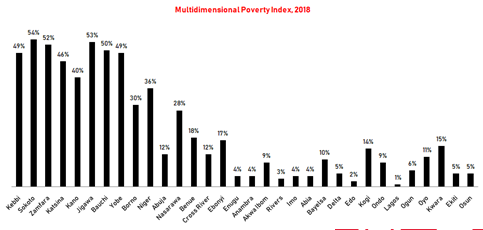
Looking at the rate of unemployment and the number of women in need of basic social amenities such as health, education and water, it would not be too far for someone to conclude that governments are struggling to attain these indicators in the last four years. This becomes more glaring when the men, women and children of all ages in the multidimensional poverty index are considered. These are the people who lack access to basic health, education, living standard and prone to various threats since 2015. For this index, a 2018 report puts the proportion of the people in it at 97 million, the highest in Africa.
As painted earlier, the north region equally remains the region with the highest number of people living in the MDI. If Nigeria will eventually not achieve the targets within the SDG1, the region is most likely to be the clog in the track of the realisation because the region has a large number of states with the people in the MDI. While the north region seems to be the real clog, a significant number of states in the south and west regions are reducing the rate of the people in the MDI. For instance, 1% of the people in Lagos live in multidimensional poverty.
Source: Global Multidimensional Poverty Index, 2018; Infoprations Analysis, 2019
In the course of the investigation and analysis, it was discovered that states and federal governments have developed varied social net programmes with the intent of leaving the people out of extreme poverty. But, there are issues militating against the full implementation of the programmes. The low budgeting for health, education and social welfare such as child protection by the governments remain the main issue. Apart from this, existing programmes are reaching a few percent of the poor because of the fragmentation approaches to project implementation. Already, the newly conditional cash transfer of N5, 000 to vulnerable households have been described by non-state actors as political tool being used by the Federal Government to favour the ruling party –All Progressive Congress.
The right to land is another indicator capable of taking a significant number of people from extreme poverty. When the vulnerable are given access to use their land for economic activities, experts say the growing poverty rate would be reduced, analysis suggests. From 1978 to 1992, and recent policies by the state governments, Nigeria has had the cause to ensure people’s right to land acquisition with little or no successes. The 1978 Land Use Act gives the state governor and local governments the power to grant “statutory rights of occupancy”.
The place of this Act in ensuring secure tenure rights to land in terms of legal recognised documentation and income status remains debatable among the experts and public analysts. According to experts and analysts, some state governors and local council chairmen are using the Act to their advantage –approved the required documents based on the people they have affinity with or organisations they have stakes in. In what appears as a new tool of making life meaningful for the vulnerable herdsmen, Nigerian government recently came up with the idea of harnessing lands for them to ease their cow rearing businesses, which some citizens and analyst frown at. The government initiated the idea in line with the incessant attacks on the farming areas and the farmers. The farmers have largely been displaced and killed by the herdsmen at various locations, especially in the northern and southern regions. The attacks add to the number of people displaced due to the Boko Haram insurgency since 2009, which constituted 79% of the IDPs population in 2015.
The consequences of the attacks, missed people, killings and kidnappings have been severe on the economic activities. For those who are saved from the attacks, many are still struggling to survive. Their lands have been degraded. The families of the kidnapped victims have paid ransoms of several millions of Naira in the last three years. These impacts are pointing to the fact that the country’s GDP is bleeding, which has the tendency of thwarting the expected GDP growth rate for 2019 and the next three years.
With the SDG 1, the Nigerian government and others are also expected to equal distribution of income. However, the last four years have been characterised with the dwindling and increasing inflation rate, causing prices to fluctuate, and increase unemployment and poverty. Nigeria’s inflation has been higher than the average for African and sub-Saharan countries for years. Despite the unstable inflation rates, the Federal Government is yet to find a balance for taxing businesses and citizens in line with the income status, fueling the income inequality across social status and geographical locations. Experts believe that the poor are being taxed heavily while the rich are enjoying various tax reliefs. A public analyst notes that “the amount of money that the richest Nigerian man can earn annually from his wealth is sufficient to lift 2 million people out of 6 poverty for one year. Lifting all Nigerian people living below the extreme poverty line of $1.90 out of poverty for one year will cost about $24 billion. This amount of money is just lower than the total wealth owned overall by the five richest Nigerians in 2016, which was equal to $29.9 billion.”
Correlates, Determinants and Consequences
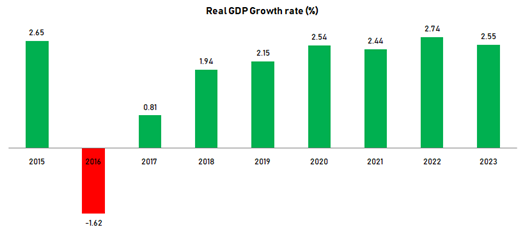
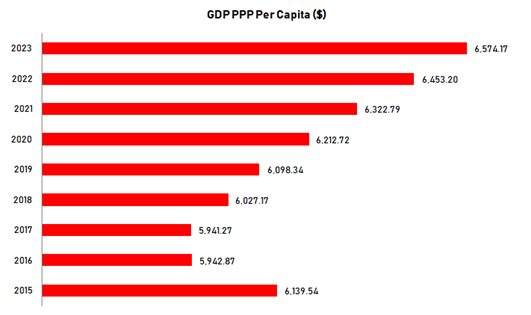
We have seen what governments’ data say about the SDG 1. For a deeper understanding of the progress made so far, there is a need to look at the correlates, determinants and consequences of the progress. From the GDP perspective, Nigerian government recorded ‘significant growth’ in 2015. This growth was hit by the economic recession in 2016, making the GDP to be at -1.62% before growing to 0.81% in 2017 and 1.94% in 2018. Examining the existing data from the GDP purchasing power parity perspective, Nigeria also had poor economic performance in 2015. The PPP is a measure that shows the economic power of the people in terms of their purchasing or spending power in a year, which could also determine the number of the people at the upper, middle and bottom of the pyramid [see GDP PPP’s chart for more understanding].
With the good macroeconomic performance examined and projected ones, it seems that Nigeria is likely to attain some of the indicators examined earlier if the results are allocated and used judiciously. However, experts believe that the poverty will increase as long as the population grows exponentially, while the economic growth remains dwindling. This indicates that the current growth of the economy will not lift people out of poverty. The economy must grow above the population.
Now, let us see the correlates and determinants that exist in the last four years among the emerged data. Analysis shows that population and economic growth had 22.2% connection between 2015 and 2018. This is an indication that one percent in population equal 22.2% increase in economic growth. In spite of this linkage, Nigeria was unable to lift the majority out of poverty within the period (see earlier statistics). During the period, the average population growth was 2.66%, while economic growth was 0.95%.
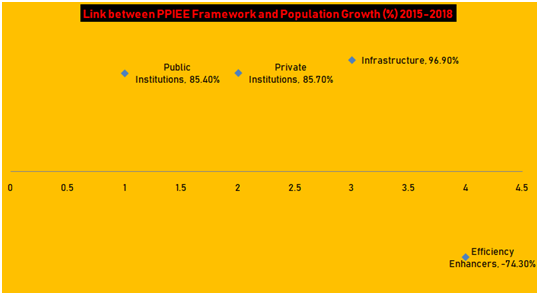
Analysis further shows that the population and PPP grew negatively during the period. A 46.0% reduction in PPP was found based on the population growth rate, indicating the low contribution of the populace to the economy and earning of the income that was not sufficient to make a standard living. Analysis specifically establishes that during the period, the average population was 188,461,404, while the average GDP PPP per capita was $6,012.71.
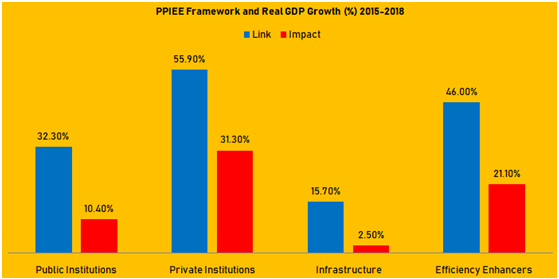
Since the economic and population grew during the period because of the people and government’s activities, the country’s economic competitiveness rankings between 2015 and 2018 were analysed along with the macroeconomic indices. The results are striking. According to the World Economic Forum, the country recorded poor rankings within the public institutions, private institutions, infrastructure and efficiency enhancers. These are the indicators appropriate for the determination of the government progress on the SDG 1.
Source: World Economic Forum, 2018; Statista, 2019; Infoprations Analysis, 2018
During the period private institutions had significant impact on the real GDP growth than the public institutions. Infrastructure had an insignificant connection with and impact on the Real GDP growth. These connections and impacts show the extent to which the poor rankings connected and severed the real GDP growth. This has many implications. For instance, the processes and activities are not sufficient to ensure good linkage with the economic growth. This is also applicable to the level of infrastructure. It is obvious that people did not have adequate facilities that could improve their contributions to the economic growth between 2015 and 2018.
Source: World Economic Forum, 2018; Statista, 2019; Infoprations Analysis, 2018
From these insights and implications, it is clear that the governments and policy implementers need to tweak the existing transition framework developed from the MDG impact assessment. It is highly commended that the Federal Government has institutional, policy and legal, partnerships, human resources, communications and financing frameworks. But, these are not enough as it could be deduced from the previous analyses that they are not really yielding the desired results. Within the institutional framework, property rights and government efficiency need to be improved upon, while the fight against unethical behaviour, corruption and undue influence should be intensified. These efforts are not be intensified by the governments alone, private sector also has significant roles to play, especially in their interactions with the public officials, politicians and other firms.
Going Forward
It has been established that one policy or strategy cannot eliminate extreme poverty in a society. Before achieving SDG 1, there is a need for mixed policies and strategies. Governments should stop measuring the number of people escaping poverty from the macroeconomic performance alone. Many countries in the developed world have stopped using this approach. Attention has been shifted to 3PT when social policy and direct household-level support become the means for reducing poverty and inequality.
The vulnerable people need to be supported with the real social assistance programmes. When this is done, they should be prevented from falling into or further into poverty. It is not enough to give them cash every month, support their informal businesses with stipend and expecting them not to be in poverty again. Many eventually spent the cash and stipend for business on health and accessing basic education. Politicians and others who have interest in eliminating extreme poverty should engage the vulnerable households in productive activities that have a propensity of increasing their income. Giving agricultural subsidies to the people who have political connections is not a transformative approach to social net programme implementation. It is a retrogressive approach that increases gender inequality and social discrimination.
Religion is meant to unite the people by teaching them how to love one another, and live together in peace and harmony, irrespective of nationality, tribe or colour. But what do we see today? Discrimination and religious conflicts. Even people with the same religion have conflicts.
Muslim parents would object against their sons and daughters getting married to Christians and vice-versa. Christians would not give Muslims any position in the work environment. These trends continue to grow from generation to generation. It deepens into our heart and causes unnecessary segregation. Are we not human?
It baffles me when I see people make religion the reason for not doing something humane. Where is the love? Where is the humanity?
Seven years ago, I fell in love with a Muslim girl. We truly love each other despite the difference in our religious beliefs. We were not even bothered by the difference between us, we just go with the language of love.
Somehow, my mom got to know about this and immediately object against it. She told me, ”As long as I am still alive, you will never marry a Muslim girl. You are a Christian and we Christians don’t get on the same page with Muslims. They are not righteous. They are into juju.”
She said many things that were not actually true about the Muslim religion. It’s obvious that many people only go with what they hear from shallow-minded people.
I told the girl what my mother said and she told me something quite shocking. She said, ”Of course, we can never get married unless you turn to a Muslim. My parents would rather disown me or kill me if I marry a Christian.”
That was the deal-breaker.
All my life, I struggled to understand why there’s a big disparity in both religions. I read my Bible and I understand one thing – Jesus was always spending his time with the people who are not even righteous. He told the people that he was here because of these people.
You look at our religious leaders, they are doing nothing to help the matter. They always preach against it. They have brainwashed our parents and make them see other religions as unbelievers. Everyone goes about with that mindset and wouldn’t want to associate with people from other religions. It’s so sad.
These are things we don’t really understand from these self-righteous messages that we preach:
Hatred: We are spreading hatred instead of love. When you make others see another religion as a barrier to their spiritual growth, they start hating on each other. They start judging each other. But who are we judge another person? Our judgement is always an opinion fueled by our own ego and bias analysis of a person.
Disunity: There can never be one nation with this type of mindset. Muslims won’t welcome Christians around them. They won’t even employ them in their own organization. The reason is clear – we are not the same. When you are preaching against another religion, simply know that you are creating disunity. Of course, disunity occurs in the absence of love.
Growth is hampered: The nation will never grow. Let’s take a look at Jurgen Klopp’s view about religion. The German tactician once said, ”Mane and Salah always fast at a particular period of time which I respect them for that because it is their religion. They always give their best with or without fasting.” That’s really a great perspective to learn from someone who understands what it takes to be human. What impact does this have on the German coach? He has transformed the Liverpool team into winners. No wonder he is currently the world’s best manager. There can never be growth in a nation that makes a big deal from differences in religions. Remember, no one chooses to be a Christian or a Muslim.
Nigeria is still suffering from this myopic way of thinking. If we are talking about having a one Nigeria, then it starts with our religious beliefs. Everyone should be free to practice the religion he wants. Everyone should fall in love with whosoever he or she deems fit to love and be with.
How someone will treat you is not based on religion. It is based on being humane and having a conscience. I have been dealt with by this so-called born-again. I have been cheated upon by these self-righteous Christians and Muslims.
We need to start looking past all these small talks. They are really not relevant to our growth and development as a nation and the world at large.
The most popular TV Reality Show, Big Brother Naija, has finally come to an end on Sunday, October 6, 2019.
You’d be surprised at the data collated from this most talked about TV Reality Show.
A data expert, Adedayo Ayodeji Faniyan collected and published a useful data analytics that summed up the whole situation in the country. According to him, he decided to work on the figures due to what he overheard his colleagues at work were saying. He said,
”A few months ago, some people were arguing at the office about the most talked-about BBNaija Housemate. I normally wouldn’t bother about it, but I saw an opportunity to solve a problem and put the discussion to bed. My team and I started collecting data with different keywords such as #BBNaija, Big Brother Nigeria 2019.”
Faniyan and his team started working on this from August 8th to August 25th, 2019. According to him, the data collected was massive and they had never imagined that they would collect that much.
Faniyan continued, ”Excel could not open the file which I was not surprised about it, so we used R/ Python to clean the Data removing all irrelevant tweets (promotional tweets).” ”Our findings was – a total of 11 million tweets were collected. 5 million tweets from this pool were not related to #BBnaija conversation, they were majorly promotional tweets with the hashtag and were deleted. We were left with a total of 6,223,189 tweets by 214,388 accounts. These were found to be related to the BBNaija housemates.” – Faniyan Faniyan concluded, ”In August, there were 4,179,480 tweets while September had 1,626,169 tweets between August 8-25, and September 1-7 and 27. 25.22% of the tweets were posted between 12am to 11:59pm while others were posted in the later hours of the day.”
Faniyan shared the link to the complete data here.
This is a real staggering stats. It is not a good omen for the country as these people are majorly youths. According to a LinkedIn Influencer and a Giant Writer, Rosemary Egbo, ”When President Buhari called us lazy, we were all angry and attacked him on social media. I think we owe him an apology. The sad state of this matter is, these youths are unemployed. But you’ll be surprised that they took from the little money given to them by their parents to vote for these housemates.” I bet you would be surprised that the majority of these people did not vote during the last election. They never even bothered to register for a voters card. When we were supposed to vote for a more competent and innovative leader, you won’t see them. They are not even concerned about the state of the nation but they are always on the internet blaming the government they never voted for. Well, I stand to be corrected though. 11 million tweets is massive, but it would be nice if we can get to see what the age bracket of this 11 million tweets were. That’s another analytics figure that would be quiet expressive.
Although I am not anywhere a fan of BBNaija as I think its a waste of necessary resources that needs to be channelled into more priority things in Nigeria, I commend Adedayo Ayodeji Faniyan for working on this.
Anyone who looks into these stats will definitely see that our youths are lazy. There are many innovative programs that could help the thinking and creativity of our youths, but they chose to spend all their limited time arguing on Twitter and trolling each other on Instagram about the best housemate. I am ashamed of our youths sometimes.
You can’t watch BBNaija from beginning to end and still blame the government for unemployment. Common! Use your head.
Read that over 200 million votes were recorded. Each vote costs 4 naira. Now let’s do the calculation – 200 million votes multiply by 4 naira, that’s equal to 800 million naira.
If the stats were to be true, that’s a whole lot of money made by the BBNaija organizers. What can the youth learn from this? – ”Always Think Creatively.”
Someone’s creative thinking has got millions of youths glued to the screen for months. Then he made over 800 million naira. Aside from that, there are many big companies that sponsored this TV Reality Show. The winner gets 60 million naira but a First-Class graduate gets 100,000 naira.
Good people, it is very amazing. Through some sponsors, the cost of my Vanguard Executive Masterclass has dropped from N350,000 to N150,000. If you have paid since I posted it here yesterday, you will be getting a refund.
We’re expecting more sponsors, and if someone/company writes the full cheque, the workshop becomes completely FREE to those that have paid.
As always, I remain humble on how my fellow citizens support any venture or initiative I pursue in our nation. Tell your supervisors, managers, and register today by contacting:
Jude on 08034187233
Ife on 09095372559
Email:Conferences@vanguardngr.com
To learn more about this workshop including theme, structure, etc, please click here.