DD
MM
YYYY

PAGES

DD
MM
YYYY

spot_img

PAGES

Home Blog Page 6651

Vanguard newspapers and its horde of retractions should concern media stakeholders in Nigeria

0

Vanguard newspaper is one of the major daily news platforms in Nigeria founded in the 80’s and owned by a veteran journalist, Sam Amuka. It is one of the newspapers that has a vibrant online presence. Like other newspapers, Vanguard, owned by a veteran journalist, is expected to uphold the highest ethics of the profession to act responsibly, be accountable to the readers and pursue truth at all times. However, the reverse seems to be the case with the newspaper house. And the reasons are not far-fetched.

It is one of the most visible newspapers online occupying the 14th position among the top websites in the country. Yet, there is a need to watch the way the newspaper publishes stories and retract such stories at a very high frequency. A search for retraction on the newspapers website would reveal a plethora of stories the newspapers has retracted. The usual composition of the retraction usually makes one wonder if Vanguard has an editorial policy in place at all. As a teacher of journalism, one begins to wonder why Vanguard newspaper goes to bed with a story it has not been able to confirm. The age long journalism maxim is “if you are in doubt, leave out.” However, this maxim seems not to be for the media house as it keeps publishing and retracting stories at will.

Vanguard newspaper in publishing false stories does not discriminate against its victims – known and unknown; high and low; persons and organizations. All have been subjected to the mentally agonizing process of being lied against on Vanguard’s platform. And then the retraction would surface days or weeks later with the media organisation apologizing profusely for putting up untrue stories. The content of their corrigendum is both laughable and worrying at the same time.

A good example is the false story published against the personality of Arc (Pastor) Oyinmebi Bribena on May 8, 2019 headlined Amnesty Boss Dokubo Alleges Blackmail, Defamation by Bribena, Other. A retraction of the story was published on June 12, 2019 where the media organization apologised for publishing false, unsubstantiated news story against the personality of the man of God/Businessman. This was more than one month after the story had been online! Why the rush to publish a story you would come back to deny its veracity?

A much more recent editorial indiscretion of the Vanguard newspaper was displayed through the much talked about story against the personality of  Prof. Yemi Osinbajo, the Vice President of the Federal Republic of Nigeria, who was wrongly accused in a story with the headline N90bn FIRS Election Fund: Osinbajo’s Problem not 2023 Politics. In disclaiming the story, Vanguard wrote : “…. we have since discovered that the story lacks factual substance and we hereby retract it in its entirety.” The retraction came two days after the story was published. Why does the media house rush to publish and come back to deny the fact of the story? Where is the gate-keeping role of the editorial team?

Putting up corrigendum for editorial mistakes by a newspaper house is a standard practice all over the world. However, it becomes alarming when such is becoming a house style as we seem to have it in the Vanguard newspaper’s case. Such culture queries the investigative powers of the newspaper and the credibility of its content. As a member of the fourth realm of the estate and the watchdog of the society, the Vanguard should tidy up its editorial policy and process to minimize the number of retractions it has to issue out. The Nigerian Press Council should as well challenge the media organization on the frequency of denying its stories.The publisher should charge his editorial board and management team to rise up to this challenge of editorial shoddiness by the media company. It is then that the principles of fairness, balance and truthfulness could be upheld by the media house.


Lessons from Design of Nations: From Faded Detroit to Ebullient Silicon Valley

4

Henry Ford began producing Model T in Detroit around 1908. In the 1960s, Detroit rose to the mountaintop and became one of the most important tech-cities in America, as entrepreneurs moved there, to pursue a future of starting a car company. The number of car startups in Detroit exceeded 100! And the future looked unbounded.

Then, OPEC (Organization of the Petroleum Exporting Countries) which began life in Baghdad (Iraq), in Sept 1960, started to work! OPEC’s work was to get members to control crude oil production in order to get more money per barrel in the international market.

OPEC contributed to the destruction of Detroit because prices of fuel went up even when Detroit car makers like Ford, GM and Chrysler were not paying deep attention to Japanese car makers who produced fuel-efficient vehicles. The American car makers have always liked their big cars, typically agents of fuel guzzling!

The Japanese introduced a huge shift, and made cars that used less fuel per mile driven, and consumers moved: expectation demand worked. Just like that, Detroit began a sustained decline as the big 3 car companies lost market shares with layoffs, and plant closings everywhere. Detroit has not recovered – in short, Detroit city went through bankruptcy, and the car makers were bailed out by the U.S. to ensure their continued existence.

Simply, Detroit was innovation. But Detroit declined. The modern American Detroit today is Silicon Valley. This is Google’s 21st birthday. Google’s impact cannot be overstated in our world; it has totally redesigned and transformed how we find and consume information. With Google, Facebook, Apple, Intel and amalgam of other companies, America has renewed even as Detroit faded. 

With Uber and Lyft, adding a new layer on Detroit, U.S. will get a part of the game in most parts of the world, irrespective of the brand of cars people use. So, in Lagos or Nairobi, even if you are using Toyota for Uber, America will get a part of that revenue. Simply, creative destruction can come but nations with inherent internal capabilities will always emerge stronger.

Creative destruction can be described as the dismantling of long-standing practices in order to make way for innovation. Creative destruction was first coined by Austrian economist Joseph Schumpeter in 1942. Schumpeter describes creative destruction as innovations in the manufacturing process that increase productivity, but the term has been adopted for use in many other contexts.

The Lesson for Nigeria

In this video, I have shared what needs to happen for us to have that internal capacities to renew. Yes, as the Kano groundnut pyramid was declining, Nigeria could have made Eket a powerful city for energy technologies. As the palm oil declined in Owerri along with cocoa in Ife, Kainji dam could have been boosted to power the next industries in Nigeria. We must be prepared for shifts and re-alignment as a nation, across all the geopolitical zones. All the young people are going to Silicon Valley, not Detroit, and America continues to thrive. Nigeria needs to see itself as one nation in order to have a big picture perspective on how to manage creative destruction as it happens.

Rise Networks Unveils AI Ideathon

0

According to McKinsey, Artificial Intelligence will redesign the operating systems of various industries. It would make many sectors to become intelligent, fueled by data. The transformative effects will be felt in agriculture, education, energy, logistics and manufacturing, and in the process will contribute $13 trillion to global GDP by 2030.

Rise Networks, Nigeria’s premier AI powered learning, research and work readiness centre, that created  ISE, the first career coach job Bot in West Africa, has launched a National Artificial Intelligence Ideathon for game changing ideas  which will fix frictions in education, agriculture, healthcare and financial inclusion.

This AI Ideathon is open to data scientists, students, academicians,  working professionals, developers and other enthusiasts across Nigeria who will develop innovative solutions that will solve various paralysis in the country and encourage industry focused research and development that will birth AI innovations to transform various sectors. 

Winners will get an opportunity to present their AI applications to public sector decision makers, C-Suite players, entrepreneurs, venture capitalists who will help them execute and scale their solutions.

They will also be rewarded with modern work tools such as a 2018 13 inch Apple Macbook Pro+ $1000, a 13.5 inch Microsoft Surface Book 2, a 13 inch 2018 Apple Macbook Air along with the publication of their ideas in The Rise Labs National AI Innovation ebook, mentorship by AI thought leaders in Nigeria and around the globe, national public recognition and opportunity to network and fundraise at Workplan’s‘’Africa’s Action Plan on Education and the Future of Work for the Youth’’ on November 23rd 2019. Besides, they will get a free 3-6 months workspace, incubation and technical support at Rise Labs.

Entry submissions began on August 19th 2019 and will end on September 30th 2019.  Participants must be 18 years and above while minor must have the consent of their parents or guardians.

Nigeria needs AI powered ideas to solve some of her challenges in security, education, healthcare, agriculture, logistics and transportation, retail, manufacturing, oil and gas, justice delivery to transition to an intelligent economy.

Studying The Endangered Discipline of Communication in Nigeria and The Ways Out

0

As a teacher who specializes in teaching media and communication studies, I have realized that the discipline is very competitive. The competition manifests in the number of graduates produced in the monotechnics, polytechnics and universities offering this course. Graduates who offered the course also get competition from graduates of other disciplines who are keenly interested and bountifully talented as broadcasters, writers and content provision generally. It is a talent driven discipline. People who are ordinarily gifted with the skills of presentation and writing would want to have a stake in the media and communication industry.

 The power of learning from the internet is equally an issue. Young people now warehouse skills using YouTube and other websites offering free courses in the discipline. More so, some of the components of media and communication studies are highly sought after by the industry. When all these factors are put together, there is a high tendency to declare the media and communication studies a threatened species among other disciplines. High competition from the massive number of students offering the courses as well as external threat from those outside who are either talented or who employed self development to warehouse some of the skills that make one a complete mass communicator are pointers to the danger awaiting mass communication graduates beyond the four walls of the school.

 The situation is made graver with tertiary institutions that fail to equip their students with the necessary skills. Most often, this is caused by the huge of number of students admitted. And largely by a lack of resources. Over populated classrooms make real and impactful training practically difficult. Studios that are supposed to be equipped and which should serve as a laboratory for the students to experiment their skills and discover themselves are most often and sadly under lock and key. Internship or what is particularly referred to as media attachment is not supervised by the departments. This makes students lose interest in ensuring that they get the necessary link up with the industry.

In the face of these issues with the pedagogy of communication and media studies, what could be the way forward for those who are currently on training for mass communication or media studies? As a teacher of mass communication, I have some pieces of advice for those in training and the graduates already in the labour market. 

One, as students in communication or media studies, you have to ensure you get  skilled up whether your department makes it a compulsory part of the curriculum or not. This means you have to take the path of self development. Fortunately, the internet is a big classroom. You can choose to learn whatever skills ranging from photography, editing or presentation skills. If you do not do so, those outside of the discipline are willing to go deeper and will give you a run for your money. 

Two, practice is the next thing to embrace. After acquisition of skills in your area of choice, what you need to do create a space for yourself is to ensure you practise the skills you have learnt. You can create a blog and write for yourself. You can as well write for other platforms online. If you want to specialize in presentation, you can attach yourself to a local television or radio station by offering to give your service for free. The pay you get is the opportunity to create a portfolio for yourself and develop your work experience. Whether you create a platform for yourself to write for blogs or create your own blog or Youtube Channel, you get to stand out from competition.  

Three, create a social media account to prepare for the world of work. Professional social media sites such as LinkedIn give you the platform to showcase yourself and market your skills. They also provide you the link to follow your choice media companies you want to work for. A display of your past works or writings can land you a job. They are also reference points for your employers to understand you have the required skill sets to function within their companies. This equally stands you out of the game. 

As commonplace as these ideas may sound, they are important tips that students and graduates of communication or media studies and its variants in Nigeria need to uptake. I have noticed that there is a lack of the understanding of both the intensity of the competition from within and outside of the discipline as well as the required insight to prepare for the future. The earlier this is learnt, the better for the concerned segment of the Nigerian graduates.

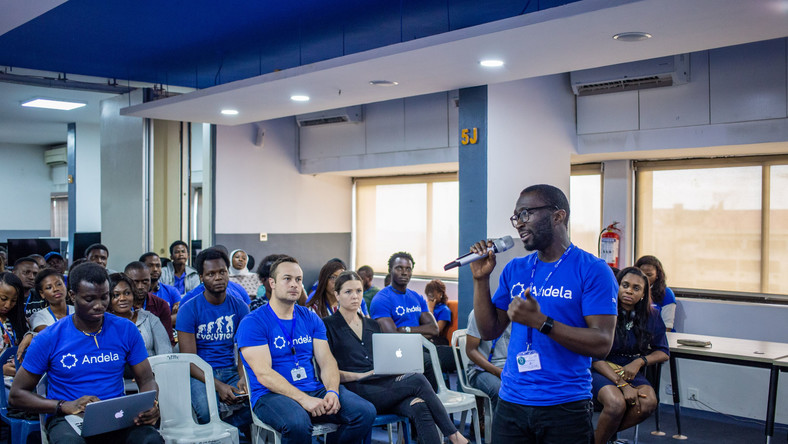
The Andela Experiment

2

This is thought-provoking: the construct in Nigeria has been consistent – universities should educate, prepare and unleash to the economy competent graduates. But Andela has shown that doing just that ALONE is not enough. Yes, you can have all competent graduates (by global standards) but if there is no opportunity, they will not flourish. That explains why in a world where software developers are scarce, a company in Nigeria is firing hundreds! Simply, there needs to be opportunities before the agents of productivity can work! This Olumide Durotoluwa’s observation deserves deeper thoughts form policymakers! 

One of the arguments against the Nigerian education sector, is that they do not churn out the right talent. While this is very correct, but here, we see an educational firm, with a global market, producing the right talent, yet limited by the diminishing returns of marginal productivity. For a quick reminder, the law of diminishing marginal returns, states that when an advantage is gained in a factor of production, the marginal productivity will typically diminish, as production increases. On a macro level, this implies that, even if the Nigeria education system, churns out the right talents, without creating an economic opportunity for them, we will continue to experience the same problem.

Obviously, Nigeria has crossed the productivity threshold a long time ago, where an increase in labour force, can no longer bring the desired increase in economic productivity.  When productivity fails to grow significantly, it confines potential gains in wages, corporate profits and living standards. The resulting effects are underemployment, talent exodus, increase in the cost of education, etc.

Except the government, corporate organization, create an eco-structure, which can continue to absorb the increasing number of graduates, while at the same time, funding education, it will be difficult to make giant economic strides.

I must confess that his observation is deep.Have 20 Andelas in Nigeria but without opportunities, the brilliant geeks will stall, and possibly leave the nation. Simply, there is a limit a nation can get to without a strategic plan that harmonizes all elements at the same time. We cannot waltz into prosperity as a nation – broad strategic plan is imperative. 

You may think it is graduating brilliant graduates only to be thrown off that you have them, and will not know what to do with them. This is a huge (unexpected) discovery that Andela has provided for the nation. Let me call it the Andela Experiment: the availability of extremely brilliant and competent graduates without opportunities will not advance Nigeria, other factors are critical and required to make use of the graduates, and ensure they are not jobless!

The Andela Experiment needs more examination because it has shown that even the universities ALONE cannot save Nigeria, at least in the short-run.

The Andela Evolution – Fires 420 Engineers