DD
MM
YYYY

PAGES

DD
MM
YYYY

spot_img

PAGES

Home Blog Page 6654

Africa and the Responsibility to Protect, a Costly Political Choice

0
Africa Union AU

On September 20, 2019, Country representatives at the on-going 74th Session of the United Nations General Assembly (UNGA 74), voted either in favour of or against the responsibility to protect and the prevention of genocide, war crimes, ethnic cleansing and crimes against humanity. Surprisingly, some countries decided to abstain from voting. The responsibility to protect “embodies a political commitment to end the worst forms of violence and persecution”. The principle was formed following the inability of the international community to prevent the atrocities of the Balkans and ethnic cleansing in the Rwandan massacre of the 1990s, coupled with the public outcry, criticizing the military intervention in Kosovo by the North Atlantic Treaty Organization (NATO) as overreaching and a violation of the prohibition of the use of force.

I struggle to understand why any nation within the bounds of reasonableness and good conscience would vote against a principle as laudable as the responsibility to protect. It is even worse and a sign of reckless indifference if a nation abstains from voting.

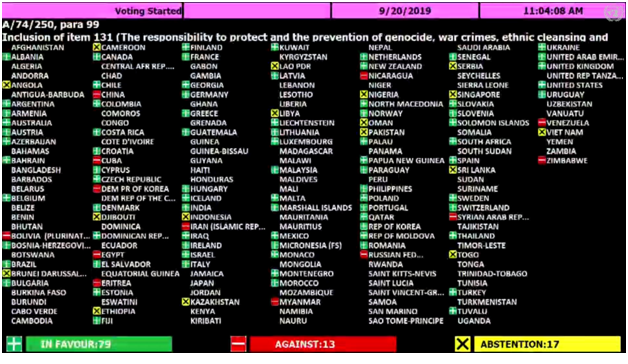
The figure below shows the outcome of the vote for the inclusion of item 131 (the responsibility to protect and the prevention of genocide, war crimes, ethnic cleansing and crimes against humanity) in the draft of the agenda of the 74th session of the UN General Assembly.
Source: UN General Assembly 74th Session.

The UN General Assembly is the main deliberative, policymaking and representative organ of the UN. All Member States have equal representation and each of the 193 Members in the Assembly has one vote. It is important to note that votes on all resolutions require a simple majority except recommendations on peace and security, the election of Security Council members, Economic and Social Council members, and budgetary questions which require a two-thirds majority of vote by Member States.  Unfortunately, resolutions passed by the UN General Assembly is not binding on Member States. That power resides only with the UN Security Council acting under Chapter VII of the Charter.

The non-binding power of resolutions by the UN General Assembly could partly explain why of all the 50 African countries present, only Morocco, Senegal and South Africa voted in favour of including the responsibility to protect in the agenda of the UNGA 74.

ARGUMENTS AGAINST THE PRINCIPLE OF RESPONSIBILITY TO PROTECT

Besides the non-binding nature of the UN General Assembly resolutions, what could be the other reasons for the African countries that voted against or abstained from voting? Two reasons quickly come to mind – The unpredictability of the extent of force in military intervention where misuse is probable, and more importantly, the likelihood of undermining of State sovereignty. Interestingly, most of the countries that voted against the inclusion of the responsibility to protect on the UNGA 74 agenda are predominantly resource-rich countries which raises the question of trust. I get it.

Addressing these concerns would require credible commitment from intervening forces to abide by the spirit and letter of the principle as set out in paragraphs 138, 139 and 140, respectively. Note that the use of force applies only when appropriate diplomatic, humanitarian and other peaceful means fail to achieve the expected result. The principle expressly states that, “should peaceful means be inadequate and national authorities manifestly fail to protect their populations from genocide, war crimes, ethnic cleansing and crimes against humanity”, the International Community through the United Nations would intervene to restore peace. Military intervention becomes expedient under this circumstance because the world would be playing a zero-sum game if we choose not to act in the face of unconscionable and brazen crimes against humanity.

WHY DOES THE RESPONSIBILITY TO PROTECT MATTER?   

Article 2 of the Human Rights Act clearly specifies the right to life as fundamental and sacrosanct, implying that nobody, including the Government, can try to end your life. It mandates Government to make laws and take appropriate steps to protect any life in danger of death. It is basic knowledge that no meaningful development can take place in a hostile environment. Let us awaken our consciousness by at least having these conversations and subsequently following them up with conscientious actions.

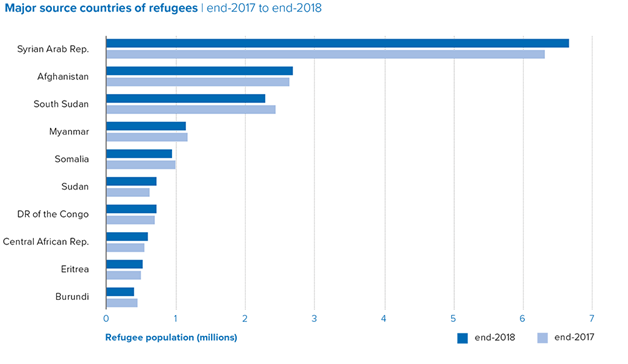
The figure below is a report by the United Nations High Commission for Refugees (UNHCR) showing the trend in source countries of refugees as at the end of 2018. African countries make up 7 of the top 10 source countries for refugees globally.
Source: UNHCR, Global Trends Forced Displacement in 2018


While South Sudan, Somalia and Burundi recorded a drop in the number of refugee seekers year-on-year, Sudan, Democratic Republic of Congo, Central African Republic, and Eritrea increased between 2017 and 2018. Responsibility to protect matters because human lives matter.

I sincerely hope that African countries have not individually and collectively made a costly political choice by their refusal to vote in favour of the responsibility to protect. Only time will tell.
Public Service Interest or Public Funds Interest

0

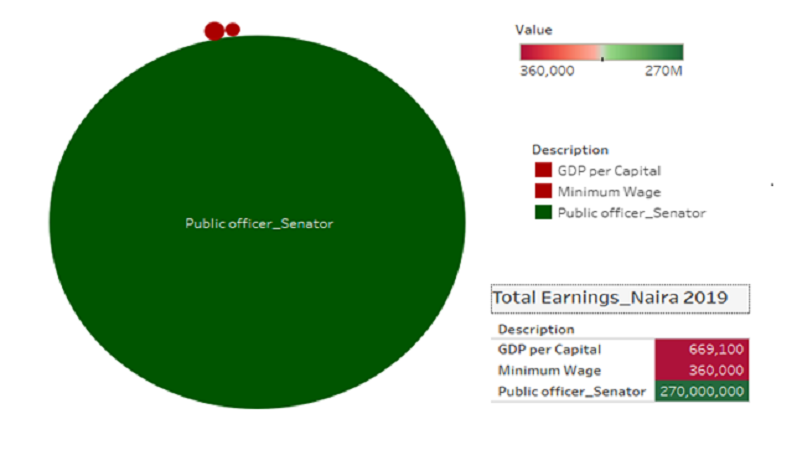
A picture is worth a thousand words, nevertheless let’s take a dive into the world of arithmetic again in addition to the above picture.

With reference to the interview granted by Senator Shehu Garba on BBC network, here is an assessment of earnings of public officers in this case Nigeria Senator against minimum wage and GDP per capita. An elected Senator has access to annual earnings of about N270 million naira while the minimum wage in the country is set at N360,000 naira annually. A simple arithmetic shows us that it will take  750 years for an employee earning the minimum wage to equal the annual earnings of the Senator while it takes the Country GDP per capita 400 years to do the same.

Now let’s consider their counterpart from a country like the United States. A US Senator annual earnings is $174,000 which is equivalent to N62 million naira while the annual minimum wage is set at $15,040 equivalent to about N5.5 million naira. It takes 11.5 years for an employee earning minimum wage to equal the annual earnings of a US Senator.

When you compare, contrast and recall the 750 years it takes for an employee earning minimum wage to equal the possible earning of a Nigeria Senator, you will quickly understand why politics is the biggest investments and dangerous venture in the Country. Remember that Senators are just a fraction of the larger political team earning from the public funds.

Considering the fact that the majority of the Country population lacks access to basic amenities,  and live in tough conditions, are the public officers supposed to be a financial drain to the public funds or it’s the financial drain itself that causes the neglect of their public responsibilities?

Why Digital Marketing Could Turn Your Business Around Positively

0

In a digital age, millions of people spend so much of their time poking around digital platforms. Businesses are becoming increasingly aware of this fact and therefore leveraging on the popularity of these platforms to promote their goods and services. How does your business leverage on this?

Marketing is the act of connecting with customers with a bid to convince them towards buying a product or subscribing to a service. Marketing, in whatever form, is one of the key activities that every business must partake in, as no business can survive without effective marketing and publicity. Marketing refers to activities undertaken by a company to promote the buying or selling of a product or service. Marketing includes advertising, selling, and delivering products to consumers or other businesses.

If the objective of your business is to sell more products or services, then marketing is what helps you achieve that goal. Anything that you use to communicate with your customers in a way that persuades them to buy your products or services is marketing, including advertising, social media, coupons, sales and even how products are displayed. Marketing is the process of teaching consumers why they should choose your product or service over those of your competitors. The key to successful marketing is finding the right marketing strategy (including your message, timing, and method of communication) to reach and influence your consumers.

Digital marketing is the marketing of products or services using digital technologies, mainly on the Internet, but also including mobile phones, display advertising, and any other digital medium.

The Benefits of Digital Marketing to Business

Digital marketing is a way to promote brands and products online and through other digital channels. Most businesses have a specific audience they are trying to reach, and digital marketing aims to help businesses reach these target consumers through the internet and other digital avenues.

There are a number of different digital technologies that marketers and companies use to get their marketing message to their target audience. In addition to their website, a company might also use PPC and display ads, email marketing, mobile technology like smartphones, social media, and other mediums to attract and engage their target consumers.

Other benefits of Digital Marketing includes:

  1. Informed Decision with the Valuable Data and Analytics: With digital marketing, you can have an idea of the exact number of people who have viewed your website’s homepage in real time. With google analytics, you can track stats and information about your marketing website. It will let you know about?—?the number of people visiting your business page their geographic location the sex, age and interests of the visitors how much time they are spending on your site the source of traffic from various gadgets website bounce rates how the traffic has changed over time
  2. Higher Revenues: It’s a well-known fact that higher conversion rates can be generated by effective digital marketing techniques. Hence, it will deliver loads of profitable benefits for your business in terms of better and higher revenues. While advertising your brand, you’re sure of getting influx of revenues from Ads and marketing strategy channels.
  3. Compete with Large Corporations: Digital marketing shouldn’t sound as foreign as binary code to you. Don’t worry if you are dealing even with a small industry. The importance of digital marketing also lies in the fact that it lets you compete head to head with big brands and large corporations. From a small vendor to a large powerhouse, digital marketing offers an affordable and effective marketing tactics. Small brands can drive traffic both locally and across the country by reaching out to their target consumers.
  4. Earn Trust and Build Brand Reputation: Digital Marketing leverages on social media signals, social proof and testimonials availed from bonafide consumers. The more reliable these social signals are, the higher the trust rate it can generate from targeted audiences. People would trust information about a particular brand if the data comes from people they know. And once you meet their expectations, your brand reputation will go viral. Eventually, it will open new doors of opportunities for reaching bigger markets. Businesses can use their digital platforms to build their company’s brand and reputation. A well-developed website, a blog featuring quality and useful articles, a social media channel that is highly interactive are some of the ways by which a business can build its brand.

Conclusion

It’s not easy as business to invest time in Digital Marketing and its Channels. Regardless, if you’re not yet utilizing the power of digital marketing for your business, you are missing a lot of golden opportunities.

Eliminating Examination Malpractices in Nigeria

0
Joint Admin JAMB Students

The importance of education in our nation cannot be overemphasized or underestimated. This is because it helps in the all-round growth and development of an individual as well as the society at large.

If we fail to uphold the principle of proper education, all we would be left with is unsatisfactory individuals being stirred out of our educational institutions.

The fact that the world today is a global village means that products of Nigerian institutions will tend to contend with students from other parts of the world in spite of their nonchalant attitude and lack of seriousness towards education. Teachers and authorities have plagued the educational sector over the years.

The Nigerian student has to prove that in a country stigmatized and often referred to as being corrupt, and also with a dilapidated educational system, can stand at par or shoulders above peers from other nations.

However, the problem with the falling standard of education is ”Examination Malpractice”.

This can be defined as an action taken before, during or after an examination that can render the results invalid.

This could involve entering the exam hall with foreign materials, copying another candidate, impersonation, exchanging answer booklets, inappropriate conversations, examiner bribery, amongst others.

Someone asked whether it is possible to end examination malpractice in Nigeria? Before I answer the question, I asked what made him say that, and he shared his story.

He told me when he wanted to rewrite WAEC in 2015, he enrolled in a private school in order to pass the exam. He said he was told that private schools have a good reputation when it comes to O’Level examination compared to a public school. The only difference – you pay more in private schools.

When the examination started, the invigilator left the school premises and the chemistry teacher wrote all the solution for them on the board. Two hours later, the WAEC invigilator came back and asked if they are through. He collected every answer booklet from the students and left with a brown envelope that indicated a bribe.

Examination malpractice is very rampant in our educational system in Nigeria. The disappointing part, it is both in the public or private school sector. Examination malpractice starts from primary to secondary school and still continues at the tertiary level. Examination malpractice leads to corruption later on in life.

Ways to Minimize Examination Malpractice

  • Schools should employ good teachers: I observe that some schools have incompetent teachers. Some teachers don’t know how to teach. Teaching is a form of communication that entails passing knowledge. If the teacher lacks good communication skills, it would be very difficult for students to learn.
  • Parents instigation: Some parents instigate their children to be part of examination malpractice. Even some parents pay money for their children in order to pass. They call it runs. That’s so sad. I think if parents can stop encouraging their children by paying for their examinations runs, it would minimize the high rate of examination malpractice. Students would sit tight and pass.
  • There should be penalties for examiners/invigilators by the government: I think most of our examiners are the anchor of examination malpractices. Immediately they’ve been offered a little amount of money, they allow the students to indulge in examination malpractice. If there is a heavy penalty (let’s say 20 years imprisonment) by the government, the rate of examination malpractice will reduce as well.
  • Computer-based examination: When the high rate of examination malpractice is unbearable for JAMB, they adopt the computer-based examination which has helped tremendously in reducing the high rate of examination malpractice. I think the government can implement this in every school.

A better Nigeria starts with corrupt-free students. If the leaders of tomorrow are taking the easiest route to success, what becomes of the nation’s tomorrow?

Think about it.

“Everywhere you go, Ballon d’Ors”

0

Chinedu Junior Ihekwoaba, I feel your pains on this one. Lionel Messi does not deserve to win FIFA Men’s Player of the Year. That he won it is unfortunate. Messi is GOAT (greatest of all time) but 2019 did not belong to him. Also, 2019 was not for C. Ronaldo.

For the fact that Samuel Eto’o (of Cameroon) never won anything of value (from FIFA) and Jay Jay Okocha never ruled African football with African footballer of the year, I have come to see football awards as part of entertainment.

Do not put much in those awards! You may be surprised that N. Ekekwe could win Ballon d’Or in December. My understanding is that Virgil Van Dijk begins with “V” and Ndubuisi begins with “N”. And when the ballot goes to N, light will go out and I will be awarded the award. On my return to Lagos, I will melt the “hardware” and create replicas of 20 million: everywhere you go, Ballon d’Ors. Now, you are playing!

Have a great Tuesday.

The Surprising FIFA’s Awards