For a while I steered at the map of the world hanging on the wall with continents silhouette like big isolated islands on a seemingly calm vast ocean and seas of water as I contemplated a series of political-cum-economic epochs, their developments and how they have reshaped the world differently from what my eyes momentarily beholds to a complex web of bilateral and multilateral relationships. Traditional economics argues that resources are fixed in supply at any given time with respect to ‘competing interests’ for their use. These interests in the mold of sovereign states realizing that their survival and relevance in the world is a direct function of access to requisite resources through international trade and commerce, have devised both fair and aggressive means encapsulated in their respective foreign policies in achieving their goals.
From ancient times to modern day, the struggle for power and wealth by nations has not changed, only the methodology and complexity has altered. Every country wants to be great. Even Donald Trump, President of the United States is still chanting, “Let’s make America great again!” A great power is defined as a sovereign state that is recognized as having the abilities and expertise to exert its influence on a global scale. By character, it wields enormous military and economic strength as well as soft power and diplomatic influence. The power equilibrium has always been unstable as major global events, most times war, determine who emerges superpower.
History has produced different sets of superpowers. For example, in the 3rd century, Rome, China, Aksum (present day Ethiopia), and Persia (present day Iran) held sway as the most powerful empires. At the end of World War One (WW1), the United Kingdom, Soviet Union, and the United States were supreme. The powers reduced to two after World War Two (WW2) leaving the United States and the Soviet Union as the super polar powers. Contemporarily, the People’s Republic of China has joined the group. If we include France and Britain to the group we get the 5 permanent members of the United Nations Security Council who can all veto important world decisions emanating from the General Assembly.
The intent of this piece is not an attempt to give a chronological account of how nations become superpowers, but to show from my perspective how the acquisition of wealth and power via the instrumentality global trade and diplomacy can enthrone a country to the zenith of global influence. Using specific examples, I will show how trade routes and their reorientation vis-à-vis China and the Silk Route have been pivotal in this perpetual quest.
Starting from my corner of the world; kanem-Borno is quintessential of how trade and commerce along trade routes enormously prospered ancient empires enabling their expansion and longevity. The Borno Empire (1396 – 1893) was a medieval African state of Niger. It was a continuation of the Great Kanem-Bornu Kingdom founded by the Sayfawa Dynasty. In time it would become even larger than the Kanem incorporating areas that are today part of Nigeria, Chad, and Cameroon. The indigenous people were the Kanuris who were naturally endowed with leadership. With this attribute, they built one of the most organized governments in the Sudan area. During this era, there were three Trans-Saharan trade routes; the empire had control of the third route stretching from its capital city at Njimi to Tripoli in Libya. Resources from the control of this route were used to wage wars of conquest against rival states. Spoils and revenues were used to further advance the trade and increase the prosperity of the empire.
By the 18th century, the dominant avenues of trade were oriented away from the Sahara towards the rising commercial ports of the Gulf of Guinea and Biafra. This was a new economic order spearheaded by Western Europe with Portugal in front. Finding it difficult to partake in the Trans-Saharan Trade, they instigated political upheavals in North Africa that destabilized trade and commerce between West/Central Sudan and North Africa in favor of the Trans-Atlantic Slave Trade. By estimates, 12.8 (approximately the population of Rwanda) million Western and Central Africans were traded as slaves for cheap labor in plantations and factories that lasted for over 400 years. It devastated a region and prospered another. Expectedly the mercantilist countries achieved surplus trade balances and increased in wealth and might. This was the most infamous trade in the annals of world history as caused by Mercantilist tendencies.
Mercantilism is an economic system that beliefs in the merits of balance-of-payments surpluses to increase the money supply and stimulate the economy with high levels of protectionism to achieve this. This practice peaked in the 15th to 18th centuries and witnessed fierce rivalry amongst European countries for state power, wealth, and territorial expansion through the acquisition of colonies in other parts of the world for raw materials and finished goods. In principle and practice, state governments and advocates of the economic system believed that military strength and state prosperity was an end in itself and could only be achieved by positive net balance of trade at the expense of neighboring countries. The protagonists were England, Germany, and France. The forces that influenced mercantilism were the Renaissance, Protestantism, Commercial capitalism, discovery of gold in the new colonies of the Americas, and the charting of new trade routes on the high seas.
The abolition of the Trans-Atlantic Slave Trade by Britain and the United States, who hitherto benefited in no small proportions, with the Abolition Acts of 1807, 1808, 1833…that finally, put an end to the trade in the 1870s and heralded the era of Legitimate Trade. This era ushered in a new kind of rivalry for more wealth, and by extension, power. Major European powers like England, France, Germany, Portugal and a few others sponsored their explorers and missionaries to explore the hinterland of Africa, mapped and documented her vast untapped resources. When they completed their assignments, it became apparent to their home governments that imperialism would be far more lucrative than fair trade.
In order to avoid warring amongst them over the virgin stupendous wealth of Africa, the 1885 Berlin Conference was convened to peacefully share the African Pie according to some variables. And so, Africa once again became a prey to the insatiable resource-hungry imperialists (Just as a lion does not spare a gazelle). How these colonial lords forcefully and greedily administered their respective colonies is excellently documented in Walter Rodney’s “How Europe Underdeveloped Africa,” 1972. He argues that, Africa’s current underdevelopment inversely mirrors Europe’s development in that Africa was deliberately exploited by European regimes.
As Africa hemorrhaged in the Atlantic, the Pacific was the battlefield for the United States and the Great Empire of Japan for geopolitical dominance in East and Southeast Asia. Under Imperial Japan’s monarchical constitution, the emperors were believed to have descended from Amaterasu, the Sun goddess, thus possessing divine rights to rule Japan. During the reign of Emperor Hirohito, Imperial Japan sought to subjugate the entire Asia with its growing military might that even China, the sleeping giant, could not resist. Japan’s imperial ambitions clashed with the territorial and economic interests of the United States, Britain, France, and the Netherlands as each of these countries had colonies in the resource-rich Southeast Asia. This was the period of World War Two (WW2) when Nazi Germany and Fascist Italy declared war with other European countries.
As tensions escalated between the United States and Japan with the potential of war, as a strategy, Japan joined the Axis power to immobilize the former on both sides of the Pacific and Atlantic when eventually it seizes control of the Philippines, Dutch East Indies, and Malaya colonies belonging to the United States, the Netherlands, and Great Britain. It is interesting to note that at this period, China and the United States were allies with the U.S. aiding and supporting China against the aggression of Imperial Japan. Before the height of hostilities, the US was the major trading partner of Japan supplying it with oil and metals for its booming economy (the same relationship holds with the US and China today).
Then came the trade war as the US imposed a series of tariffs and embargoes; the most effective was the oil embargo of 1939. For Japan, that was the straw that broke the camel’s back as it responded with a strike on the US Pacific Fleet in Pearl Harbor on December 7, 1940, and the Philippines on 8 December.This preemptive strike, Japan thought, would enable them to conquer Southeast Asia without interference. The strike was adjudged a technical victory for Japan as even the then British Prime Minister, Winston Churchill lamented, “In all the war I never received a more direct shock. As I turned and twisted in bed, the full horror of the news sank in upon me. There were no British or American capital ships in the Indian Ocean or the Pacific except the American survivors of Pearl Harbor hastening back to California. Over this vast expanse of water, Japan was supreme; we everywhere were weak and naked”.
But Japan’s victory was short-lived when in August 1945; the US dropped two nuclear bombs on the cities of Hiroshima and Nagasaki. The devastation wiped out an estimated 129,000 to 226,000 souls. Despite this, Japan was reluctant to surrender until the surprise attack from the Soviets who had a pact of neutrality with them.
At the end of World War Two, WW2, a modern Japan was born with the enactment of a new constitution that deprives the emperor of political power. Japan is today considered a regional economic power only. On the Atlantic, the end of WW2 fueled nationalistic agitations by the indigenous peoples of African colonies resulting to political emancipation for most of the colonies in the 1960s. Knowing that they cannot survive without the continuous unfettered access to the resources of Africa, the erstwhile colonialists decided to create a political and economic umbilical cord relationship that Kwame Nkruma (first president of independent Ghana) in 1963 appropriately termed “Neocolonialism”.
By definition, Neocolonialism is the practice of using capitalism, globalization, and cultural imperialism to influence a developing country instead of the previous colonial method of direct control. Also, in his book, “Neo-colonialism, the Last Stage of Imperialism”, 1956 explained this relationship. “In place of colonialism as the main instrument of imperialism we have today neocolonialism… [Which] like colonialism, is an attempt to export the social conflicts of the capitalist countries…The result of neocolonialism is that foreign capital is used for the exploitation rather than for the development of the less developed parts of the world. Investment under neocolonialism increases rather than decreases the gap between the rich and poor countries of the world. The struggle against neocolonialism is not aimed at excluding the capital of the developed world from operating in less developed countries. It is aimed at preventing the financial power of the developed countries being used in such a way as to impoverish the less developed.”
In this period of neocolonialism, the former colonialists were fond of toppling African governments that did not give in to their whims and caprices and replacing them with puppets. As neocolonialism was the new order in Asia, the Cold War and Nonaligned Movement was taking centre stage in global affairs. The Cold War was a period of global tension for fear of a Third World War just two years after WW2 between the Soviet Union and its satellites (the Eastern Bloc) and the U.S. and its allies(the Western Bloc). The two world powers were fighting for dominance in poor, low developed regions known as the Third World. The conflict was military (with nuclear warheads pile up, threats and proxy wars), political and economic rivalry. The two nations competed for influence in Latin America and decolonizing states of Africa and Asia. The Third World countries were smart to form a neutral bloc called the Nonaligned Movement which sought good relations with both blocs chiefly for aids and economic benefits.
A significant part of the Cold War was trade conflicts that was fought with trade barriers and embargoes imposed and counter-imposed between the East/West blocs. Both capitalist and socialist ideologies were at war. The Cold War finally ended after 45years on December 3rd 1989 and1990, the Berlin Wall came down, borders opened and free elections ousted communist regimes everywhere in Eastern Europe. In late 1991, the Soviet Union itself dissolved into component republics. With stunning speed the iron curtains were lifted and the Cold War came to an end.
In a previous paragraph, I referred to China as a sleeping giant and an ally of the U.S. during the U.S./Japan rivalry in the Pacific. It is interesting how countries become allies when their interest is mutually beneficial and foes when their interests run parallel. Now the table has turned, an ally has become a foe ready to wrest the global pie from the reigning superpower. With Russia relegated to the background, the trade war (always a precedent to arms conflict) has begun, who emerges victorious in the end, only time can tell. The awakening of China…
China, prior to 1978 was a nonmarketable socialist economy, in other words, it was a closed economy influenced by the Marxist philosophy of Mao Zendong, a revolutionary political icon. This system did not favor a vast majority of the Chinese masses, hence necessitating deliberate liberal economic rejuvenation after his demise. China, in earnest, began to introduce and implement capitalist market reforms in the 1970s in a successful attempt to integrate the national economy to the global economy as a way of bringing prosperity back to the people. Now a socialist market economy, it’s the second largest economy by nominal GDP(Gross Domestic Product), and the world’s largest economy according to Purchasing Power Parity, PPP, according to the International Monetary Fund, IMF. The government successfully grew the economy at an average rate of 10% for over 30 years. As the manufacturing hub of the world with lots of thriving businesses that have produced the highest concentration of young millionaires, and in the face of political and economic opposition from the U.S., it was time to spread her tentacles beyond her shores with an effective strategy that would “trump” the Trans-Pacific Partnership Agreement, TPP, been negotiated by the U.S. and other nations in the Pacific rim to check the rise of China in East and Southeast Asia.
The TPP was initiated by the U.S. in 2008 under the Bush administration and was hotly debated under Obama but Congress could not pass it. The trade pact was intended to reduce Chinese economic influence in the region. In the words of former President Barack Obama, ‘If we do not pass this agreement – If America doesn’t write these rules – then countries like China will’. The U.S. was trying to prevent a subversion of its regional and global interest by China. The idea of the TPP was not originally conceived by the U.S. but its intention to join made it necessary to rewrite the agreement in its favor. China saw the TPP as a trap to curtail its growing influence in the region and the world; therefore, she treated it with disdain and suspicion as she secretly devised her own trade strategy which she unveiled in 2013 as the Belt and Road Initiative.
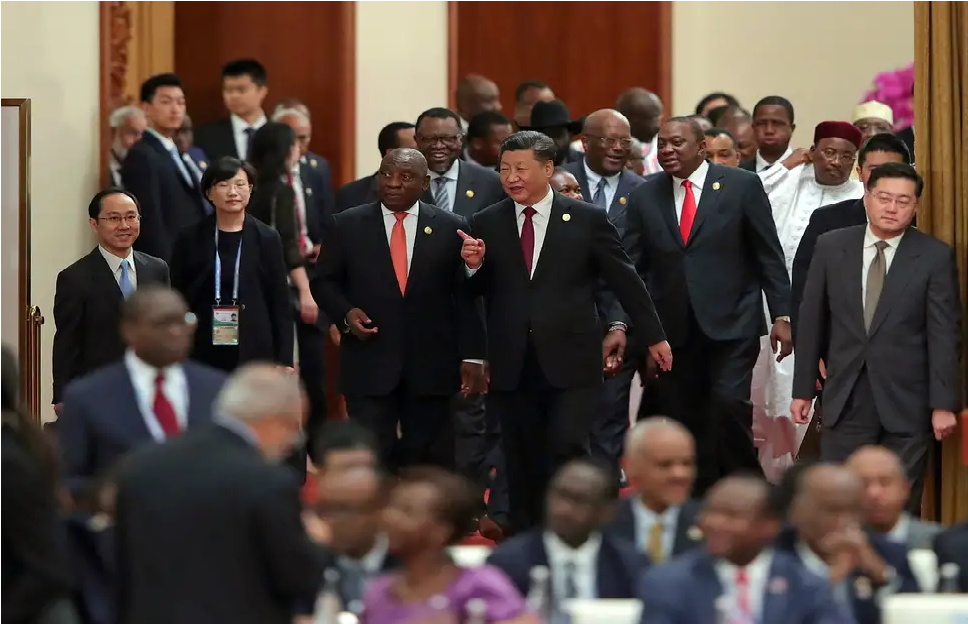
A lot has been said about the Belt and Road Initiative in the public domain and I suppose it will not be a trite if I recall its objective. The initiative is a reorientation of the ancient Silk (Trade) Route connecting Eurasian countries and East Africa with interior China. In its modern form, it stands on the foundation of the old to reconnect the rest of the world by creating a global market centering on infrastructure development, finance, cultural exchanges, trade and diplomacy. It membership transcends chronic infrastructure deficit countries of the world to world powers like Italy becoming the first G7 country to join.
The U.S. is fighting hard to remain the undisputed superpower with its withdrawal from the TPP because China outsmarted it with its own initiative and the U.S. is not ready to play second fiddle. So far, the U.S. has imposed tariffs worth over $250 billion on Chinese U.S. bound goods and services. Also, the arrest of Ms Meng Wanzhou, Huawei’s Chief Financial Officer and Deputy Chair in Canada over suspected violation of trade sanctions on Iran and North Korea. China too has retaliated by announcing tariffs of $60 billion worth of U.S. China bound products accounting for as much as 95% of all U.S. exports to China. But there is a constraint on China on the magnitude of tariff it can it can impose because its trade with the U.S. has been in its favor for decades. In 2018, the U.S. trade deficit with China was $419 billion when we subtract U.S. receipts from the trade volume: $(540-120) billion.
As it is said in Africa, “When two elephants fight, the grass suffers”. Rightly, the IMF has predicted that an escalation of the tit-for-tat tariffs could shave 0.5% off global growth by 2020. With the ongoing trade talks and the military show of force by both the U.S. and Chinese militaries in the Pacific, I scarcely foresee a repeat of the Pearl Harbor event not because of the activities of the United Nations but due to the fact that nuclear armed superpowers are more responsible knowing it is less costly to jaw-jaw than to war.
Like this:
Like Loading...