DD
MM
YYYY

PAGES

DD
MM
YYYY

spot_img

PAGES

Home Blog Page 6672

Alpha Mead’s Call2Fix App as a Disruption in Nigeria’s Facilities Management Industry

0

Like other previous decisions, the introduction of a mobile app to fix identified frictions in the building maintenance and other facilities across Nigeria by Alpha Mead Facilities, a strategic business unit of Alpha Mead Group, has shown that the company is actually ready to boost the growth of Facilities Management industry and inspire small businesses in Africa.

Bringing the product to the market is not surprising because a report has indicated that FM industry needs to be disrupted with the innovative products and solutions.  According to the report, “the industry growth depends on how the players and professionals collectively resolve issues within the processes, solutions, technology and people components of the industry.” The company has equally demonstrated that it could capitalise on its capabilities and competences towards the growth of other players, especially sub-contractors in the industry.

Call2Fix: What is in it?

Now, the question among the potential users and service providers is what is in the app? The Chief Executive Officer, Alpha Mead Group, Engineer Femi Akintunde briefly answered this question. “It is for the benefit of retail customers and SME companies who are unable to afford the FM contracts offered for their required FM services.” With this answer, it appears that the company is intensifying efforts on making people and small businesses understand the need for good facility management culture.

As an on-demand and round-the-clock digital application, users have the opportunity of calling building maintenance artisans with the capabilities and experience of handling their maintenance or repair services in homes or offices. Already, the company has trained 1,000 artisans and ready to leverage their many years of industry experience, size, technical, operational and financial capacity and the wide network of their operation across Nigeria and other African countries.

With Call2Fix, customers will be able to rate performance of the artisans assigned to them. This rating system is not just a function of remuneration for the artisan, it also determines how frequently work will be assigned to the artisans by the application. Meaning that the better rating an artisan gets, the more opportunity he has to be assigned a job by the app.”

Call2Fix and Sustainable FM Industry

As the company begins assigning artisans to the users within the initial coverage areas in Lagos, Engineer Akintunde believes that the app is a game changer in the industry because it brings more power, joy and peace of mind to numerous customers. “It is about comfort, security and efficiency of service.”

Is Call2Fix really a disruptive innovation as stressed by the CEO of Alpha Mead? The answer to this is best gleaned from the number of services expected to be sought by the users. From soft to the hard services, the app will definitely disrupt the Facilities Management industry in Nigeria and African countries, where it has presences.

In Nigeria, the emergence of the app has demonstrated that companies within the passive category, offering services such as electrical and electronic, civil works, plumbing, HVAC, cleaning, domestic helps, carpentry, home appliances, fire systems, gardening, waste management, swimming pool, relocation services, office equipment and scaffolding need to tweak their people and solution innovation processes towards sustainable value capturing from the app. There is no doubt; active participants (players offering integrated facilities management solutions) have been pushed to the wall. The expectation among the industry experts is the emergence of another app that will fix other frictions in the industry.

Long Road Ahead
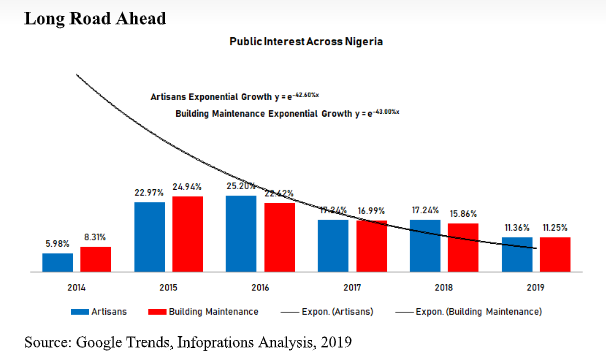
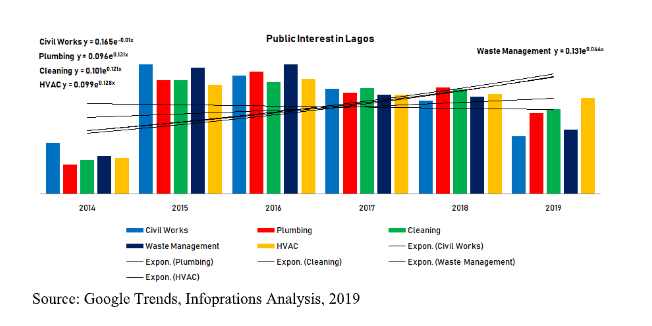
Meanwhile, despite the initial research about the target market by the company, analysis indicates that exponential growth of public interest in artisans and building maintenance in the last 5 years (September 1, 2014 to September 17, 2019) in Nigeria has been on the decaying threshold. The exponential growth rate of public interest in artisans is -42.60%, while building maintenance is -43%. A significant interest occurred between 2015 and 2016, analysis reveals. However, the choice of Lagos as the starting coverage area aligns with the growth of public interest in select services.

Analysis shows that interest in doing plumbing, HVAC, cleaning and waste management has been growing at 13.10%, 12.80%, 12.10% and 4.4% respectively. These results imply that the company needs to do more on marketing and communication of the inherent values of the app, most importantly through digital platforms. This is imperative because of the need to target a great number of internet users and app enabled-mobile phone customers.

Anthony Joshua Needs Focus To Defeat Andy Ruiz

0

Anthony Joshua may lose to Andy Ruiz Jnr again.

I know this is not good news for everyone connected to Africa, especially Nigeria. We always want to see our own people do well in every aspect of life.

Joshua, the former unified heavyweight champion will go against Andy Ruiz Jnr, who defeated him at the Madison Square, in the United States of America, in June. The match was seen as the greatest shock in the history of boxing and sport in general.

The rematch tagged, ”The Clash of the Dunes”, will take place in Saudi Arabia.

However, Anthony Joshua may yet suffer another defeat. A lot of people expect nothing but victory for the Nigerian-born British boxer, but the problem is – ”can Anthony Joshua handle the pressure?”

Andy Ruiz has nothing to lose as he’s seen as an underdog, which makes him more calm to do another damage on Anthony Joshua.

If Joshua doesn’t want to suffer another defeat, he should stay away from the media. Focus is the key and that’s all he needs. He should see the match he had against Ruiz many times, evaluate and learn from it. Then do a lot of work behind the scenes.

Staying on social media won’t help the British boxer. A lot of pressure is being mounted on him. The truth is, nobody is giving Andy Ruiz the credit he deserves. Everyone is seeing it as a fluke and expecting Joshua to reclaim his belts.

I hope Joshua is not going with this belief as well. Ruiz studied Joshua and attacked him at his weakest point. Joshua needs to rate Ruiz higher than any other opponent he’s ever faced because he was the one that handed him his first defeat.

Ruiz will come out stronger and better. If care is not taken, we might see a repeat of the first match. The worse, a draw may likely be the final result. But I do wish Anthony Joshua will win and reclaim his titles, else, it could be the end of his wonderful career.

Good luck to Anthony Joshua in Saudi Arabia on December 7.

Africans will be rooting for you!

That Microsoft Strategy on Linux

0

You are an industry leader in a market segment. Your competitor has launched and made its product largely free. You make money in some global regions, but in some other areas people are pirating your product – using it without paying for it. You have two game plans for the pirating regions:

  1. Make it harder for them to steal (using law enforcement or technology protection). But you do know that if you do so, the users will likely move to your competitor. That means, forever, that market is lost. You will not like that to happen.
  2. Allow them to steal provided that prevents them from using the competitor. But as they steal, have an immediate game plan to make the product extremely affordable so that they begin to think this needs to be paid for additional security protection.

I just described how Microsoft outclassed Linux in most parts of the emerging market. I will use China for illustration here even though that applies to most countries.

The software piracy in China which Microsoft largely ignored provided that kept Linux out was one of the reasons China is a Microsoft nation today. As most people used the pirated Windows,  everyone adopted Windows. Then over time, Linux was largely forgotten. Today, Linux looks like an enterprise focused product; in the past, the playbook included personal computing.

With time, Microsoft started preaching to users that for small fees, they could  get better security and protection from malware. Already used to Windows, most customers went for that, and magically Microsoft started making money in China. And later, it surprised the hold-outs, upgrading their stolen software with new versions but on the premise that they must register the solution. By the time people went through two update cycles, noticing the huge benefits, many became believers. 

Across markets, companies have different methods to win territories. Intuit has it own technique.

One company that has done that very well is Intuit, an American company that is known for selling tax software. A key attribute of Intuit is giving most things free. You can accuse the firm that it hates revenue. You see competitors building products and solutions on its platforms. But there is a catch: after a few years, the competitors become invisible. They become folded into Intuit business in the eyes of customers.

So, for decades, Intuit continues to swallow competitors without buying them. I have called its model the Fish Bait Acquisition Construct. It is a model where you give things free to competitors. As they come to enjoy the freebies, you trap them, and over time, they become weak. The end game is that at the end, they beg you to take over their assets.

We are also seeing OPay in Nigeria with a strategy.

Yes, OPay is running what I call the Invisible Layer Strategy. The Invisible Layer Strategy is a strategy where a company builds a product utilizing critical infrastructure of another competing company, in the same product line, but finds a way to under-cut that company on cost of services to end users. Today, OPay offers zero fee to customers who use it to pay for DStv services in Nigeria.

Simply, most things may not make sense to users – but companies know what they are doing. Some games intentionally make themselves easy to pirate as  part of adoption and growth strategy.

The Fish Bait Acquisition Construct

CBN and the Cashless Policy

0

I smiled when I saw the CBN new cashless policy.

The largest cash movement in volume happens within the population at the mid-bottom of the Pyramid.

Until we understand the behavior and business activities of the people in the middle-bottom of the pyramid; cashless policy will be unfruitful.

According to NDIC three years ago, only 2% of Nigerians own 90% bank deposits. This means 98% of Nigerians owns 10% of bank deposit, which indicates that huge amount of cash is in circulation outside the bank.

A little analysis of the Policy, an individual will be charged 3% on withdrawal of an amount above 500,000; and 2% charges for depositing the same amount.

Let us take N501, 000 withdrawal for instance, then the charges will be N15, 030. Our people are sensitive when it comes to paying charges.

Fortunately, for the transaction that falls within the individual category, it will be more prudent for people to transact with Banking Agents and perform their transactions in tranches other than going to banking halls because the transaction charges will be higher in banks.

I believe Microfinance banks who are customers to Deposit Money Banks (DMBs) will not be affected since they fall under the corporate category because if they do, they will also pass down the charges to their customers.

Presently, Agency banking is still largely a cash based business; the market has become wider with this policy.

For cash policy to progress, the approach MUST be built from Bottom-Top.

The concern should be focused on how my security Guard (gateman as popularly called) accept his salary at the end of the month through digital payments, how will my Gate man’s Mai Tea accepts digital payments from him when he buys a cup of tea. The trend goes in that manner.

The population that will be  affected under the Individual Category of this policy will be  enormous.

There should be much aggressiveness in digitization of financial inclusion drive.

Many Fintech companies are only transaction based. Opay is already in the right direction by creating a community of business with ORide, OBus, OTrike, OFood, OKash and OWealth. All their customers have wallet from which they can pay for these services without physical cash movement.

A holistic view of how cash is mostly used is needed to give the true picture, this will enable formulation of a near accurate cashless policy.

This is my view on CBN AND CASHLESS POLICY.

The Belt and Road Initiative

0

“China, prior to 1978 was a Non-market Socialist Economy; in other words, it was a closed economy influenced by the ideologies and leadership of Mao Zendong, a revolutionary political icon. This political and economic system did not favor a vast majority of the Chinese masses, therefore, the need for economic rejuvenation after his demise.

China began to introduce and implement capitalist market reforms in the late 1970s in a successful attempt to integrate the national economy with the global economy as a way of bringing prosperity back to the people. Now a Socialist Market Economy, it is the second largest economy by nominal GDP (Gross Domestic Product), and the world’s largest economy by Purchasing Power Parity, PPP according to the IMF (International Monetary Fund). The government successfully grew the economy at an average growth rate of 10% for over 30 years. As the manufacturing hub of the world with lots of thriving businesses that has produced the largest concentration of young multimillionaires…”  (David Gani, 2019).

It is time to spread her tentacles beyond her shores with an effective strategy.

The Belt and Road Initiative, BRI, also known as the One Belt One Road Initiative (OBOR), is apparently one of the most audacious social, economic, and political strategies ever conceived in recent world history. It was proposed by the Chinese President, Xi Jinping in October 2013 based on an ancient trade route. It created the world’s largest and most promising economic development zone. Within this initiative, the old trade route once again displays its vigor and dynamism to enhance economic cooperation and cultural communication among Eurasian countries.

At this juncture, for us to better appreciate the subject of discuss, we must make a time voyage back to ancient Asia, precisely the 2nd Century BC in Chang’an (now Xian) and examine an old trade route that would later be christened “the Silk Road” in 1877 by Ferdinand von Richthofen, a renowned German geographer. History has it that the Chinese were the first people to breed Silkworms for its linen by-product for commercial purpose. At this time, the silk fabric was in high demand by the nobles in Europe and Asia. Just as it obtains in any clime, as human settlements expand with attendant population growth, people tend to specialize in different skills thus necessitating the need for trade in a bid to satisfy the insatiable needs of man. Articles of exchange along the ancient Silk Road included gold, precious stones, tea, herbal medicine…and most importantly, silk. The prosperity of this trade influenced the rise of five major civilizations starting from the West Han Dynasty that was credited to have built the Great China Wall to protect the trade route, and to the last dynasty of Yuan that enjoyed the last glory days of the trade route around the 14th Century before its eventual decline.

The ancient Silk Road connected the Far East and the Western Dominions of Rome, India, Persia, China, and other major cities in trade, culture, and diplomacy along six major corridors or economic zones. The Silk Road measures 7000km square and it took 2 years to make a round trip from Rome to China. The trade lasted for over 1400 years at the time of Marco Polo’s travels (C. AD 1270 – 90). If the roads were to be gathered together to form a piece of land, it would be approximately the size of Akwa Ibom State in present day Nigeria.

In the light of this, let us return to a future date, to October 2013 and briefly examine the rationale for the modernization of the old Silk Road into the One Belt One Road Initiative. According to the mouthpiece of the Chinese Government, China’s People Daily, “Indeed B&R is a connectivity of system and mechanism to construct a unified large market and make full use of both international and domestic markets through cultural exchange and integration. To enhance mutual understanding and trust of member nations, ending up in an innovative pattern with capital inflows, talent pool, and technology database.”

The B&R Initiative was launched together with the Asian Infrastructure Investment Bank, AIIB with an initial endowment of $100b to address infrastructure gap amongst 68 member countries which covers 40% of global GDP, and 65% of the world’s population. The Silk Road Fund, SRF was established a year later to fund businesses. The modern Silk Road is now expanded to three zones: the Silk Road, Maritime Silk Road, and Ice Silk Road (still under consideration). With so much said about the land-based Silk Road, we shall now talk about the sea-based, and ice-based silk roads.

The Maritime Silk Road is a complementary initiative aimed at investing and fostering collaborations in South- East Asia, Oceania, and North Africa through several contiguous bodies of water of the South China Sea, South Pacific Ocean, Indian Ocean, and Mediterranean. In addition to the Maritime Silk Road, Xi Jinping also urged close cooperation between Russia and China to carry out the Northern Sea Route Cooperation to realize an “Ice Silk Road’ to foster the development in the Arctic Region. In the next 10 years, the whole initiative is estimated to cost four to eight trillion dollars ($4-8t).

Let us now shift our focus by examining how well the initiative it is faring in member states in infrastructure investment, construction materials, education, power grid, iron and steel, railways and highways, and automobiles. There are lots of Chinese firms currently engaged in member countries of the B&R economic zone making sure that the initiative works. In these concluding paragraphs, we shall look at a few of the numerous projects executed and ongoing in AIIB member states. Note, however, that these projects are not limited to the Less Developing Countries, LDCs but also in the member states of the Organization for Economic Cooperation and Development, OECD that are signatories.

Starting with Nigeria, the China Civil Engineering Construction Company, CCECC, is currently working on the construction of the Lagos-Ibadan standard gauge at a cost of 1.5 billion dollars. Down to Kenya, on June 17th, 2018, Wang Yang, Chairman of the National Committee of the Chinese People’s Political Consultative Conference, CPPCC, visited the Chinese-built Mombai-Nairobi Railway. After having a ride, he hailed the B&R Initiative and called for more cooperation between the two countries. Moving to Ethiopia, where the China National Water Resources and Hydropower Engineering Corporation (CWHEC) is building the 300mw Tekeze hydroelectric dam.

To the territory north of Ethiopia, Djibouti to be precise. China is expanding its global military might in Africa as it opens its first overseas military base providing logistical and defense support to African countries as part of China’s plan of projecting itself as the leader of the developing world and a nation that finds itself in solidarity with developing nations. African countries can barely finance their security agenda, and many nations face deficits when it comes to countering terrorism, piracy, and natural disasters.

Conclusion wise, the above listed examples of what the Chinese Government is doing in Nigeria, across Africa, and other parts of the developing world through the instrumentality of the B&R Initiative should suffice in giving us confidence that Nigeria’s economic development is getting an exponential boost.