DD
MM
YYYY

PAGES

DD
MM
YYYY

spot_img

PAGES

Home Blog Page 6741

The Rise and Rise of Container Shops in Nigeria

0

The first time I heard about container shops, I was like “What’s this person talking about? How can that woman own a container? Does this person really know what a container of goods cost?” That was many years ago.

I was living in Ibadan the first time I heard about a container shop. I heard about it from someone that resides in Koroduma, close to Mararaba in Nasarawa State. I haven’t heard or seen anything like that before. So I was actually confused when I heard that a petty trader owned a container. Things like that didn’t exist in Anambra and Oyo States then, so you can understand my ignorance and confusion.

I later moved to Koroduma and saw this wonderful edifice. I was like, “Whaaaatttt! Is this for real? Containers as shops?” I mean, I have only seen containers as ‘containers’ for goods that are moved by long trucks and emptied when they are brought to warehouses. I have also seen containers as makeshift offices in construction companies. But I’ve never seen them as private shops, and even homes. My small mind thought that once these containers were emptied in the warehouses, they will be bought by these construction companies, resold for more importation and exportation, or dismantled for other constructions works, such as gates and wheel barrows.

What I know that petty traders use in those days as their shops were temporary structures made with wood and aluminium sheets, commonly known as batchers. But these structures have their disadvantages because they are easily affected by fire outbreaks, thefts, termite attacks and weather attacks. But the conversion of these batchers to containers is an innovative idea that saved these petty traders a lot.

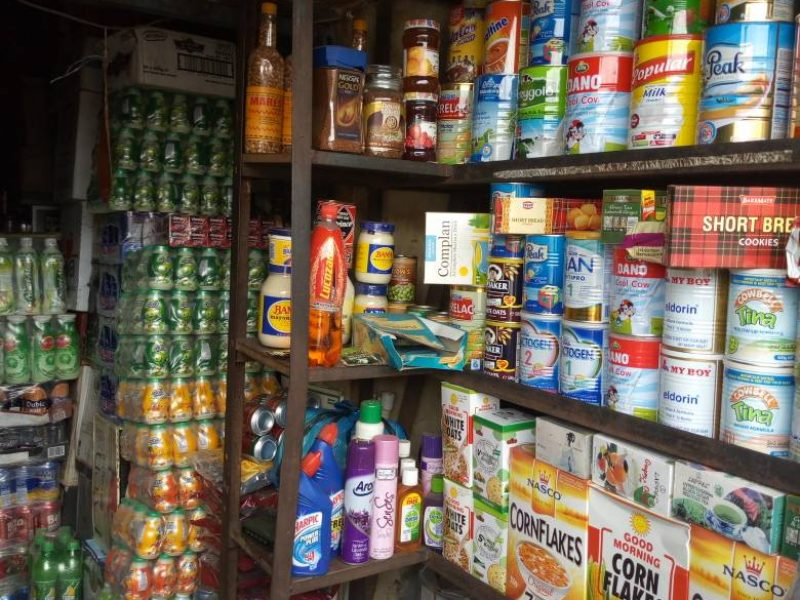
The first time I saw a container shop, I marvelled at the artistic works done to that chunk of metal. Openings were made for the windows and doors; rafters were constructed above it and zinc or aluminium sheets used to make its roof. The inside wasn’t left out as the floor was tiled. Shelves were built on the walls for the display of goods, and the ‘office’ table and chair kept at one corner. A veranda was also added to this shop by extending the ‘roof’ and tiling the floor at the front, and sometimes sides of the container. Trust me, it was a beauty to behold. If you didn’t look well, you may think that it was actually a real house made with cements, sands and blocks.

But my major interest in this piece is not about the aesthetic features of the container shops, but the economic roles they play in Nigeria. I believe they can be found in every part of the country today. Here in Enugu, they are springing up in every nook and cranny of the town. Though this invention has a lot of advantages, it equally has some menaces that need to be checked before they get out of hand. But I will start with the good side of it.

  1. Less Capital Investment: The good thing about having a container shop is that it is cheaper to start. I asked, about two years ago, how much a container costs and was surprised to hear that they come in sizes – one room, two rooms and even three rooms (lol) – and in grades – the very durable (the original foreign ones that came into Nigeria with imports), the constructed ones (the ones made in Nigeria using lower quality metal), and the second hand of any of these two. I was told then that a one-room durable container will cost me like eighty thousand naira (#80, 000), while the constructed one of same size may take me like forty-five thousand naira (#45, 000) to acquire. If I decide to go for the second hand containers, I will need to have between thirty-five to twenty thousand naira, depending on the grade and size.

I looked at this and realised that I could easily start up a small scale business with about a hundred thousand naira, that is, if I see where to keep the container.

  1. Lower Rate of Thefts, Damages and Accidents: The coming of container shops has reduced the reported cases of loss of goods to theft. These containers are built in such a way that their locks cannot be easily accessed by someone without the right key. This means that it will be very difficult for a thief to break in.

Containers also prevent fires and destructive animals from gaining access to the goods inside the shop, unless the ‘house’ has been destroyed in some parts by rusts. Honestly, I haven’t seen anyone who lost her wares in the container to fire.

  1. Mobility: It sounds funny but it is true. Container shops are mobile shops. I witnessed this first hand when the Nasarawa State government came to demolish most of the containers placed on major streets. The way these shop owners were carrying their shops, with all the goods inside, into nearby compounds were marvellous scenes to behold. So, if the area you placed your shop isn’t accommodating, you just have to carry your shop to another place. No need for too much talk.
  2. Revenue Generation: Even though our government has not really acknowledged these types of shop owners, a lot of revenues are being generated through them. These people pay tax, or I say taxes, to different officials from their respective domiciled local governments. They also pay rent, even though that may be small. Yes, in case you didn’t know, they pay whoever that is in charge of that land they kept their shops. And then, they are traders, one way or the other, which means they contribute to the economic affairs of the country. Besides, I have seen a huge container shop used by a wholesaler to stock and supply drinks to retailers. So, container shops are not owned only by petty retailers.

Like I said earlier, container shops can cause some social nuisances to the community. One of the ways they do this is by littering the environment with abandoned containers. Because containers are private properties, nobody else can enter and use it without the permission of the owner. In most cases, the owners of such shops may leave town and never bother going with their ‘shops’. Some of them may put it up for sale but will send away prospective buyers with their exorbitant prices. These abandoned containers obstruct the free movement of cars, humans and floods. And they can become comfortable habitants for deadly animals and miscreants.

Another problem with these container shops is the illicit transactions going on in and behind them. I have observed that some of them in Enugu seemed to be peddlers of marijuana. Maybe because nobody really checks on their business dealings, nor regulate their operational time, they can comfortably go ahead with both legal and illegal businesses. Law enforcement agencies need to be more vigilant with some of these people. Instead of treating them like they don’t exist, the government should encourage them to register their businesses so that they too will feel like they ‘follow’.

The way container shops are springing up in every space in the city needs to be looked into. I am not against them, after all they are reducing the rate of unemployment, but they need to be checked. The way they keep containers these days is gradually making the town look untidy, unplanned and unorganised. These shop owners look for any available space that could contain their ‘shops’ and drop them there (even if they block part of the road, they don’t care). The concerned landowners and caretakers seemed to be more interested in the little money these people pay them than in the problems they create.

Anyway, container shops have come to stay in Nigeria. No one can send them away right now, at least not in the near future. All that the town planning agencies need to do is to map out places for them to keep their containers and ensure that they stick to their corners.

The law enforcement agencies should also monitor the activities of these people. They should not be allowed to open these shops in residential areas only to start selling illicit goods and inviting the wrong type of crowd.

As for the unemployed, you actually don’t have reasons to complain now because you can see that a lot of business ideas have been flowing around. What skills do you have? What business do you want to go into? Have you ever thought of owning your own ‘mobile’ shop or office? See, there’s no need to waste more time. This is Nigeria, things are moving very fast right now. So, look around you and find the right spot for your own container shop and mount it there, before someone else takes that space.

Keep the hustle real.

The Contenders: Winning Grammy Awards for Nigeria

2

Why are we still waiting for the first African to win the Grammy Awards?

Just like every writer dreams of winning the Nobel Prize award, the same applies to every musician.

The highly coveted Grammy Awards has never been won by any African till date. Although we’ve had many nominees such as Fela Kuti, King Sunny Ade, Femi Kuti, and Seun Kuti; but none seems to have done enough to win the accolade. 

Could this mean that African musicians are not doing enough to convince the organizers of the Awards? 

I don’t think so. In fact, Africans are doing exceedingly great. After the American music industry, I will choose the Nigerian music industry as second if not first. I don’t see how the American music industry is better than us. 

Wizkid

We have talented musicians who were not given the right opportunity and environment to grow, yet they made waves and even collaborated at the International level. Examples include, Wizkid, Burna Boy, Kiss Daniel, Wande Coal, Simi, Phyno, Adekunle Gold, Patoranking, Dbanj, Don Jazzy, Ruggedman, Timaya, Tuface Idibia and many more. They all started from scratch. 

Back in the 90s, Africans only listened to American music but these guys have changed the game. People now listen to Nigerian music. Even the Americans listen to Nigerian music. We’ve seen collaboration with international acts like Beyonce, Chris Brown, Wyclef Jean, Rick Ross, Snoop Dogg and many more. 

But the big question is, ”why haven’t we seen any Grammy Awards winner from Africa?”

What are the criteria being used by the Grammy Awards organizers in selecting their winners?

Whatever the criteria may be, I don’t see any reason why it should elude Africans. It’s time for African musicians to win this. 

I nominate Ayo Balogun, aka Wizkid, to win Grammy Awards this year. The CEO of Star Boy record label has really been a top hit for ages. He’s been 10 years in the game and he’s getting stronger.

His collaboration with Beyonce titled ”BROWN SKIN GIRL” is a banger. I don’t see any reason why the Soco crooner shouldn’t win the award. 

Lyrically, he is sound. No wonder he had a sold-out concert at the O2 arena in London. He has also won numerous international accolades to back his talent. It is time for Africans to get what we deserve.

Grammy Awards cannot continue to overlook our homegrown talents making waves outside. If they are getting featured by international acts, it simply shows they are amazing. 

Let’s not only preach equality but also let’s practice it. 

We hope to see Wizkid and many more African musicians win the Grammy Awards this year.

Wedding Is Not An Investment

0

Have you ever been to any Nigerian wedding?

Yes, I have been to many. I can’t even remember some anymore. When I see how people attach so much importance to just a day event, it makes me wonder where our priority lies as human. 

Often times, I have seen people put themselves under the pressure of satisfying the public. They will go as far as to borrow money to spend on planning a wedding ceremony. Some had even gone to the point of emptying their bank account just to satisfy every invited guest in just one day. The worst part of it all, these weddings don’t even last. 

Am I against anyone having a big party?

No! Far from my point of view. I have written this to tell everyone to tread with caution when planning a wedding ceremony. Spending big doesn’t make you big. People will attend many more wedding ceremonies after yours. Meaning, people won’t dwell on it again. The annoying part is that you won’t satisfy every invited guest. So why even try at the expense of your pocket? 

Wedding is not an investment. As much as it is worth celebrating, it should be done reasonably. There’s always life after the wedding. Why attach so much importance to just a day event when you should be more concerned about the life events – marriage. 

We need to break away from the ”I will do it only once” mentality. Because it has put many into a terrible situation. The wedding ended and you had to realize that you’d pay back your debts. It is not a good way to start your home with your loving partner. Thinking about debts when you are supposed to be honeymooning in Dubai or Canada may frustrate your home and put your marriage vows under threat. 

I understand your partner may want a big ceremony, but I will advise you to check your pockets. Use what’s left after savings to organize your wedding. There’s no standard rule that specifies how a wedding should look like. In fact, you don’t even need to go bankrupt to organize any. If you can only afford to feed five people, it’s fine. After all, no one will help you feed your home. 

Don’t ever succumb to the pressure of family or your partner because a marriage that starts with debt may never last. It’s too early to start living in fear and frustration. Think about your unborn children. The cost of training a child in Nigeria is no longer a penny. Would it not be better to invest in your children that will be there for you in your old and stricken days than to lavish on a day wedding. 

Lastly, if you are not a celebrity, there’s no need to lavish your money on a wedding because it won’t make the headlines and neither will you make any profit from it, unless you can conveniently afford it. 

A better Nigeria starts with a great mindset. This boils down to every one of us. We don’t want broken homes anymore. The children are the ones who suffer from failed marriages. We want our children to be well catered for, and it starts by foreseeing the future.

It makes no sense to borrow money for a wedding but can’t borrow money to execute a business idea. 

Think about it.

Yahoo Yahoo: What Companies Should Learn from Invictus Obi’s Fraud Case

2
The fraudster in Forbes 30 Under 30

Having been listed as one of Forbes 100 Most Influential Young Africans 2018, Obinwanne Okeke (Invictus Obi) is a celebrated entrepreneur in Nigeria. Only for the news to break out that he has been arrested by the Federal Bureau of Investigation (FBI) for defrauding Unatrac Limited to the tune of $11 million.

If you convert that to Naira, at the rate of 360 Naira to a dollar, that’s over 4 billion Naira! The saddest thing about the whole situation is that the fraud happened under the nose of Unatrac Limited’s Chief Financial Officer (CFO).

15 illegal transactions within 8 days!

According to the affidavit released by Marshall Ward of FBI in supporting the arrest of Mr Obi, the illegal transactions were successful because the CFO fell for phishing. In case you are not aware, phishing is a hacking technique in which a hacker disguises as a staff of an account provider and persuades a targeted victim to click a link so as to resolve a problem with the account. The utmost aim is to steal the login details of the targeted victim.

Aside from falling for the phishing scam, it was also stated in the affidavit that Mr Obi and his accomplices changed the email settings of the CFO. Emails sent to the CFO from the members of the Finance Team were automatically marked as read and moved to a separate folder outside the inbox.

This means there was a slight change in the inbox settings of the CFO within the period; however, he didn’t notice. With all this information from the affidavit, it can be said that the CFO’s lack of cybersecurity knowledge cost his company millions of dollars.

If the CFO had been trained in cybersecurity, the situation might have been different. This is because, in cybersecurity classes, people are taught how to protect themselves from viruses, malware, phishing, and other online vices. If the CFO had attended a cybersecurity class, he would have known that the email sent to him was dubious.

He could have noticed the changes in his email inbox settings, too.

The lesson here for companies is that they should make cybersecurity training a must for their employees, both old and new. Besides, antivirus and antimalware should be installed on the companies’ servers, including the email servers.

Doing these would help prevent the case of identity theft and the stress of speaking to EFCC or FBI to help recoup your stolen money.

From Hero to Villain: The Sad Side of Invictus’ Obinwanne Okeke Cyberfraud

0

He was featured on Forbes under 30, list of young millionaires, celebrated far and wide by friends and well-wishers, even the “God-Wheners” who envy his success as an Entrepreneur and a young African force to be reckoned with. That was Obinwanne Okeke, a.k.a Invictus Obi, the founder and CEO of Invictus Group of Companies, not long ago. He was basking in the glory and honor of his successful empire until a few days ago, when the FBI’s investigative wind blew toward his castle and exposed the skeletons his empire was built upon.

In a painstaking investigation, the FBI revealed that the high flying young man, whose investment in real estate, energy and construction, is operational in 3 African countries namely, Nigeria, Zambia and South Africa, have been a kingpin of wire fraud. The $11 million graft investigation started in June 2018, when the victim, Unatrac Holding Limited, a UK headquartered caterpillar and industrial heavy duty machines company filed a complaint with the FBI, reporting that company has been defrauded through email phishing.

The Bureau went to work, started connecting the odds and putting the pieces together to find that the email address of the company has actually been compromised and the traces are pointing to Nigeria. There was a well calculated move that took the unsuspecting company unaware.

According to the FBI’s Affidavit, on about April 2018, Unatrac’s Chief Financial Officer (CFO), received a Phishing email containing a weblink, purportedly to the login page of the CFO’s online email account hosted by Microsoft office365. When the CFO opened the link, it led him to a phishing website crafted to imitate the original Office365 login page. Not concerned about the legitimacy of the page since it appears the same, he put in his login credentials and they were all captured through the spoofed webpage.

After capturing the legitimate credentials, the Fraudster was able to log into the original Office365 email account and accessed the entire information. For over 464 times, he accessed the account, gathering information and planning how to use them.

The fraudster in Forbes 30 Under 30

Satisfied with the information at his disposal and with full access to the account, Invictus Obi started working full time. Manipulating templates, cloning invoices and receipts, forwarding them to partners and clients of Unatrac.

During the period of unauthorized access, activity logs show that the Invictus created modified filter rules for the CFO’s account on seven occasions between April 10 and April 17, 2018. The filter rules intercepted legitimate emails to and from employees on financial team, marked them as read, and moved them to another folder outside the inbox. Thus, he hid from the CFO, responses from the individuals he was sending fabricated emails.

It was on the belief that those emails were coming from the CFO that the company’s financial staff processed and transferred in installments, the whooping sum of $11 million. And it was too late to recall by the time it was discovered to be fraud.

Wondering how in the world Invictus Obi was able to pull that off? He had a degree in forensic criminology with distinction. So his criminal mind outsmarted the unsuspecting protocols, and the fraudulent proceeds were worth the risk. But as smart as he thought he was, he gave himself away with one important detail – his email.

Invictus Obi, in his smartfulness created REDACTED emails and phone numbers to carry out his schemes. One of those emails happened to be his company’s email that he has severally used to apply for US visas. He was still in the US when the FBI uncovered that and issued a warrant for his arrest.

So the wind did not only expose the skeletons beneath his castle, it also shook the foundation so that it comes crumbling. But not only for him but several others, especially those doing legit online businesses in Nigeria. The green passport has taken another jab, and the impact will be felt at the airports, seaports and shores away from home – especially by the innocent.

Those whose only crime is to live in geographical territory where criminals thrive, and to share the same means of identification with them when it matters. Their cry of innocence wouldn’t change the status quo, and their good reputation will make no difference. It’s the index finger that got dipped into the oil, but the rest of the fingers got stained by it.