DD
MM
YYYY

PAGES

DD
MM
YYYY

spot_img

PAGES

Home Blog Page 6748

Health for All, Everyone, Everywhere; Achieving Universal Healthcare Coverage in Nigeria

0

The focus of this year’s World Health Day is achieving Universal Health Coverage through primary health care. Universal health coverage is WHO’s number one goal. Key to achieving it is ensuring that everyone can obtain the care they need, when they need it, right in the heart of the community. 

Progress is being made in countries in all regions of the world, but I have observed that this is not the case in Nigeria. Millions of Nigerians still do not have access at all to health care. Millions more are forced to choose between healthcare and other daily expenses such as food, clothing and even a home.  

According to the World Health Organization, primary health care is a critical foundation for universal health coverage. It can address the vast majority of people’s health needs throughout their lives. Universal health coverage (UHC) is about ensuring all people can get quality health services, where and when they need them, without suffering financial hardship.

  • No one should have to choose between good health and other life necessities.
  • UHC is key to people and nations’ health and well-being.
  • Everyone can play a part in the path to UHC, by taking part in a UHC conversation.

Too many Nigerians are currently missing out on health coverage;
“Universal” in UHC means “for all”, without discrimination, leaving no one behind. Everyone everywhere has a right to benefit from health services they need without falling into poverty when using them. We must begin to make UHC a priority agenda in Nigeria.

I am calling on the Nigerian Government to take UHC very seriously and provide the very basic healthcare needs of the populace. UHC is everyone’s business, this includes the leaders, health care workers, patient’s etc, and we should all work together and make our voices to be heard.

Here are some facts and figures about the state of UHC today (Source: WHO)

Incurring catastrophic expenses for health care is a global problem. In richer countries in Europe, Latin America and parts of Asia, which have achieved high levels of access to health services, increasing numbers of people are spending at least 10 percent of their household budgets on out-of-pocket health expenses.

UHC means that all people and communities receive the health services they need without suffering financial hardship. UHC enables everyone to access the services that address the most important causes of disease and death and ensures that the quality of those services is good enough to improve the health of the people who receive them.

UHC is not just about health care and financing the health system of a country. It encompasses all components of the health system: systems and healthcare providers that deliver health services to people, health facilities and communications networks, health technologies, information systems, quality assurance mechanisms and governance and legislation.

Can community health care workers address the Primary healthcare Crises in Nigeria?

‘Community health –care workers know the traditions, cultures and practices of their communities, making them indispensable especially during an outbreak of emergencies’ (WHO).

With the reduction in the number of doctors in Nigeria today, it is high time the health ministry makes use of ad hoc staff to fill in the gap in suitable aspects of primary care provision.

In many developed countries of the world who can boast of a good number of primary health care centers per geographical area/population, they still make use of physician associates, health visitors, advanced nurse practitioners, pharmacist independent prescribers, nurse advisors, and health care assistants etc to fill in the gap.

In Nigeria we do not have enough medical practitioners per population or geographical area. This is the time to train and retrain more community health care workers to help in managing long term conditions, reduction in childhood illnesses due to lack of immunization.

Trained birth attendants will also help reduce maternal mortality and community nursing care will reduce infant mortality.

Studies have been conducted in some developing countries and there is enormous evidence to portray the importance of integrating lay health workers in primary health care force.

I believe this is a step in the right direction if we must provide universal health coverage in Nigeria. 

The systematic integration of community health workers at a large scale could be an effective and a rapidly implementable approach to the current primary care workload crisis we have in Nigeria.

I feel there is a sense of urgency for this; and I’m calling on all stakeholders to work together towards achieving UHC in Nigeria.


Reference: [World Health Day, WHO]

The Amazing Nigeria’s Layer3Cloud – Indigenous, Data Sovereignty, Low-Latency

1

Over the next few years, one of the most critical infrastructures that will play a critical role in the formation and growth of digital companies, from ecommerce to fintech, is cloud computing. Cloud helps ideas scale rapidly by enabling companies to optimally acquire computing resources they need at the capacity they require. By moving what used to be an exorbitant fixed cost investment into an affordable subscription model, companies can have access to hosting and computing services in a phased format, making it possible to start digital business with lower capital.

Cloud computing is the on-demand availability of computer system resources, especially data storage and computing power, without direct active management by the user. The term is generally used to describe data centers available to many users over the Internet. (Wikipedia)

Layer3, a category-king indigenous ICT company, has unveiled Layer3Cloud. This cloud service is engineered for Nigeria and broad African business ecosystem. Layer3 was founded by my Federal University of Technology Owerri, Nigeria (FUTO) classmate, Oyaje Idoko (pictured above) – a leader in Africa’s ICT sector.

Layer3Cloud is an Infrastructure-as-a-Service (IaaS) solution that allows businesses and organizations of all types to remotely and virtually build, manage, store and instantly deploy servers and data in our secure data centers all without the financial outlay on hardware, maintenance or replacement, yet retaining the ability to access and administer all services as needed. Layer3Cloud runs out of ISO certified data centers in Abuja and Lagos ensuring maximum availability, security, and disaster recovery.

We are transforming the way businesses think about IT: A new, commodity-focused approach ensures maximum resource efficiency by ensuring outlay is aligned fully with IT usage.

Additionally, we can provide a full end-to-end managed private cloud service, acting as your very own IT team, 24x7x365, managing, monitoring and maintaining your systems around the clock to ensure your institution is always online.

The cloud service sector in Nigeria has been growing as companies begin to move their services and operations to the cloud. Besides the largely cost-competitiveness, cloud simplifies operations, with data consolidated more effectively. Cost, technology usability and customer service are major elements which continue to drive adoption; Layer3Cloud is positioning itself in the local technology and business domains with its offerings. Those services include:

Enterprises: Layer3Cloud provides a mature range of solutions designed specifically for the unique security, compliance, privacy, and governance requirements of large organizations.

Public Sector: The future of the Nigerian public sector demands a scalable cloud platform. The Layer3Cloud platform is purpose-built, running out of in-country certified data centers and it allows government agencies meet the data sovereignty policy requirements of the country.

Startups and Web Hosting Firms: Layer3Cloud understands that start-ups have constraints and have to be frugal with where and how to allocate their limited funds. The firm works with them from the spark of an idea, to the first customer and beyond. The solutions are designed to help startups build and grow startups.

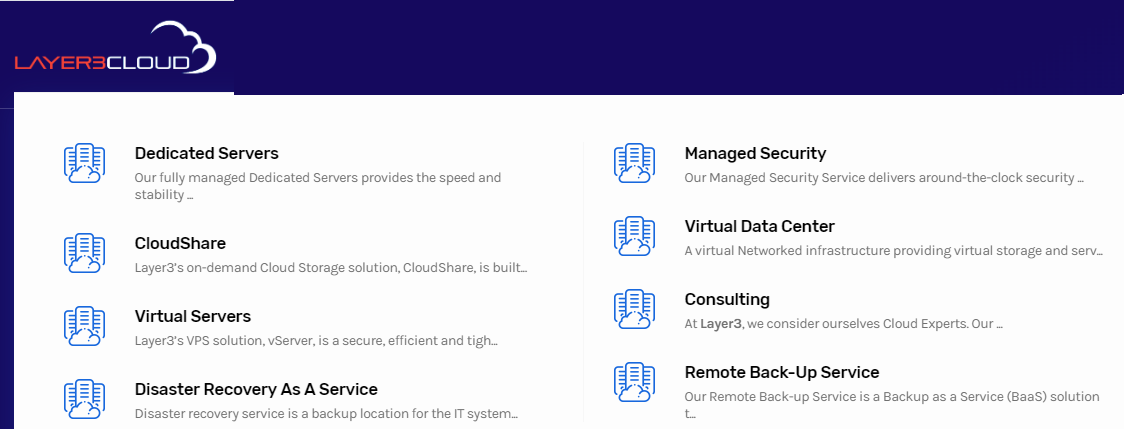
Here are some key services offered by Layer3Cloud.

Layer3Cloud Services

The Benefits of Layer3Cloud

Layer3Cloud is building critical building blocks of computing elements, the primitives, in its data center businesses with specific focus on Nigeria and Africa. Through these elements, companies can have access to file taxes, handle procurement, HR administration, and more. The benefit is that companies can reduce outside constancy by relying on these primitives which are optimized and flavored for the specific local market.

Low Latency, Fast Data Throughput: Layer3Cloud datacenter is stationed in Nigeria. This gives it an edge over global competitors on latency. Benchmarked with global competitors, Layer3 speed is faster for companies in Nigeria.The service also has fast data throughput.

Local Support: Layer3Cloud has team members in major Nigerian cities to physically assist companies deploy on its cloud infrastructure. In other words, if you are starting up and needs help, the engineers will come in person to help you navigate the process.

Affordable: Layer3Cloud is priced in Naira which provides huge comparative advantages to companies earning revenues on Naira.

Secure, Reliable, in Compliance: Layer3Cloud provides top-notch security and reliability. It easily helps companies meet all the local compliance to regulations on data privacy and management in Nigeria. Your main server or disaster recovery recovery servers will find a good home in Layer3Cloud.

Key Features

The datacenter business in  Nigeria is advancing. Innovations in products and technology are leading the way.  Layer3Cloud as an indigenous company understands the competitive forces. It has to build great products before foreign competitors build them. Speaking with the team, they noted that they are differentiating to serve local clients in Nigeria and Africa in many ways. Here are some key features in Layer3Cloud.

  • Dynamic scalability at a moment’s notice
  • Localized service in Nigeria means extremely fast and ultra-low latency access to resources compared to foreign-based services
  • 99.9% availability
  • VMware Certified Cloud Service
  • Self-service and 24/7 support
  • Advanced networking and security add-ons: Firewall, VPN, IPSec, SSL
One of many awards Layer3 has received

All Together

The cloud service in Nigeria is expected to see massive growth as Nigerian technology ecosystems deepen. In a world that is unconstrained and unbounded, there is no reason not to embrace cloud especially where it is offered by an indigenous firm you can visit its offices, and the firm will give you time to understand your business needs.

Begin your free Demo by contacting Layer3Cloud today.

KAIOS Plans To Connect the Next Users to the Web

0

KAIOS Technologies is a startup on a mission to  bridge the digital divide by connecting the next billion non consumers who are at the base of the pyramid and not served by the current telco players without access to internet in emerging countries.

In developing countries such as in Africa, internet infrastructure is not available to millions across the continent and where it exists in some parts due to corruption, it costs a lot which makes it unaffordable for many. 

Google’s  Project Loon was conceived to fix this friction in emerging markets while Facebook launched it’s Internet Access Free Basic programme to provide accessibility to basic internet across Africa. These initiatives have still not made internet consumption a basic affordable commodity, which will help to provide the opportunities that will empower Africa’s young generation to unlock their potentials for prosperity.

KAIOS believes that it’s emerging operating system for smart feature phones will redesign the mobile communications market focused on the lower income consumers with more than devices running on it’s platform already shipped in Canada, USA, Asia, Europe and other parts of the world. Devices which run on it’s Operating System requires limited memory and still offers a rich user experience with access to apps like Google Assistant, Whats App, Youtube, Facebook, Google Maps and Twitter.

KAIOS brings apps, Wi-Fi, GPS and other advanced features to non touch smartphones and has established partnerships with leading Original Device Manufacturers/Original Equipment Manufacturers and carriers such as AT&T, Sprint, T-Mobile, Reliance Jio, HMD Global, Micromax, Doro, Bullit, Maxcom, MTN which launched it’s feature phone powered by KAIOS this year in Nigeria, Africa’s largest market, Orange and China Mobile and plans to be embedded in over 150million devices globally before the end of 2019.

Most Fintechs Built on Transaction Fees Will Fade in Nigeria in 3 Years

6

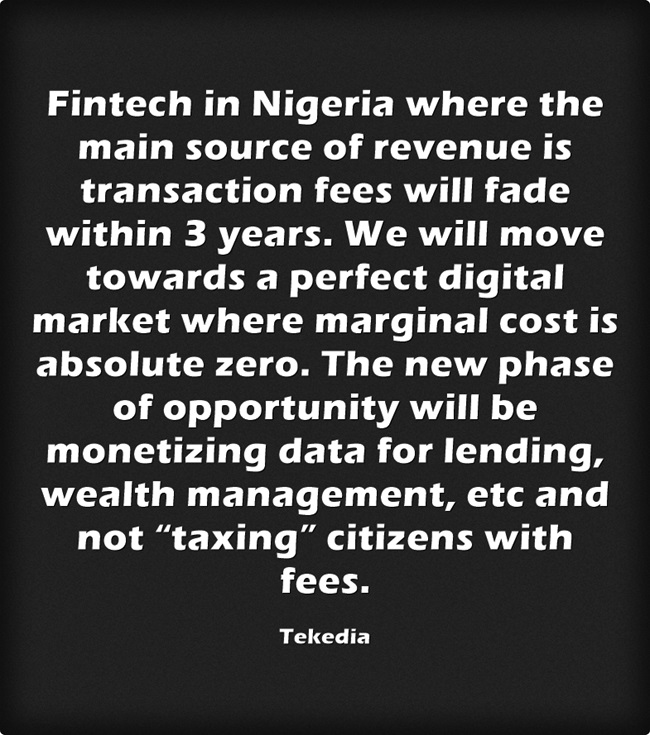
Fintechs in Nigeria where the main source of revenue is transaction fees will fade within 3 years. We will move towards a perfect digital market where marginal cost is absolute zero. The new phase of opportunity will be monetizing data for lending, wealth management, etc and not “taxing” citizens with fees.

Paytech startups built on transaction fee-based revenue will struggle as new business models evolve where transactions can be efficiently processed at absolute zero transaction cost and distribution cost. My state of Nigerian fintech shows a shift in the equilibrium on the points where startups make money from users. This will simply become the new normal. 

Consider the possibility that OPay has bank accounts in all banks in Nigeria. If a customer ( paying for DStv) pays through it, it will simply receive money from the customer to the specific corresponding bank account it maintains in the customer originating bank. At the same time, it will pay the merchant to the merchant’s bank account using its (OPay) funds in the same bank as the merchant’s. Because wallet-to-wallet transfer in Nigeria does not attract a fee, this two-sided intra-bank transaction (inflow and outflow) does not cost OPay and its customers any transaction fee.OPay, relying on bank APIs, automates this protocol. This is Option 1. There are other options on how to execute this including having a holding quasi-entity.

Do not be confused on this – we will leapfrog London and New York in this domain. The architecture of our banking system makes this possible. I do not expect it to be changed!

Updated after Flutterwave $35 million Raise

Comment: I remember an old post of yours where you spelt doom for payment outfits like flutterwave where you mentioned they couldn’t just thrive on payment charges. May I ask what you now see differently.

My Response: Share the link please. I would be interesting to actually use that to teach. My position has been this: any fintech that competes for checkout pay by sending code will fade.But those that help clients to improve their businesses will win checkout pages and thrive with the clients. But share the link. Flutterwave has subject matter experts in education, trading, agro, etc that help their clients before they work on those checkout pages. That is the Silicon Valley Bank model which I have advocated for them.

Plus – doing that is one way of dealing with decreasing percentage on transaction fees which have dropped from 6% (when BankAmericard was unveiled in U.S.) to now about 1.4% on average. It will get to near zero one day. We have 0.99% on fees in most platforms. So, if you do not help clients, fees would not do it!

Comment: Well you just answered the question already. Sharing the link won’t matter then. Thank you sir.

Private School Bus Management Needs Logistics Tech Aggregators in Nigeria

2

Recently, while walking through Divine Estate, Amuwo Odofin, Lagos, I observed the parking lot of a private school in that vicinity. I counted about seven buses parked within the compound. These buses were parked because the school is currently on vacation (3rd term holiday). As a typical Igbo Man, I began to calculate how much revenue those buses could have been generating if they were deployed on the roads during this holiday.

Recall, the holidays started July 12th, 2019 and most schools will reopen 9th September, 2019. This means we are talking about 60 days (approx.2 months) with those buses being idle. Apart from the holidays, weekends and public holidays, those school buses are also idle generating zero revenue. Come to think of it, we are talking of some brand new Toyota Hiace buses with market value of between N18 million and N22 million sitting idly for 60 days. Some of them that were bought fairly used may have market value of between N5 million and N10 million.

I reflected on the reasons why most private schools choose to own school buses and the reasons include:

  1. To ease the transportation problem of their pupils who probably come from far distances.
  2. To advertise the school within the vicinity of the school’s target market.
  3. To ensure the safe delivery of the pupils to their parents by a system they can trust and have control over.
  4. Most parents specifically request for this service as they do not have the luxury of time to do such school runs.
  5. This is a means of revenue generation for most schools when managed properly.

However, on a Facebook group of school owners, many of the school owners complained bitterly about managing their own school buses. These are some comments from them:

“Maintaining a school bus is a headache on its own…”- I.O

 “I have parked mine for the past two years. Am healthier. Drivers and mechanics were my major headache. I told myself I was too young to come down with high blood pressure.”… E.O

 “It swallows up the school finances. You end up spending school fees to fuel the car.”…R.B.J

 Other observations from the comments include:

  1. The school bus drivers colluding with mechanics to inflate cost of maintaining the vehicles.
  2. Parents complaints of poor service by either the bus drivers or late arrival of the drivers.
  3. Multiple taxations from local government revenue collectors, etc
  4. Excessive cost of fuelling the vehicle which ends up not adding up when compared to the revenue generated
  5. Parents’ resistance to pay new rates that incorporate the high cost of running the school bus.

Since these schools are not transport companies, I make a case for them to outsource these buses. Transport tech startups can fix this market friction. For one thing, these schools already have the buses. The major thing they require is a system to effectively manage these buses and generate more revenue from these buses. Instead of allowing these buses lie idly during the holidays and weekends, they can be aggregated to be used for school runs during the school hours (peak period) and holidays and weekends (off-peak period).

Instead of having more than ten different schools buses deployed to Ago Palace way for instance, you can have say 5 buses dropping off students at each of the partner school during the peak period. The transport tech company can track the movement of all its buses and know where to quickly deploy more buses especially during the peak period (6:30am -8:30am). The same pattern will definitely happen during the closing period (2:00pm-4pm). During the off-peak period in between,the buses can be utilized intra-city so that it would be easily available for the school closing time. Holidays and weekends afford the buses the opportunity to be used both inter-city and intra-city for transportation.

One of the issues that any startup desiring to go into this niche market should put as top priority is the safety of the children onboard the buses. It should be able to design a tracking system whereby these buses safely deliver the children to their parents. With the rising cases of kidnapping in our society today, such tech startups should be able to assure both parents and the schools that the safety of the children is assured.

Most times when I pass through Doyin bus-stop, Iganmu-Orile around 7:30am to 8:00am on weekdays, I see a good number of pupils trying to board tricycles (keke) to their various schools. The same situation plays out on Babs Animashaun Road by Gate. This makes me to wonder why Zido(the Keke aggregator) is not keying into this opportunity. Its aggregated tricycles could work with private and public school authorities to pick and drop these pupils to and fro school. At the rate of N200 (N50 per passenger), they could do 10 trips between 6:30am and 9:00am and the same average between 2pm and 4pm (closing time). This can generate N4000 per tricycle within the school rush period on such routes as Doyin to Masha, Doyin to Shiita, Doyin to Eric Moore, Gate to Shiita, Gate to Eric Moore,etc. The revenue generated could be more if the parents choose the option of having their children dropped at home rather than the bus-stop.

As the new school year begins in few weeks time, I believe that transport tech companies can explore the market opportunities of transporting schoolchildren across our major cities with their securities assured and revenue generated for both school and the companies.


PS: Names have been abbreviated to hide the identity of the commenters.