DD
MM
YYYY

PAGES

DD
MM
YYYY

spot_img

PAGES

Home Blog Page 6764

Days of Rage – Is Nigeria About to Experience Revolution?

0

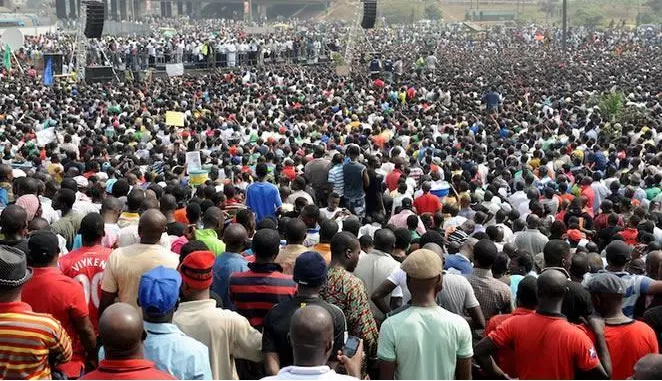
Come August 5, the streets of Nigeria are expected to have different looks. It will be filled with people bearing placards, wailing in a united throng, resisting the dispersing forces, demanding the government to step down, and probably, refusing to go home.

That’s #RevolutionNow, the Hashtag has been making waves on Social Media, spearheaded by the former presidential Aspirant, and Founder of Sahara Reporters, Omoyele Sowore. It seems Nigerians have suddenly woken up from their political slumber and want to make a warning statement to the powers that it’s no longer business as usual.

Topics of good governance, positive change in the Nigerian polity have always been a daily discussion in the offices, Bars, homes and Social Media. But it could barely get further than that, the political Lords know this, and Nigerians know why. It is upon this that the Nigerian political culture was developed, and there seems to be a mutual acceptance based on fear and interests, except on few occasions.

On Monday 2nd, 2012, mammoth crowds, under the brolly of Occupy Nigeria, took to the streets in Lagos, Abuja, Kano and the Nigerian High Commission in London, to protest the increment in petrol pump price. It held the cities to a standstill, paralyzed activities, and drew the largest crowd of protesters in the recent history of Nigeria. It could have buried the question of docility if not that it was politically motivated. In the end, the Actors got what they wanted and the crowd, having been used, went home to continue with their suffering from where they left it.

Ever since then, there have been so many protests, divided through religious, ethnic, and personal interests’ lines. When the Indigenious People of Biafra (IPOB), took to the streets of the Southeast demanding secession, the Government responded with brutal force that sent more than 150 members of the protesters to their early grave. Then there were Shiites whose members were massacred at the tone of 400, a whopping number of lives wasted in muzzling contests. The Government did make a bold deterrent statement; it’s “fight the Government at your own risk.”

Although there have been protests here and there, representing one interest or the other, the people have learned to keep the Government’s message in mind: “Don’t be callous enough to threaten the Government, or you pay dearly.” Not that some groups don’t try, they do once in a while. But it doesn’t take them long to realize that the Government’s resolve in quelling protests is stronger than the constitution. Just as it happened on the 22nd of July, when Shiites hit the streets of Abuja, once again, and triggered the free flow of bullets that resulted in the death of about 20 people. Their determination to dare also earned them a place on the proscription list where IPOB has long been seated.

It is upon this political culture that the #RevolutionNow is set to take place, allaying the fears, confronting the dangers, resisting the intimidation, and most of all, determining to see the flow of blood that may not lead to any positive change.

The people as usual have been grossly divided along religious, ethnic, political and personal interests’ paths. And for these reasons many have distanced themselves from the looming Revolution. There are yet others who are not in this category, yet they don’t see revolution as an answer to Nigeria’s big questions: using instances of revolution, especially in Africa as study cases.

The former DG of Bureau of Public Service Reforms (BPSR), Dr. Joe Abah, was vocal about his disagreement with revolution as a solution to Nigeria’s many problems. In his conversation with Human Right Activist and Lawyer, Mr. Segun Awosanya, Dr. Abah opined that revolutions only happen in homogenous societies, often with unifying characteristic. And that’s something Nigeria lacks. There are so many dividing factors that make it impossible for people to speak in voice; and for this reason he believes that revolution is not possible or feasible in Nigeria.

He went further to explain that the resultant consequence of revolutions is usually far worse than the preceding conditions. He said:

“The new order simply replaces the old order and status quo continues as normal. In some cases, the new order is worse than what was there before. Many dictators were former Revolutionaries. Many were worse than what they replaced.”

Using some examples, Dr. Abah explained further while he thinks revolution will do more harm than good. The French revolution which enthroned Liberte, Egalite, Fraternite, did not translate to the behavior of the French during colonialism. The French didn’t extend liberty, equality and fraternity to their colonies. Another example that is ample to the subject of revolution took place in Nigeria in 2012, and Dr. Abah noted it. He said:

“Then there was the Arab Spring. Has that revolution made the Arab a more just place? I am not sure. Then there was Occupy Nigeria. I think most of the leaders of that revolution are in government today. We are still paying fuel subsidies, the reason for occupy Nigeria.”

The truth in this analysis of revolution, especially in Africa, has unprecedented evidence to be denied. However, a call for action to effect good governance can only be ignored to the proliferation of rots in governments. Mr. Segun Awosanya, responded to the above analysis with a clearer explanation of the motive behind the scheduled revolution, at least from his own perspective. It’s more like a ‘wakeup call’ than usurpation of power. Knowing well the kind of government the people are dealing with. He said:

“Rise as one’ is not the literal meaning of Revolution. We live in the 21st century and must act like it. There is no point giving a regime thirsty for blood a reason to mow down innocent citizens. There are better approaches that will get the government interested in being responsible.”

As much as this statement tries to minimize the premonition of chaotic 5th of August, other players are talking tough. With their adopted slogan, “the days of rage,” the convener, Omoyele Sowore, and Singer, Eidris Abdulkareem, were on a broadcast video, promising a shutdown of the country. A perceived threat that the government doesn’t want to reckon with. Mr. Sowore also said that he has been informed that the Department of State Security Services (DSS) has put him under surveillance, something he said he expected to happen, even far worse than that. But it is just what it takes to liberate the oppressed from their oppressors. He said:

“We have moved from the surveillance of the people to the sovereignty of the people. All that is needed for revolution is for the oppressed to choose a date they desire for liberty, not subjected to the approval of the oppressor.”

The cause seems to be generating interests from far and wide, even those who have tasted the brutality of the Government because of their activism couldn’t cower to the perceived threat that the revolution may pose. Deji Adeyanju, a Civil Right Activist, and an ardent advocate of good governance, has thrown his full weight on it. Senator Shehu Sani, the former Minister of Aviation, Femi Fani Kayode, and many more are joining the Train. The interest is growing and waning, substantial numbers of people are joining the cause while others are choosing to watch from a distance. So far, over 22 cities across the country are mobilizing for the revolution.

Amnesty International has expressed concern over the possibility of the Government cracking down on the revolutionaries, as it would amount to trampling on their fundamental human right. The statement issued through their twitter handle reads:

“#RevolutionNow is a movement of Nigerian youths committed to fighting for freedom and just in exercise of right to freedom of expression and freedom of association.

“Authorities must respect the rights of #RevolutionNow movement to assemble and seek for freedom and just without fear or any intimidation. Nigeria belongs to all of us.”

Two days after Amnesty International issued this statement, a crowd of protesters converged at its office demanding that they leave Nigeria. A video that surfaced online later showed the crowd receiving cash, which means they were rented.

However, the Nigerian Bar. Association (NBA), Ikeja Branch has pledged to provide pro bono services to those who will be protesting in Lagos.

In the early morning hours of today, the Convener of #RevolutionNow, Omoyele Sowore was whisked away by the DSS, his whereabouts are unknown. This development has cast doubt and faith in the planned protest. It’s evidence that the Government is afraid of what is to come.

But, Will the revolution still go on without Sowore? The campaign for his release has been launched on Social Media with the hashtag #FreeSowore.
Marketing and Sales Strategies of Onitsha Main Market Traders

3

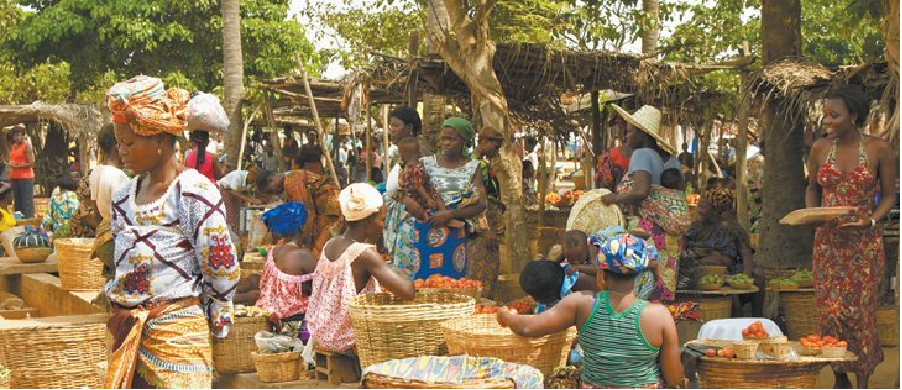
Every seller in a Nigerian open market invites every passer-by to patronise him or her. This strategy can be found in every part of this country. But whether the buyer will respond to this invitation and patronise the caller depends on a lot of things, one of which is the strategy used by the seller. I never realised this thing until I found myself in different parts of the country and witnessed different attitudes of sellers.

Some sellers lose their patience during price haggling and tell the buyers to try other places. Some just ignore buyers and send them away with their silence. There are those that will pick up quarrels because their buyers demanded for prices they believed are too low. I once had an experience where one woman that was selling tomatoes pick up a broomstick, used it to make circular movement over her wares and then threw it at me saying I wanted to bring bad luck to her because I priced her tomatoes low in the mornings (lol). Well, I always find something different in Onitsha Main Market.

My mother always says that an Onitsha market trader can sell sand to a man in the desert because of his sweet words. Truth is, in Onitsha Main Market, once you step into a shop to check on their wares, unless you don’t have money at that moment, you can hardly leave that shop without buying something. And you will be happy that you did. Don’t worry, I’ll tell you the strategies these people use to get me all the time (even till today).

1. Style of Inviting Customers

Once you enter that market (it’s actually hard to state where the market started and ended), I will start receiving invitations from different people. These people won’t say the normal “Aunty, come and buy” sort. They always make theirs colourful and personal. They say things like “Aunty, your clothe is beautiful. I have something like that.” “Fine aunty, good morning. Did you come to market today?” (This type always makes me smile and respond). “Aunty I have beautiful clothes that will size you. I even have for your fine children” (As if they know my children). Honestly, these people personalise their own system of invitation, making it look like they knew you before. Replying their greetings and questions could lead to further discussions on what I want. If I don’t want what they sell, they will happily direct me to where I can get them. If they sell what I wanted, they will lead me like I’m an emperor to their shops.

2. Receiving Customer at the Shop

When I get to the shops, they will first offer me a seat. Next, they will ask if the electric fan is ok for me and all. They will ask about my trip (as if they know where I’m coming from); if it’s been long I have been looking for the thing, and so many other things. By now the person that led me to the shop would have left to look for more customers while someone else attends to me.

You see this strategy, these traders use it to connect with the prospective buyer and then win their trusts. When this connection becomes successful, the trader can access the buyer’s taste and budget. They also use this to learn how to work on the buyer to get him to part with his money. This stage can last as long as possible.

3. Price Haggling

The price haggling of a trader in Onitsha Main Market is worth emulating. To start with, they will bring out goods that are of higher qualities and more expensive. From there, they will keep coming down until they get to the quality and price range you can afford. Then, price haggling starts.

Unlike most places I’ve been to, where traders call people names for mentioning lower prices, Onitsha Main Market man or woman will work on your psyche to get you to see things from his or her side. He will plead; he will cajole; he will tell you that the selling price will only give him a profit of fifty naira; you will even be told stories of how they ‘suffered’ to make ends meet because ‘sales are poor’ (even the current selling price was arrived at because they needed to make some sales). Chai! These people eh. By the time they are done with you, you won’t know how to demand for a lower price.

4. Unavailable Brand

In some places, when a seller doesn’t have the brand requested by a buyer, he will either tell the buyer to check the next shop or just plainly tell him that it’s unavailable. This is not the usual practice in Onitsha. In Onitsha, the owner of the shop you entered will first try to convince you to buy the brands available. If you insist on that one you wanted, he will tell you that someone will be sent to bring it from their ‘other shop’. Which other shop? The person sent out will go to the neighbouring shops to look for it. If they tell you that the brand isn’t in the market, believe them or else you may search through the market and not get it.

This strategy is good for both the seller and the buyer. For the seller, he is able to retain his customer while he creates good working relationship with his neighbours (you know, ‘you sold mine when yours was finished, so I’ll sell yours when mine is finished’ kind of relationship). For the buyer, it saves him a lot of stress moving around the market in search of the product.

5. Team Work

In Onitsha Main Market, the sellers always have cordial relationship with their neighbours even though they sell the same thing. There is no form of competition and fighting over customers there. Rather they will team up to help a neighbour convince a buyer. The major reason behind this practice needs to be found out.

6. Entertaining Prospective Buyers

Sometimes these sellers buy drinks for their prospective buyers – though this depends on the quantity of things the buyer is likely to buy. But they can willingly offer you drinking water. Note that this happens during price haggling, or even before it. So, tell me how I can comfortably walk out of a shop without buying anything after I’ve finished the drinks?

The summary of it all is that in Onitsha Main Market, the traders make their buyers feel special, important and appreciated. They are ready to ‘serve’ their customers. To them, every naira counts – a customer that will bring in N100 is treated with the same respect as the one that will bring in N10,000. There are so many lessons to be learnt from Onitsha Main Market traders.

Business men and women, and sales agents need to learn that everybody is a prospective customer that can bring in much value. They need to learn to connect with their prospective and existing customers. They should learn the power of team work and good relationship with their ‘neighbours’. This means that they should minimise unhealthy competitions with other persons and companies in their line of business. Honestly, someone needs to carry out a proper research on the marketing and sales strategies of the Onitsha Main Market traders so they can become marketing models for businesses.

Ok, so now you know why these Onitsha people collect all your money once you go there. What do you plan to do with this knowledge?

Forces Preventing Nigerian Startups from Being Global Businesses

0

From the north to the east and west to the south, business creation is not difficult as management in Nigeria. Various issues and challenges remain the clogs in the wheel of sustainability of many startups. A recent report indicates Nigerians have the strong sense of spotting opportunities around them for starting businesses, but access to capital, talent and customers have been some of the major obstacles preventing growth of their companies in the last decade.

The prevention has led to non-recognition of the country’s startup ecosystem globally. The country is only getting a mention in Global Startup Ecosystem Report and Ranking despite the claim that the  startup ecosystem is the most valuable in the African continent. The recognition gap might not be a serious issue among the stakeholders, most importantly the policy makers, considering the recent upsurge in capital flow into the country’s startups.

In 2018, 148 Nigerian startups raised $178m in various rounds during the year. Available information indicates that over $17m was raised in Q1 2019, 8.5% higher than they did in Q1 2018. Investigation has also revealed that tech startups raised $110.9m from local and foreign investors between January and June 2019. This has once again established the leading role of the tech startup in attracting significant FDI and Capital Inflow, and the tech as the most preferred investment destination for investors.

There is no doubt, Nigerian startup economy is growing, but not in line with the global peers. Beyond fund attraction, natural and artificial frictions are preventing the sustainable growth of the startup ecosystem and benefiting from over $2.8 trillion value being created within the global startup economy.  This piece examines factors impeding Nigerian startups from being on the global map. The argument is that stakeholders need to contribute to the startups growth beyond providing tax incentives, passing ecosystem friendly laws and establishing capital support programmes.

What’s lacking?

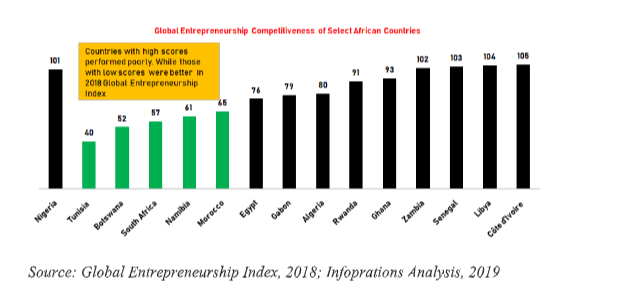
Answers to this question lies with the Global Competitiveness and Entrepreneurship Indexes perception of the country in 2018. The two indexes, according to their proponents, rank countries across the world, considering certain indicators at individual and aggregate levels.

To support the earlier positions and understand the veracity of the issues affecting global placement of the Nigerian startups, startup skills, cultural support, product innovation, process innovation, risk capital and internalisation were the indicators selected from the Global Entrepreneurship Index for analysis along with the selected indicators from the Global Competitiveness Index.

Within the startup skills indicators, among other factors, GEI believes that startups performance depends on the extent to which entrepreneurs have access to tertiary education. The most corresponding indicators in GCI are the tertiary education and quality of the education system.

Prevention and reduction of pervasive corruption are the factors GEI expects policymakers to work on before meaningful and effective cultural support could emerge in Nigeria. This is clearly complemented by the GCI’s measurement of the country’s competitiveness within burden of government regulation, diversion of public funds and irregular payments and bribes. Though, there are policies and programmes helping startups, but it appears that GCI wants the government to address the complexity of regulations and bribes among the agencies responsible for business registration and management.

Apart from the elimination of the systemic corruption, the two indexes expect Nigerian government and other stakeholders to provide an enabling environment for venture capital and private equity financing. GCI specifically emphasises equity financing through local market. These are their indicators within risk capital indicator which must be addressed to pave ways Nigerian startups to reach global status.

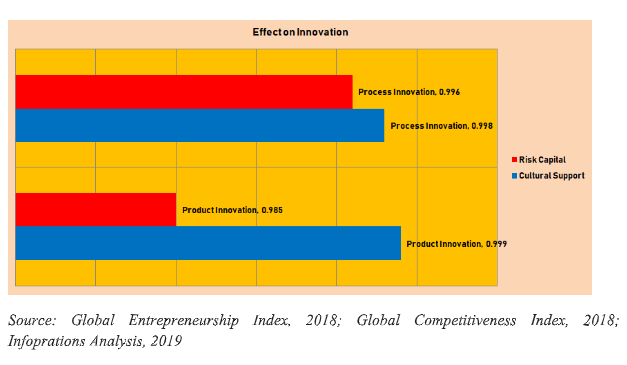
Being global requires having the right processes and sustainable products that offer the real values to the users. The two indexes have realised over the years that Nigeria is lagging behind in the areas of product process and product innovation.

To right the wrongs within the process innovation, GEI asks Nigeria to work on the quality of scientific institutions and availability of scientists and engineers. Adding to the discourse, GCI believes that Nigeria must ensure availability of research and training services to the startups to enable them create the right processes for products or solutions creation and delivery.

Innovating the right and better products or solutions, according to the two indexes, depends on collaboration in research between universities and industries, protection of intellectual property. The expectation of the duo is that Nigerian startups globalisation would be realised when the issues in the indicators are addressed in addition to the facilitation of interaction of individuals in increasingly complex networks in order to make products and control of international distribution.

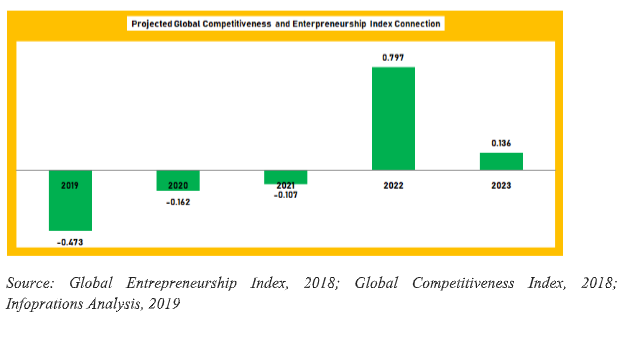
This is imperative because analysis shows that the identified indicators connected negatively. One point in Nigeria’s business environment competitiveness (among other countries) reduces the competitiveness of the startups by 47.3%. The poor ranking of the identified indicators in the GCI remains the significant factors contributing to the negativity.

Using 2018 as the base year, analysis reveals that the negativity would continue till 2021 before showing positive linkage in 2022 and 2023. Failure to solve issues in the indicators would continue to impact the GDP growth. Already extrapolation analysis of the select GEI with the GDP growth between 2015 and 2018 indicates a 35.1% reduction in GDP growth.

Parents Need to Break out of Old Thinking on Children’s Career Planning

3

I grew up in an environment where mothers don’t have a say in the future of the children. Meaning, the fathers decide the children’s future. Whatever becomes of the children lies in the hands of fate.
Mothers can’t challenge the fathers’ authority. It makes me wonder if marriage in Africa is slavery. Are two heads not better than one?

When I was much younger, my dream was to become a writer through the art of storytelling.
My reasons were:

  • I want to help companies present their brands into words or videos.
  • I want to help them sell their products to their target audience without appearing like selling.
  • It’s something I really love doing as I discovered most companies struggle when it comes to getting in front of their target audience.

My passion for storytelling got fueled up when I was awarded the ’Master of Riddles’ in my nursery school days. I was the only one who would be called on to tell stories to the whole school. That was more than money to me.

In my secondary school days, I wanted to go into the ‘Art Department’ because of my love for poetry and writing, but my father insisted I go to the ‘Science Department’, so I can become an Engineer.

However, I struggled throughout my secondary school days. I didn’t do well in my Physics and Chemistry as I would have loved. Those two subjects are the backbone of the Science Department. Although I did manage to pass them. Thanks to the late-night coffee and cramming. I bagged a weak credit in Physics and Chemistry.

Since I already knew what my father wanted, I obtained a JAMB form and applied for Mechanical Engineering course. I wasn’t admitted. I tried three more times but didn’t succeed. After three years of wasted efforts, I had to settle for Statistics at the Federal Polytechnic Ede, Osun. I graduated with Distinction (both at the OND and HND level)

After graduation, I couldn’t find my purpose in life. I was completely lost. I struggled to fit into the labour market. I spent two years in search of a job. When I couldn’t handle the heartbreak and disappointment of job search anymore, I quit and went back to my first love, “Writing”.

Through “Writing”, I had the opportunity to meet amazing people across the globe. I also got many job offers and even started an entrepreneurship journey.

“Writing” gave me money, a car and a house. It also put sumptuous meals on my table. I went from being broke and frustrated to working with top clients and companies in America, Canada and the UK.
What else could I have wished for?

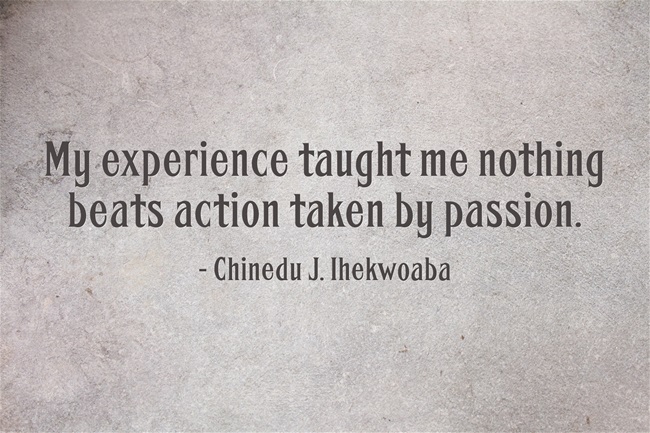
My experience taught me nothing beats action taken by passion. Many are still living a borrowed life by trying to be what their parents want them to be. It’s time to break out of the old pattern of thinking. Yes, I mean to break free from it.

Break out of the old pattern of thinking: The old pattern of parenting is killing children’s dreams. It’s time to let the kids be whatever they want to be.

When I become a father, my job would be: to offer the much-needed support and encouragement for my children’s development. This can only be achieved when I know their strengths and weaknesses.

Most African fathers don’t really know much about their children. Perhaps, what they love doing. They are being subjected to the old pattern of parenting. How their parents raised them choosing everything. They never had a say because they’d be reprimanded for being disrespectful.

I have trained and mentored many job seekers through my digital skills courses and helped them to discover their purpose in life. During my time with them, I realized that many had been subjected to pursue a career their father had imposed on them. Through their father’s act, many dreams had been killed. Many were made mentally retarded and psychologically redundant. Many never got lucky to discover their purpose and never lived to their full potential.

I would appreciate if the African universities will offer courses in Fatherhood. We need to save the future generations and break away from that trend. Of course, I must note that mothers, in some homes, are not left out of this challenge of deciding their children’s careers by fiats.

How our Mindset can Determine our Financial and Social Status

4

Some time ago, one of my neighbours told me about a motivational video called “The Secret”. She lent me the video and I only watched part of it because I lost interest along the line. I mean, it didn’t make sense to me then. I was deep into a financial crisis to have time to listen to what they called “Law of Attraction”. I mean, what has a law or an attraction got to do with helping me pay my bills and offset my debts? Anyway, I returned the CD with a huge “thank you” and “I enjoyed it so much” kind of smile. At least I wasn’t completely lying.

Years later, another person told me about how positive energy attracts good things and negative energy attracts the opposite. I told this very person to go to physics class and lay down his argument (lol). For my ‘ignorance’, I received a book as a gift from this ‘teacher’. Guess the name of this book – The Secret (you can imagine). Honestly, I haven’t had time to read the book because I didn’t want to confuse myself. But a post I saw on LinkedIn about how rich men think helped me understand this theory (The Law of Attraction). I will tell you how.

I’ll first like to define two major concepts I want to use in this analysis – the rich and the poor. When I say ‘the rich’ I mean those people that know how to manipulate the resources within and around them to generate income for themselves and their dependents. By ‘the poor’ I mean those who are unaware of any resources within or around them that can be used to generate their much needed incomes. So, don’t take offence whenever I use any of those terms.

Alright, so here we go. I’m an extrovert – yeah, that’s me. This means that I relate easily and freely with everybody irrespective of their financial status and all. But I noticed that anytime I’m in the midst of the poor I am always uncomfortable because I will have to be careful with what I say so I don’t get them angry. I have to agree with them that there is nothing good about Nigeria; I have to agree with them that everybody is starving; I have to agree with them that no matter how hard you try you can never make it unless you become corrupt; I have to agree with them that all those rich people out there killed their wives and mothers to do money rituals; I have to agree with them that going to school is a waste of time. In fact, for every conversation had with them, something negative must come up. If I make the mistake of disagreeing with them, I will automatically become a traitor (trust me, you don’t want to be there).

With these people, I have to keep my brain in a standby mode (or should I say sleep mode?). If I mistakenly say anything that sounds intelligent to them, I will be seen as an anomaly and therefore no longer a member of the group.

But in the rich man’s camp I can freely express my ideas and have them appreciated and constructively criticised. I can receive insights into everything that exists in the community. I can get motivated by someone’s success story. I can get a mentor who thinks my intelligence needs to be well channelled. I can get someone that will tell me the economic activities that can bloom within my area. I can get someone who will encourage me to take a risk. I can also get someone who is pushing up and wouldn’t mind if I tag along.

Now let me connect what I learnt about this Law of Attraction to my experiences in these two camps. Please, I’m debating this based on the physical sense, not on the metaphysical (I’m not a guru). So here’s the deal – a positive mind attracts positive mind, while negative mind attracts the opposite. Therefore, like minds attract each other.

The truth is that the rich want to keep connecting with the rich, while the poor are comfortable with their kind. The rich man there wants to meet with someone who can give him ideas on how to increase his income. He wouldn’t want to invest his time, energy and money on gossips and complaints about how bad everything is. The only complaint he can endure is how a business venture didn’t turn out as planned. But this complaint must be followed by a solution. The poor, on the other hand, spends the time he will use to think up solutions to problems on lamenting and accusing others. He will seek out his kind who will lament with him. He wouldn’t be comfortable in the midst of those who wouldn’t see his reasons for the complaints. The poor has actually accepted defeat and is now pointing accusing fingers at the ‘causers’ of his problems (which are everything and everybody).

What am I trying to say here? Sometimes our mindset could either make or mar us. For us to be successful in everything we do, we need to think positively; we need to see opportunities in everything; we need to stop complaining and start looking for feasible solutions to our problems; we need to think of how to move ahead and reach our goals despite the hurdles (in fact, we need to turn those hurdles into job and business opportunities); and we need to learn to conquer our fears. Above all, we need to mingle with the rich.

We cannot attain our goals if we don’t have mentors to guide us on how to do so. Mentors are usually those who have been where we are and are already where we wish to be. They are therefore among the rich. It will not be possible to have a mentor if you have the mindset of the poor. Trust me no one wants to listen to a complaint, unless there is a solution proffered by the complainant. So, stop complaining and start taking action.