DD
MM
YYYY

PAGES

DD
MM
YYYY

spot_img

PAGES

Home Blog Page 6766

Steps To Register A Company With Nigeria’s Corporate Affairs Commission

1

The importance of registration of a business with the government through the Corporate Affairs Commission (CAC) can’t be overemphasized.

Owners of businesses may think that registration of their businesses with the government through CAC is a waste of time or think its another way the government extorts money from businesses. But when you register your business, you are doing yourself a whole lot of good than you are doing the government.

The registration of business is statutory provided for in Part B of the Company and Allied Matters Act (CAMA). Since it is a legal requirement for businesses that operate in Nigeria, it is needed to accord your business a legal status.

So for those interested in doing business in Nigeria, both foreigners and fellow country men and women, here is the process you go through to register your business with the federal government of Nigeria.

Pick A Name

First you need to pick a name and check for availability of proposed company name. Some names are prohibited; reserved to be used by the government. Also,  some names can’t be used because they have been used by another business or they are similar to the name that has already been used by another business.

Pre-Registration Form

The next step is to complete pre-registration form called CAC1. This can be done online by filling the form on the Company Registration Portal (CRP)

Then you pay filing and stamp duty fees; the stamp duty fee which is also referred to as registration fee costs N15,000. This is the only money legally required of you by the government while registering your business.

Upload Documents

You proceed by preparing the signed scan copy of your pre-registration documents for upload as follows:

  • The registration form (Form CAC1.1)
  •  Memorandum of Association and Articles of Association (MEMART)
  •  Recognized form of identification for Director(s)/Subscriber(s) of the company’s shares and Secretary of the company.
  • Evidence of payment to CAC i.e. the receipt of payment of the stamp duty fee or the registration fee.

You will have to upload those scanned documents for processing.

Receive your Certificate of Incorporation

Finally, submit the original copies of the documents uploaded to the Corporate Affairs Commission (CAC) office you had selected. They will be exchanged for your Certificate of Incorporation and the Certified True copies (CTC) of the documents you submitted with the Corporate Affairs Commission.

The Certificate of Incorporation that is issued to you is the evidence that shows that your business has been registered with the Federal Government of Nigeria through the Corporate Affairs Commission and its duly incorporated.

There are numerous benefits your business or corporation enjoys when it’s registered with the government through the Corporate Affairs Commission (CAC) and incorporated. Some of those numerous benefits are;

  • Your business will be incorporated as you will be issued a Certificate of Incorporation by the Federal Government of Nigeria through the Corporate Affairs Commission (CAC).
  • Your business acquires a legal status, can sue and be sued and will be a full fledged legal person.
  • When your company is registered, accessing loans and grants becomes very easier either from the banks or from the government.
  • A registered business has the capacity by the reason of its incorporation to employ full-time employees and staff and pay them salaries and other remunerations.
  • Your business will have the opportunity to seek for intern especially from National Youth Service Commission.

The body or agency established and empowered by the Federal Government of Nigeria to incorporate or register businesses or corporations is the Corporate Affairs Commission (CAC).

The Call for Nigerian Indigenous Vessels: NIMASA Needs to Re-Strategize

0

Regardless of topping the chart on Port State Control inspections carried out in West and Central African Countries, 2018 by Abuja MoU, with a total of 636 inspections as a maritime institution of authority, the Nigerian Maritime Administration and Safety Agency, NIMASA, can only boast of 2 ship flag inspections within the same period as against the total of 350 ship flag inspections amounting to 174% difference carried out by Liberia in the corresponding year.

Apparently, this report portrays NIMASA as an energetic workforce in fight against substandard vessels which operates in the country’s seaport, kudos to this current administration on that aspect. But on the other hand, the report equally reveals the need to facilitate the accessibility of the Capital Vessel Financing Fund, CVFF, in order to encourage the indigenous shipowners come on board.

The CVFF fund is government funding assistance for ship acquisition under the Cabotage Ship Fund established under the Coastal and Inland Shipping (Cabotage Act. 8) in 2017, by the Federal Government of Nigeria through the Nigerian Maritime Administration and Safety Agency, NIMASA, with concluded plans to disburse $100 million Cabotage Vessel Financing Fund, CVFF, to indigenous shipowners at a single digit interest.

However, the deplorable situation has generated worries and hot debates on the gloomy mysteries preventing the disbursement of the fund as well as whether NIMASA fully understand the importance of having indigenous ship owners, which according to maritime experts, is the only way to compete favorably with foreign investors.

The level of worries registered on the faces of potential indigenous investors can be seen through their comments on the need for the acceleration in disbursement of CVFF fund to enhance their participation in the maritime business.

Former Chairman, Indigenous Shipowners Association of Nigeria, ISAN, Chief Isaac Jolapamo, hinted on the need for democratization and localization of the maritime industry which is a panacea to the meted frustration being experienced by intended ship owners who have been striving to invest in the shipping business as he rightly put that some of the prospective ship owners are not where they were supposed to be because they were denied the cargo..


On the issue of discrimination and favoritism against the indigenous ship owners, he also pointed out that foreigners have advantage over Nigerians in their own country which according to him is regretful and discouraging especially when the government officials who indulge in such atrocities are still holding public offices without blemish. He said: “I have an instance of one of us here who was taking out of NNPC system when he was handling a shipment for them for $350,000 but it was handed over to foreigners for $550,000 and the people who are doing this are still making waves, they are getting promoted in the government circle.”

In his paper presentation, tagged “Innovative Concepts and Sustainable Approaches to Effective Ship and Maritime Infrastructure Financing in Nigeria: A Critical Review”, Professor Fabian, a director of Kenner Partners, stated that Nigeria’s maritime industry is still at its infantile stages in terms of funding and must source funds in other ways aside from the federal government.

I quite agree with him because the financial burden of the federal government is becoming unbearable especially on the issue of petroleum subsidy and the need to offset the debts already incurred by the current administration, especially as the debt profile according to Debt Management Office (DMO), has reached N24.4 trillion.

Prof. Ajogwu however, advised NIMASA to be transparent in disbursing the CVFF loan and bring in other innovative ideas to facilitate the local vessel ownership.  

However, from the information gathered, NIMASA said to have remitted US$124 million for the Capital Vessel Financing Fund (CVFF), into the Treasury Single Account (TSA), in the last capital year of 2018, which is in the Central Bank of Nigeria (CBN), but could not be accessed due to some logical reasons as defended by the Director General, NIMASA, Dakuku Peterside.

According to Dakuku, the funds cannot be disbursed as directed by the then Honorable Minister of Transport, Rotimi Amaechi, due to some issues generated in the past concerning similar funds which must be clarified.

He said: “the Honorable Minister of Transport, who has the final authority to approve the disbursement of CVFF, I’ve been engaging with him, his desires will still come to CVFF, he doesn’t want the way of similar funds was disbursed in the past. And so, he has ordered a quick review of the guidelines, as soon as the fund was reviewed with the guidelines, we will commence the process of disbursing the CVFF.

The trudging face of the Ministry of Transport can be clearly seen as the Ministerial appointments are still without portfolios hence the gloomy face of handling the issue if the former Minister is not reinstated. On this premise, however, I must say that there is essentiality for NIMASA to go back to their drawing board and re-strategize.

Therefore, the need to call for foreign investors is now, to enable national individuals who wish to navigate their business acumen towards shipping industry, to be given a level playing ground as leverage, by establishing a relationship between them and other promising private financial institutions duly regulated by the country’s maritime authority. 

Nigerian Universities Need Cultural Management Strategy for Improved Learning and Students Unionism

0

Similar to what is obtainable in other democracies, institutions of learning in Nigeria are expected to create and manage knowledge for the growth of individuals, businesses and society in general. The realisation of this depends on the extent to which human and material resources are appropriated in line with organisational structure.

Like other nations in the world, roles are assigned to individuals on a needs basis and as the job titles suggested towards knowledge creation and management in relation to status, authority and power. Hence, there are managers and subordinates. The execution of tasks by the managers and subordinates is mostly driven by culture. This is in two folds; organisational and societal culture.

Whether corporate or societal culture, in countries with high power distance, subordinates are expected to respect their managers or supervisors while carrying out the assigned duties. When counterproductive work behaviours are perceived, the subordinates cannot escape the wrath of the managers.  In most cases, failure to perform the assigned duties is seen as a breach of trust. From the university environment to business premises, power distribution is determined by context. It is interactional and situational in nature.

As students, lecturers and authorities working towards knowledge creation and management in the country, it is imperative to reflect on the effects of power distribution on learning and unionism. The reflections are driven by the recent study conducted in collaboration with a colleague and happenings in the universities.

Classroom Engagement

The first place most students experience power is the classroom. Both the lecturers and the students need to come together before knowledge could be created and managed. In our study, we found that age, gender and ethnic groups of the students, who participated in the study, facilitated the expected respect and obedience to the lecturers in the classrooms.

This is a reflection of the Nigerian society where cultural upbringing and values demand that young ones remain quiet when elders are talking. One of the consequences is hindrance to contribute or ask questions in the classroom. Beyond this, some strict cultural rules and personal beliefs prevent students from contributing during classroom interactions, our study reveals.

Students at lower levels are more likely to respect their lecturers. This does not mean that those at the higher levels disrespect their lecturers. Our study suggests that familiarity of the students with their lecturers reduces the degree to which they key into the anticipated hierarchal context for engagement.

The issue is complicated because the lecturers and students must interact for any meaningful learning to take place. According to one of the lecturers who participated in the study, while interacting, there must be mutual respect. In a situation where students do not respect the lecturers the atmosphere of learning will not be conducive and the listeners (who are the students) will find it difficult to assimilate the course.

On suggestions for improvement among students and lecturers, one of the lecturers said both students and lecturers must understand that they need each other.  Hence, nobody will exist without the other and nobody knows all things. While the lecturer passes the knowledge with humility, the student must also receive it like a child for the purpose of scholarship. Students on their own part would want lecturers to be open to ideas and come down to the level of students while still maintaining their respect and integrity.

Thesis/Project Engagement

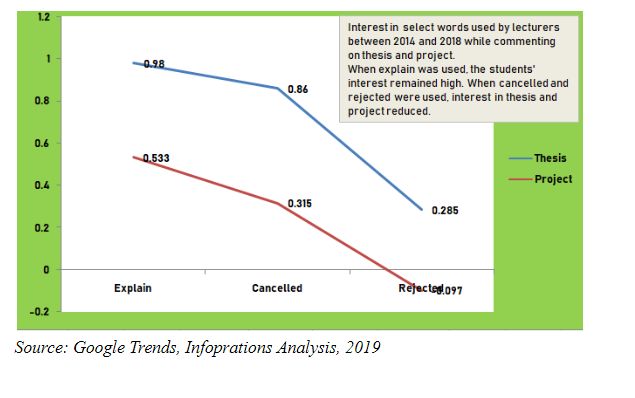
In a recent article published on this platform, the writer captured a typical power distribution during students’ engagement with their lecturers while writing the thesis (for postgraduate) and project (for undergraduate). “So, what do we do? We go home, sit down and try to unravel what our supervisors meant by “recast”, “expand”, “rephrase”, “expunge”, “explain”, “What is the relationship?” or whatever is written.

We were even happy when we see things like that, trust me. It was better than seeing two long strokes running through the page with captions such as “not accepted”, “redo”, “cancelled”, “rejected” and things like that. Honestly, course works were more fun in school than writing projects. Truth is that in course work you don’t have to get your lecturers ‘angry’ by asking questions.”The writer’s position was further explored using real time data that established public interest in thesis, project, explain, cancelled and rejected within education sector between 2014 and 2018.

Civic Engagement

University or any higher institution of learning is not created for academic purposes alone. It is a place where many politicians in the society honed their political skills and knowledge through unionism. The need for unionism has been premised on the fact that student rights must be ensured by the authorities, while their entitlements such as better living condition must not be jettisoned.

When there are obvious reasons for the students to agitate for improved living conditions or protect their interest, authorities usually exercise authority, expecting the students to respect it. Since the establishment of the National Association of Nigerian Students (NANS) in 1980, many battles have been fought, won and loss by the association.

In most cases, authorities believed that student unionism is impeding the expected function of the institution. Over the years that students and institutions have had frictions, students on their part believe that unions make administration easy. Despite this position, administrators believed that students cannot be nurtured for the positive benefits of the society in environments where there is no respect for authority.

Strategic Options

One of the solutions to the emerging issues is a formulation of cultural management strategy. Authorities need to have the strategy as part of the overall strategy for knowledge creation and management. It would be better some training courses be held for the lecturers and the students to get acquainted with the classroom cultural management strategy. Lecturers who appropriate  collectivistic teaching and supervision strategies such as small group and discussion during teaching and thesis or project supervision less need to be encouraged to increase the use of the strategies.

Curbing Poverty in Africa will Happen Through Entrepreneurship

0

Currently, Africa is home to the poorest people in the world. Despite several intervention programmes by global aid agencies such as the United States Agency for International Development(USAID) , Department for  International Development (DFID) and the World Bank, the menace of poverty rages on. According to the latest World Bank estimates, the share of Africans who are poor fell from 56% in 1990 to 43% in 2012. A report by the Brookings Institute forecast that by 2030, 377 million Africans will be living in poverty, this figure will constitute 87 percent of the world’s poor people.

The question then arises: “why is the continent still home to large numbers of poor people considering the continued flow of poverty targeted aid from the international community?” The earnest answer is that global intervention approach to ending poverty in Africa which often entails the distribution of food, healthcare and other relief materials across vulnerable African communities lacks sustainability. It is an instance of perpetual dependence on the well-meaning donors which limits the beneficiaries from attaining self-sustenance.

The global community needs to reconsider her aid schemes. Interestingly, the process of redesigning aid support to Africa is in process as some foreign agencies have identified investment in youth entrepreneurship as a complementary scheme in their aid efforts.  For instance, the International Federation for the Red Cross and Red Crescent (IFRC)  signed an agreement with the Tony Elumelu Foundation (TEF) in 2018 to support 200 entrepreneurs in the Niger Delta and NorthEast Regions of NIgeria. This has widened the reach of the entrepreneurship programme initiated by the TEF which has trained and given seed capital to many entrepreneurs in Africa.

In the same vein, the United Nations Development Programme has also signed an agreement with the Tony Elumelu Foundation(TEF) to support 100,000 entrepreneurs in the Sahel region of Africa over a period of ten years. This joint programme is geared to engage the young population in Africa starting with the Sahel region which is home to 1944 million young people .

As Tony Elumelu says, “global aid agencies are preventing further prevalence of poverty by building enterprises in communities”. The enterprise structures will create employment in communities at risk of poverty which (which is a proponent for social crisis): “give a man a fish and you feed him for a day; teach a man to fish and you feed him for a lifetime”.

Effective Ways To Do Family Business Succession Planning

5

The traditional family business succession planning in Nigeria observed from the last two generations is for parents to set up a business and almost from birth, decide which of their children will inherit and run the business after they retire or are gone.  While this is a genuine succession planning, Nigeria has had more of failed attempts than success stories when it comes to family business succession. It fails, because most parents get emotional and fail to provide the needed structure for the success of such successions. This is partly the reason while Nigerian businesses retire with the owners and we have lesser cases of businesses that transit from one generation to another. An example, look back to major cities in Nigeria, which of the top brands and ‘door-opening’ brands of the 1960s, 1970s, 1980s, 1990s or even early 2000s are still here.  Are memories of some names coming to mind already?

What is Succession Planning? I like this online definition that says “Succession planning is the process of pinpointing key needs for leadership and intellectual talent throughout the organization over time and preparing individuals for present and future work responsibilities”. Please note the key words needs for leadership and intellectual talent as we continue our discussion on this subject. 

Some of us may be at a stage when we are considering our children as successors to manage our businesses; while some are thinking about it for another ten or fifteen years from now.  And some of us are presently ‘running our show’, but in less than thirty years from now, the reality of succession may face us. What will be our continuity plan when that reality hits? Wherever you belong on the scheme of things, here are some items you may want to, not only tick off, but consider seriously. 

Formal Education is not enough: Yes I have this on top of my list, because usually, some parents think that once they have sent their children to the University, encourage them to do a masters training or even an MBA, it has fully prepared them for family business succession.  Formal education should only be a part of the plan, and is not enough to prepare anyone to run a business that his or her parent has run for say twenty years. In those years, a lot has gone into the business: culture, goodwill, modus operandi, norms, values, ups and downs, successes and failures, formal and informal operations which cannot be properly managed with a classroom experience only.

The Right Organisational Structure: Organisational structure is relative to type, industry and size of a business.  But organisational structure is critical, no matter where and how you are playing.  If you are considering a family succession plan, it becomes more vital to create the right structure for your business way ahead of time.  It can never be too early to create an organisation structure, but it can become very challenging when you wait too late.

Systems, Processes & Procedures:  To make the transition less challenging and at a reduced cost (monetary, emotional, time and other resources), it will be important, early in your business to run a system that is process-driven, with procedures for key job activities and departments;  in addition to detailed policies that guide the actions of everyone in the business. Not just an informal way of giving and receiving instructions, but processes, procedures, standard operating system and policies that are documented, communicated, implemented, followed through and reviewed as the need arise.

Personality Trait: Every human has a personality trait, and that largely determine what one is  good at and what one will not be so good at. Some people, their personality makes them good for indoor, desk-bound jobs, to others such a job will be a punishment, because they do better with outdoor jobs that keep them on the move. So it is important to consider your type of business, its demands and do a personality trait test with your child to determine if he or she is truly fit for the business or if the responsibility is more suited for another child rather than your first son or first daughter.  I do not like the sight of blood or violence attack; so if my father had insisted I study medicine or become a nurse, I would have been a disaster. For those who have children facing addiction or dependency issues, seeking legal help with estate planning for heirs with substance abuse can ensure the long-term stability of the business and the well-being of all involved. A well-thought-out plan can prevent future conflicts and protect both the family and the enterprise.

Test their Interest:  You may have an engineering business and have succeeded in having your child study engineering as part of your ‘unofficial’ succession plan.  After graduation, there is need to test the continued interest of your child to follow the path of Engineering, before you begin a detailed investment in succession plan. His or her interest may have been changed by his encounters and exposure by the University environment or overall societal environment as he/she matures.

On the Job Training: Start early on the job training for all your children whether you see them as possible successors or not.  Create an Internship and Volunteering plan for each of them right from secondary school to university graduation.  Some part of their holidays could be spent working either in your business or the business of your friend, associate, partner or even client. It is an exposure they will be forever grateful for.

Second part of on the Job Training:  I recall a proverb in Nigerian Igbo tribe that says, you do not give a child a coal of fire to hold.  It will burn him or her (paraphrased). Power corrupts and absolute power corrupts absolutely, the political scientists say.  So usually, because some of our parents are unprepared for family business succession, by the time some of their kids are coming out of university, the business is yearning for survival and fresh ideas; and the natural thing to do, is to bring a child straight into leadership position.  It is a coal fire that would burn the child and the business.

First recommended option will be to have your child learn the ropes of the job by going through the career path structure in your business.  Let the HR Manager take him/her through the interview process. Get them employed at an entry level and allow them to learn and grow through the process.

Second recommendation will be to allow your child after university graduation to work in other organisations to learn, grow and build a successful career meritoriously.  If your child wants to do their own thing after school, do not discourage it either, the failures and successes will prepare him or her for the role awaiting him/her in future in your business.

Whatever type of job training (from internship to the real job) that you choose, make efforts as much as possible to ensure your child learns through most of the business circle – from Front Desk management, to Customer Service assignments, General Office Administration, Human Resources Management, Accounting, Production or Service delivery circle.  It does not necessarily mean being an accountant when they are not professional accountants. But passing through some tutelage period in key sections of business operations will do more good than harm.

When the time is set to have your child or children take on full responsibility of running your business, here are some things you may want to also consider:

Accountability:  Make your child accountable to the organisation and the team.  A more functional approach is that they are responsible to a Board of Directors. Where there is none, because of the type of business, set up an Advisory Board of men and women they would learn from, who will also bring value to the table and let them have a reporting responsibility to the Advisory Board.

Discipline: I would assume by this time that discipline is already embedded in the culture of your business.  Where there is no sacred cow, and everyone including your child adheres to the rules of the game, the culture, norms, values and work ethics of the organisation including the processes, policies and procedures.  Where this is lacking, failure is on its way.

Professional Support: Of course remember to seek professional advice from your Lawyers, Financial adviser, Estate Planner, Human Resources and Management Consultant to ensure a good foundation and good closure. Professional support will give everyone involved soft landing, especially your existing employees.

Prepare for Environmental Factors: Finally, I would add, make sure your succession plan includes a proper strategic plan that prepares the business five to ten years ahead; and take into consideration possible political, economic, social, technological or other environmental factors that can affect the succession plan or the existence of the business itself.

Conclusion

Family business succession plan is a matter to be well thought-out and implemented, not a reactionary approach to implementation and certainly should not be allowed to be incidental.

It is a way to create an enduring legacy for the family; it can be fulfilling to all parties and stakeholders, but it all depends on the preparedness and the work that goes into it.