On a very fascinating thread, MTN explains what we have been saying: I can go to a market (Nigerian Stock Exchange) and display my farm produce (MTN Shares) for all to see but without any obligation to sell to any new person. But if some people that had bought the produce while I was on the road to the market decide to re-sell their portions, they are free to do. I have done nothing wrong in the community because people know where these resellers are: ”According to Nairametrics, just yesterday, MTN Nigeria Plc was the most actively traded stock, with 93.7 million shares valued at N13.5 billion exchanged in 464 deals.” This is the source of the episode. [MTN linked to it via the ad below, so I give it to it].
There has been misconception and confusion in some quarters about MTN’s listing of shares on the Nigerian Stock Exchange (NSE) a week ago.
There has been confusion in some quarters since MTN announced a week ago, that it was listing its shares on the Nigerian Stock Exchange (NSE) by way of introduction. Nigeria info in a podcast and CNBC in a report have both tried to break this down but this thread by Neusroom will help put things in clearer perspective. The issue primarily borders on the perceived scarcity of the company’s stock but the numbers indicate a different story. According to Nairametrics, just yesterday, MTN Nigeria Plc was the most actively traded stock, with 93.7 million shares valued at N13.5 billion exchanged in 464 deals. (TC Daily)
If you are doing digital transformation designed to drive consumer digital product sales on the web, one cost element you must watch carefully is marginal cost. Simply, marginal cost is the cost of serving an additional user in your ecosystem; understanding that cost is extremely important to architect a scalable business. You can also read this my Harvard Business Review piece.
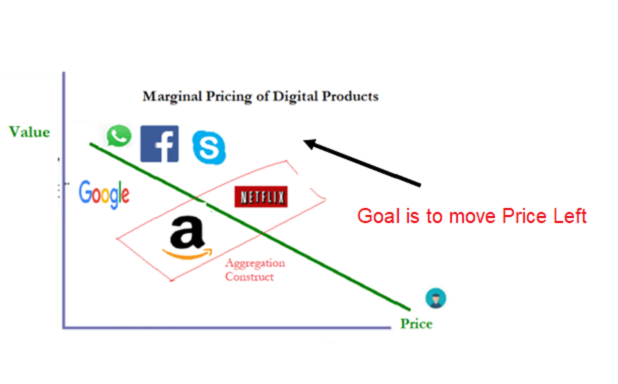
In a perfect internet market, the marginal cost of a digital product is zero. The implication is that only companies with natural equilibrium tending to near-zero marginal cost for consumer markets tend to experience huge growths. Google and Facebook are largely offering products at close to zero marginal costs. For accomplishing that, they make the products free, triggering huge scalability.
And of course, the scalable advantage is possible since the companies are also delivering huge value even as marginal cost is going low. Your goal is to move your product towards the LEFT of the plot where value is high even as marginal cost is lower.
Understand that when marginal cost goes low and value increases, you have disruptive impact in the market.
The freemium is possible because under that near-perfect market system, the marginal cost of producing a digital product becomes zero [Facebook cost is negligible when a new user registers on Facebook]. And if that zero production cost is attained, selling cost can be set at zero, marginally. By doing that, scale comes, and network effects set in – yes, more users will bring more users in a positive continuum that create virtuoso circle.
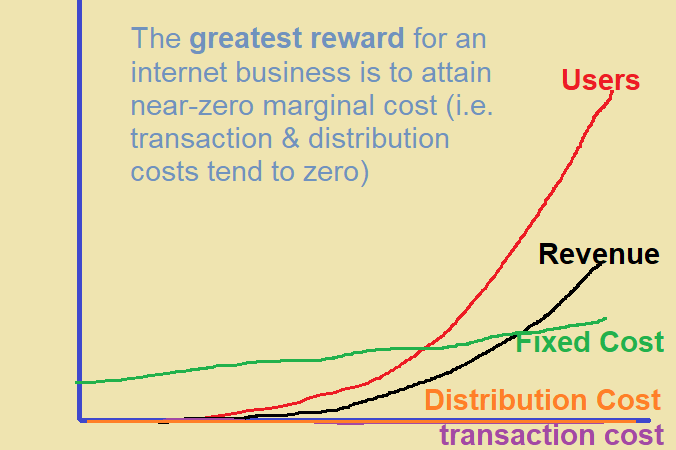
I give lectures on marginal cost as part of our workshops. I do spend two hours explaining to digital technology companies why they must understand marginal cost to build scalable strategies. Marginal cost is broadly broken into Transaction Cost and Distribution Cost. If your distribution does not go lower as you grow, your unit economics will struggle online.
That is why ecommerce does not scale in Africa as the distribution cost does not marginally reduce as scale happens. Why that does not happen is because logistics is a physical component of the distribution cost, not a digital element, and cannot be reduced via codes online. In other words, ecommerce is nothing “electronic” when it comes to Africa; it remains an offline business because the marginal cost is dominated by offline logistics as we have no efficient postal system which startups can leverage for growth.
It is the same marginal cost paralysis that hinders banking services from reaching every corner of Nigeria, at scale. Because in some cases, you are likely to encounter scenarios where cost of providing the services outweighs the revenue accrued there; making it obviously an unsustainable practice.
So most times, when you question why companies aren’t in a rush to set up businesses in certain locations, the supposed goldmines; bear in mind that business activities don’t always equate profitable returns, and without thinking things through, you are likely to fizzle out after starting on a high.
What happens in digital businesses also takes place offline, that is why you do not go about opening up branches just to count the number of outlets; if you open without analysing the cost implications, economics will help close them after a while.
In other words, if the marginal cost is not moving towards zero, then you are better off saying goodbye to massive scaling.
Invention is an idea; innovation gives you products and services. Fixing the transportation paralysis in Lagos remains a challenge in our nation’s largest economy. Many have postulated how different ideas could help: have a water-based transportation system, have a subway system, move some parts of Lagos to another state, and more. Of course, when you check most of the suggestions, it comes down to political actions at both local and state levels.
But things in Nigeria do not just happen at the jet speed – they crawl when governments drive them. That does not mean you should always blame governments – most times, they have limited resources, despite the huge challenges that abound. The implication is thus: they have to prioritize, and too bad, traffic continues to drain the economic energy of Lagos.
Interestingly, few months ago, I met a company that was doing something in the space: Gokada. The startup is a co-pioneering on-demand motorbike hailing service which makes it easier to move from one location in Lagos to another. The young people there pursued a solution to a market friction, and in less than a year, built a recognizable brand in Lagos.
During one year anniversary of Gokada
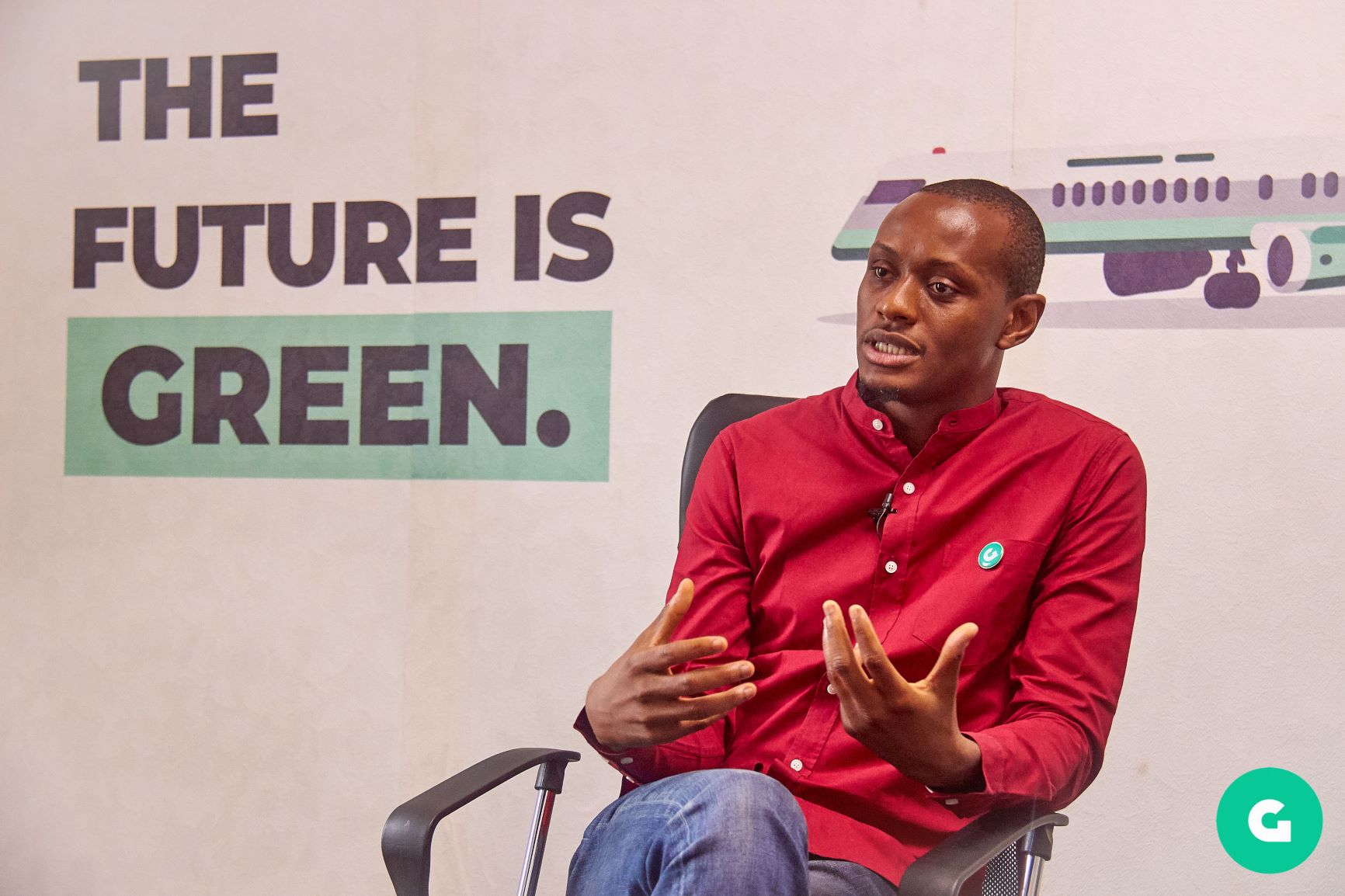
When they celebrated their first year of service to Lagosians, I visited them in their Ilupeju headquarters during my last visit to Lagos. There, I met the head of the team, Deji Oduntan, who communicated his vision that motorbike was just the entry point into the broad transportation opportunity. They have a really nice artwork where they declared “The Future is Green”. Gokada is that green – very fascinating futuristic vision I must note.
So, I was shocked when I read that Deji had left. It does happen – they always have things ahead. Who knows – he may announce something new in days: fintech, edutech, agtech, insurtech, VC funds, etc. While he gets my wishes to his future [no company statement yet of reason and possible next thing], let me examine what has happened in this sector and Gokada over the last one year he ran the show.
I’m Deji Oduntan, Co-Founder and former CEO of Gokada, an innovative motorcycle taxi startup that has taken Lagos and soon, the rest of Nigeria, by storm. Yes, former CEO. I can confirm that I’ve indeed left the company, and as finally announced, Gokada recently raised its Series A round of funding, an achievement that took a great deal of my time and effort, which I now fondly consider one of the best parting gifts I could’ve given.
My understanding is that Gokada co-pioneered this sector by professionalizing the regular okada domain. Yes, they utilized aggregation construct and unlocked huge value for the stakeholders. Today, Nigeria has at least five motorcycle taxi players including MAX. Simply, Deji and his team stimulated a latent industry and opened new areas for investors to deploy capital and create opportunities in the nation. That they created such impacts within a year is commendable. The sector Gokada plays is going to become more active across Nigeria in coming years.
If anyone had told me that something like this can be done in Nigeria that quickly, I would not have believed. But the day I rode a bike in Victoria Island to meet an important meeting reminded me why innovation is key. Finding a roadmap to separate the amalgam of okadas in Lagos, and creating a unique brand along the way is not easy. That Deji and team did that demonstrate capability on awareness and observation in the market opportunity.
When I visited their HQ office, I noted they planned to get female riders in the game. They have setup a Driver Training School to train new drivers. The idea of training is critical because anything happens on the Nigerian roads with okada drivers. So, finding a nexus to have professionally trained drivers was strategic for Gokada. And getting women into the sector is great for economic equality.
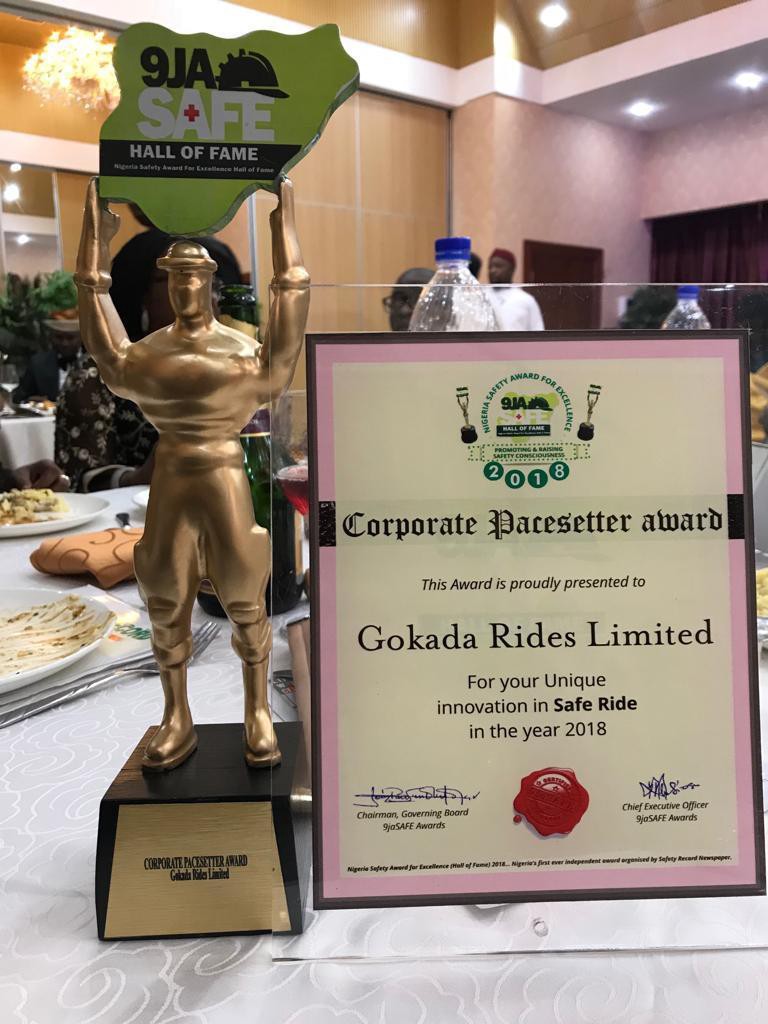
Gokada award (source: Medium)
Running a business of this type is never easy – you have to have statistical models to ensure supply and demand are well managed. That can come via decentralization of drivers while ensuring that originating and transit locations must offer you volume to attain sustainable equilibrium point. To get the best drivers, you may even have to have the recruitment localized while making sure their locations are strategic in the hub where the business runs.
This is not Uber or Bolt – this is Gokada. It is a very great example of Aggregation Construct which actually worked locally. The scale of many elements that must align and how they were able to piece them together within a year to great the brand bring optimism that Nigerians can build category-king companies not just locally but internationally.
To Deji Oduntan, who executed this with his team, he just opened a Pandora box in this sector – I expect great things to continue to happen in the industry. The Future is Green may include Black, Red, and Blue with the end goal being that traffic frictions are fixed across the streets in Nigerians.
We will be checking what comes next for the exiting CEO. Nigeria needs people that can kickstart new sectors and expand our economic growth. And build to glory, at scale.
May 29, 2019 is a big day in Nigeria – most governors would begin to serve their mandates. We sincerely wish them well as they serve the Nigerian people across our nation. Traditionally, I expect many to issue statements early June, informing the citizens that most of those promises that got them to the government mansions may not be realizable because of funding paralyses in the state. Yes, we just met an empty treasury and did not know it was this bad before those promises of heaven-on-earth!
People – it is not a joke as only about ten states are deemed economically viable in Nigeria. Yes, most states would need help to meet their financial obligations to their citizens and workers. It is on this premise that I write: we want to provide supports to states towards deepening their IGRs (internally generated revenue). This is our proposal:
Setup SME Growth Fund: We will work with a state to setup an SME (small and medium scale enterprises) Growth Fund. This fund can come from many sources including the state and our own funds. The primary motivation for this fund will be to help growing SMEs expand operations and employ more people in the state.
SMEs to Adopt TAP Technology: With TAP (Touch and Pay Technologies) technology, all transactions, offline and online, will be digitally recorded. Only SMEs using TAP to collect and record revenues will qualify to tap into the SME Growth Fund. The fund will be setup in such a way that support will go only to companies with demonstrated track record via receipts of payments captured via TAP.
Our goal is simple: zero revenue leakage even on cash-based transactions whether you are in your shop or not. You sell garri, we capture all payments digitally. You sell mama put, all payments are recorded. You have okada riders riding for you, you get revenue visibility. You own a bus, you know how much the conductor collected. You run a shop, all transactions are captured live.
Waive “Taxes” for users of TAP: The state should waive all taxes for users of TAP for the first five years for any SME with total annual revenue below $100,000 (i.e. N36 million). Yet, through TAP, states can efficiently collect VAT as SMEs will be encouraged to add VAT as their customers pay and all elements will be recorded.(Taxes, levies and fees under the control of states. On VAT, states can assume same contractual deals federal government gives to tax collecting bundlers; states do not control VAT but could help federal government with an arrangement.)
Implications
By waiving the corporate taxes even when collecting the VAT, the state could expand the tax base to make up for the losses on corporate taxes. Also, by making the use of TAP as a prerequisite to connect into the SME fund, a clear incentive will be for many to adopt receipted and digital-captured transactions with VAT tied to them in the informal economy. The clear benefits are:
The SME builds a credit and business record to access growth fund.
State collects VAT and expands the taxpaying pool.
SME will use actual business records to access more funds to grow, beyond the growth fund.
Most informal economy participants become more integrated into the formal economy.
All Together
We will be happy to discuss this in more details with any state (or state agent or contractor) that has interest. Sure, we will earn income from small interest fees on the SME Growth Fund since it would be managed as a pure financial lending solution. With cashflow records used for loan making, we expect defaults to be very low. Also, we will also earn transaction fees for the use of our technology.
For the state, there will be a clear stimulated IGR base. Our model shows that we can triple the number of SME-compliant VAT collectors through this mechanism within 12 months. Also, the IGR of a state will at least double within the same period.
If interested to learn more, contact our team here.
Great idea prof, but the State will be lukewarm in accepting this proposal as VAT is only centrally collected and redistributed to all via FAAC, it is not what is obtainable in the US where states administer and manage VAT in their domain. Tax holiday from Corporate tax can only be granted centrally too through FIRS and not via State revenue agencies, The only taxes that the States will be interested in boosting would be PAYE which they majorly control and administered by the State Revenue agencies.
My Response – Adedeji – the use of “Governors” does mean it can facilitate many things with the federal govt. Largely, a state can be a very efficient vehicle to collect VAT and could be paid just the same way federal government is paying contractors. There is innovation here if we want to run a future-proof economy by bringing the informal sector in. With the incentives of injecting more cash into the business, many may connect. Besides the tax, a state has incentives to make SME support based on real cashflow – and that is where we are going with this.
In July 2017, I wrote a piece titled “The Andela Problem” and partly concluded thus: “The business cannot scale outside the blue, because the revenue is the developer, and you cannot mass produce them. There is a space constraint on how many you can have in the offices. Sure – you have more offices, but that also increases cost. For the very fact that these workers remain with Andela, and not leaving, it will quickly run into carry-capacity” paralysis.
Then, few minutes ago, I received a note: “Andela just announced it has broadened its hiring criteria for Senior Engineers; whilst previously, the primary route was via the Andela Fellowship, as of today, Andela will also recruit mid and senior level engineers in 2019, as it looks to scale its operations. They will be hiring more senior engineers across each of their four hubs on the continent.” People, that is both evolution and revolution – Andela is now supremely amazing.
Andela is solving the global technical talent shortage by building distributed engineering teams with Africa’s top software developers. In four years, Andela has hired over 1,000 software engineers out of more than 140,000 applicants and become known as the “Best Place to Work in Africa,” with tech campuses in Lagos, Nairobi, Kampala and Kigali. Backed by Generation Investment Management, Chan Zuckerberg Initiative, GV, CRE Ventures and Spark Capital, Andela is powering global engineering teams while catalyzing the growth of tech ecosystems across the African continent
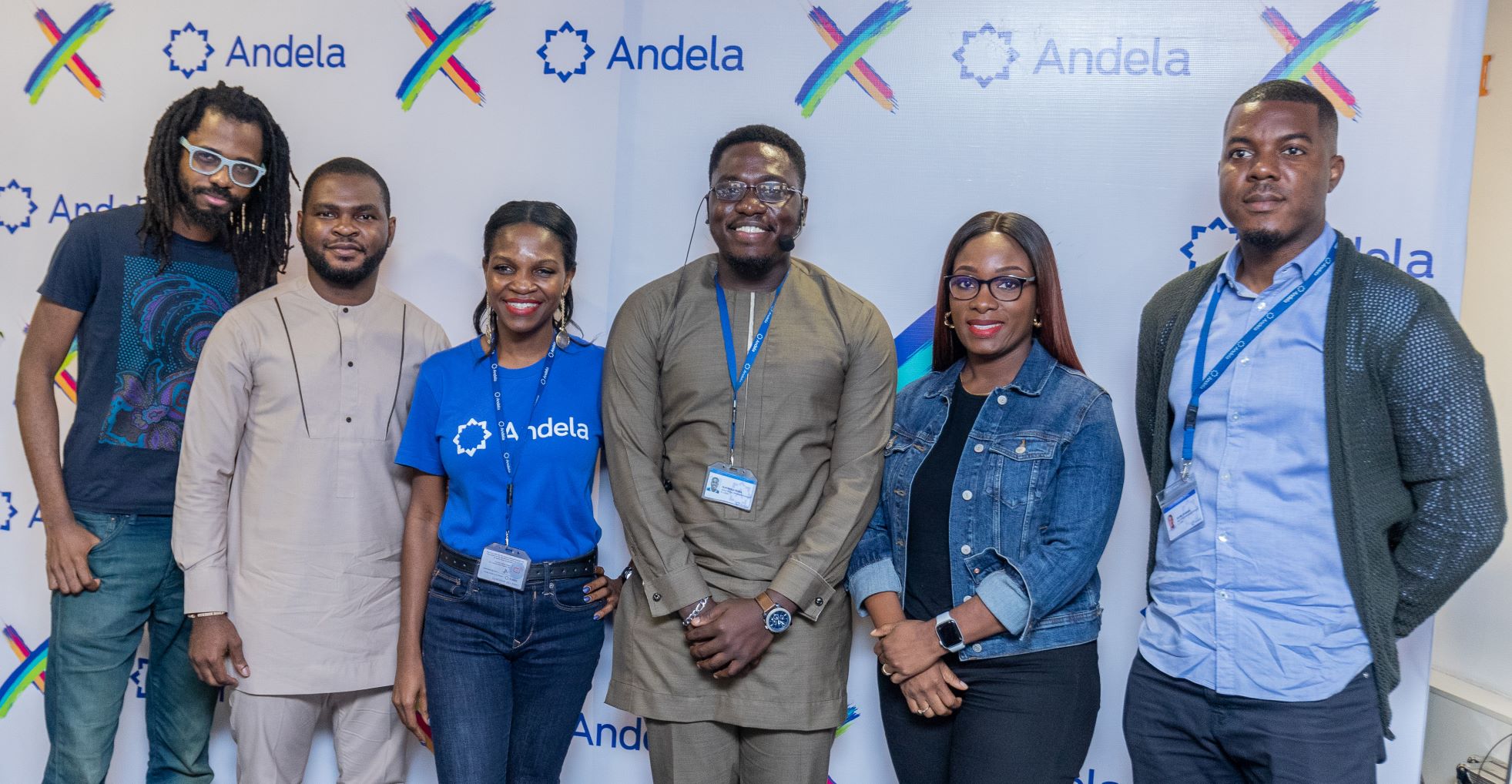
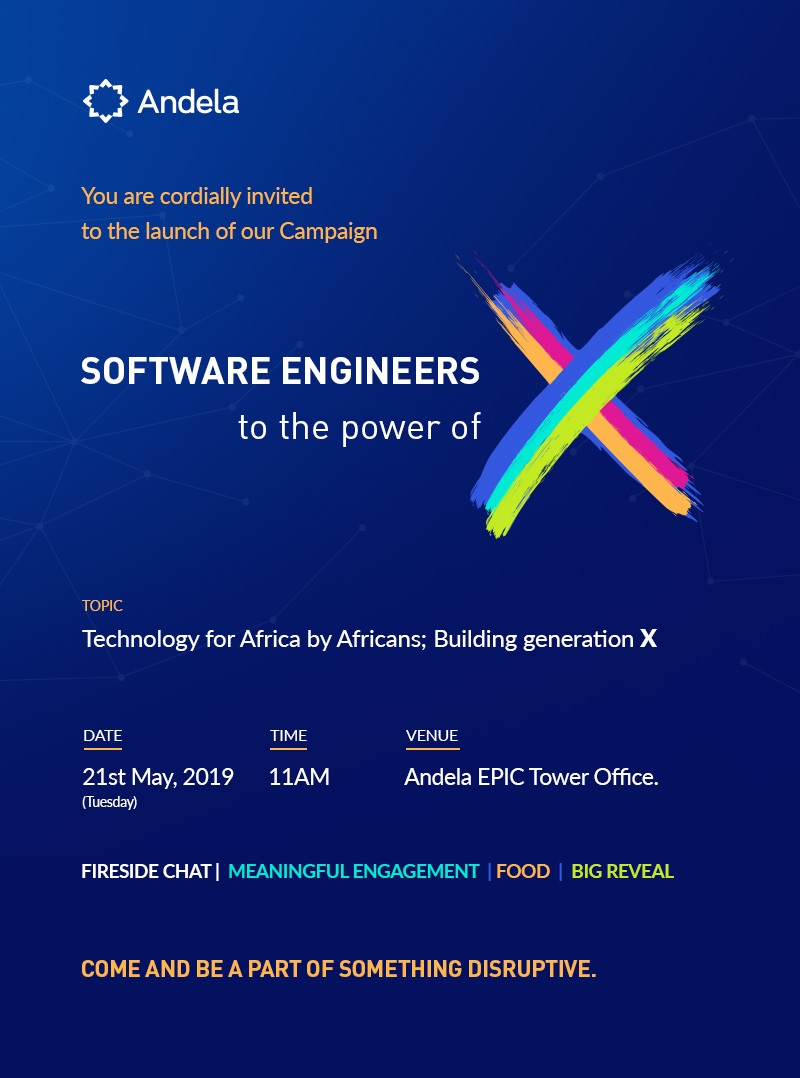
That 2017 piece has been read more than 25,000 times with varying comments. Interestingly, few days ago, I received an invitation from Andela that it was going to unveil a new initiative – The Power of X. I do receive many daily – so nothing special. But few minutes ago, the Andela people shared this press statement (I have reproduced the relevant portion).
Andela, the company building distributed engineering teams with Africa’s top software engineers, is recruiting mid and senior level developers in 2019, as part of a new Power of ‘X’ campaign, as it looks to scale its operations and meet growing demand. This comes as more companies seek to enhance their technology teams via distributed workforces.
Since its launch in 2014, Andela has received over 140,000+ applications to it’s Technical Leadership Program and has trained 1,000+ software engineers, who have worked with global companies including Safaricom, Invision, Viacom, and Skillshare. Andela now accepts applications from experienced software engineers who are proficient in Ruby, Javascript (React, Node, ES6+, Angular), Python (Django or Flask) and Native Mobile Technologies for iOS or Android. The move to recruit more senior technologists is an expansion of the company’s business model.
Andela engineers work on global challenges, within global engineering teams, yet play an important role in their local ecosystems. The 1,000+ Andela Software Engineers are central to Africa’s growing tech community, and are leaders or members of Forloop, Teencode, Startup Grind, Progate, Facebook Developer Circles, to mention a few. Andela is a gateway for experienced and talented engineers to become part of Africa’s most expansive network of technologists. Apply here for Senior Software Engineering roles at Andela.
Simply, Andela is looking for Senior Software Engineers. In other words, if you have the experience, Andela will hire you! Yes, you do not need to have gone through the Andela training system to be “andelaized” into the system. This trajectory is huge. It is huge because Andela can easily scale without marginal cost paralysis of having to train talent. Yes, it can find talent anywhere it wants without the construct that it must FIRST train before it can scale.
The Power of X is a brilliant pivot as the pool of talent is now unbounded and unconstrained for this category-king company. With capital, it can hire 10,000 people in a year and put them to work around the world. This is better than training mere 1,000 people in five years. Yes, 1,000 in 5 years – you cannot change the world at that pace.
If Andela had invited my practice after that piece, they could have arrived at this trajectory in 2017 instead of losing precious two years. That is what we do for startups around the world. But thank goodness, Andela is now unconstrained with a huge scalable advantage. I see this company listed in the New York Stock Exchange by 2024. It has a great business model now – and I can conclude with “The Amazing Andela”.