DD
MM
YYYY

PAGES

DD
MM
YYYY

spot_img

PAGES

Home Blog Page 6889

Explore the CBN Creative Industry Financing Initiative for Your Business – Up To N500 million 9% Interest Rate Loan

1

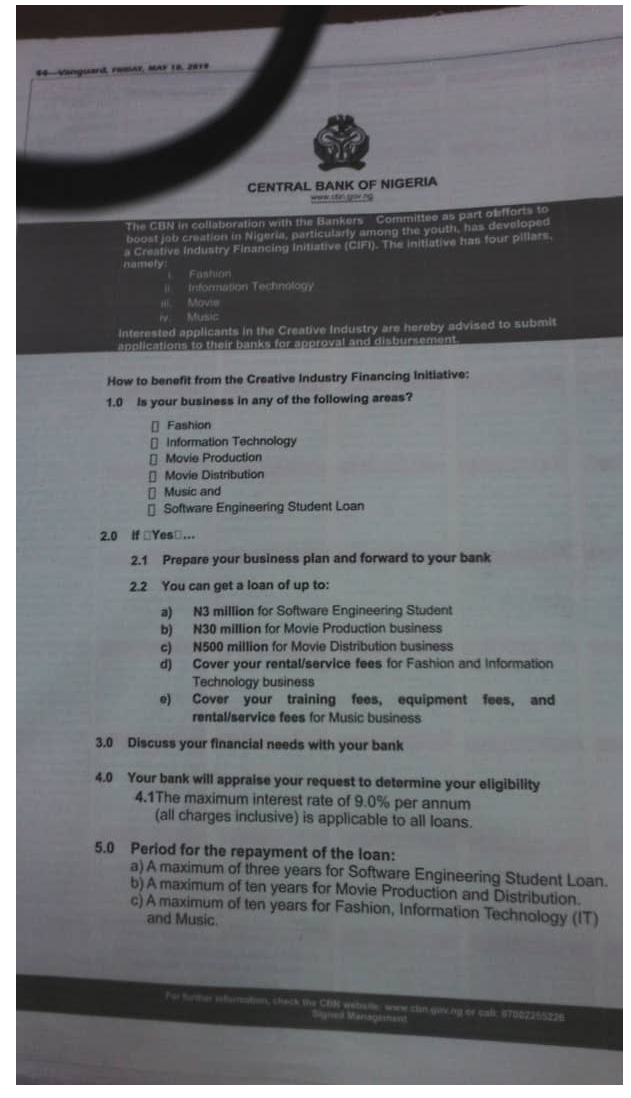
The Central Bank of Nigeria has adverts in some national newspapers on the Creative Industry Financing Initiative.  They have movie production, movie production, software, etc sectors for different financing packages for young people. You can get a loan of up to N500 million at 9% annual interest rate (all charges inclusive). It may be something some here may explore. It looks great if the banks will not ask for your grandfather’s chieftaincy cap or grandmother’s ceremonial beads. The adverts below…

  • a) N3 million for Software Engineering Student
  • b) N30 million for Movie Production business
  • c) N500 million for Movie Distribution business
  • d) Cover your rental/service fees for Fashion and Information Technology business
  • e) Cover your training fees, equipment fees, and rental/service fees for Music business


The Advert below.

The CBN in collaboration with the Bankers’ Committee as part of efforts to boost job creation in Nigeria, particularly among the youth, has developed a Creative Industry Financing Initiative (CIFI). The initiative has four pillars, namely:

  1. Fashion
  2. Information Technology

iii.               Movie

  1. Music

Interested applicants in the Creative Industry are hereby advised to submit applications to their banks for approval and disbursement. 

How to benefit from the Creative Industry Financing Initiative:

1.0  Is your business in any of the following areas?

  • Fashion
  • Information Technology
  • Movie Production
  • Movie Distribution
  • Music and
  • Software Engineering Student Loan

2.0 If “Yes”…

2.1 Prepare your business plan or statement on how much you want for your business.

2.2 You can get a loan of up to:

  1. a) N3 million for Software Engineering Student
  2. b) N30 million for Movie Production business
  3. c) N500 million for Movie Distribution business
  4. d) Cover your rental/service fees for Fashion and Information Technology business
  5. e) Cover your training fees, equipment fees, and rental/service fees for Music business

2.3 Go to any bank of your choice to access the fund.

3.0 Tell your bank how much you need.

4.0 Your bank will discuss your request and provide you the money

4.1 The maximum interest rate of 9.0% per annum (all charges inclusive) is applicable to all loans.

5.0 Period for the repayment of the loan:

  1. a) For Software Engineering Student Loan, it is a maximum of three years
  2. b) For Movie Production and Distribution, it is a maximum of ten years
  3. c) For Fashion, Information Technology (IT) and Music, it is a maximum of ten years
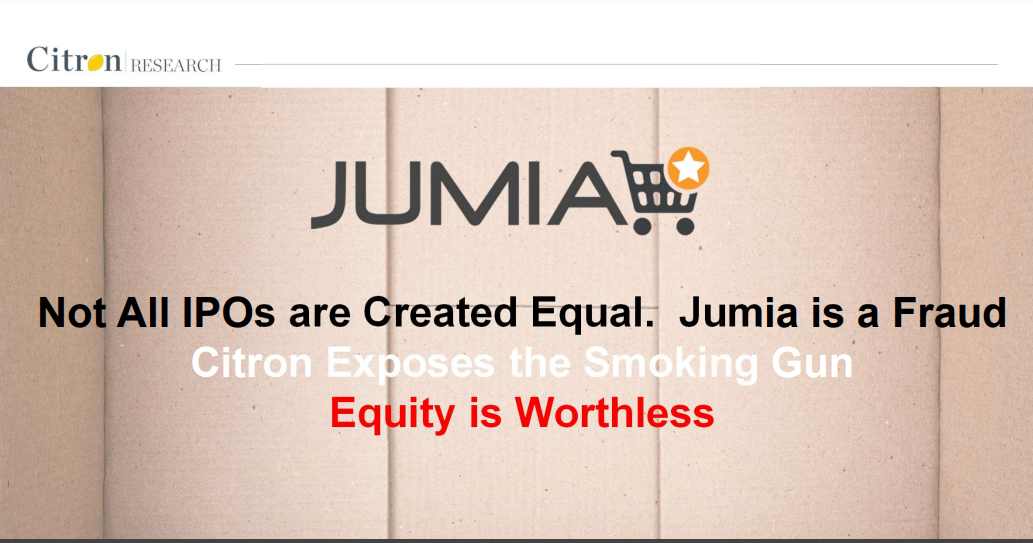
Citron Research Calls Jumia a “Fraud”, Stock Drops [Download the Report]

1

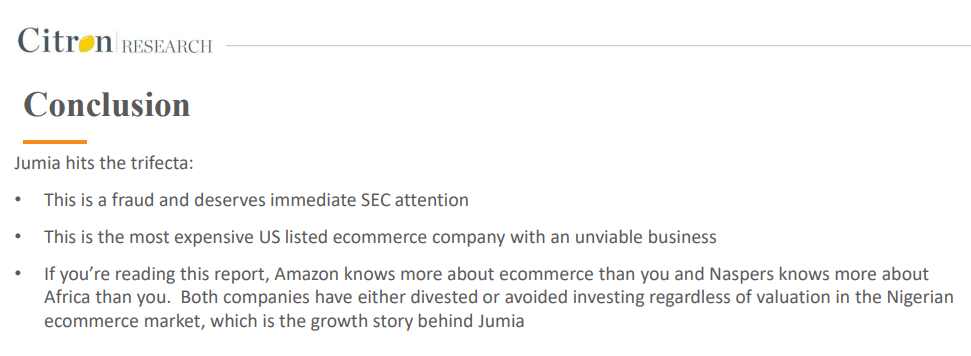
They have drawn the first knife on Jumia, calling it a “fraud”.  The Americans are wrong – Jumia is not a fraud. However, the business of ecommerce which Jumia is a key player in Africa requires more saints to overcome. Unfortunately, the saints of ecommerce, the believers to make the market boom, are scarce: “Jumia learned the hard way that Nigeria, Jumia’s largest and most important market, is not an easy place to do ecommerce for plenty of reasons including logistics, poverty, …”

From the report

Let me leave it there until Jumia reports two consecutive quarterly earnings – that is where everything will begin. As it stands now, the IPO was just an event. One thing is painful – they have left Germany, calling Jumia now a Nigerian company. You can download the Citron report here.

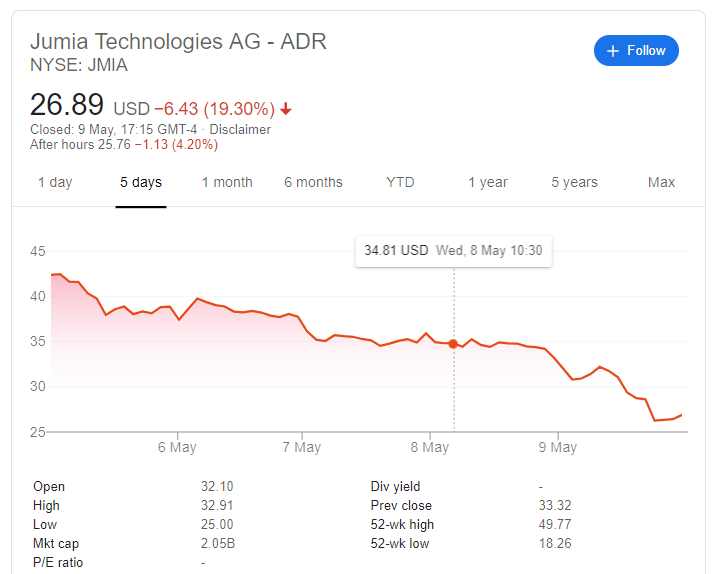
Jumia Technologies AG JMIA, -18.79% shares sank 14.6% in Thursday trading after Citron Research’s Andrew Left, a noted short seller, announced in a report that they have the “smoking gun” that shows why Jumia equity is “worthless.” “In 18 years of publishing, Citron has never seen such an obvious fraud as Jumia,” the report said.

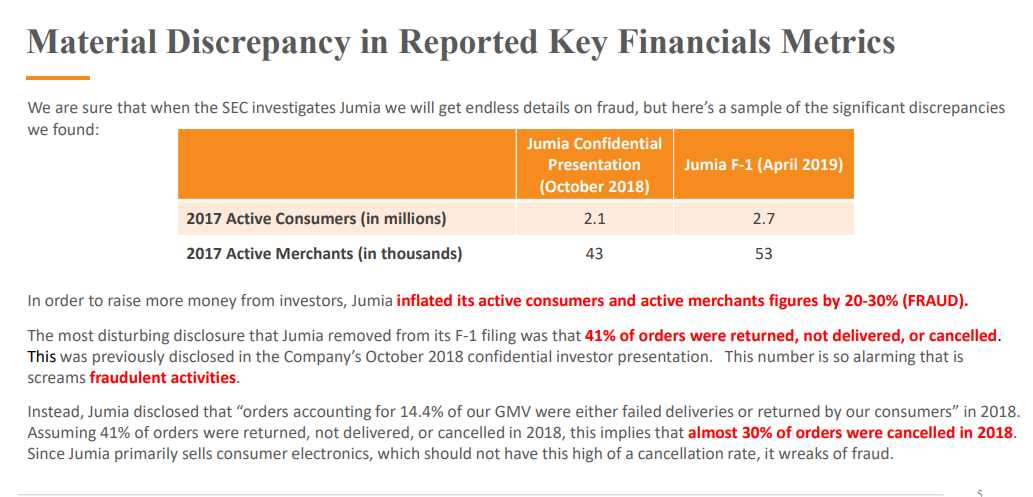
Citron goes on to highlight what it calls “material discrepancies” between the confidential investor presentation from October 2018 and what the company told the Securities Exchange Commission, including: inflating active customer and active merchant numbers by 20% to 30%; and that 41% of orders were returned, not delivered or canceled. “When a company markets to investors ahead of its IPO and then a few months later omits material facts and makes material changes to its key financial metrics to make the business seem viable, this is securities fraud,” the report says.

Citron also references media from Nigeria, Jumia’s biggest market, accusing Jumia of fraudulent activity. Jumia shares began trading on April 12, and soared 160% as of early this week. Shares were priced at $14.50.

Unless the numbers below are typos, Jumia has huge issues to deal with.

From the report

Jumia stock value

*The author is a short seller. He makes money when stock drops value. I do not know if he has shorted Jumia.

Comment on LinkedIn Feed

Comment #1

I was surprised when I saw the NYSE event of Jumia. A lot of things went through my mind. It’s just like UBER, Lyft and a couple others rushing to the market. None of these companies are reporting profits but are heavily funded having raised a lot of cash. So what has been sold is just on paper, worthless because you cannot earn from dividend payouts on these firms because there’s none to pay out, but the returns on the stock market…this is capitalism…but how does this differ from the sub-prime mortgage where derivatives are sold on the back of loans that are given to people with no means of paying the loans while hyping property values.

Jumia could be the Amazon of Africa, but Amazon was not built on debt and is a profitable business. I think we are importing business ideas into Africa that are not adapted for Africa. The poor credit system and lack of social support system that ensures that cash is in circulation and people purchasing power is loosely dependent on their social standing makes it imperative that we look at businesses differently and contextually. There cannot be another Facebook of Africa, and Jumia isn’t the Amazon of Africa by any stretch of imagination. They really need to re-jig their approach.

Comment #2

What’s best suited for Africa is many small businesses in every part of Africa providing focused and tailored services at close to a person-to-person level. This is why I foresee that organizations that can “break up” to small focus businesses and excellent agents network will hit the bullseye faster than a behemoth like Jumia.

By listing, they just simply created an exit strategy for some investors who needed to cash out. You need to understand the big scheme of things. A company that’s making loads of profit would be hesitant to list (e.g. MTN)…one that’s struggling will do everything to list on the stock market so as to get liquidity and create exit points for the investors that have been bleeding!

Bongajum Lesley’s Bongabike Wants To Fix Africa’s Electricity Problems

2

By Nnamdi Odumody

About 600 million Africans are without electricity, hampering overall economic productivity. Bongajum Lesley, a young Cameroonian, grew up in his village where inconsistent power supply caused his lecture notes at school to be destroyed by tears as a result of this critical paralysis. A couple of his colleagues lost their homes from fire accidents caused by candles, and fuel generators. He managed to graduate despite this mishap while others who couldn’t study under darkness, unfortunately, dropped out from school along the way.

Having developed series of non communicable diseases which also affected other members of his family, and being predisposed to being obese and diabetic at as young age, exercise was his only solution. He started working out at the gym and loved the spinning sessions, seeing positive results a few months later in his physical, mental and emotional wellbeing.

After he had lost 10 kg in three months since commencing exercising, and wondered where the energy lost at the gym was going to, he remembered the law of energy conservation which states that energy can neither be created nor destroyed but transferred from one form to the other. Immediately, an idea to develop an exercise bike which connects the mechanical energy from pedaling, by its user, to electricity while building muscles, emerged. He shared this vision with his gym mates, friends and family members and those who developed interest lent their support on how to make it better.

Prototype of Bongabike

With this, he developed a working prototype. The classic version of the bike which is more affordable harnesses energy from the sun, and pedaling by its user, storing it in a portable battery. This is designed for those whose main need is electricity. The second version is a virtual bike featuring a 15 inch touch screen filled with pre-recorded spinning classes, choreographed to meet its user’s fitness and energy needs with plans to include more entertaining and educative features.

Lesley’s Bonga Power Bike is his third entrepreneurial venture as a serial entrepreneur having founded ventures in healthy beverage and cosmetics (Le Havre which scaled to 10 African countries within two years). His plan is to do to electricity what mobile phones did to communication while making workout fun, educative as well as productive.

NNPC Needs to Adopt Smart Connected Technologies To Prevent Oil Pipeline Leakages

0

By Nnamdi Odumody

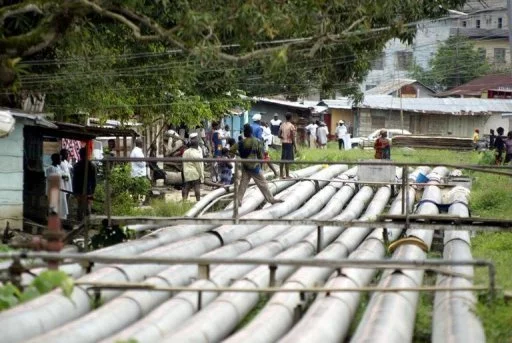
According to the Nigerian National Petroleum Corporation December 2018 monthly report, Nigeria lost $295 million as a result of shut down in production linked to leaking pipelines which carry crude oil from oil wells to flow stations in the Niger Delta.

The Bonny Terminal was shut down for two days due to pipeline leakages with a loss of about 26,000 barrels per day, worth $1.4 million, while at Okoloma and Imor facilities, 16,000 barrels per day for five days were lost due to planned maintenance.

Brass Creek and Trans Ramos pipeline which had been shut down, since April 24th 2018, due to leaks in a creek flowing into Odimodi resulted in a loss of 35,000 barrels per day production into Forcados terminal.

About 2,730,000 barrels worth $156million were lost when the Akpo terminal was shut down for 26 days for full field maintenance, the Usan terminal lost 1,299,000 barrels due to north loop pigging scheduled downtime, and also maintenance activity for a period of 2-13 days.

The leakage causes water pollution

More so, 340,000 barrels worth $19million were lost on Brass terminal as Addax shut in production for four days due to operational issues while it stopped delivery into the Nigerian Agip Oil Company facility due to leakages in November. The Qua Iboe terminal witnessed a 12 day shutdown in Asabo & Ekpe field due to Distributed Control System|Electronic Safety Shutdown System (ESSDS) upgrade which caused a loss of over 568,000 barrels worth $32 million while the Abo terminal was shut down for nine days maintenance, resulting in another loss of 108,000 barrels worth $6.1 million.

The Okwuibome field at Tulja terminal was closed for the whole month of October due to flooding at Beneku flow station which resulted in a loss of 22,000 barrels per day, worth $1.2million.

The NNPC needs to adopt Smart Connected pipeline technologies such as drone monitoring, distributed acoustic sensing, robotics, blockchain and 3D printing which will help in optimization for efficient pumping activities from its oil wells to flow stations. This should be supported with predictive maintenance of pipelines in real time, monitoring equipment failure and leakages, monitoring pipe thickness, temperatures and erosion, detection of cracks in pipelines and corrosion to minimize losses which leaking pipelines cause the Nigerian economy in crude oil earnings.

This is one way it can become profitable like peers like Saudi Aramco: “No one knows how much NNPC makes but we do know that Saudi Arabia’s equivalent of NNPC, Aramco, is making real money: Arambo generated $111 billion for the kingdom in 2018!”

The Australia’s 46 million times Banknote Error

0
Australia money

It is really hard – typos mess people up. There are red faces after $2.3 billion worth of currency has a misprint of the word “responsibility” in the banknote’s ‘micro-text. Australian treasury people will never forget the spelling of responsibility again: the Australian $50 note, printed 46 million times, used “responsibilty’ [sic].

46 million of Australia’s new $50 notes have been printed with a typo, the Reserve Bank has confirmed.

The “new and improved” $50 banknote was rolled out in October last year, with a host of new technologies designed to improve accessibility and prevent counterfeiting.

But the yellow note also contains a typo that misspells the word “responsibility”.

[…]

The small error occurred on Cowan’s side, in the text of her speech.

“It is a great responsibilty [sic] to be the only woman here, and I want to emphasise the necessity which exists for other women being here,” it says.