
DD
MM
YYYY

PAGES

DD
MM
YYYY

spot_img

PAGES

Home Blog Page 6904

Lessons from Dubai, Singapore and Barcelona on Smart City for Africa

0

By Nnamdi Odumody

A Smart City is a city in which technology is a driving force in provision of smart services to its citizens. According to Mckinsey Global Institute, by 2025, cities will save up to $1.7 trillion a year delivering services if they deploy new digital systems on a large scale. As part of hosting the 1992 Summer Olympics, the city of Barcelona which is the capital of Catalonia in North Eastern Spain converted its abandoned textile district into a technology hub called @22 which is now home to dozens of startups, and laid a network of fiber optic cables which covers 310 square miles.

Twenty seven years later, it is Europe’s and the world’s most wired city. With an operating system that runs the entire city within one interface in place, different applications aimed at making the lives of its 2 million residents happier, it saves $58 million annually through Connected Water management, $37 million from Connected Street Lighting Solutions, reducing costs by one third.

According to Cisco, Barcelona will see cumulative economic benefits of 832 million euros by 2025, including 86.4 million euros in extra tourist spending. Its #1 tourist attraction, Camp Nou which is the homeground of FC Barcelona new stadium, will offer new revenue streams by linking fans directly to merchandising with free Wi-fi. It will also remove the fences around its 54 acre compound that attracts about 1.7 million tourists annually, creating a smart city neighborhood in the middle of Barcelona.

The Emirate of Dubai launched its Smart Dubai Initiative to make it the world’s smartest city by 2021. Between 2014 and 2017, Dubai launched 137 Smart Initiatives and 1, 129 Smart Services with 307,105 total downloads. It’s AVG happiness index in 2016 was 90 percent  with 30,123 questions asked in three months and 11 billion AE Dirham transactions same year.

The Government of Dubai between 2003 and 2015 saved $1.2 billion through smart services with $5.6 saved by them for every $1 spent on Smart Transformation. It’s potential value from IoT (Internet of Things) is $4.8 billion by 2020, $1.5 billion potential value at stake from government blockchain by 2020, $2.9 billion potential gross value added to GDP from Open and Shared City Data annually starting from 2021 (i.e $1,000 value per person in the city) while 100 percent Dubai government transactions will be on the blockchain by 2020. Dubai’s government will celebrate its last paper transaction by 2021.
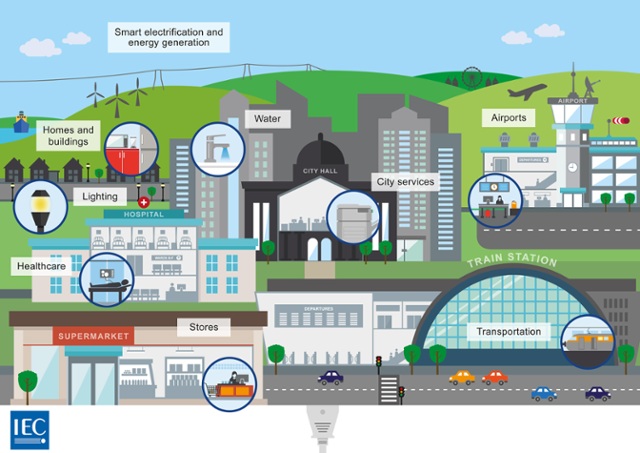
Components of Smart City (source: IEC)

The Smart Nation Singapore is the national effort of the government to remake the city state and its about 5 million citizens to embrace technology to make their daily lives easier, irrespective of age, gender, race and religion. It’s CODEX (Core Operations Development Environment and Exchange) is the digital platform that will enable the government to deliver better digital services to citizens faster and more cost efficiently. Its benefits:

  • Reusable digital components including machine readable data flows, middleware and micro services will be shared across agencies so that developers can plug and play into these resources and focus their time and energy on building better products to serve the public better.
  • The adoption of common tools and standards within government and by vendors will reduce bugs and raise the quality, reliability and security of services.
  • Government can tap into what the commercial cloud can offer in scalability and reliability as well as software services and tools.
  • This facilitates public and private sector to work together to develop more user centric services for the public.

The Smart Nation Sensor Platform is an integrated nationwide sensor platform to improve municipal services, city level operations, planning and security. More systematic use of sensors and data to improve urban planning, build more responsible and reliable public transport and better public security. An interconnected network of 110,000 lamp posts with wireless sensors will collate data that will be used for urban and operational planning, maintenance and response.

The Lagos State Government and other State Governments of the Federal Republic of Nigeria, Governments of Rwanda, Kenya, and Mauritius can learn from these three different experiences in adoption and implement smart initiatives and services to digitally transform their nations as well as enjoy the benefits of digital economies. Our continent needs to get 5G adoption and deployment right as it will be important in this redesign.

It’s Easter – the day of resurrection

0

It is Easter – the day of resurrection. I want to wish you all-around Easter in your life and career. As Heavens send angels on assignments today, may you be remembered to move from any valley in your life to the mountaintops. The grace, the amazing grace, and the abiding grace qualify you.

In mathematics, they call it exponential. In nuclear physics, they use quantum. I am combining them with wishes of exponential quantum blessing and breakthroughs. Today, no commercial-level computing can process that trajectory effectively. It is a huge gbaam – unbounded Miracle.

It is glory – overcoming the bounds of physics on this earth to experience the miracle of grace. As the mountains surround Jerusalem, so shall the grace this Easter will bring: total protection, total security, and total abundance.

Happy Easter

The Career Ladder – From Valley to Mountaintop

For Smarter Regulation of Airbnb in Africa

0

Hotels in South Africa are asking government to regulate Airbnb. They do think – allowing the hospitality platform to operate without regulations will eat into their business opportunities. DStv did ask for the same thing – regulation – against Netflix. Taxi owners did ask for the same element – regulation – against Uber. It is part of the new normal: get the technology portals out so that the old parties could continue!

Major entities in the hospitality industry in South Africa have called for government to step in an regulate Airbnb, according to a City Press report.

Airbnb has seen impressive growth in South Africa, and local hotels are concerned that the unregistered accommodation establishments listed on the platform are taking away business from established bed-and-breakfasts and hotels.

The Federated Hospitality Association of SA (Fedhasa) called for government to crack down on Airbnb, and smaller organisations have echoed this call.

The Port Elizabeth Metro Bed and Breakfast Association (Pembba) added that Airbnb brought in over R6 million in Nelson Mandela Bay last year, 65% up on the previous period.

The fact is that even if government regulates these digital platforms, the trajectory will not change because these platforms operate on near-zero marginal cost where the providers bear all the costs. The man that has a room to rent in Airbnb carries all the costs: no renter, Airbnb loses nothing! Largely, unless you ban it, no hotel can match that pricing because the man can always price lower than hotel chains as its cost model is more competitive. Airbnb will live on anything that comes to it because its cost is close to zero.

So, the shout for regulation will not change anything unless the hotels want to ban Airbnb in the nation. Doing that will be unfortunate since Airbnb provides income-earning opportunities to many citizens of South Africa who have rights to free enterprise as the hotels. By October 2018, South African Airbnb providers had made real money from Airbnb since it launched in the country in 2008. So, this cannot be structured for the hotels to be the sole winners. Others are indeed making money from South African tourism with their properties: “Findings released during Airbnb’s Africa Travel Summit found that South African Airbnb hosts have earned over R4 billion [$290 million] since the platform was founded in 2008, the Sunday Times reports.”

Regulation must be designed to support the South African tax base, leaving markets to decide who wins – hotels or Airbnb providers. So, charge Airbnb hosts the same tax rate you charge hotels and collect all the fees proportionately to track the hotels’. Once you do those, allow market forces to do the job. It is very possible we may not even need hotels in the future, and if that happens, let it be. But do not stunt Airbnb through arbitrary ban. Be fair and let customers decide the winners.

Why Airbnb Struggles In Nigeria

LinkedIn Comment on Feed

The good news about these stuffs (Airbnb, Uber Facebook etc )is that my House, Cars, Phones/laptops etc which could have just been liabilities can be transformed into Assets and bring incomes.
Since what they do solely is to close the gaps between potential services suppliers and services buyers, they play role of income redistribution.

Government area of interest should be on Tax generation and security/safety of the citizen (host and the guest).

Meanwhile Investment of companies in the Hotels, Printing and Logistics businesses needed to be protected because of the fact the established business are real employers of labour. I will suggest that Government therefore put higher Taxes on both Airbnb and the host to save the economy.
Since Airbnb operate at near zero cost, they can always operate at profit. Let them pay higher Tax. The host bears the cost.

The big players are on the receiving ends because of their huge operating costs and admin cost which make their cost high.

The game has already entered Printing business in Nigeria. The software company makes money from the buyer and also charge the printer for using their platform. It is challenging!

Another Comment

The only confusion here is that the Hotels Associations have not told us what exactly needs to be regulated: pricing or business model? It’s a different thing asking the government to save your dying business, in that case – you have the right to do so; but also note that you cannot always get what you ask for.

If we believe in free enterprise, both hotels operators and Airbnb providers are out there to make money, the only thing government should care about, aside from safety is how much comes in as taxes; anything else is more or less a harassment.

Lobbying is fundamental part of political governance, so as Hoteliers lobby the government, the Airbnb providers should also lobby; no one has a superior argument, it’s all about how you see it.

Again, we will always need the big hotels, for various purposes, beyond lodging, you cannot have big conferences or functions in Airbnb provider’s apartment; so the hotels will always be there. Since hoteliers cannot compete in bed and breakfast prices with Airbnb providers; they should reinvent their business model and shift more attention elsewhere.

Alibaba’s Xiang Hu Bao Crowd Insurance Model Could Work in Nigeria

0

This is a great idea for health insurance: crowd-insurance. Alibaba Ant Financial’s Xiang Hu Bao, which means mutual protection, has attracted 50 million people since its October inception. Simply, people crowd-insure themselves with no insurance company involved. U.S. Lemonade has something similar but not in health insurance.

The product operates somewhat like a collective, in which members contribute evenly to payouts of as much as 300,000 yuan ($45,000) when a participant falls critically ill. It’s free to sign up, there are no premiums or upfront payments, and disputes about claims are adjudicated by volunteer members, according to a statement from the company on Thursday. In return for managing the process, Ant will take an 8 percent administrative fee out of every payout.

[..]

The company’s foray into health care comes at a time when the country is grappling with a rapidly aging population, one of the more pressing long-term threats to the world’s second-largest economy. Ant said Thursday it hopes to sign up 300 million Xiang Hu Bao users within two years, which would represent more than 20 percent of China’s population.

Managing fraud? “Ant is using the same blockchain technology that underpins digital currencies like Bitcoin, which rely on common verification by members. Members who fall critically ill within 90 days of joining the plan will not be compensated.” They are bringing the tech elements together to deliver new business models.

I think with the deep distrust in the Nigerian insurance, crowd-insurance may be a good idea if the regulators will ever allow such. At least religious organizations and cooperatives can explore the model if platform-tech tools are available to power them. This is a great business to explore in Nigeria but focusing on churches, mosques and cooperatives which already have pre-existing trust infrastructure among themselves.

The insurance industry in Nigeria has used IT for productivity gains. Now is the time for the next level of innovation which is taking the insurance industry to the web. What they have been unable to do for decades – industry penetration acceleration – can happen if they digitize their products and make it possible for Nigerian entrepreneurs to participate via InsureTech. Should that happen, new products will evolve, and could actually deliver the aha moment that will make Nigerians begin to like buying insurance. The time is now: Nigeria needs a 21st century insurance industry.

LinkedIn Comment on Feed

A sort of an insurance model for esusu? Part of the motivation for contribution is that potential date to getting your returns on investment, once that element vanishes, many people could take off… The model can work well for middle-class settings, but what happens to children of the contributors?

Another twist, especially when it’s difficult to know who falls ill more often and who maintains better hygiene. Lots of things to outline. A good experiment worth doing, it can go either way.

Another Comment

Do you realise that that this is very similar to what is already done in the traditional village meetings? Just informally. Where everyone pays levies to the association and when a member is ill or deceased the association handle the cost up to a set amount. As long as the person’s own payment is up to date.

China Plans Dedicated Lanes for Autonomous Vehicles

0

These are three trends and technologies which Diamandis has captured.

Dedicated Lanes for AV: According to KPMG, China is currently ranked 20th in the world on its Autonomous Vehicle Readiness Index. To step up its game, the country is developing new road infrastructure with dedicated autonomous lanes. Slated to begin operation in 2020, the first stretch will be a 100 km road connecting Beijing with the Xiongan New Area in Hebei province. The road will embed sensors and electronic tolls that aid in the development of autonomous technology and facilitate easy payment for cab-hailing companies that begin to rely on driverless vehicles.

AI-Authored Book: Scientific journal publisher Springer Nature just released the first machine generated textbook by a scholarly publisher. Developed by the Applied Computational Linguistics (ACoLi) lab at Goethe University in Frankfurt, “Lithium-Ion Batteries: A Machine-Generated Summary of Current Research” is an attempt to distill insights from the vast amount of research in the area. According to Springer, over 53,000 papers on Lithium Ion batteries have been published in just the last three years. While there is an element of human quality control in the training phase, the algorithm condenses and organizes the pre-approved, peer-reviewed publications into coherent chapters and sections, giving researchers just 180 pages to review and consider versus 100,000+.

Road that Recharges EV Buses: Reimagining electric vehicle (EV) charging from the ground up (literally), the Swedish transport administration is now experimenting with electric dynamic charging roads. In a $12.5 million showcasing project, the Smart Road Gotland consortium will pilot a 1-mile stretch of e-road between Sweden’s Gotland Island airport and the town of Visby, capable of charging electric trucks and buses as they run over it. Funded primarily by the Swedish government, the project will leverage a Dynamic Wireless Electrification System developed by Israeli company Electreon, a driving lane-embedded infrastructure that powers vehicle batteries wirelessly.