DD
MM
YYYY

PAGES

DD
MM
YYYY

spot_img

PAGES

Home Blog Page 6911

Nigeria’s 60 million Digital Problems

0

The federal ministry of education dropped something this week: illiteracy level in Nigeria. Watch the number – 60 million illiterates in Nigeria – as you pursue that digital strategy. It is a very significant number which takes away a huge chunk of the 180 million people in population. Largely, when you take out the pre-readers (at most 15 years by literacy classification, 44% of population), you may have only about 40 million literate adults since 60 million adults are already classified illiterates.  (About 80 million Nigerians are aged at most 15 years which means you have 100 million remaining from 180 million. If you remove 60 million illiterates, you are left with 40 million adult literates in the population.)

Sonny Echono, Permanent Secretary, Federal Ministry of Education, says nearly 60 million Nigerians are illiterates, assuring that literacy centres will reduce the high percentage of illiteracy in the country.

Mr Echono made this known on Thursday at the Federal Government College Otobi, during the inauguration of a pilot Literacy Centre for the North-central zone.

The permanent secretary expressed regret that the illiteracy rate among the youth and adults is high, saying that the literacy level at the lower cadre of the colleges is also alarming.

As the Permanent Secretary ministry of education noted, the number is increasing. In other words, adult illiteracy in Nigeria is growing. In 2015, adult illiteracy for Nigeria was 41.3 million; today, it is now 60 million. Adult illiteracy of Nigeria increased from 24 million in 1991 to 41.3 million in 2015 growing at an average annual rate of 21.00 %.
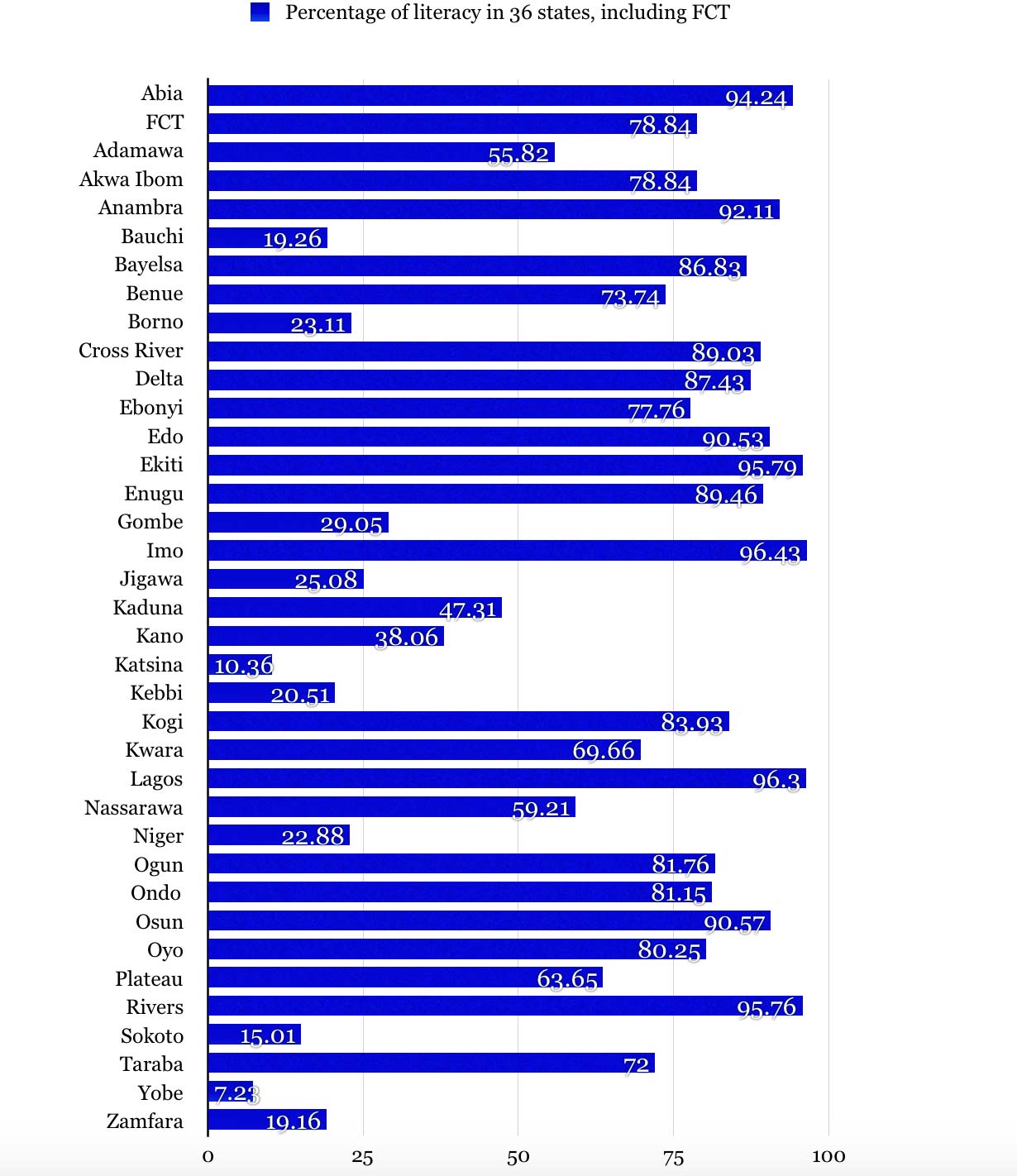
I commend the government for doing something about this through this literacy school initiative. Besides, they need to add community-driven initiative that works with mosques/churches and village leaders. In my village where I can say we have close to 99% literacy rate (my state, Abia state, has literacy rate of 94.24%), community women leaders run the show.

LinkedIn Comment on Feed

Comment #1: As always, Nigeria is a strange place. Ordinarily, you would expect the illiteracy level to depreciate substantially over the past years, because the younger people were all expected to receive basic education; but it turned out that the opposite is the case. Again, to make blanket statements such as “60 million Nigerians are illiterates” is misleading too; when my home State is nearing 100% literacy level, so a clear distinction is needed, to get some people up and running. 

No State in the entire northern region reached 80% mark, the few that crossed 70% are predominantly the minority tribes in those areas, so there is a clear relationship here; that’s where major enlightenment and awareness need to be directed. The federal government doesn’t have much to tell people from my State, its focus should be heavily directed, with laser-focused attention on the States that are simply below baseline.

Yobe State has 7.2% literacy level in a country that operates “federal character” regime, and one is still searching for the meaning of injustice? Most state governors in the north should just vote around 70% of their annual budgets to Education alone, the numbers coming from there are just pathetic.

Comment #2: And this figure is coming from the ministry which makes it likely to be a discounted account of the true picture. This fact even makes it more cringing.
Huawei Filed Most Patents in 2018 – WIPO

0
US sanctions are affecting it

By Nnamdi Odumody

Huawei Technologies, the Shenzhen-based Chinese telecommunication equipment maker, saw a 25 .01 percent rise in profits as a result of its continuous investment in research & development which has seen it develop innovative products that have improved the customer experiences in its markets. It posted net income of CNY 59.30 billion in 2018 while its revenue for the year jumped by 19.50 percent to CNY721.20 billion.

According to its 2018 annual report, Huawei invested CNY 101.5 billion (14.1 % of its sales revenue) in R&D ranking fifth in the European Union Industrial R&D Investment Scoreboard. Guo Ping, Huawei’s rotating chairman, said at the release of the report that Huawei’s R&D expenditure over the last 10 years had reached more than CNY480 billion.

According to the World Intellectual Property Organization (WIPO) data on patents filed, Huawei filed 5,405 patent applications in 2018, placing it in first position among all companies globally.

Asia-based innovators filed more than half of all international patent applications via WIPO for the first time in 2018 on significant growth from China, India and the Republic of Korea, capping another record-setting year for WIPO’s global intellectual property (IP) services.

[…]

China-based telecoms giant Huawei Technologies, with a record number of 5,405 published PCT applications, was the top corporate filer in 2018. It was followed by Mitsubishi Electric Corp. of Japan (2,812), Intel Corp. of the U.S. (2,499), Qualcomm Inc. of the U.S. (2,404) and ZTE Corp. of China (2,080). ZTE Corp., which was the top applicant in 2016, saw a 29.8% drop in the number of published PCT filings in 2018, its second straight year of declines. The top 10 applicant list comprises six companies from Asia, two from Europe and two from the U.S.

Huawei won the award for Supplier of the Year 2018, and Best Innovation 2018, at MTN’s Annual Supplier Award ceremony in Dubai, based on performance metrics such as quality, delivery and support, account performance management, innovation and meeting MTN’s compliance and risk requirements.

About 197 Fortune 500 companies use Huawei’s products, and in 2018, they sold 200 million phones getting 14.8 percent of global market share, and placing them in second position to Samsung Electronics. It has 36 joint Innovation centers across the world, 176,000 employees and 79,000 R&D employees.

Asia is now the majority filer of international patent applications via WIPO, which is an important milestone for that economically dynamic region and underscores the historical geographical shift of innovative activity from West to East.

Director General, WIPO, Francis Gurry

African companies should learn from Huawei and invest a significant portion of their annual profits on Research and Development to come up with products that will compete in blue and red oceans in order to consolidate their market dominance.

What the Paystack – Lambda School Will Cost You in Future: At Most $25,000

0

Just as you decide to apply for the Paystack-Lambda School income share agreement education – you get training free, to pay from your future paychecks – please note this: it could cost you up to $25,000. They have capped the future pay at $25k. Yes, there is a huge opportunity cost there. You are looking at 9-month remote software training and the possibility of paying $25k for same in future. Make those decisions yourself.

The ISA [Income Share Agreement] for African students is a little different from the ISA for students from the US and EU, in recognition of different economic conditions. As an African Lambda School student, you only pay the ISA if you’re making over $15,000 a year (or the equivalent in your local currency). If you don’t find a job, or don’t reach that level of income, you’ll never pay a cent. If you do meet the minimum requirement, you’ll pay 10% of your gross income monthly (before taxes) over the course of 5 years. The amount is capped at $25k.

The U.S. wage base is $50,000 but they have made the African one $15,000. The Lambda School is a 9 month immersive training program that gives you the tools and training you need to launch a new career. The program trains people online to be software engineers at no up-front cost. Instead, students have the option to opt into an Income Share Agreement where they pay a fraction of future income.

LinkedIn Comment on Feed

  1. When you have nothing, all agreements really look fantastic, until you worth something, then you begin to question everything. In Naira terms, that’s over N8M pay out in five years, and if Naira tanks, it could be over N10M. The catch is that you only pay when you are working, but when you now have a colleague who goes home with full cheque – while yours is punched with 10% drop; you are likely to feel ‘cheated’, but remember where you were coming from… No free lunch, just make sure you possess both the mental and emotional capacities to make this sort of decision, once you are in, you are locked!
  2. That calls for some decision. For me, I would use the following parameters to make that decision. 1 ) Are they going to provide me with a job after the training? 2 ) Are they going to provide me with all the facilities I need for the training apart from the training content? That is to say, are they going to provide me with laptop, internet, and electricity for the training? Or maybe access to any training facility?

Paystack Brings Lambda School To Nigeria; Income Share Agreement Is Here

Ireland’s Touchtech Payments Which Stripe Acquired Was Co-Founded by Nigerians

0

Stripe, the global payment processor, acquired Ireland-based Touchtech Payments. Touchtech Payments provides solutions which help in online transaction authentication for financial services entities. It does offer transaction authentication ecosystem to increase transaction rate and reduce fraud. The company was founded in 2014, and is headquartered in Dublin, Ireland.

“Today we’re thrilled to announce we’ve been acquired by Stripe, which will help us accelerate our work and support more customers. Strong Customer Authentication, a new EU regulation coming into effect on September 14, 2019, will radically change the way European customers buy online. As a result, the internet payment landscape is going to change a great deal, and both banks and businesses operating online are going to have to adapt,”

The size of the deal was not disclosed for the company which has raised about $1.4 million mainly from government sources.

“Touchtech builds software that helps banks enable frictionless and secure payment experiences. We’re looking forward to supporting their work to improve the online payments ecosystem,” said Patrick Collision, Chief Executive at Stripe.

[…]

“Stripe and Touchtech are both using innovative new technology to grow the overall size of the internet economy. Both organizations work hard to take a long-term view of what’s best for both businesses and for customers. We’re confident that we’ve found a natural match. As part of Stripe, we will continue to grow our products, based out of Stripe’s R&D hub in Dublin. We are really looking forward to the things we can build by working with Stripe, and can’t wait to show you what we’re up to,” (source: Press release)

Touchtech Payments Ltd now operates as a subsidiary of Stripe. But the real deal is that Touchtech Payments has a Nigerian connection right there in Ireland: “Touchtech was founded in 2014 by Shekinah Adewumi, Niall Hogan and Joseph Kuye. Kuye has since left Touchtech leaving Adewumi and Hogan as the remaining members of the original founding team”.

Shekinah Adewumi and Joseph Kuye are the co-founders of fintech start-up TouchTech Payments. Their product is a new online authentication software product designed to reduce card fraud, increase the number of transactions completed online and make it easier for people to cyber shop.

“One of the largest contributors to online credit card fraud is the lack of proof that the cardholder is in possession of the card at the time of purchase. Our system solves this problem,” Adewumi says.

“A separate issue for retailers is that the current method of purchasing online is a 13-step process whereby consumers must manually input card details followed by a ‘Verified by Visa’ authentication. This final step alone results in a third of all purchases not being completed. Our system does away with this manual entry requirement.”

co-founders of Touchtech

The Virus of Football

1

By Temitope Akintola

The nature of my job affords me the opportunity to travel a lot, interface with people from different walks of life and get very social.

In my recent travels on the continent, from Far East Ethiopia to the west in Senegal, one theme seems to be ever present in every hang out spot, bar, club, resorts or even in formal meetings that I attend: FOOTBALL.

Football presents itself as a very potent weapon across the continent, it’s your go-to topic to start a conversation in any setting these days, even the wealthiest man on the continent.  Aliko Dangote would burst into laughter and excitement once Arsenal Football club is mentioned and that could easily turn to a heated argument if long time friend Femi Otedola tries to spite him at Arsenal’s lack of success in winning the premiership for over a decade.

I vividly remember a TV presenter in Nigeria starting with facts how Boko Haram had not attacked a village or dropped a bomb during the period of the last World Cup held in Russia. 15 July 2018 marked one of Boko Haram’s biggest attacks on the Nigerian Military since 2015 – that date coincided with the last day of the World Cup.

We forget our differences, our religion, and our struggles, once the game comes up and we start to hug when our team scores not minding the religion, ethnic group or political party the person belongs to; only one cluster matters now; what football team you support.

I carefully add that this trait is not limited to football, but as an African from the West, Football is sports to us. The “Ping-Pong diplomacy” was coined when China ended a 25 years of no-communication with the US by inviting American players to an exhibition match, Nelson Mandela used Rugby to unite RSA in 1995.

However, Joe Humphrey said that “sport is essentially anti-family and encourages unethical, discriminatory behaviour”.  What happens when we do not support the same team? Violence? Racism? Targeted attacks?

I asked my friends’ kids in Ethiopia, Senegal and Nigeria to write a composition on what they would like to be in the future and I got about the same response. They all want to be footballers. They want to be the next Amiya Taga, Sadio Mane and Jay Jay Okocha. They wrote with so much passion for the game, a caustic, consuming passion that takes every other thing as secondary, leaving football as the primary focus.

Do we blame the kids? Footballers are more celebrated these days than Nobel Laureate winners in our society. It’s gradually becoming the ultimate achievement to play in Europe. Our schools spend more on sport activities like NUGA games, Inter House sports than they spend to equip the laboratories and on JETS club.

Is football becoming a new virus to our future generation?  Is our love for football doing more harm to our economy and our future than good? Is there a balance to be found? Is it time for schools to revisit the curriculum? Every home now boasts of a potential sports gambler in Nairabet and Betnaija now?

I leave us with this statement from Tupac “Black Americans do not need any more basketball players or football players but rather Physicists, Mathematicians and Businessmen because these are the class of people that would re-write the black history and add the needed pedigree to the black nation”.

Thank you for reading