DD
MM
YYYY

PAGES

DD
MM
YYYY

spot_img

PAGES

Home Blog Page 6957

The United States vs. Huawei – Is it about 5G or Politics as Usual?

0

In a previous article, I mentioned that the development and deployment of 5G has often pitched as a race between operators/countries and there seems to be an assumption that the country that dominates this race will gain a technological superiority and dominance. Russia is now formally in the 5G race as it plans to rapidly build its 5G networks and deploy 5G technologies as early as 2020.

In recent times, the United States Government accused Huawei of espionage but did not explicitly cite the development of 5G as a bone of contention. The US specifically mentioned that Huawei’s communication equipment could not be trusted and went a step further in warning its allies to neither trust China nor deploy Huawei’s equipment within their 5G networks.

Despite the warning, the US was unable to cite any evidence of risks/compromise in Huawei’s products. Of course, this creates doubt and makes one begin to wonder if this is an attempt to slow down China’s leading role within the 5G space or simply politics as usual. And if indeed there were a race among countries regarding the development and deployment of 5G, China seems to be leading, as a result of the Government’s support and aggressive technology ambition, which it calls ‘Made in China 2025’.

Countries like Australia, New Zealand, Japan etc. have thrown their weight behind the US stance and formally declared their intentions of excluding Huawei from their 5G networks.

In a further twist of event, the British Intelligence (despite a gruelling Brexit negotiation and a desperate need to formalize trade agreements) came forward with the suggestion that the deployment of Huawei’s equipment within their networks poses a manageable risk. The British Intelligence went further to ascertain that they have developed techniques capable of mitigating these threats within their networks. This is not particularly surprising to those familiar with the UK telecoms sectors as large mobile operators within the UK depend heavily on the use of Huawei’s equipment and technologies for their operations. This is besides the huge grant and funding awarded to higher institutions of learning within the UK to accelerate the development of communication technologies.

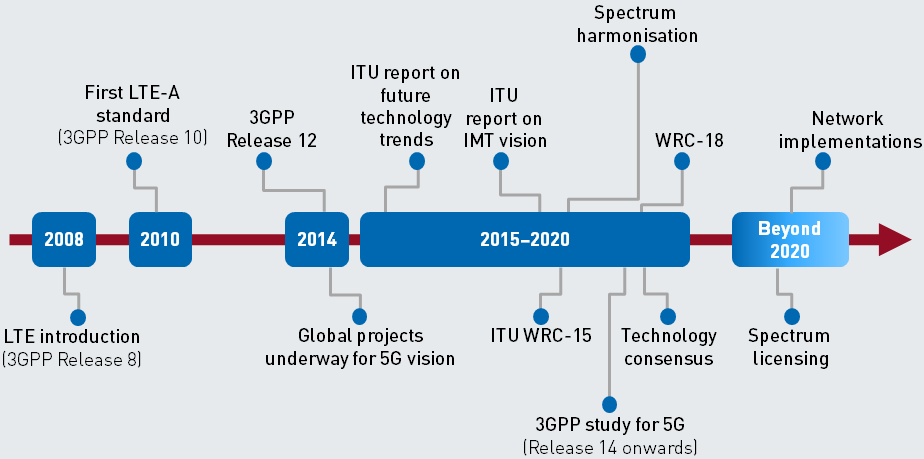
Timeline towards 5G [Source: Analysys Mason, 2014]
Like their British counterpart, the Europeans (especially the Germans), well known for their hard stance on privacy issues, have suggested that they could not find any evidence of espionage within their networks; specifically, that there is no evidence that Huawei is installing back door into its products for use within their networks and as such they may not exclude Huawei from their 5G networks.

Yet, countries like Canada are watching closely and are yet to formally announce their intentions of either excluding or including Huawei from their 5G networks. Canada could have other political or business reasons for sitting on the fence.

If indeed there are no evidence of espionage, as claimed by some of these countries, it makes one wonder if the US stance against Huawei is simply an attempt to stop Huawei’s (or China’s) supposedly ambition to dominate the 5G race or simply politics as usual.

Tekedia Business Webinar – Q/A Session #3 [Video]

2

“The sessions were so educative and propelling prof. and I am glad I didn’t miss out.” 

“Wonderful, this was môre than what is expected, so great, i appreciate your critical thinking and am glad to be part of the training”

Thank you for the seminar. The episodes where very insightful and it was a pleasure hearing from you. Hoping to get back to implementing those insights into what I do. Thank you once more.

– Feedbacks from Webinar participants (see Webinar page)


We have concluded the Q1 2019 Tekedia Business Innovation Webinar. We do think it went great.  Five foundation sessions and three sessions of Q/As (Q/A session #3 is freely available below) were presented. All these recorded sessions are now available for replay. If you missed the webinar and want to partake, you can still partake via any of these ways:

  1. Use Paypal and pay $15 here
  2. Pay into any of the Nigerian bank accounts (N5,000) listed here.

Please email tekedia@fasmicro.com after payment to set up your account. Once your account is done, you will access the video on this platform.

The Foundation Session Topics

Each foundation session has a separate video.

  1. The Purpose and Fixing Frictions of Nations
  2. Framework 6 – SIX Frameworks to Unlock Values in Markets
  3. One Oasis / Double Play
  4. Mechanics of growth
    • Pillars in Building When Not Visible
    • Beginning with Minimal Funding
    • Investment Options
  5. Find the Edges
    • Opportunity Pillars
    • Opportunities
    • What Can you do better?

Certificates and Presentation Slides

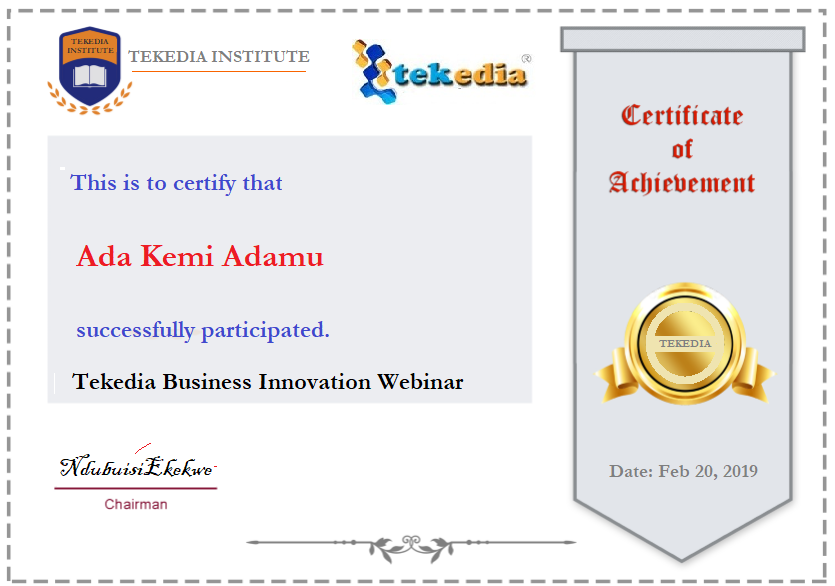
For the participants, the certificates and presentation slides are now available. Email us with your Tekedia registered email and we will deliver them. Ensure to write your name in the way you want it in the certificate.

Sample of Certificate for Participants

10 Costly Mistakes of Sustainability Implementation and Reporting in Nigeria

0
Lagos Island (source: Guardian)

CSR reporting is gradually becoming mainstream in Nigeria and other developing countries for any organisation committed to responsible business practice especially with the support and encouragement from regulatory agencies such as the Central Bank of Nigeria (CBN) and the Nigerian Stock Exchange (NSE). But when done incorrectly, reporting can do more harm than good both to the organisation and society at large.

The following are 10 mistakes to avoid when planning, implementing and reporting on your sustainability efforts:

1. Lack of Sustainability Strategy

Before thinking of reporting, you need to integrate sustainability principles within your organisation, assess through both internal and external audit depending on your operations and improve on performance to enable you collect valid and verifiable data for reporting and assurance. The process can be summarized as follows:

  • Know thyself: Assess the organisational attitudes and understanding of social responsibility by leadership. Your CSR strategy must be authentic and must ring true for your organisation and stakeholders
  • Choose a globally recognised standard to implement your strategy: An example of such standard is ISO 26000 Social Responsibility which covers 16 out of the 17 Sustainable Development Goals (SDGs). This provides for credibility and scalability.
  • Implement and integrate Social Responsibility within all operations of your organisation including your relationships
  • Work from the inside out: Implementation of SR strategy starts from within the organisation, for instance ensuring that you have implemented occupational health and safety within your organisation, stakeholder mapping and engagement, labor and employment conditions, fair operating practices, etc. then philanthropic and intervention schemes or activities and communication with external stakeholders.
  • Continual improvement: Assess, measure and improve on sustainability strategy. Ensure that data is continuously being collected and verified for management review

2. Mismanaged data

Good data collection is essential to gaining meaningful results from initiatives such as auditing or foot printing. Assign data collection responsibilities to trained people (not just on sustainability reporting but on strategy and implementation as well) – either inside or outside your company – and continuously check the numbers for accuracy. Remember, you must work from Strategy to Reporting.

3. Materiality and Relevance

Avoid disordered priorities. Recognise that the pillars of the triple bottom line are interconnected, and that long-term sustainability goes beyond shareholder profits. A good manager will prioritise sustainability in the CSR reports by weighting it equal to financial performance. As well, implement within all organisational operations but report on things that are relevant. ISO 26000 SR has a procedure to determine relevance especially on field audits which is important in order to collect data for reporting.

4. Discounting feedback

Reporting shouldn’t be a one-way endeavour. Take the advice of third parties such as auditors and stakeholder panels, who can comment on your report and help verify data accuracy.

5. Breaking the rules

Good reporting should follow a trusted framework or guideline. The Global Reporting Initiative (GRI) is a good example. However, never ask your reporting firm to implement your strategy or allow your strategy consultant to be involved with assurance even if they have the skills to do so. Otherwise, the credibility and authenticity of your report or assurance will be questionable; avoid that conflict of interest.

6. Tenuous comparisons

Organisations are inclined to track their progress internally. Accept that you’re one fish in a large sea. Stakeholders will want to know how sustainable you are compared to your industry peers, not necessarily your own benchmarks.

7. Unreachable targets

Targets in CSR reporting should be linked to corporate priorities. Make them relevant and aggressive but still achievable. Always remember that you will still need to report for the next year therefore may be required to report on those targets set out in the current report.

8. Underreporting/overreporting

Don’t limit communication of your
sustainability performance to the sustainability report. Use a variety of media to communicate your progress and challenges. Ensure your message is consistent across media. However, do not make it look like an advertisement for the organisation.

9. Inadvertently greenwashing

While it’s important to convey your environmental and social progress, it’s a mistake to focus solely on the positives or on programmes immaterial to your organisation. Make reporting meaningful by acknowledging the areas where you still have room for improvement and tying your SR goals back to your company mission.

Done correctly, CSR reporting increases share price and bolsters stakeholder confidence in your firm even with the small and medium enterprises (SMEs). Done poorly, CSR reporting opens your company up to consumer derision and stakeholder criticism.

10. Image Laundering

Avoid using reporting as an image laundering tool. Address market, operational or stakeholder challenges with the aim of finding lasting solutions to the issues. Adopting globally recognized standards will help through due diligence to identify salient risks in any part of your operation, mitigate or completely eliminate them.

5G Technology Enables World’s First Remote Brain Surgery

0

By Nnamdi Odumody

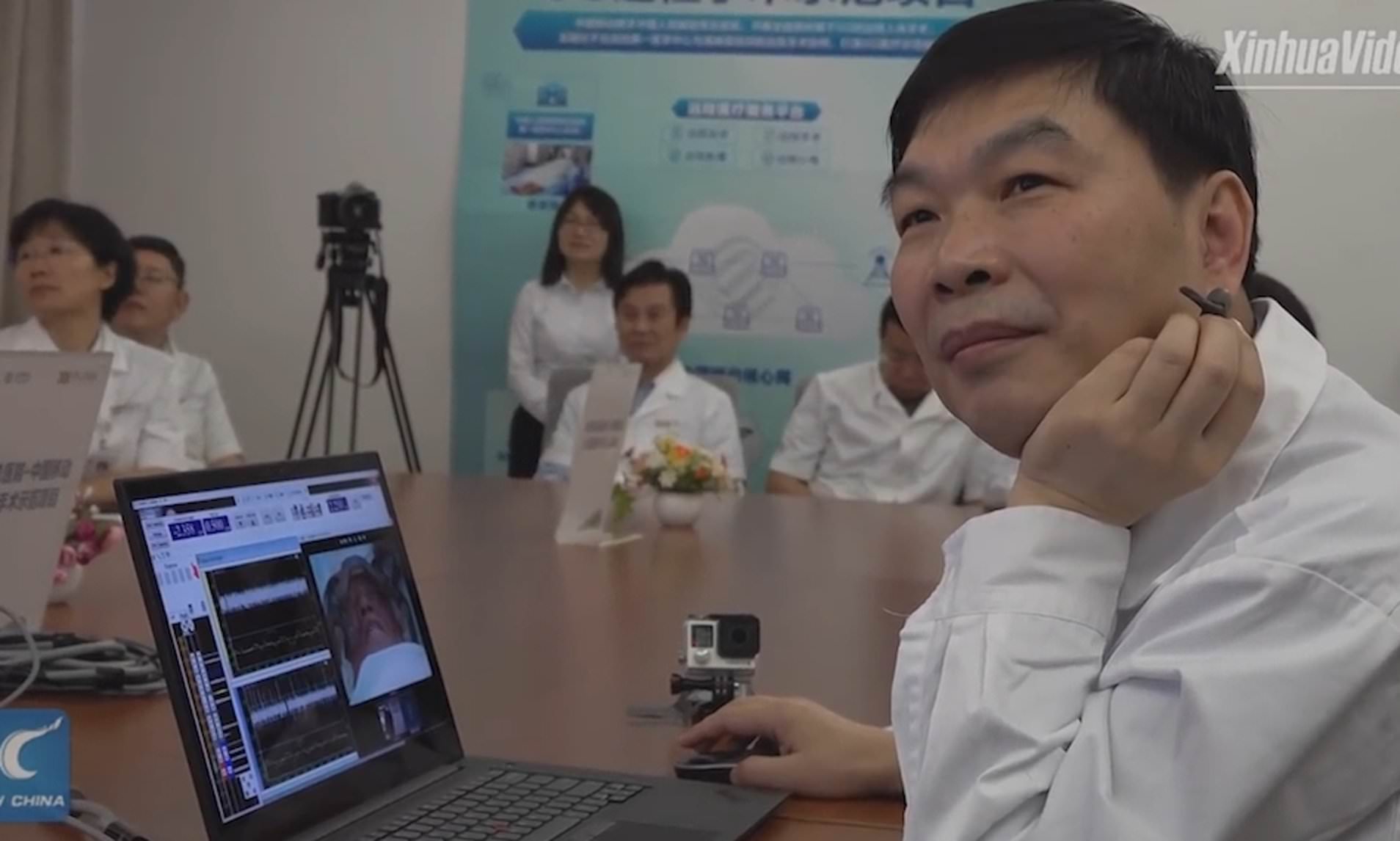
Dr Ling Zhipei, a surgeon at the People’s Liberation Army General Hospital, has performed the world’s first ever brain surgery over a 5G mobile network. Using surgical robots, he put a deep brain stimulation implant, a medical device, into a patient with Parkinson’s disease while he was at Sanya, on the island of Hainan, while his patient was in Beijing more than 1,800 miles (3,000km) away.

A Chinese surgeon has performed the world’s first remote brain surgery using 5G technology, with the patient 3,000km away from the operating doctor.
Dr. Ling Zhipei remotely implanted a neurostimulator into his patient’s brain on Saturday, Chinese state-run media reports. The surgeon manipulated the instruments in the Beijing-based PLAGH hospital from a clinic subsidiary on the southern Hainan island, located 3,000km away. The surgery is said to have lasted three hours and ended successfully. The patient, suffering from Parkinson’s disease, is said to be feeling well after the pioneering operation.
The doctor used a computer connected to the next-generation 5G network developed by Chinese tech giant Huawei. The new device enabled a near real-time connection, according to Dr. Ling. “You barely feel that the patient is 3,000 kilometers away,” he said.

According to him, the technology will make it easier for medics to operate on people who live in more remote areas and can’t travel. The operation was performed using surgical robots controlled by Dr Ling who connected to them through a 5G mobile network while he was working in Hainan. The procedure lasted for about three hours, and the patient was fine after the operation.

Deep Brain Stimulation (DBS) helps to control problems associated with movement, and is the main type of surgery used to treat Parkinson’s disease. It involves implanting very fine wires with electrodes at their tips into the brain. These are connected to extensions under the skin behind the ear and down the neck which then connect to a pulse generator. When the device is turned on, electrodes deliver high frequency stimulation to the targeted area which changes signals in the brain that causes Parkinson’s.

Dr Ling said that the 5G network has solved problems like video lag and remote control delay experienced under the 4G network ensuring a nearly real time operation.

The operation was performed with the help of China Mobile network and Huawei’s 5G technology. Also recently a liver surgery was recently carried out over 5G.

5G is enabling intelligent capabilities of the future of work, and healthcare is not left out.

What is 5G? All You Need To Know

Tekedia Webinar – I will be on Air at 2pm Lagos Time Today, Again

0

Good people, I will be on air at 2pm Lagos time today. After the Tekedia business webinar Q/A session yesterday, we have more questions for the Saturday session. So, I will be live at 2pm to provide insights and guidance on same. Login with your credentials on the link team had provided.

Dates: Friday March 22 2019 (repeat, Saturday March 23, 2019)
Venue: Online.
Webinar Theme: Winning in Nigeria (and Africa)
Register: There are two ways to register (you need to pay to value my time); please email tekedia@fasmicro.com after payment to set up your account.
  • Use Paypal and pay $15 here

  • Pay into any of the Nigerian bank accounts (N5,000) listed here.

Meanwhile, the recorded sessions for the five sessions covering Mission, Operating Frameworks/Models, Investment Options, Starting & Taking Action, and The Opportunities in Africa remain. As you go through them and you have questions, comment on the Comment section or email my team.

The recorded Q/A session of yesterday has deep insights also. Everything is recorded to simplify the stress of bandwidth and time availability – just use the same link to access all. Watch them.

See you on air at 2pm.