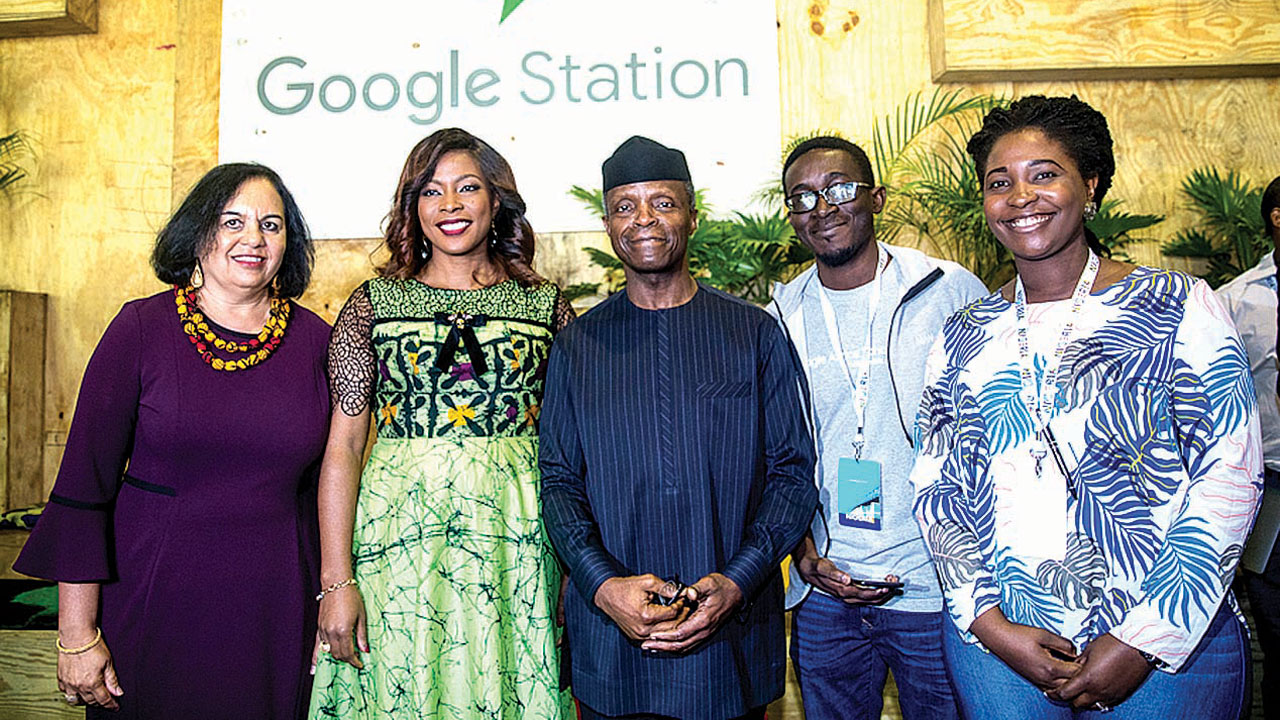
Google is offering a really good service in Nigeria: free Wifi in some strategically located areas. In most other nations on earth, governments do just that. I expect it to extend the service to major schools and airports in the near future; it is already in MMA2 airport Lagos.
Certainly, while we can all read meanings into the double play strategy where it gives free Wifi to expand its domains, across board, it is a very positive initiative. Largely, there is no element of fairness or objectivity to call the Google initiative “illegal” as reported by the Nation. My understanding is that Google pays ISPs who are already licensed to provide internet services in Nigeria, and then makes the services free to the citizens. Unless there is a law in Nigeria that says nothing can be given free, at scale, NCC (Nigerian Communications Commission), the industry regulator, has no case.
Investigations by the Nation revealed that the Nigerian Communications Commission (NCC), the regulatory body for telecommunications in the country, has reported global internet giant, Google, to the Federal Government for evading regulatory oversight in its bid to expand its ‘free’ Wi-Fi deployment in Nigeria.
Google is currently rolling out the ‘free’ Wi-Fi service in Lagos and Abuja with plans to expand to other locations in the country, a development that has caused great concerns in the industry because of the threat to the investment made by existing telecoms operators and privacy issues occasioned by the internet giant’s mode of operation.
A letter from NCC to the Presidential Enabling Business Environment Council (PEBEC) under the Office of the Vice President, sighted by our correspondent, indicated that Google may be illegally providing its ‘free’ Wi-Fi in the country under obscure conditions that put it beyond regulatory purview.
The letter, signed on behalf of NCC’s Executive Vice Chairman by the Executive Commissioner (Stakeholder Management), Mr. Sunday Dare, reported to the Office of the Vice President (PEBEC) that “Google is operating in Nigeria without being licensed by the Commission with the implications that it does not pay applicable fees, levies and taxes that are paid by other players in the telecommunications sector.”
Sure, this is a new territory but it changes nothing: people give out bags of rice, beans, water, etc. They indeed bought those things and then freely gave them out to expand their missions. It is irrelevant whether it is free access to Internet or free amala! The real question is what happens after the giving – and that is where regulation would be needed.
We all understand the fear around Google Station, the free Wifi service: if Google makes the web free, no one will buy mobile credits from the telcos thereby reducing government revenue. But we need to understand that Google is buying the web services from licensed ISPs in Nigeria. Certainly, it may not be balanced to restrict such services.
Certainly, I do expect NCC to make sure that Google does not prioritize its apps or services over others on these free Wifi services in ways that restrict fair competition. So, Google cannot restrict access to competitor’s websites or solutions while allowing a similar one it provides. That is where regulation matters but not attacking a company that buys services from Nigerian companies and then make those services free!
What Google is doing is what American companies do to improve market caps. Yes, spend say $10 million to give free Wifi in Africa, record great user growth and Wall Street adds $1 billion in your market cap, arising out of the momentum. Retail shops do massive discounts in America to meet sales targets, losing money on the way, but seeing market valuation move north. Simply, it could make sense to “lose” $15 million in a quarter on discounts in order to add $500 million in your market cap because of same-store merchandize volume growth, stimulated by the discount.
Nothing is indeed free but on this free Wifi service, there is no harm to the Nigerian people. Google should not be harassed out of existence.
LinkedIn Comment on Feed
The only thing I see here is an array of confusion, from NCC to the reporter reporting the whole stuff. The PEBEC under the office of the VP was “excited” about the Google’s initiative, they even went to California sometime ago…
NCC wants Google to perhaps pay for license and probably taxes for offering free WiFi services. NCC will have a case only if Google’s free WiFi is purely satellite based, without having anything to do with any licensed telecom firm in Nigeria. So in the spirit of trying to protect the investments of licensed operators, NCC can stop Google from doling out free stuff; else it’s another round of confusion.
Mentioning ‘privacy’ concerns is a weak argument, Google can always collect and harvest data from people, NCC’s licensing doesn’t control how Google collects data, Android alone is a rich source for data collection…
Google is trying to do what the government has been preaching for ages, and now NCC is confused. The NCC that got budgetary provision to support SIM card registration, and still gets budgetary provision to support broadband expansion?
Well, to resolve the squabbles, send money to telcos, as a way to cushion their investment losses, then encourage Google to expand its free stuff!
Google Nigeria Promises Free Wifi, What Do We Search Or Do With It?