By Martins Eke
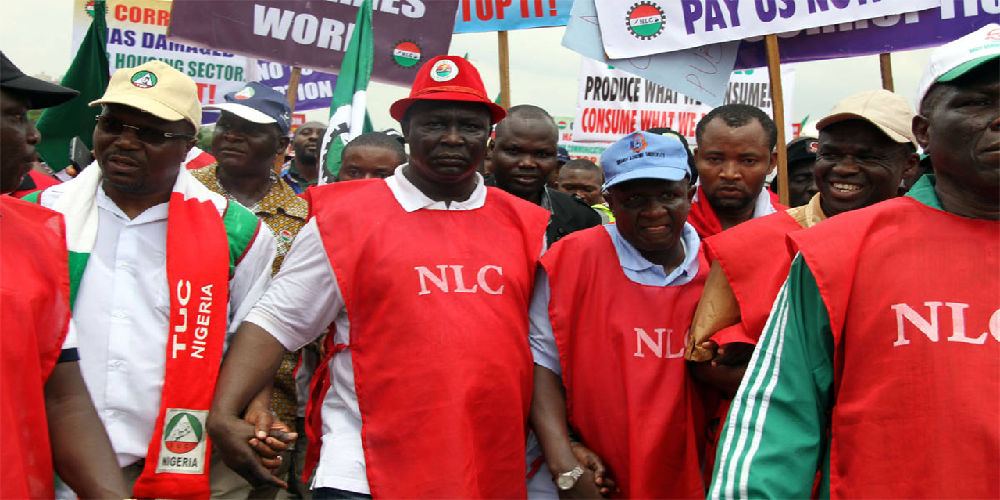
It is superfluous to mention that interlocutions relating to the minimum wage in Nigeria have unfortunately received little or no concern. For a fact, Nigeria’s minimum wage talks are as messy as the Brexit talks. Perhaps, the sparing attention lent it is the better of two conditions: What is more is that in times where minimum wage issues motivate some conciliatory attention, there appears to be disconcerting variation in the ends of both the Federal government, Nigerian Governors Forum and the Nigeria Labour Congress. What this sloppy condition means is that Nigeria may continue to whirl in circles – one that is immensely attributable to the unfathomable doggedness of the Nigerian Government Forum which has refused to agree with the threshold of 30,000 Naira minimum wage and the near justifiable insistence of the Nigeria Labour Congress, the effect of which is the irremediable nationwide strike.
It is logical to admit that the government of Nigeria cannot, or strongly ought not to put a flat minimum wage across the states in the Nation. An action in this direction reeks of two neat indices of feigned naivety: first, that every state in Nigeria has equal economic strength and a deliberate absentmindedness to the asymmetrical output of states over the years serving to unfairly cover for the inequities of some states in terms of their returns to the Gross Domestic Profit of the nation.
While we concede that a flat minimum wage cannot reasonably be made across board, we however express dissatisfaction at the lacunae in constitution – the originating source of all laws, contemplates a minimum wage that cuts across all states of the federation which in for our money, is the genesis of this vicious circle which promises no revelation of amity. Whether it pleases us to hear, the interplay of factors such as cost of living and income generation will always interface to determine what a state can pay and we must admit that the effect of these factors do not apply across board in similar fashion. One may ask, is it not foolhardy to then consequently react in similar fashion across board?
For some inexplicable reasons, it is apparent, if not intrinsically true, that Nigeria which ought to be a federal state has always gravitated somehow to centralization. This is perhaps as disconcerting as it is unforgivable, considering the prodigious amount of literature including the constitution that theorizes the government of Nigeria as a palatable federalism. This organic hypocrisy perhaps is borne out of the caution to not become a confederate state. We are best suited to work like the United States of America but we are stuck to the cleavages of our colonial masters who do not even practice a federal system.
The United States of America adopts a minimum wage based on a state basis and also has a federal minimum wage. Facts and verifiable statistics have it that, 29 states in the U.S enjoy a minimum wage higher than the federal minimum wage while states like Georgia are a bit below the threshold.
If Nigeria is to take a cue from such idealism then maybe we may have had a reasonable head way presenting a more printable panacea than any cockpit fight between the Federal Government alongside the Nigerian Governors Forum and the Nigerian Labour Congress can possibly provide the citizenry without a choice but to remain at the unfortunate end of a meaningless tussle of unimaginable grandstanding.
The National minimum wage brawl is sheer wickedness on the citizens and governors who legitimately cannot pay or at best is a nearsighted fight of the Nigerian Labour Congress to either flutter settled waters or just for what it is worth. How prudent is it to ask of Lagos state that which can be reasonably asked of Sokoto state which has 81.2% poverty rate?
By and large, the controversy has lingered this long not because the NLC and Federal Government have held doggedly to their jealous ends of bargain but because somehow, the Nigerian Governors Forum has not reconciled with paying 30,000 naira minimum wage and of course, they wear the shoe and know the attendant consequences of assenting to a figure that they cannot pay. In fact, how many governors have religiously kept the extant minimum wage of 18,000 naira and are not owing its civil servants? Although, corruption is a contributory factor to this failure, nonetheless, we cannot say the plaint of the Governors have no bearing. No doubts, they all admit to top up the existing 18,000 naira minimum wage but not by almost a 100% as demanded by the Nigerian Labour Congress, a good number are within the threshold of 24,000 naira as its minimum wage and in fact, that is the amount proposed by the federal government.
Furthermore, the implication of imposing a minimum wage which is difficult to maintain is often felt more by the labour force who are often at the behest of their employers. The likelihood of reduction in the workforce is too strong to be dismissed quickly, consequently leading to an increase in unemployment rate and its far-reaching negative effect on our economy and society at large and even those who would be fortunate to retain their job will have to live with the fear of job insecurity and of course, battle unpaid salaries. These indices are not mere speculations but are the challenges that we battle presently even at 18,000 naira minimum wage.
Be that as it may, how then does the present struggle improve the lives of the labour force if it comes with the attendant consequence of job insecurity? Isn’t the Nigeria Labour Congress being overly short-sighted in this struggle? Wouldn’t it be fair to say that NLC victory over the minimum wage will spell tomorrow’s doom? can we then say such victory is laughably pyrrhic.
RECOMMENDATIONS
- Ultimately, the constitutional provision on minimum wage should be revisited. The extant placement of minimum wage as a matter for the exclusive legislative powers of the National Assembly is too rigid. The state should enjoy the privilege of legislating on minimum wage bearing in mind the threshold as contained in the national legislation, this will afford the State Labour congress a leverage to agitate on a wage it thinks is fair in a particular state that way, it would avert possible nationwide strike.
- That the Nigeria Labour Congress should invoke the Freedom of Information, Act in demanding for the financial books of each state to ascertain the threshold of the federal minimum wage scale.
Like this:
Like Loading...