
DD
MM
YYYY

PAGES

DD
MM
YYYY

spot_img

PAGES

Home Blog Page 6986

TechCrunch Falls To Subscription

0

It is not really news that TechCrunch, a pioneer tech-focused blogging platform, is going subscription. Without subscription, TechCrunch has no future. Adjacent to the ruined empire of Yahoo via Oath/Verizon, TechCrunch was walking dead. Simply, because of Facebook and Google, no massively organized news website can survive without subscription unless you are the Guardian UK which knows how to beg for donations. Yet, I give the Guardian three years to join the full party which New York Times, WSJ, FT, WashPost, Bloomberg, and others have since toasted.

I won’t bury the lede. TechCrunch is launching a subscription product called, appropriately and deliciously, Extra Crunch.

Extra Crunch, as it says on the tin, is an additional layer of content, coverage, product and events-based offerings for our most regular and engaged readers. This will consist of articles that go more in-depth on topics in the entrepreneurship and startup universe, of course.

Of course, TechCrunch is not in the league of the entities I have just mentioned: TechCrunch does no serious news investigation which means its cost is low. Yet, that does not mean that it does not have bills to pay in the age where two companies (Google and Facebook) are soaking everyone on digital ads.

TechCrunch will be fine now, with Extra Crunch. It will lose some users but it will start making money since it has more brand equity than The Information, a polished competing tech platform which is subscription-based. I have called this the Diminishing Abundance of Internet where having lesser number of users may improve revenue.

In this videocast, I discuss what I am calling the Law of Diminishing Abundance of Internet. It is a construct that some companies become poorer even when they are growing in numbers of customers reached.That applies to industrial sectors like publishing and telecoms. The lesson here is that risk in any business model must be examined from the lens of this mirage abundance which Internet has provided in some sectors.

The Key Insight from The Announcement

In the Extra Crunch announcement, I picked this main paragraph.

Quietly, and with the gratifying support of management, we’ve been reconfiguring TechCrunch over the past few years to focus on making sure that we’re providing useful, engaging content to readers, not just advertisers. While our audience — you folks — is still one many advertisers would love to reach, that’s their job, not ours. Instead, we wanted to re-align all of our goals around what we saw as the future of sustainable journalism.

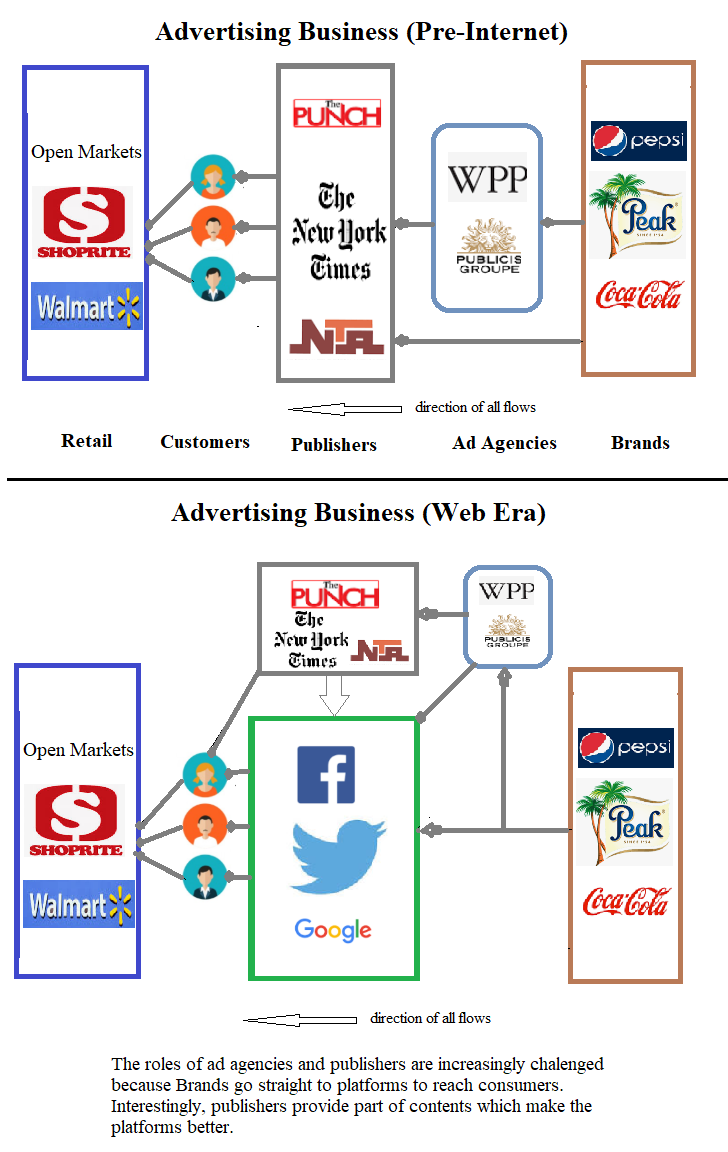
What TechCrunch is saying is that with this subscription pivot, it does not care what advertisers will like to see because the readers are paying. The implication is that TechCrunch will create a better product to ensure readers keep paying as they are more sensitive than Google AdSence, an advertising product.

With subscription, TechCrunch will rewire its position in the plot below which explains it all (I’d explained the plot extensively here). By understanding this plot, you will get the idea why TechCrunch is going subscription.

The Challenge Before Ad Agencies


LinkedIn Graduates From Video Product College

1
View of main building with logo and signage at the headquarters of professional social networking company LinkedIn, in the Silicon Valley town of Mountain View, California, August 24, 2016. (Photo by Smith Collection/Gado/Getty Images).

This is very fascinating for people that like this platform: LinkedIn is launching LinkedIn Live, a live video product. For years, the platform where global professionals congregate has refused to focus on video. But that is now history, as LinkedIn pivots to align with the world where Facebook, TikTok , etc have made video a critical part of communication and information exchange.

LinkedIn — the social network for the working world with close to 600 million users globally — says that video is the fastest-growing format on its platform alongside original written work, shared news and other content. Now it’s taking its next step in the medium in earnest.

This week, the company is launching live video, giving people and organizations the ability to broadcast real-time video to select groups, or to the LinkedIn world at large.

Simply, in a world where people do many things at the same time, the easiest way to pass information could be videos. I do think that LinkedIn videos will have more impact in the professional domain world than YouTube. Because professionals are already on LinkedIn, contents created with business and professional ethos will do better on LinkedIn Live.

The focus area seems just right: “conferences, product announcements, Q&As and other events led by influencers and mentors, office hours from a big tech company, earnings calls, graduation and awards ceremonies and more”.  It will expand to include many other areas users will add as LinkedIn Live scales.

I do plan to use LinkedIn Live; we already share many video contents on Tekedia.


Fix The Root Cause of Failure – Understand That Failure Is Part of Success

2
Source: Titanium Success

This is from a LinkedIn comment on the piece titled – The biggest failure is NOT fixing things that lead to failures.

One of my greatest pieces of wisdom on time management cleverly linked to success & failure! Period! Even greater than my masterpiece “Eat that frog” by Brian Tracy. Thanks, Ndubuisi Ekekwe

As I noted in the piece, I hold this principle that those that come on top are not always the most gifted but those that plan BEST.

“I was a bookworm in university: yes, the too-much reading type because I knew I was not the smartest in class. But I knew if I worked hardest and smartest, I would come on top. That is a principle I apply in life: put extra efforts to mitigate deficiencies in capabilities and quickly learn and advance.”

Yes, the real issue is not the failure but not dealing with elements that keep causing failures.

I wrote a long piece in Harvard Business Review (print) on this, using the engineering process of tracking “noise” and “failures” in inertial sensors while working on an accelerometer for iPhone. In that piece, I explained the core engineering challenge: how do you design for high reliability? Simply, you need to know what causes failures and deal with them, from silicon to production.

As you do that, let it become a positive continuum where even though failures may still occur, you keep reducing the rate of failure until you hit your optimal threshold. You must understand that failure because it is part of success. Measuring failure and why it happens are key components of what matters

The Biggest Failure is NOT Fixing Things that Lead to Failures

Comprehensive Directory of 7,000 Nigerian Companies and Startups

0

We work with many global and local entities, helping them to understand the state of commerce and industry in Nigeria. To do this work very well, we build database of firms, quarterly tracking indicators and many things. This process is done fanatically as we want to walk into Boardrooms and Workshops with arsenals of the […]

This post is only available to members.

Nigerians’ Big Exodus To Canada

2

It is a serious issue and one I do not have the moral fiber to discuss since I also resigned a job and left for America many years ago. Yet, because commenting is free, I will go ahead.  There is a big exodus happening in Nigeria right now, and the destination is Canada. When I say exodus, I mean real type like the one described in the recorded Exodus. Lol.

As at 2017, there were over 11,000 Nigerian students in Canada. They hardly go back to Nigeria after graduation. Canada will gladly keep them to work because of their skills acquired through relatively high international school fees paid by parents from back home. This is a win-win situation: Canada gains from the inflow of revenue through international school fees from Nigeria and other foreign lands, retains the highly skilled hands after their graduation; Nigerians and other foreign nationals find abode in Canada and partake in the robust economy under a relatively peaceful and prosperous society.

Today, as I write, a company in Victoria Island is shutting down a department after all staff received the Canadian immigration visas. They are going to Canada, and Canada is asking for more.

If you have a top-grade team, managing the Canadian risk is a big issue now in Africa. But finding answers will be very hard: you cannot take away the rights of people to put their services whenever they desire. Yes, the ILO guarantees many times including the rights of people to freely work without impediments imposed on illegal contracts.

Canada has a more friendly immigration policy than most developed nations

Yet, if the Nigerian government has not seen this trajectory, it is blind. Our problem now is not training and developing talent, but actually keeping the talented people in Nigeria. Most young developers are moving into Europe to code, and some living in Lagos are actually working outside Nigeria, receiving payments via wire transfers. So, that your neighbor who does not leave house, in the day, may be working in Amsterdam via his laptop! It is very crazy as I had a Nigerian entrepreneur living in U.S. who told me he was going to Lagos last month to hire three software engineers. It is a slam dunk decision: he would save tons of money doing just that!

Of course, you know about the exodus of doctors from Nigeria. If you check the class of 2010, from any decent medical college in Nigeria, I am sure more than 90% of the doctors are outside Nigeria. Those finishing this year will be off by 2025. And yet, government massively subsidizes medical education only not to have a plan on how to retain the medical graduates. See it this way: Nigeria is subsidizing medical manpower in UK, Canada and Australia where most of our doctors relocate. I hinted on a partial solution in a piece in Harvard Business Review. But that is just someone with no real or imagined power writing.

Nigerian leaders must get real – this country is bleeding talent!

Comment from LinkedIn Feed

The problem with this post is that more than 50% of the probable commenters are ‘guilty’, including the author! But in the spirit of commenting being free, everyone is highly welcome.

It’s a quandary, with no clear solution. It is not easy to remain in Nigeria, especially when you have the means to run away. It is also not easy to convince another person to stay, when the person’s world seems to be crashing on his/her head. Even those who are holding on at the moment may soon run away as well, once they run out of ideas/excuses on why they must remain here.

Staying in Nigeria requires a special talent, which only few people have, the rest are waiting for their turn to run away, so do not think the people you see around or call from the other side of the Atlantic really want to be here; they are also counting days. At least we have handed governance and fixing Nigeria to average people, then waiting for the almighty ‘fix’, so that we can congregate in Nigeria and sing “no place like home”, it may never happen!

The greatest damage they did to us was colonisation, which didn’t end with independence, it continued, especially psychologically, which is even more powerful.