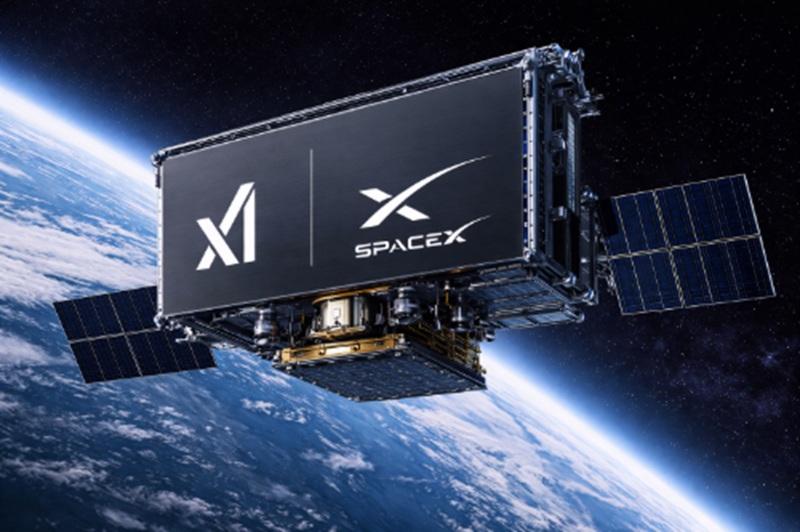
SpaceX said Wednesday it has signed an agreement giving Anthropic access to Colossus 1, a massive artificial intelligence supercomputer platform, in a deal that underscores how the global AI race is rapidly evolving into a battle over computing power, energy supply, and physical infrastructure.
Anthropic plans to use the additional compute capacity to expand services for subscribers of its Claude Pro and Claude Max AI assistants, according to a statement released by SpaceX.
The partnership brings together two companies that increasingly sit at the center of Washington’s sophisticated technology ambitions: one dominating commercial space launch and satellite infrastructure, the other emerging as one of the strongest challengers to OpenAI and Google in advanced AI systems.
More significantly, the agreement reveals how AI competition is entering a new phase where access to chips, electricity, and data-center scale may matter as much as the sophistication of the models themselves.
SpaceX said Anthropic has also expressed interest in jointly developing “multiple gigawatts” of orbital AI computing capacity, a concept that could fundamentally reshape how the industry thinks about future AI infrastructure.
“The compute required to train and operate the next generation of these systems is outpacing what terrestrial power, land, and cooling can deliver on the timelines that matter,” SpaceX said.
The idea may sound futuristic, but it reflects mounting pressure across the sector as terrestrial AI systems consume enormous amounts of electricity and overwhelm existing computing networks.
Training and operating frontier AI models now requires vast clusters of high-performance GPUs, advanced cooling systems, and uninterrupted energy supplies. Industry analysts estimate the largest technology companies could spend more than $700 billion this year alone on AI infrastructure, with much of that capital flowing into data centers, semiconductor procurement, and power generation.
Anthropic said last month that demand for Claude has led to “inevitable strain on our infrastructure,” which has impacted “reliability and performance” for its users, particularly during peak hours.
The industry’s hunger for compute has become so intense that executives increasingly describe electricity itself as the next major AI bottleneck. That dynamic helps explain why companies are exploring nuclear energy agreements, dedicated power plants, and even space-based infrastructure as potential long-term solutions.
Orbital computing could eventually offer several strategic advantages. Space-based systems would theoretically have access to near-constant solar energy, reduced cooling constraints, and physical separation from terrestrial infrastructure risks such as cyberattacks, grid failures, or geopolitical disruptions.
While such projects remain years away from commercial reality, the fact that companies are openly discussing gigawatt-scale orbital AI systems illustrates how dramatically the economics and ambitions of artificial intelligence have changed over the past two years.
The SpaceX-Anthropic partnership also underpins the growing convergence between the AI, aerospace, and defense sectors.
SpaceX already operates one of the world’s most sophisticated satellite and launch ecosystems through Starlink and its reusable rocket infrastructure. Integrating AI compute capabilities into that ecosystem could eventually position the company as a strategic infrastructure provider not just for communications and defense, but also for distributed global AI networks.
The agreement may also deepen speculation that Elon Musk is seeking to build a broader vertically integrated technology empire spanning rockets, satellites, chips, AI systems, and cloud-scale infrastructure.
That strategy increasingly mirrors trends across the wider industry, where major players are racing to control every layer of the AI stack, from semiconductors and cloud computing to proprietary models and enterprise applications.
The deal is expected to strengthen Anthropic’s position in an increasingly expensive and competitive AI market. Claude has gained traction among enterprise users for coding, reasoning, and long-context AI tasks, helping Anthropic secure major partnerships and multibillion-dollar commitments from large cloud providers and infrastructure companies.
Yet scaling those systems requires enormous compute resources at a time when the global supply of advanced chips remains constrained.
The AI boom has already transformed the semiconductor industry into one of the most strategically important sectors in the world economy. Companies such as Nvidia, AMD, and Intel are benefiting from surging demand for processors used in AI training and inference workloads, while cloud providers are spending aggressively to expand capacity.
At the same time, concerns are growing that the concentration of computing resources among a handful of companies could deepen barriers to entry in AI development and widen the gap between dominant firms and smaller competitors.
The deal also arrives amid heightened geopolitical competition over AI leadership. Governments in the United States, China, and Europe increasingly view AI infrastructure as a national strategic asset tied to economic competitiveness, military capability, and cybersecurity resilience.
Washington has been pushing aggressively to strengthen domestic AI infrastructure and reduce dependence on foreign supply chains, especially as tensions over semiconductors and advanced technologies intensify.
Against that backdrop, alliances such as the one between SpaceX and Anthropic are becoming about more than commercial expansion. They are emerging as part of a broader contest over who controls the next generation of global computing infrastructure.
SpaceX did not disclose the financial terms of the agreement or the scale of compute resources Anthropic will initially receive through Colossus 1. But it explained that Colossus 1 features over 220,000 NVIDIA GPUs, including dense deployments of H100, H200, and next-generation GB200 accelerators.