DD
MM
YYYY

PAGES

DD
MM
YYYY

spot_img

PAGES

Home Blog Page 7004

GTBank Market Cap BIGGER Than Smallest Ten Banks; 15 Banks Trading in Nigeria

0

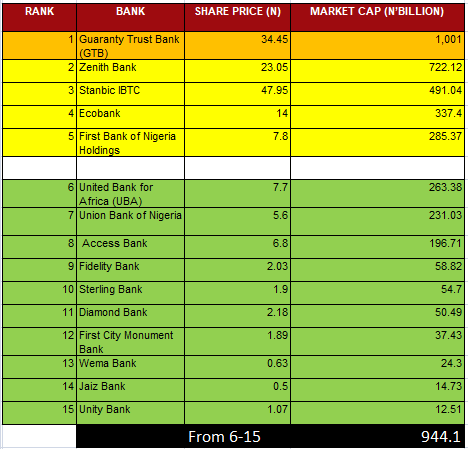
On pure market cap on the Nigerian Stock Exchange (NSE), GTBank remains the most dominant financial institution in Nigeria. From Cable data, closing on Dec 31 2018, you can see that GTBank can trade the ten “smallest” banks, based on market cap, with its market cap [sure, deals include premiums; this is pure academic here].

We have 15 banks trading on NSE; GTBank commands 26% of the total bank value, by market cap. GTBank is worth one trillion naira; the smallest bank, Unity Bank, is worth 12.5 billion naira.


RANK BANK SHARE PRICE (N) MARKET CAP (N’BILLION)
1 Guaranty Trust Bank (GTB) 34.45 1,001
2 Zenith Bank 23.05 722.12
3 Stanbic IBTC 47.95 491.04
4 Ecobank 14 337.4
5 First Bank of Nigeria Holdings 7.8 285.37
From 1-5 2,837
6 United Bank for Africa (UBA) 7.7 263.38
7 Union Bank of Nigeria 5.6 231.03
8  Access Bank 6.8 196.71
9 Fidelity Bank 2.03 58.82
10 Sterling Bank 1.9 54.7
11 Diamond Bank 2.18 50.49
12 First City Monument Bank 1.89 37.43
13 Wema Bank 0.63 24.3
14 Jaiz Bank 0.5 14.73
15 Unity Bank 1.07 12.51
From 6-15 944.1


The Uber Bank of Lagos

0

One of the most fascinating trends in modern commerce is the concept of technology-enabled modularity. Like the Cambrian Moment, modularity enables the combination and recombination of technology elements and primitives to achieve different objectives. Yes, when a company has invested in a category-crossing core technology infrastructure, it is possible it can use that platform to do many other things. With the fixed cost in the books, modularity opens vistas to build new technology layers upon the core infrastructure. That vision is not bounded by the industrial-age mantra of core competency because these modern species of tech companies are “unboundable” because they live in the unbounded Internet! I had since argued that the concept of core competency has been wounded: Amazon could be a health insurance firm in months even as Google could become your local attorney!

They taught us in economies that companies have to specialize and build core competencies.  They need to do things really well and be the best possible in the domains. But today, we think that does not make a lot of sense. For technology companies, everyone is doing everything, even at top-level. Alphabet, Google parent company, is a car company, a search company, a medical company, an advertising juggernaut, etc. Amazon.com is an e-commerce firm, a publisher, a movie producer, a drone maker, and soon a car maker.

Anyone can do anything because most of these firms operate on the internet where distribution is unbounded. And if distribution is not bounded,  vision must not be bounded. Amazon wants to sell to the world anything. If you expect it to stop on books, fashion and kitchenware, it is your risk. Facebook assembles its own servers for running its data centers. Google parent company, Alphabet, is a car company, internet service provider, and [pick your interest].

This trajectory is heating up, not in U.S. but also in China, where category-king digital empires are evolving. The news is this: Didi, Uber-clone in China which became more competitive than Uber in China, is now a fintech (financial technology) company.

China’s top ride-hailing app today expanded its repertoire by selling financial services to its 550 million users. Didi this morning announced the rollout of its first two financial products available inside its app: car loans and personal insurance. Other options, such as wealth management and more forms of credit services, are coming later, the company said.

[…]

The US$56 billion startup last year made some financial services available to its drivers, but today’s move expands its fintech ambitions to everyone across China.

Just imagine how its banking partners would feel: this company used to focus on its ecosystem members, but now wants to offer financial services to the broad citizens of China. So, it is fair to call Didi a fintech even as you are free to recognize it as a digital transportation company.

Why This is Possible

Technology has become so efficient that the capabilities to enter into territories have been reduced. To be a financial service firm these days would not require hiring many experts on compliance since someone had built most compliance elements in software. So, you can pay for that software and within days you are ready to go. Simply, the barriers of entry are falling and it is easier to enter into new domains. And as you move into that domain, technology gives you productivity gain that even if you are not really great, you would be fine to a large extent.

So, in the near future, Uber can wake up one day and apply for a banking license to offer financial services to customers in Lagos. For Uber, it makes no difference because it is another layer on the core technology which Uber had already built. Also, one day, it can add insurance because it is another layer. The most important part has been built. What remains is new market and territory to add new layers of applications. It is not hard to see as Facebook Inc through WhatsApp and Instagram is a fintech, money remittance company, ecommerce company, and meeting place.

This is an interesting future because internet is liberating markets from traditional custodians, and consumers will benefit. No market or sector is immune from this drug called ‘destructiv innovationi”.

What Nigeria Labour Congress Should Do On Minimum Wage Negotiation with Government

1

Yesterday, I sent a brief to the Nigeria Labour Congress (NLC) through my non-profit African Institution of Technology. In the brief, I provided some indicators and anchors on how the labour union could engage with the federal and state governments on the minimum wage negotiations. A key part of my brief focused on using data to make its case. As things stand, NLC is not communicating well despite the trumpet it is blowing.

The Nigeria Labour Congress (NLC) has pledged commitment to workers welfare while appealing to the Federal Government to urgently transmit the bill on the new national minimum wage to the National Assembly.

Ayuba Wabba, NLC president, made the appeal in a New Year message on Tuesday in Abuja.

According to him, 2018 remains one of the most traumatic for workers especially given the failure of government to enact and implement the new national minimum wage of N30,000.

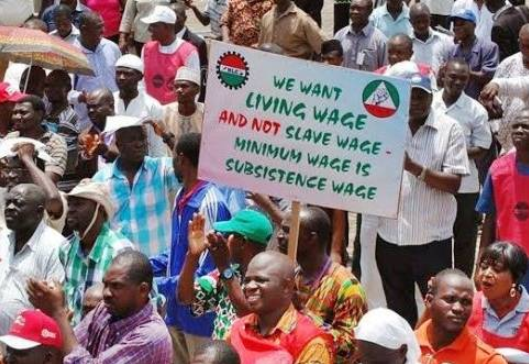
First, it is sheer lack of awareness to expect the governor of Zamfara state to agree to pay the same minimum wage as the governor of Lagos state. Yes, I do not expect Abia State governor to agree on any deal signed by the governor of Rivers State on minimum wage. Largely, Nigeria should not and cannot have a flat minimum wage: states should look at these elements with local data and conclude what makes sense. It is unfortunate that NLC has not figured that out with its one-size minimum wage for Nigeria.

I dropped some useful insights. When I started my business, my office was in Lagos. But within months, I realized that we were wasting money in Lagos having our engineers there. Lagos did not offer any competitive advantage to our technical team but was stressing everyone out. We moved to Owerri where money that cannot afford a decent one-bedroom apartment in Lagos can give you a 3-bedroom apartment in the best neighborhood. My team cheered because that relocation added 20% to their purchasing power especially on housing. Simply, living expenses in Nigeria vary and no state governor would agree to be in bondage to another’s.

So, for NLC, it has to rework its numbers with local data. A state level model is what makes sense if it expects to come out of this paralysis. Throwing N30,000 monthly minimum wage, and expecting Zamfara state and River state governors to converge is not a smart strategy. Possibly, Zamfara could pay N25,000 per month while Lagos state could even go for N45,000.

Sure – NLC posits that N30,000 is the minimum each state should pay. Unfortunately, if that is the case, no one would agree to add a kobo above that N30,000. In that case, while Abia state workers may be better, nothing has changed for workers in Rivers and Lagos states.

Of course, I am not a labour advocate: I am an employer of labour. Nonetheless, I struggle when extremely smart person keep talking and barely making time to listen: strikes will not suddenly make the cost of living in Lagos state to be the same as Zamfara state. And the same strikes will not upgrade the revenue capacity of Abia state to be at parity with Rivers State. If my state governor in Abia state agrees to the same minimum wage with the governor of Lagos, I will question his judgment. NLC should appreciate this at state level.

[Apply] 2019 Tony Elumelu Foundation Entrepreneurship Programme Opens

0

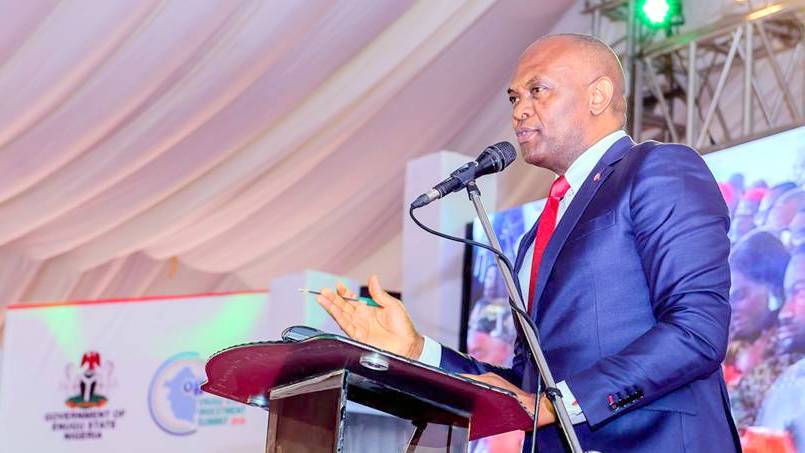
The Tony Elumelu Foundation, an African-funded and founded philanthropy, committed to empowering African entrepreneurs is now accepting applications for the 2019 cohort of the TEF Entrepreneurship Programme.

The programme is a 10-year, $100 million commitment to identify, train, mentor and fund 10,000 African entrepreneurs, a press statement from the organisation has stated.

The programme’s objective is to generate at least one million new jobs and create at least $10 billion in new business revenue across Africa.

Now in its fifth year, the TEF Entrepreneurship Programme has empowered 4,470 entrepreneurs, using a bespoke and robust selection, training and implementation process to create visible and sustainable impact across all 54 African countries, the statement highlighted.

“Outstanding African entrepreneurs running existing start-ups with high growth potential and aspiring business owners with transformative ideas are invited to apply. We are particularly looking to grow representation from French, Arabic and Portuguese speakers, as well as female entrepreneurs.”

Inspired by Tony Elumelu’s economic philosophy of Africapitalism and his vision to institutionalise luck and democratise opportunity for a new generation of African entrepreneurs, the Foundation has implemented one of the most ambitious entrepreneurship programmes globally.

Selected entrepreneurs from previous years have transformed their businesses and their communities after gaining from the Programme’s 7 pillars: $5,000 in seed capital; business development training; one-on-one mentoring; access to TEFConnect; pan-African meetups; TEF network membership; and participation at the annual TEF Entrepreneurship Forum, the largest convening of the African entrepreneurship ecosystem.

The founder, Tony Elumelu, stated: “The private sector must be the core driver of Africa’s economic transformation, but this sector cannot attain its full potential if entrepreneurs are left behind.

“We call on all stakeholders – policymakers, business leaders and development agencies – to actively commit to creating a better future for our young Africans who have demonstrated intellect, skill, and passion, to empower them to succeed because their success is Africa’s success. The TEF Entrepreneurship Programme is by far the most impactful project of my life and represents my commitment to transforming Africa through entrepreneurship”

“The TEF Entrepreneurship Programme is open to citizens and legal residents of all African countries, who run for-profit businesses based in Africa that are no older than three years. The deadline for applications submission is March 1, 2019.

“Applications will be judged based on criteria including: feasibility, scalability and potential for growth of the product/service; market opportunity for the idea/business; financial understanding, leadership potential and entrepreneurial skills.

“Applicants can apply on TEFConnect – www.tefconnect.com – the largest digital networking platform for African entrepreneurs”.

My 2018 Businessperson of the Year – Herbert Wigwe

0

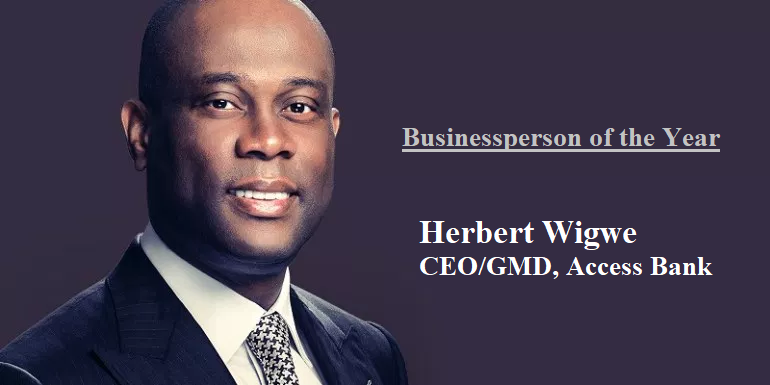
My 2018 Businessperson of the Year is Herbert Wigwe. Mr. Wigwe is currently the CEO and Group Managing Director of Access Bank plc, a leading banking institution in Nigeria.

Wigwe has a degree in accountancy from the University of Nigeria, an MA in Banking and Finance from the University College of North Wales (now Bangor), an MSc in Financial Economics from the University of London,and is an Alumnus of the Harvard Business School Executive Management Program.

In Q4 2018, Access Bank acquired Diamond Bank, transforming Access Bank (post-deal closure) to become the largest bank in Nigeria, by asset. For orchestrating that deal, after assimilation of a defunct bank (Intercontinental Bank Plc), Access Bank is sending a clear signal to South Africa that Nigeria will play hard in Africa.

Nigeria’s Access Bank Plc agreed to take over struggling local rival Diamond Bank Plc in a deal worth about $200 million that would create the nation’s biggest lender by assets. Both companies’ shares rose.

For that bravado and vision, knowing that in a digital banking future, marginal cost is everything, and scale improves competitiveness, I have chosen Herbert Wigwe as my Businessperson of the Year.

Future banking would have duality element (offer products via platforms) and that means a bank with more customers would have huge advantages; Access Bank is building for that future. The unconstrained and unbounded nativity of internet will catch up with current banking architecture, triggering winner-takes-all with dislocations across markets. Yes, just as telecom firms are imperiled across Africa, leaving big ones where one tree can become a forest, banking will follow that trajectory.

Access Bank wants scale and Mr. Wigwe shopped well. This scale will enable it to serve customers at eventual low margin – a low margin facilitated by the impending disintermediation from fintech.  The bank wants customers; in Diamond Bank, Access Bank bought new customers.