DD
MM
YYYY

PAGES

DD
MM
YYYY

spot_img

PAGES

Home Blog Page 7012

Computer Coding Locations for Children in Nigeria

0

I wrote a piece where I argued that Nigeria should prioritize the “language” of Coding over another foreign language in our schools. Scanning through comments and InMails, many want to know where their kids, students, etc can learn this “language”. My understanding is that CCHub offers something in that space, but that is Lagos.

Sure – there are many elements besides speaking that come in learning new languages. Nonetheless, I will suggest for Nigeria to prioritize coding to Nigerian kids over new foreign language as Coding in the 21st Century Global Language.

Please if you know locations where decent coding training is done across Nigeria, share below. We are not talking of Oracle (who wants to understand oracle in his life? Haha) or Python (who wants to learn snake movements? Lol); simply, we want the basics for school kids.

I know there are places banks, etc send their staff; those are not the focus. Here, I think guardians and parents are looking for kids-focused coding organizations.

If you know, share below. You could connect a kid to a greater tomorrow.

{I will be updating  this piece as I get updates from Linkedin)

LinkedIn users have crowd-suggested many schools; click here to read them on my LinkedIn feed.

Kenya Goes Mandarin for School Kids, Nigeria Go for Coding – the 21st Century Global Language

0

Kenyan kids will start learning Mandarin in classrooms starting 2020. Kenya will join South Africa which started teaching Mandarin to school children in 2014; Uganda is coming onboard also. The government of Kenya believes, rightly, that mastering Mandarin will improve career competitiveness and cushion better trade connections with China. You cannot argue on that – it is a slam dunk when you see the impact of China in Kenya. For example, most of Kenya’s sovereign foreign debts are to Chinese government or entities.

Kenya will teach Mandarin in classrooms  in a bid to improve job competitiveness and facilitate better trade and connection with China.

The country’s curriculum development institute (KICD) has said the design and scope of the mandarin syllabus have been completed and will be rolled in out in 2020. Primary school pupils from grade four (aged 10) and onwards will be able to take the course, the head of the agency Julius Jwan told Xinhua news agency. Jwan said the language is being introduced given Mandarin’s growing global rise, and the deepening political and economic connections between Kenya and China.

Yet, the question is this: if you already know one major global language that Google understands, do you really need to spend time to learn another? I do believe that in the next five years, real-time language translators will be integrated into Android, making it possible that if you can speak one major language, say English, you can communicate effectively with native Mandarin speakers, for example, without human translators.

Sure – there are many elements besides speaking that come in learning new languages. Nonetheless, I will suggest for Nigeria to prioritize coding to Nigerian kids over new foreign language as Coding in the 21st Century Global Language.

LinkedIn User Comment on This

The pseudo re-colonisation is real, and African countries are always the pawns. If it’s actually for ‘competitiveness’, I guess the Chinese government should equally introduce the learning of Pigin, Igbo Hausa, Yoruba, Swahili; or is trade no longer a two-way thing?

There is no problem with learning as many languages as possible, some do it for fun, but to make it a government policy? It’s not only Africa that does business with China, so when will both the US and German governments introduce their own Mandarin classes?

Whoever did this thing to Africans, such that their brains have accepted that they would remain third-class citizens; quite pathetic.

If Nigeria can adopt coding language at scale, better for us, that’s if the government is not already itching to introduce Mandarin here. We learned English, made French our second language, and can as well add Mandarin. The only constant is the no amount of language has been able to improve our lots.

This Market Has Changed – One Plot That Explains The Global Smartphone Market

0
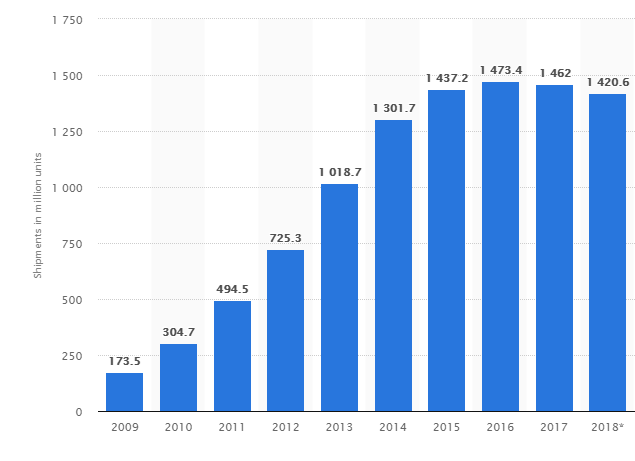
Global smartphone shipments forecast from 2010 to 2018*(in million units)

Much has been written about poor Q4 2018 quarterly records from Apple and Samsung on smartphone shipments. The immediate future may not be different for the sector –  a piece from Nikkei seems like even upcoming quarters may not offer new trajectories. Largely, it does seem like smartphone market is maturing, similar to what happened in the PC and laptop markets many years ago. A shown in the plot below, the peak might have been attained already, so it can only go lower.

Apple is cutting its current production plan for new iPhones by about 10% for the next three months in a sign that the U.S. smartphone maker is expecting a further hit this year, just a week after its market-shaking revelation that it would miss revenue forecasts at the end of 2018.

Apple late last month asked its suppliers to produce fewer of its new iPhones than planned for the January-March quarter, sources with knowledge of the request told the Nikkei Asian Review. It is the second time in two months that the U.S. company has trimmed its planned production for the flagship device.

The request was made before the shock warning issued on Jan. 2 in which Apple said revenues for the final three months of the year would come in at about $84 billion, against previous guidance of $89 billion to $93 billion. That warning — the first reduction in revenue guidance in 16 years — triggered a sell-off in stock markets around the world as investors fretted that it is another sign of a slowing Chinese economy.

Global smartphone shipments forecast from 2010 to 2018*(in million units)


9Mobile Full Statement on Teleology Holdings and Adrian Wood Non-Cooperation Claims

0

The management of 9Mobile has responded to the claims by Teleology Holdings and its leading promoter, Adrian Wood (pioneer MTN Nigeria CEO), that 9Mobile was not cooperating to transform the #4 mobile operator. The disagreement is largely unfortunate for a company looking for a redesigned path in the market.

In a statement signed and made available to journalists on Wednesday, by 9mobile’s Director, Regulatory and Corporate Affairs, Oluseyi Osunsedo, the telecommunications firm explained that since taking over the company, and without any assistance from Mr Wood or Teleology Holdings, the Board has revived and enhanced relationships with key vendors and core business accounts; improved business relationships with suppliers; enhanced its core network capabilities to deliver network efficiency competitively with other operators.

The Full Statement below

In the aftermath of the protracted mismanagement of an otherwise healthy company, and eventual default on its loans by the previous owners, 9mobile was acquired by Teleology Nigeria Limited, following an internationally competitive and exhaustive bidding process led by Barclays Africa, with participation of the Central Bank of Nigeria (CBN), Nigeria Communications Commission (NCC) and 13n Nigerian banks including GT Bank, Zenith Bank, Access Bank and others.

 ‘‘This process, which was well covered by the Nigerian media, was concluded with the initial deposit of $50 million and a further payment of $251 million as settlement to the banks who took over the company. These payments, as well as further due diligence and technical evaluations, led to the clearance of the sale by the NCC, and handover of 9mobile to the new owners, who announced a Board on 12 November 2018 with His Royal Highness Prince Nasiru Ado Bayero as the new Chairman.

 ‘‘Teleology Nigeria Limited is a consortium including several local and foreign investors. While every partner in the consortium was delivering and meeting their obligations to the partnership in terms of financial resources, physical availability for crucial meetings and extensive network to help build the business, Mr. Adrian Wood’s Teleology Holdings Limited, which only owned a minority stake in Teleology Nigeria Limited, failed severally and wholly to meet theirs. Mr. Wood was not personally present for all the critical presentations made by the consortium during the bid process and failed abjectly with his financing arrangements with Swiss-based UBS Bank. In all these failings, other partners in the consortium filled the gap and pushed ahead until the sale was completed.

‘‘Since taking over the company, and without any assistance from Mr. Wood or Teleology Holdings, the Board has revived and enhanced relationships with key vendors and core business accounts; improved business relationships with suppliers; enhanced its core network capabilities to deliver network efficiency competitively with other operators. With the assistance of leading global consultants, the company is also undertaking a complete review of its operational, regulatory, financial and technical architecture. On these basis, 9mobile has emerged from a period of uncertainty over the past two years to attain an active subscriber base of 16 million, representing a net increase of over 1 million subscribers in the last 6 weeks alone.

‘‘The company’s core strategy in the short to medium term shall be underpinned by cost efficiency, innovative product development, network efficiency and strategic technical partnerships. We believe that this approach towards organic growth is more sustainable in building a strong Nigerian telecom operator, which taps into the deep technical expertise of the Nigerian labour force than an approach motivated by short-term financial gain advocated by Mr. Wood and his associates.

“It is regrettable that Mr. Wood has allowed the same avarice, rascality, impatience and knavery that characterized his turbulent association with, and inglorious exits from several other companies to manifest again so early in 9mobile. While we wish him well in his future endeavors, we unequivocally assure our customers, suppliers, partners, regulators, and stakeholders that the Board is committed to continuing the upward mobility of 9mobile. Having invested so heavily in buying the company, and assembling a reliable team to pursue our goals, we want to categorically state that no distractions can stop us from this mission.

Nigeria Out of the Woods – Better days for SMEs

0
Flag of Nigeria

By Austyne Duru

World Bank projects Nigeria economy will expand by 2.8% in 2019 which is slightly below the Nigeria’s federal government’s assumption of 3% growth. We are hopeful that better days are ahead, although the realities on ground suggest the opposite.

Nigeria’s population grows at about 3% per annum. The implication of GDP growth of 2.8% is that our Per Capita Income stays at $2,020 hence more persons slide below poverty line. I assumed a GDP and population figures of $400 bn and 198 million respectively.

The bigger challenge is that GDP growth in Nigeria benefits an estimated top 2% who own the stakes in multinationals and politics. The remaining 98% are unable to find their feet, and in fact the additional population of 3% are born into poverty.

Policy executors know this truth but don’t act due to bad governance and deliberate effort to keep majority impoverished. Incentives meant for SMEs don’t reach the intended recipients because of sharp practices between government agencies, commercial banks, microfinance banks, and multinationals. The informal sector which accounts for 60% of job creation and economic transactions has been totally relegated in the scheme of things.

Nigeria has the potential to grow beyond 4.5% as projected for EMDEs (Emerging market and developing economies) which we are based on our SSA (sub-Saharan Africa) region and MINTS class. We need to harness the inherent potentials in our people – capacity, capability, and competency. The system must deliberately encourage startup businesses and nurture them to the next level. Politicians must stop the habit of cornering capital expenditures to their pockets while the projects are not executed. SMEs must ask more questions about the monies voted to the likes of BOI, DBN, and BOA.

2019 is even more interesting as Nigerians go to the polls to elect for the quadrennial ritual – a make or mar decision beckons.