DD
MM
YYYY

PAGES

DD
MM
YYYY

spot_img

PAGES

Home Blog Page 7031

Realities of Digital Monopolies: One Facebook is Better than 5 Different Facebooks

0

I wrote recently in Harvard Business Review that the age of winner-takes-all has made it nearly impossible for most emerging companies to have any chance against the ICT utilities like Google, Facebook and Amazon. Because of the inherent platform benefits in which a key feature is having many users, winning against these entities could be extremely challenging locally since they have the users already. So, even after cloning or making a better Facebook (technically), you have not done anything of value if there is no person there.

In a piece in Quartz newsletter, Allison Shrager explains how the dominant digital monopolies have produced different results for consumers: yes, Facebook is not charging us “more” (financially) if it ever charged despite being the category-king in its sector. Google has not taken the power of its search dominance to demand that everyone pays before we can hit that search button. Simply, it may not really hurt, to a large extent, if we have these digital entities despite them being monopolies!

Of course, there are many other impacts but on pure consumer money in the wallets, the impacts of digital monopolies are different from the traditional industrial monopolies that dominated markets and increased prices to the chagrin of regulators.

The specter of monopolies and the threat of concentrated market power are getting renewed attention in the age of Amazon and once-unthinkable massive corporate mergers. Market concentration is being blamed for almost everything that is wrong today, from stagnating wages to the rise of fascism.

There are now fewer firms in the US economy since the 1980s, and they are big. The Council of Economic Advisors estimates market concentration has increased in 75% of industries since the 1990s. The dominance of a few firms conjures images of robber barons from the gilded age, squeezing everyone from consumers to workers. But this is a new gilded age, powered by a more interconnected and global economy. As markets change, so might the ideal structure of companies. With that change comes a new understanding of monopoly power, and a reappraisal of its costs, and even possible benefits.

Traditionally, the problem with monopolies is they stick it to consumers. While market concentration has increased since the 1980s, prices on many goods have not. There are fewer airlines, but the prices of flights (after we adjust for inflation) have fallen. Prices on many consumer goods, like washing machines, food, TVs, and electronics (once you control for quality), have also become more affordable, even as there are fewer manufacturers.

Big firms can also limit competition. It’s true that there are now fewer startups and less entrepreneurship, a trend that started in the 1980s and accelerated after 2000. But if the economy were less competitive, you’d expect firms would become less productive, and the opposite is true. One study estimates that the most concentrated industries are the ones where productivity increased the most. It could be the rewards of success: The firms that innovated may have become more productive and taken a large share of the market.

Market concentration may cause new problems, however. We need the right regulations to solve these new problems, but old solutions could make them worse by undermining how firms innovate and compete in the global market. If the issue is a few big companies, the solution isn’t necessarily more smaller companies. After all, it is not clear the economy, or consumers, would be any better off with five different Facebooks. —Allison Shrager

Simply, for the fact that having many people in Facebook makes it better, and Facebook has not increased prices, there is a good argument that having one Facebook is far better than having 5 different Facebooks. That is the reality of digital monopolies for users – concentration of power may not necessarily be extremely harmful to user experiences and wallets!

The question then is thus: which country would produce the winner per category since largely one winner typical exists. And when that winner triumphs, sucking all the financial benefits from all, how could nations handle the imbalance (South Africa has some ideas). For all purposes, global economy has been redesigned by modern digital technologies: Africa needs to update its economic tools to capture the new realities.

 

Two Things To Do In December To Boost Career in January

0

This is December and very soon, many companies would be scaling down operations for Christmas. While you are in it, make time and do the following before January 3, 2019 when operations begin to ramp up again:

1. Think how you can do your job better. Look at some of the challenges you have faced in 2018, and use your experiences to think critically what you could do better going forward. Put those new ideas in maximum of two pages. As the New Year kicks off, share in mid-January with your supervisor. Make sure you present it as a recommendation, and ask for his/her inputs to help finalize the roadmap.

The key is showing and demonstrating that you have learnt some things in 2018, and you want to improve certain things to get better. If you do that dutifully, you will get respects. Process improvement must not come from the CEO alone; you do your work, and can help that firm get better in what it does through excellence at job.

A Career has many components (source: Career Tuneup)

2. Write a professional article (ensure nothing proprietary is included) and get approval to send to a trade/professional magazine or newspaper. Let us say you are working in a bank as a Database Administrator and you ended up having a good article on database administration published in one of the leading sites in tech, you have added more juice to that career.

I am always amazed when people say there are Marketing Executives in a company and they have no single article credited to them. To scale your knowledge and get many to know what you do, it is important you have contents in your name while complying with company policies. While in Diamond Bank as an entry level staff, I was publishing monthly in Nigerian newspapers and our HR liked it. One that was well received was on banking competition and strategy, drawing insights from the Art of War by Sun Tzu. I must note that (most other) people discover you from your writings more than any other way, unless you are on the big screen or already a senior executive.

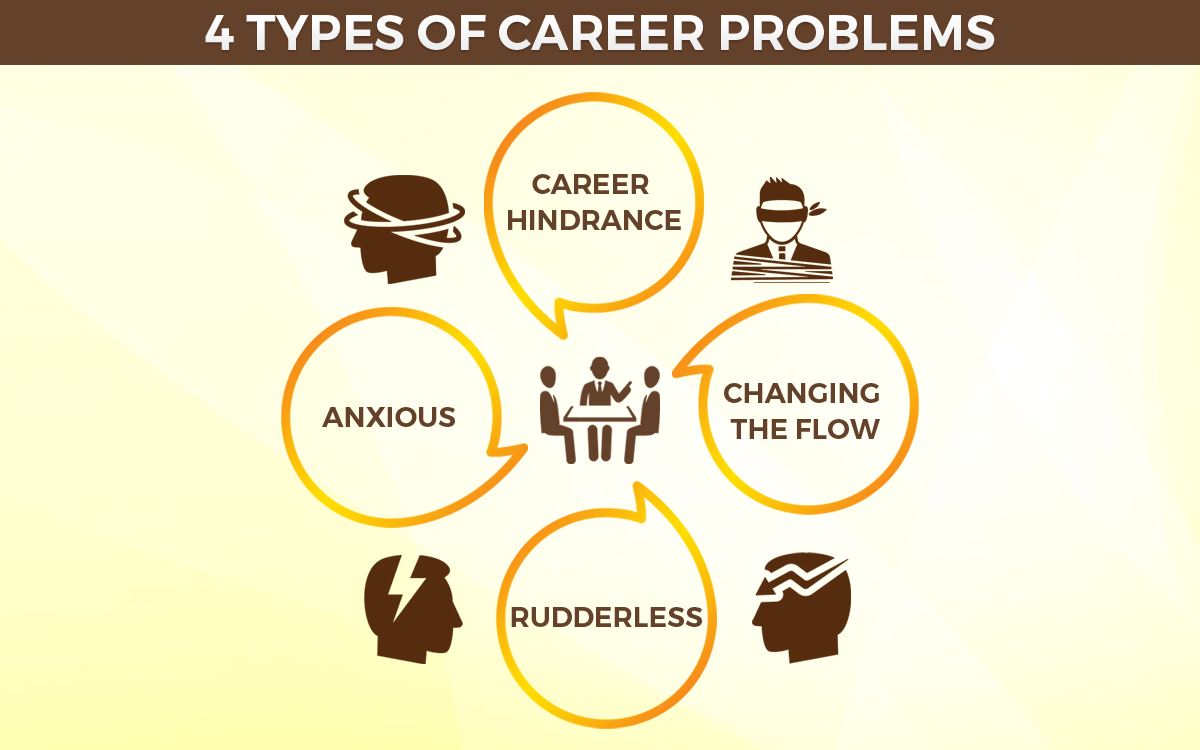
Types of Career Problems (source: Arista Infotech)

All Together

I want to wish everyone a great December and also challenge that we make efforts to use it to review our personal and professional careers. Do not walk into January without a clear plan on how to fix some of the things that did not work well in 2018. Doing that requires examining some key things in 2018 and then committing to take action where necessary, to fix them, and advance.

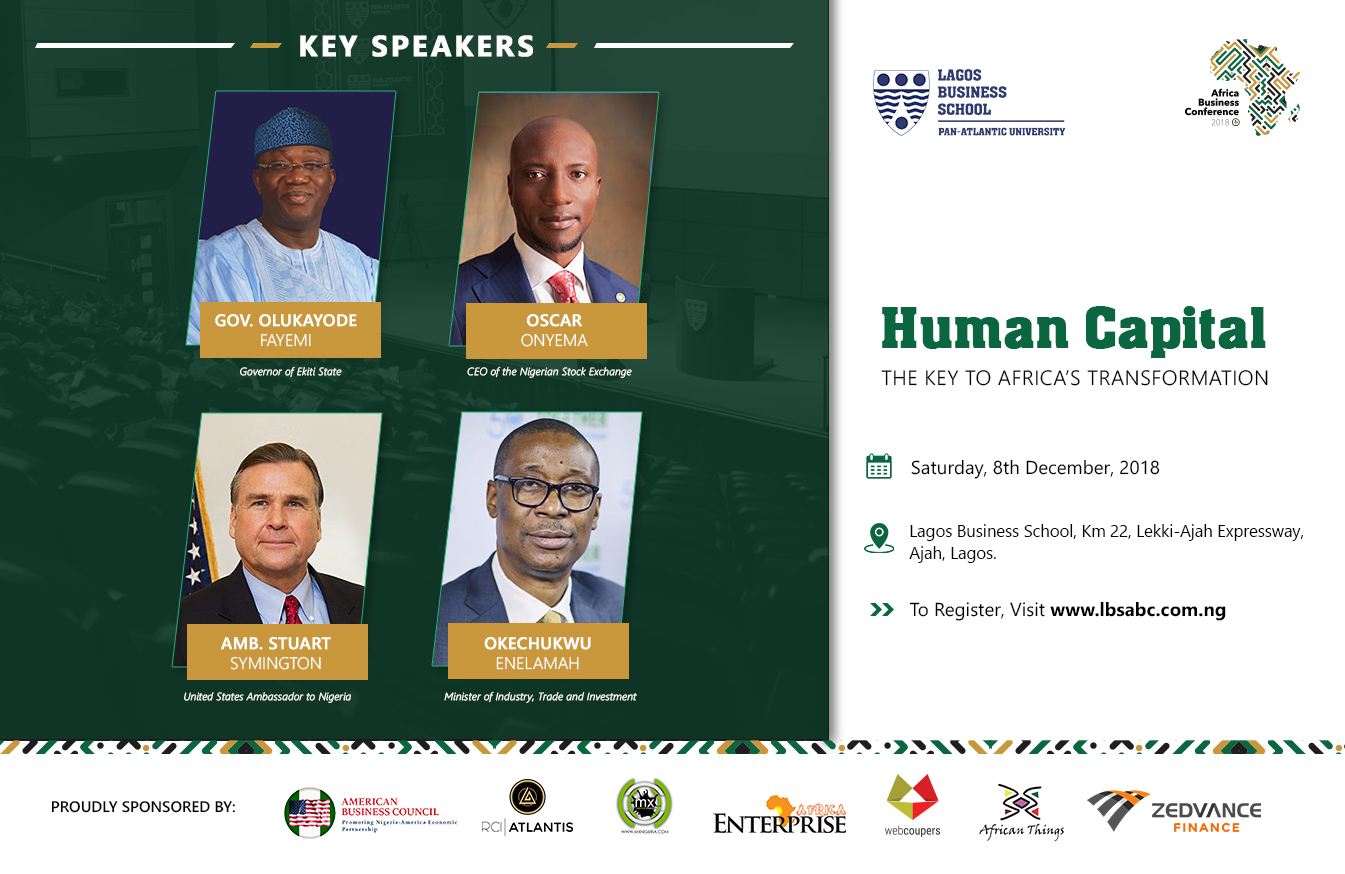
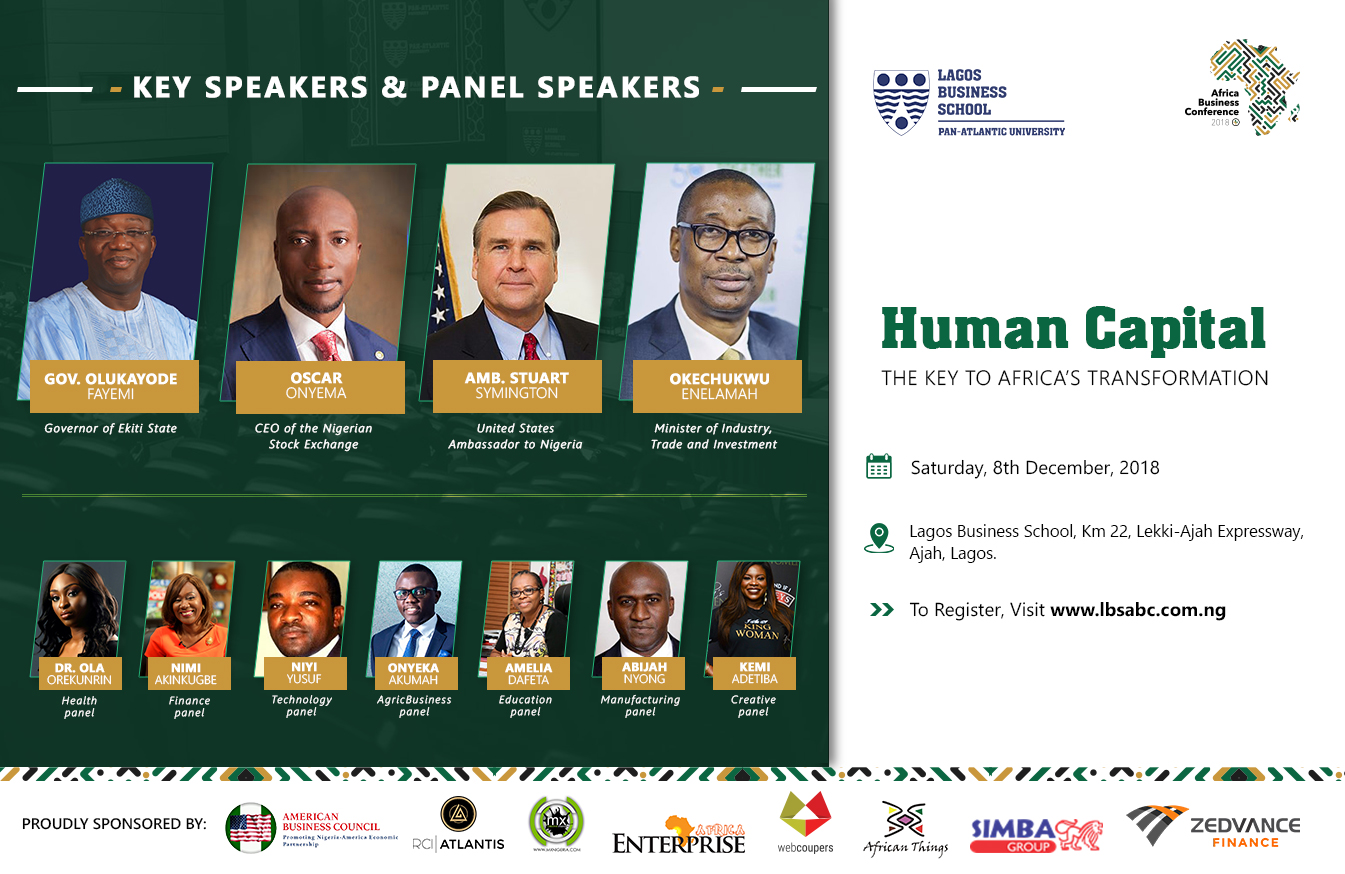
Join Lagos Business School MBA Students On Dec 8, 2018 – Gov Fayemi, NSE Onyema, Min Enelamah, US Amb Stuart, More

0

The Africa Business Conference is an annual forum that targets business leaders, financiers, and policy makers across Africa and the world , as well as investors seeking to do business in Africa, with the aim of generating insights and gaining mindshare on trends in Africa that would affect doing business in Africa and propel the continent to the forefront of advanced economies in the world. The conference is aimed at creating a platform for thought leaders to come together to chart a course forward for Africa to serve as a platform to foster networking between industry leaders and business men in Africa.

Register here immediately to attend – N5,000.

The conference has been hosted by the MBA class of the Lagos Business school since 2013. This year, in tune with the aim of the conference, the MBA hosted an earlier conference themed “Opportunity Realisation in Africa”, to set a tone for the intentional realization of goals for the year.

With the introduction of the 2018+ edition, the 7th installment is themed “Human Capital: The Key to Africa’s transformation”.
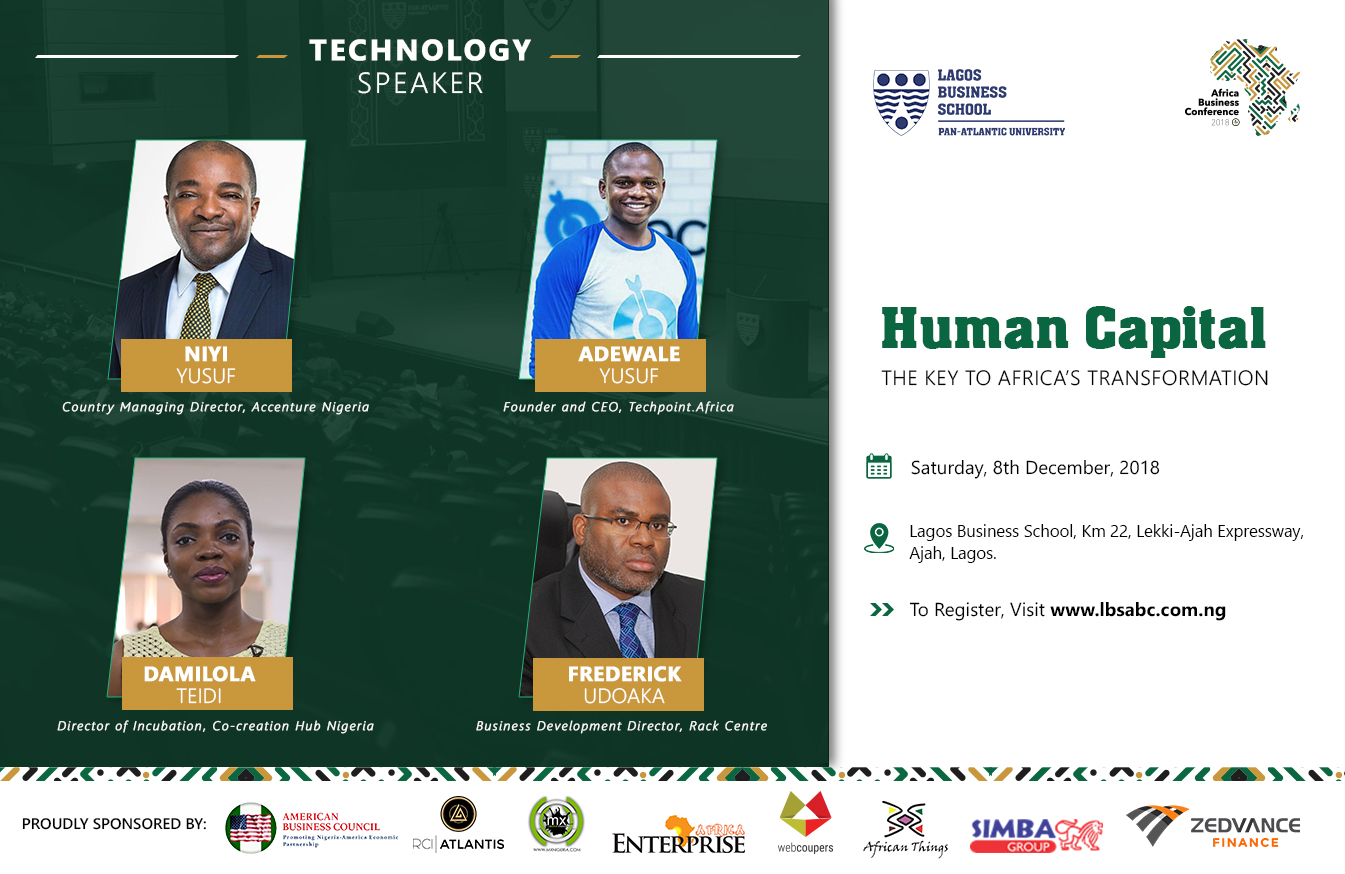
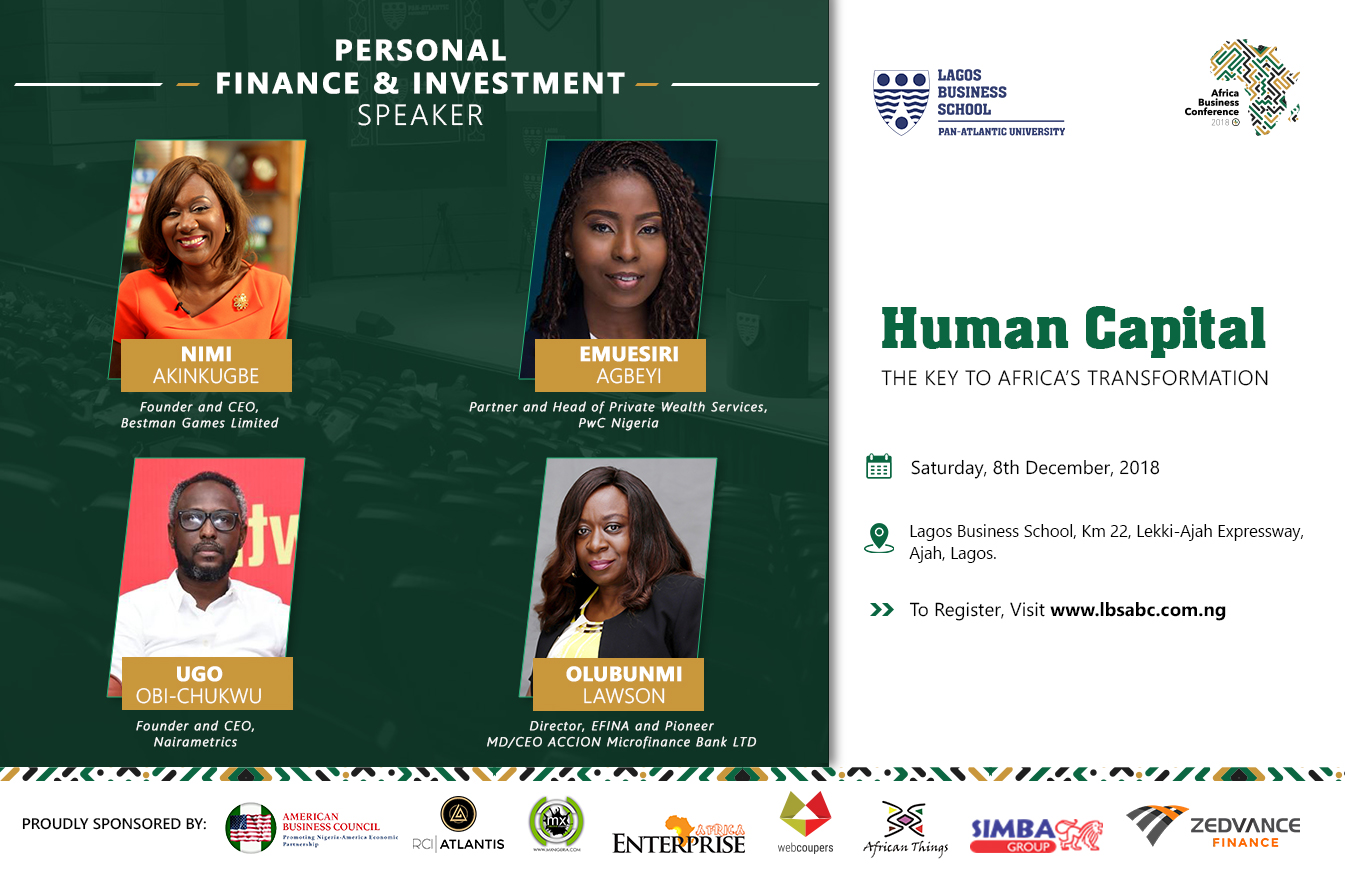
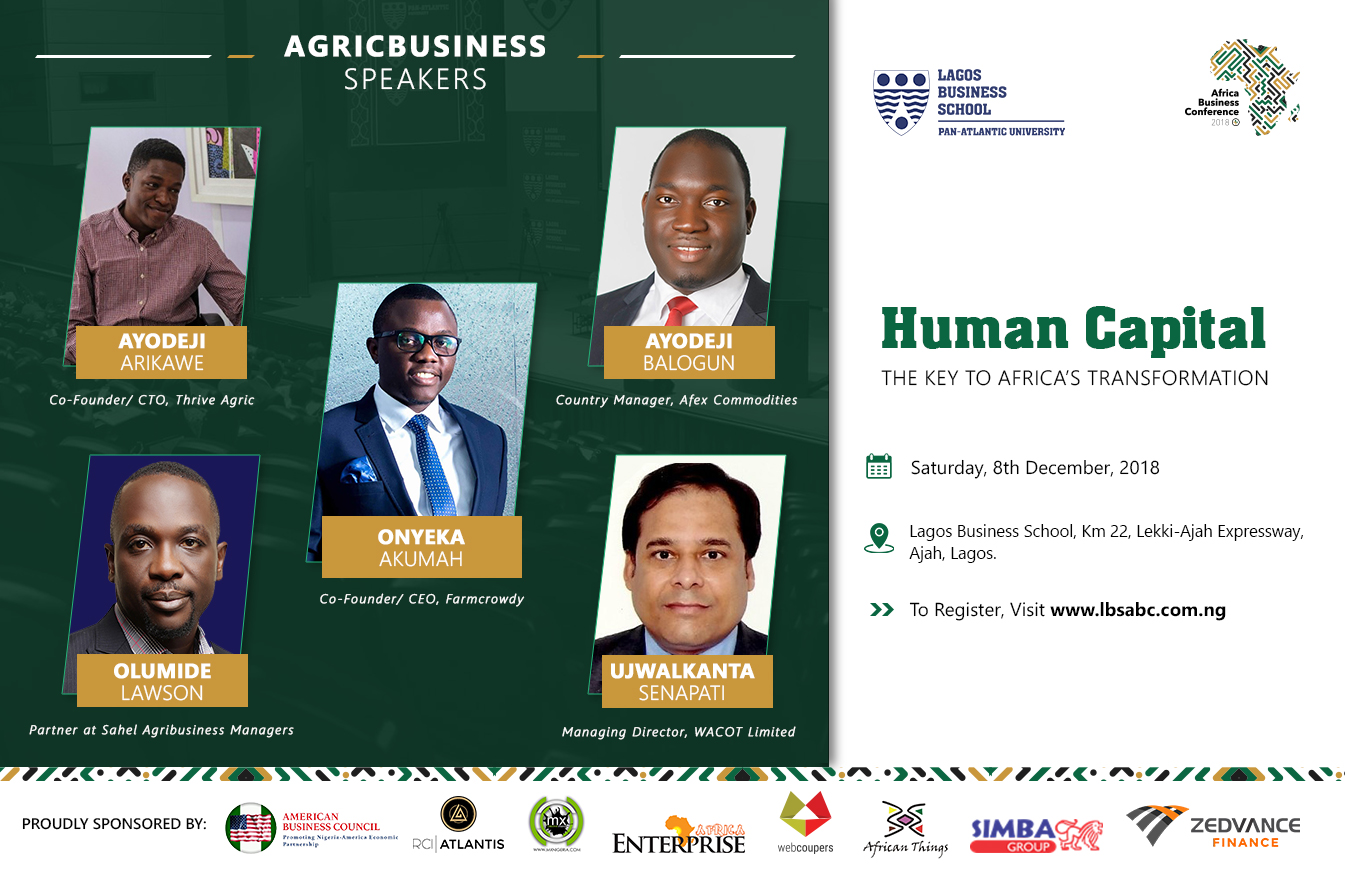
This second installment for the year came as a reaction to the pulse of the business environment and the people who make up this environment. The humans are the lifeblood of any venture first, before the idea and the finances. It is increasingly becoming apparent that as a people, Africans are the most valuable resource available in the continent, often overlooked or unappreciated.

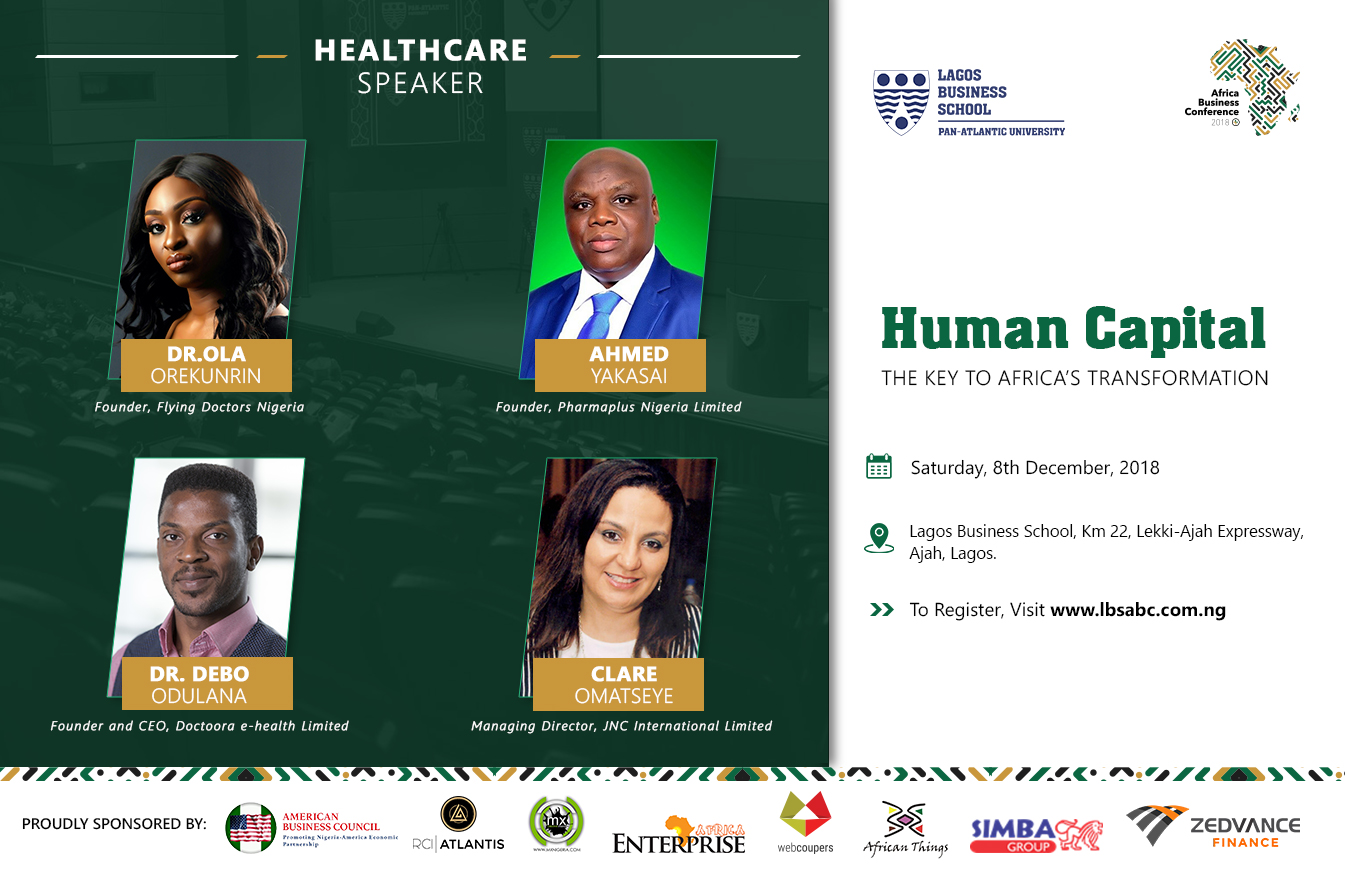
With this conference, we aim to have conversations on why we are unable to efficiently harness this strength as a continent, as a people. There is scheduled an array of key note speakers from notable works like the Nigerian Stock Exchange and the Nigerian government, as well as the international community as well as several break out panels, so that irrespective of the corner of the earth where you play, there is enough audience to your questions.

The conference true to its interest in people began with a social network campaign, celebrating Africans who have passionately worked on their interest in humanity, sharing their stories with the tag “Building my African dream”, found on social media with the hashtag #BMAD.

Further information on the conference, its panel speakers and available panels can be found on the official website lbsabc.com.ng, and through our social media accounts on Twitter and Instagram with the handle, lbsabcc.

Good News for DStv: South Africa Upgrades Its Tax Policy, Forcing Netflix to Pay VAT

0
DSTv court

South Africa has upgraded its tax policy. Now, Facebook, Google, Netflix, and other digital ICT utilities would have to pay the country’s VAT. The regulation takes effect April 1, 2019.

This after the National Treasury published new regulations specifically for electronic services which expanded the meaning of “electronic services” to “any services supplied by means of an electronic agent, electronic communication or the internet for any consideration”.

That means any electronic services from another country provided in South Africa – such as such as online advertising, online courses, online consulting services, software subscriptions, website hosting, streaming services, online games, podcasts and publications – will be subject to 15% VAT, Natalie Macdonald Govender, associate at Bisset Boehmke McBlain attorneys, said.

Making this work is simple: just ask the local banks to collect the VAT as the transactions are being processed. Where that is not possible, do not allow any customer to use South African domiciled financial products (credit card, bank account, etc) to effect such payments.

Of course, the ICT utilities will likely add the VAT and the burden would go to the local customers. And at the end, the country has collected extra change from its citizens. Google, Netflix and others would not be financially impacted even though they may lose some customers who may find their products more expensive.

MultiChoice, DStv,DStv systems (source: Quartz)

But do not miss the game plan: if local competitors like Naspers’ DStv pay VAT, it is fair that Netflix does the same. By bringing everyone on parity, competitive-pricing equilibrium will be attained. Yes, by not collecting VAT from Netflix, the company was having an advantage over DStv in South Africa [by not collecting local VAT, Netflix fees were artificially lower]. Sure, you can make a case that Netflix has taxes to pay in U.S. But that does not concern the local regulators and competitors: it was Netflix that left its home country to compete in another. It has to do like the locals!

This is certainly good news for DStv; it has made that case in the past.

“As a country we have national objectives … if I was to be very narrow, I would say [to Icasa]: treat us like Netflix, so we do not have to pay tax or comply with black economic empowerment regulations,” he told the South African newspaper. “I am saying bring the likes of Netflix in the same net. Netflix does not employ even one person in this country, it doesn’t pay tax, they do not have to do any local content.”

Watch out – Netflix prices will go higher (from the consumer angle). Implication: the best show would now WIN, not by imbalance created via 19th century tax policy.

Expect this idea to scale across Africa.

Not Just Taxes in South Africa

I do believe that the tax upgrade is partly to help the local competitors. South Africa has a great record of helping its own. Think of the massive investment PIC is making in MTN Group right now. Possibly, that would help MTN overcome the paralysis it is going through at the moment.

The Public Investment Corp. raised its stake in MTN Group Ltd. for the second time in as many days, taking advantage of a price that’s close to 10-year lows amid a crisis in Nigeria.

The PIC’s shareholding is almost 26 percent, Johannesburg-based MTN said in a statement on Thursday. The previous day, Africa’s largest wireless carrier by sales said the stake had increased to about 24 percent.

“We believe MTN has a strong set of assets and competencies,” Deon Botha, head of corporate affairs, said in emailed comments, declining to say more about the PIC’s rational for boosting its stake.

Just Confirmed To Speak in Harvard In Feb 2019

0

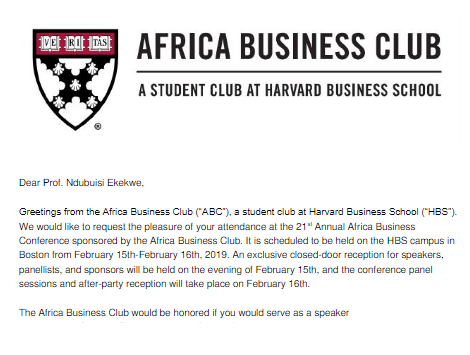
I will be speaking in Harvard in Feb 2019; just confirmed the invitation of the Africa Business Club (a student club at Harvard Business School) to speak on health during the 21st Annual Africa Business Conference.

I will be there for our health-tech startup, Medcera, which I wrote recently in a Harvard Business Review article on our plans to redesign the architecture of rural healthcare systems using emerging technologies like AI and integrated health record systems. Yes, there is a promise that if we can handle diagnosis of many common diseases with intelligent systems, doctors can focus on the most difficult ones.