
DD
MM
YYYY

PAGES

DD
MM
YYYY

spot_img

PAGES

Home Blog Page 7034

A Letter To The EVC Of NCC On 5G Trial in Nigeria

0
5G network, adaptable business model

by Olayinka Oduwole

The Executive Vice Chairman of NCC (Nigerian Communications Commission) recently reported  that Nigeria would be ready to roll out 5G networks in 2020 by making spectrum within the 26GHz, 38GHz and 42 GHz available. The EVC also noted that the Commission was working to address issues related to spectrum, infrastructural deficit and regulation to facilitate the roll out of 5G. In this piece, I would address these three issues raised by the Commission in preparing the country for the release of 5G.

The Nigerian Communications Commission (NCC) has said Nigeria would be ready to roll out 5G networks with the 26GHz, 38GHz and 42GHz spectrum bands by 2020.

The Executive Vice Chairman of NCC, Prof. Umar Danbatta, said this in Abuja Thursday during a collaborative meeting with GSMA for 5G rollout in Nigeria.

According to him, trial testing of the rollout plan has commenced in the country beginning with the Eko Atlantic Project, where broadband data will drive connectivity and allow humans to interact with connected devices to check their health status and remotely control home appliances without physical contact.

SPECTRUM

In my previous piece on 5G, I noted the vital role of spectrum availability in driving 5G penetration within any country. Whilst this is a positive step in the right direction, it’s equally important for the Commission to ensure that the new spectrum within the various bands are not offered at exorbitant prices. As noted by GSMA, spectrum pricing in developing countries, are on average more than three times higher than in developed countries, after taken into considering the income levels within the country. Making spectrum available at reasonable prices would encourage competition which would enable new market players as well as telcos to afford the new spectrum. Besides, 5G is expected to usher in new market players due to the various use cases within other industries. And the timely release of affordable spectrum would also help drive down the costs of data and other telecommunication services which would no doubt greatly benefit consumers within the country.
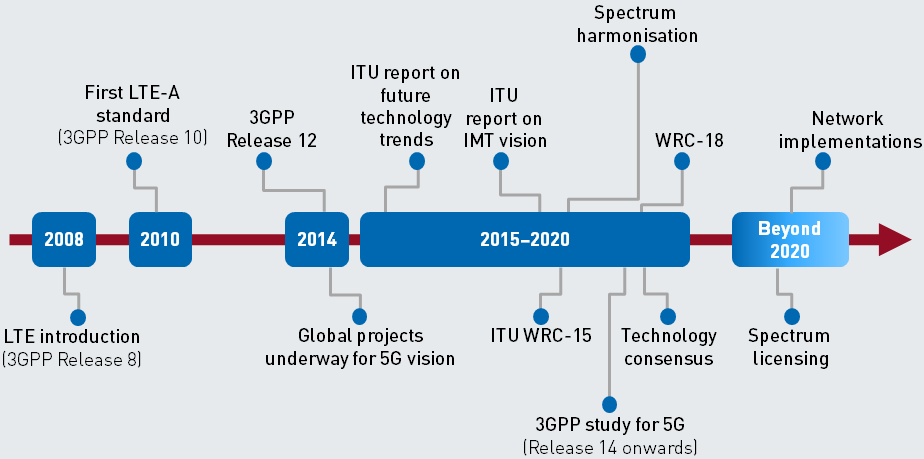
Timeline towards 5G [Source: Analysys Mason, 2014]

INFRASTRUCTURE

As I have noted, 5G requires huge investment to strengthen the capacity of the physical layer, virtualization of the core and for the high capacity backhaul networks needed to provide low latency, high speed connectivity and ubiquitous coverage promised for the various use cases. Besides, 5G may rely on the use of heterogeneous networks which would require network of different layers and of different technologies to work together in a seamless manner. Whilst the Commission has done right in pointing out the need to address infrastructural deficit, it also needs to understand that different players would need to work together to address this infrastructural challenge, hence facillating interoperability among players would be vital here.

REGULATION

I cannot over emphasize the importance of regulations in facillating the release and deployment of 5G. This is because regulations can either accelerate or hinder development within this ecosystem. The Commission mentioned that it would rely on existing policies and then develop new policies to address hiccups. I think this is a good strategy but it is important for the commission to begin to prepare to tear its existing rule book. This is because there are disruptions happening in every part of the 5G landscape that it would be hard to apply the previous rules. For example, in previous generations, it is very typical for a single Mobile Network Operator (MNO) to own and operate the entire network. With the advent of 5G, it is possible to have different operators (MNO or Mobile Virtual Network Operator MVNO) owning and operating different slices within the same network.

TRIAL

The commission also highlighted that trials will be performed using the Eko Atlantic project to demonstrate interaction between humans and machines for applications in smart home, health care etc., I think the Commission can achieve even greater results by partnering with local institutions within the country to develop innovation/research hubs as is the case in developed countries. Such hubs can allow startups within the country working on internet of things (iot) projects or machine to machine (m2m) applications etc. to test their projects. This would also drive entrepreneurial activity within this space, contribute greatly to the economic development of the country and foster collaboration between the academic community and industries.

Whilst I eagerly anticipate the release of 5G spectrum in Nigeria, I am of the opinion that deployment may take longer and predict around 2025 before it matures in Nigeria. I however may be wrong but will wait to find out.

Nigeria’s One Big Challenge: Building Durable Companies!

0

As a former banker, one thing has puzzled me in Nigeria: lack of Continuity Management (yes succession) in Nigerian business scene; empires come and most disappear.  Many empires of 1960s went under, the ones of 1970s followed, and 1980s are history. We are hoping that the legends of 1990s – Nigeria’s finest decade of entrepreneurial capitalism will be different. How can Nigeria build durable companies like the Americans and Europeans?

In a cocktail few years ago, I had the privilege of speaking before global business leaders. My business mentor, Tony Elumelu, who continues to support, gave me that opportunity. After I finished my oration that evening, a lady came to me. She was Lady de Rothschild, the chief executive officer of E.L. Rothschild, a leading independent wealth management firm in the United States with real estate, agricultural and food interests. She gave me her card and asked me to write her. But while we were talking, she dropped a sentence: her family business had celebrated its 200th year of operation! Yes, the company was founded in 1811 and is still operating in many incarnations today.

The question: why do we struggle to have companies (in Nigeria) that DO NOT collapse shortly after the founders exit the scenes?  Besides the call for new startups, there is also a need to examine while the ramped-up rarely thrive for decades.

AGPN To Honor Ndubuisi Ekekwe as a Distinguished Fellow

0

I have accepted the invitation of the Association of Governance Professionals of Nigeria (AGPN) to become a Distinguished Fellow. The investiture would hold Q2 2019. Part of the letter reads:

“Your commitment to professionalism, experience and knowledge of your field, your passion about your job and your achievement worldwide are all qualities we support and recognise.

Distinguished Fellowship is a national honor awarded by the Council of the Association of Corporate Governance Professionals, Nigeria, led by Mazi Sam Ohuabunwa, MFR, OFR, to eminent Nigerians who have made and continue to make significant contributions to their professions and the communities. Excellence, not mere competence, is the hallmark of the potential Distinguished Fellow.”

Thank you.

Join Fasmicro’s Founders Mentoring

0

In Fasmicro Advisory Services, we have been offering services to founders, startups and companies via different mechanisms. Through workshops, presentations, and development of roadmaps & strategies, we have supported local and global entities with focus on Africa. Besides these services, we have assisted founders and leaders on their missions.

I am happy that after standardizing our Founders Mentoring, it is now available publicly. Over the years, we have developed and refined a framework to give support to emerging founders & leaders as they build their firms. The Founders Mentoring which requires annual subscription makes it possible for founders to have access via email, WhatsApp, phone, and skype to us with no restriction as they build. All services are described below.

  • Discovery Innovation Workshop: To innovate is to set a new basis of competition in an economy, business sector or market. Typically, it results to disruption. This workshop will focus on innovation and growth because growth is the reward of innovation. Otherwise, that innovation is actually an invention. I will be the lead instructor with my supporting crew. The table below provides the workshop structure. We can adapt this workshop to two days.
  • Founders Mentoring: We offer a service where we mentor emerging founders or business leaders as they build their companies. The founders /leaders would have direct access to our leaders, and we would guide them on business processes and systems. Through this service, they would email, speak, WhatsApp and Skype without restriction on issues affecting their companies. Simply, we become part of the ecosystem of the company. Imagine the ability to reach Prof Ndubuisi Ekekwe at anytime to discuss business frictions you have. The service operates on annual subscription.
  • We would help you see far
  • Innovation Presentation: This is a four-hour seminar where we will present what is happening in your market, customized for your company, and then offer insights on how you can plot your strategies to win. This goes beyond industry statistics and typical SWOT analysis. We work to help clients see their markets in new ways, providing roadmaps on how they can unlock opportunities. It is an intense talk, combining technology, finance, political economy and strategy. As technology redesigns markets, I break the implications in short, medium and long-terms.
  • Development of Business Roadmap & Strategy: A business plan is not enough to anchor business execution. A Roadmap Document is required especially in a sector which is in a state of flux [changing market, changing model, startup, competition, regulation, etc]. To avoid pursuing many windy paths or dead ends, a roadmap helps to encapsulate a profitable path to the vision with pillars and enablers necessary for success.

Connect with my team if interested in any of these services.

Sources: here, and here

Nigeria’s All-Time Greatest Banking Product

0

Steve Jobs executed it through iPhone, and business legends across industrial sectors have tested the construct. Perception Demand brings demand to markets beyond the needs and expectations but perceptions of customers.  A moment of seeing and liking products you never imagined could have been possible. But upon seeing the product, you become a fan – a higher call in customership.

The Perception Demand Construct is a construct where you work on things which are not really evident to be in demand. Yet you go ahead to create that product. The demand may not be existing but you are confident you can stimulate it. Yes, you do believe that your product can elicit demand and grow the sector when launched. This is different from existing demand which could be met via starting a web hosting company or selling light bulbs where you know people actually need those services.

As I explained in a 2010 piece in Harvard Business Review, it is the pinnacle of product innovation when scaled. It offers a new basis of competition and typically engineers disruptions in markets.

In Nigeria, one bank gave us a Perception Demand product. Diamond Bank’s DIBS (Diamond Integrated Banking System) was a peerless product when it was invented in 1990s. It ushered modern banking in Nigeria by making it possible that you could deposit money in one bank branch and operate the account in any of the same bank branches. That innovation, in my opinion, is the greatest product in the history of Nigerian banking. Yes, DIBS is the All-Time Greatest Banking Product in Nigeria. It was built on perception demand construct.

Comment on LinkedIn Feed

To succeed in perception demand construct, you must show character. Steve Jobs succeeded because he never imagined or envisioned a world where every person would have an iPhone on his or her hand, but rather he built for a niche, a league of people, then encouraged and persuaded those who weren’t in that league as at the time to aspire and join the ‘exclusive’ club. And today iPhone is celebrated, despite all the talks about pricing and not being ‘accommodating’; the usual recipes for quality degradation and loss of direction.

Again, that of Diamond bank’s DIBS perhaps succeeded because it never waited for internet connectivity to be across board, or thought of what would happen to those in the rural areas, and when others saw it, they keyed in; rather than waiting for a consensus or what would be suitable for everyone.

Whether in product development or anything in life, be bold enough to set a high standard, then stimulate or spur people to meet that standard. To build an enduring and sustainable product, you must decouple your mind from ‘products activism’, where you attempt to build for all comers, except if you are selling food.

Do not go low to accommodate others, rather remain up there and bring them to your level.