With free cash, anchored on a 21st century business model [from telecom to quasi-financial entity], Airtel Africa is emerging as a fierce competitor to MTN Group in Africa. In Rwanda, after Airtel bought Tigo, it became the leading mobile operator in that innovating nation. MTN is not waiting: it recently poached former Airtel CTO Fabrice Ndatira and also picked former Airtel Deputy CEO Chantal Umutoni Kagame.
Yet, I do not think unloading Airtel guys in MTN Rwanda will change the stage in Rwanda. The fact is this: Airtel has improved on service and customers have responded. So, the business model could settle all these issues: Airtel is increasingly a platform for connecting infrastructure providers, freeing cash at scale to do other things. Those other things include investing in customer experience.
To get a clue, read this piece where it was rumored in January 2017 that Airtel Rwanda was leaving the country. Just within months, Airtel Rwanda has fixed many things and is now the market leader. It did not invent any new technology; it simply improved its business model.
Airtel Rwanda has refuted reports indicating it was closing shop, terming the media reports pointing as erroneous.
Speaking to The New Times, yesterday, Airtel Rwanda CEO Michael Adjei emphasised that they are “here for the long haul.”
“That’s not true. That’s not the case. Airtel Rwanda is not leaving the market. We want to assure customers that we are not exiting Rwanda,” Adjei.
This follows recent media reports indicating that Bharti Airtel, India’s largest mobile-phone operator and parent company to Airtel Rwanda, was exiting Africa over financial challenges.
Few days ago, the chairman of Bharti Airtel, Sunil Bharti Mittal, told Bloomberg that the firm was “considering mergers or stake sales of some of its Africa operations” to cut debt with a view of making its biggest overseas acquisition profitable.
Airtel Africa, powered on this promising business model, recently raised $1.25 billion from Softbank and other leading investors. That money is to wage market share battle with MTN Group in Africa. And since it does not have to invest so much on core infrastructure, it would be an interesting game for Africa.
As Airtel Africa redesigns its business to become a quasi financial institution, Nigeria investors should encourage it to list in the Nigerian Stock Exchange. Among all the telcos today, Airtel is closest to the sector that typically does well in NSE. We have always punished tech companies but we like financial institutions. Airtel is closer to a deal house than a telecom company as it continues to outsource core infrastructure investments. The numbers have responded as the firm is recording improving margins. The firm just raised $1.25 billion from Softbank, Temasek, etc. IPO is next.
In Rwanda, MTN is in the market to raise capital to improve its services; it is raising debt of $56.4 million. It surely needs to fight a strong battle. The good news is that if we have these companies battle in this way, consumers would win. And at the end, both Airtel and MTN would also win. African market is still growing: they just need to keep working.
The modernization and extension by the MTN Group’s Rwandan subsidiary of its network will help to ensure the loyalty of its current customers and attract new ones, in a context of increasing consumer complaints about the quality of service of the telecom company. and the fierce competition maintained by Airtel that merged with Tigo.
I spoke with an aide to a governor (Nigeria) today on the possibility of developing a framework on the Igbo Apprenticeship System. People forwarded the TED video piece and this one to His Excellency. They reached out. If this is something you would like to work on, please email my community manager here. I will be in Nigeria in February 2019 specifically for this courtesy of the governor’s office. I did note that the best roadmap would be to have a university level research because the processes involved are convoluted. With that level of research, it would be easier to make sense of the elements which make Igbo apprenticeship system function.
The Challenge in this System
To be honest here, I have no credible idea on how what they do in southeast Nigeria could be institutionalized. Giving out your 13 year old son to someone, to live and serve, with no absolute enforceable promise seems strange to my over-education.
Sure, I wrote about how Nigeria could learn from the apprenticeship system to fix our unemployment issues. But making it work in an institutionalized way should not be trivialized. The trust that goes into that cannot be replicated on any piece of document. The parents have to believe on the boy’s future master. The boy has to work for years (10 years is typical) for no pay on the promise that one day the master will settle him. He serves the master at home and office and practically becomes his son. And most times, the deal is kept, without any document.
I watched the scene live as a boy that grew in the village. As I was going to secondary school after primary school, some of my classmates went for trading. They went to cities for that, returning to the village during Christmas. Their parents’ homes became secondary; they made tents in the masters’. And the master would not even distinguish between his own sons and them. I am not sure there is any paper contract in this world that could capture that level of bond.
Getting to the Papers
Igbos are Africans; we did business for centuries without any written documentation. Yes, if they have figured out that lack of paper documentation was a problem, someone would have invented writing! But they did not [get me right, I am not saying that your contract with the bank is not good. My point is that some African institutions cannot be catapulted overnight]. Yet, someone has to try in our largely inventive societies.
As I had noted in my preliminary chat with the aide, one roadmap is evident to me: Go to a university system and fund one to make sense of the system. UNN or any state university in the east could lead this. That level of research will help everyone understand the different components before anyone can talk of formalization and institutionalization. I do not expect a 6-month consultancy to offer any useful insight; something long-term would be critical.
Yes, despite investing in a long-term research, the outcome cannot be guaranteed. You need to enter this work with humility because they are many players here. In February, I will make that case as we explore models. We can work out a process on how that engagement with universities would be structured to get the best results. It was evident that the governor’s office was looking for practical recommendation over an academic one. But here, there needs to be a fusion of theory and practice.
A Boy-Master Play
Let me give a stage on what happens when a boy, usually around 13 years is asked to live home for apprenticeship.
For a boy to leave his parents to move to city where he would live with a master, many things happen. These things have worked smoothly without lawyers and paper contracts. And if you bring those papers and lawyers, you may change the equilibrium point. First, the parents many not like to sign your papers if you are coming from government to “assist” to protect the boy. Secondly, the masters may not sign. Igbos largely do not really see governments as extremely necessary on their personal issues. In most villages, when there are erosion or local road problems, they call their sons and not government for help. Typically, the sons send money to village elders to fix the problems. The entrepreneurial individualism may make bringing government into the apprenticeship harder.
Sure, there used to be a time when banking was done without papers. Of course today we have modern banking in Nigeria. So, any system can evolve including the Igbo apprenticeship system. For that to happen, this play, which largely depicts what happens must not introduce frictions that could stop the deal – the boy going to Aba the next day.
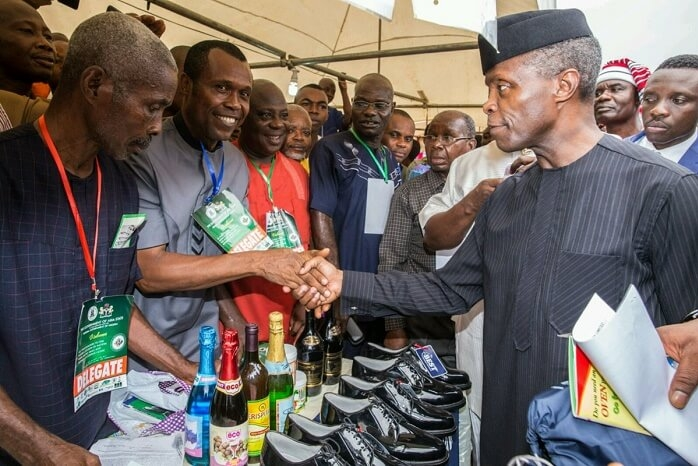
Nigeria’s VP visits Aba (source: Aba City)
(Urum is the master; Uche is the boy’s father, Obidiya is the boy’s mother and Ike is the name of the boy.)
Urum: Mazi Uche, who is that boy?
Uche: That is my first son. He just finished primary school.
Urum: I need a boy in my shop in Aba. Can he follow me to Aba tomorrow?
Uche: Ike, come here (Ike comes). Tomorrow, you are going to Aba with Uncle Urum. He would be your master. Obey and listen to him. Anything you cannot do for him, do not do for me. And anything you can do for me, do for him. Give me your hand (the man spits on the boy’s hands): I offer my blessings to you. You would cross oceans and rivers. And you would come back to this land to bless your kindred. Your wealth will come home and not wasted in cities. Our ancestors, famous traders, will guide you. Virgin Mary and our Lord Jesus will bless you.
(Then turns to Urum (the Master): This is your son. Take good care of him.
Urum: Ike, come here. You have grown. I could not even recognize you (Urum holds Ike)
Uche: (He calls his wife): Obidiya, Obidiya. Come.
(The wife arrives) Ike will be going to Aba tomorrow with Urum. Please go and bring more ugbaa for us.
Obidiya: (Kneeling down, thanks Urum) May God bless you.
Urum: Ikochim (my kinsman wife), thank you for taking good care of my brother Uche.
That is the contract. In 10 years, that boy is settled with all possible support in the world. Then, one day, he looks for boys to do same. But as he does that, he remembers his home.
All Together
Many of you have written privately to me suggesting that you could develop a strategic document to institutionalize and formalize the Igbo Apprenticeship System. I would note that I think it is time. If you have interest, let us see what can be done to formalize it.
Nice scenario Ndubuisi, but in Nnewi, it is not just the nuclear family of Uche that will be involved. Uche will summon a meeting of his umunna who will probably come the next day.
During that meeting, Ikem will be handed over to Urum in the presence of everyone. Urum on the other hand will give an indication of roughly how long Ikem will be his boy (pronounced boyi), this is usually for a six year period. Everyone one gives their blessings and the matter ends there.
Nothing is written, everything is done on trust. But the presence of the umunna is a form of check and not only do they serve as witnesses (at the end of the six year period, they would usually congregate again for the settlement), it lends weight to the saying in igbo land that a child is the child of the community. So the Urum is not expected to make such an important decision on the boy’s future without the umunna. After all if things go wrong (and they do) the ummuna will also be involved in any dispute resolution.
I like visiting Sokoto. For all the states in northern Nigeria, it is the most hospitable. Despite being the seat of caliphate, the people are largely welcoming. I am yet to clearly understand why Sokoto is that unique. But looking at some institutions, there is a clue.
In one of the hotels I stay, I have noticed that they named the buildings after founding Nigerian statesmen. Typically, they always find space for me in Nnamdi Azikiwe building. Then in front of that building, they have a space, structured for Igbo people to congregate for the nkwobis, etc. But walk down: there is Obafemi Awolowo building with settings suited for the southwest. This is at the heart of Sokoto, and the businessman is bold to go national!
Camel in Sokoto. Sokoto is a hospitable place
I asked the manager how that thinking came. He explained that they wanted to make everyone feel at home. So, in designing the place, they went to the cultural leaders of the major ethnic groups, in Sokoto, to assist in the design and settings.
This is an example of the Nativity Design Construct. If a hotel can do it, banking and fintech could also explore how Yorubas, Igbos, Hausas, etc handle and manage money to architect services that fit.
In my teachings with startups in our advisory business, I have called that Nativity Design Construct. It is a way of looking at business from the angle of the customers by making sure that you deliver solutions and services within the natural nexus of the users, eliminating any possible assimilation friction.
The one-size-fit-all model has become obsolete, so any business that wishes to survive and continues to be relevant going forward, must learn to pay attention to finer details.
It is no longer tenable to spend all your time in the lab and conference room, and then hatch out and ratchet up products and services for users/consumers you do not understand. If politicians do same and survive, for businesses, the price you pay for your misdemeanour is higher; because opening a wallet is not same as flashing your voters card, no one jokes with the former down here.
The digital platform model innovation has helped to democratise this Nativity Design Construct, making the potential users key players during the design phase of the product development. The hotel owner did not close his eyes and imagined what every tribe would cherish, rather he went out and enquired from the PEOPLE how best to go about it. A big lesson there for our men and women in suits.
Think about it – it does not make sense. You approach someone to help take a look in your business model. The person agrees to help you as part of supporting the community. Then, you send a Non Disclosure Agreement (NDA) for that person to sign. Honestly, I cannot imagine anything more stupidly insensitive than that move: you want freebies, and you still want the person to sign NDA!
A non-disclosure agreement (NDA), also known as a confidentiality agreement (CA), confidential disclosure agreement(CDA), proprietary information agreement (PIA) or secrecy agreement (SA), is a legalcontract between at least two parties that outlines confidential material, knowledge, or information that the parties wish to share with one another for certain purposes, but wish to restrict access to or by third parties. The most common forms of these are in doctor–patient confidentiality (physician–patient privilege), attorney–client privilege, priest–penitent privilege, and bank–client confidentiality agreements.
The problem is not the signatures you are asking for, the issue is the thinking that any professional will do it. Personally, when I get that, I will simply reply “We will review” and that is it. Why would I risk my businesses to help you, free? Of course, if you want NDA, we would have an engagement contract which will naturally have NDA, and enforcing it is part of my bill since my colleagues must be part of the compliance. There is no decent professional that would take over liability of agreement compliance when working for you free.
Yes, if you cannot trust the decency in humans, you should not expect to get help out of this world free. I know you read it from a lawyer (we like lawyers) but I can assure you that no credible person will help you with that mindset. The NDA you are parading is part of the reason you have no traction in that venture! If you check carefully, people are not helping you.
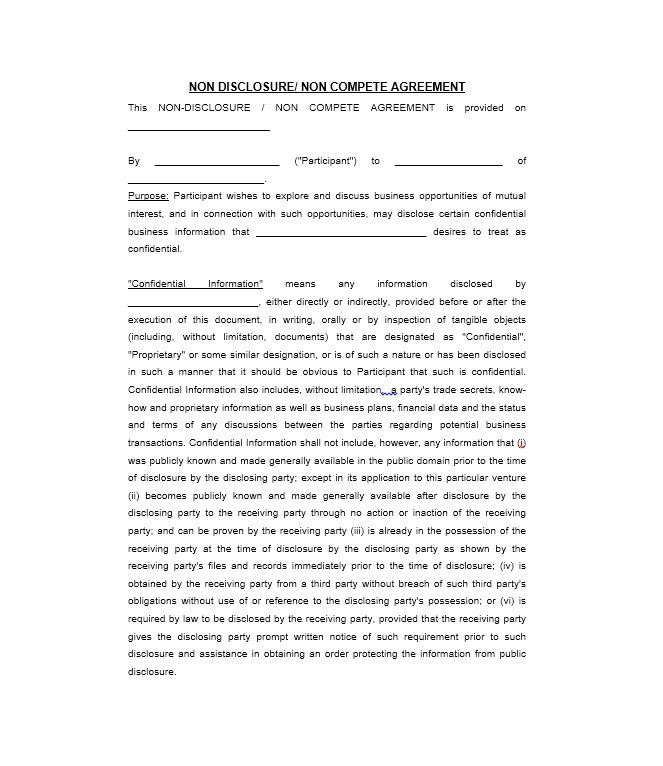
Sample of NDA (source: gratulfata)
NDA for Business Plans
Then the craziest of all: asking an investor to sign NDA before you would share your business plan. I am not aware of any credible investor that would sign, and you asking for one demonstrate severe lack of awareness of the ecosystem. While lawyers will tell you to do that (yes, to protect your idea!), you need to be informed that the market belongs to the person that writes the cheque. Possibly, unless you are Elon Musk who can come up with something extra-super-awesome, no investor would sign to read that business plan. In other words, for real investors to sign, you must have elevated your level with unbounded history of success; that does not typically happen.
Get me right – you can continue to parade NDAs looking for people to help you even when signing to absorb all risks before they could do that! Yes, you could continue to look for investors that would expose their assets to risks just to read one document they are not sure of the value therein. You can do whatever you want; it is a free world. But let me make it clear: you would not make progress with that attitude in this world where people post their business plans online to raise capital.
Business plan is largely free; execution is the key. If you check business plans on providing adequate electricity in Nigeria, there may be more than 20,000 of them in Nigeria as I write. The challenge remains that we do not have more than 5 executors at scale in that sector.
I am not saying your business plan has no value. It does have but you need to be real. If in the path of raising $100k you expect a person managing a fund with assets of $500 million to sign NDAs, you have not started. Yes, lawyers told you to do that: of course the lawyers can fund your firm. No serious investor will bother to engage you when you parade that NDA.
There are many emerging business models. Yet, do not think they would make you special to get NDAs from investors
The Way Things Work
This is what happens in this world: if you are going to meet the top 5% in the world in any private business advisory or fundraising, they would send you a document ahead. In that document, they would ask you to sign that YOU WOULD NOT DISCLOSE ANY PROPRIETARY INFORMATION during the meeting. They flip it because they “own” the world and if you do not like it, you are free to remain in your village.
If you do not sign-off that document, you would not be processed to participate in the event. In short, they hire specialized companies to process you before you can meet these super-rich people for business level discussions. All entrepreneurs looking for capital sign-off making it clear that there is nothing proprietary they would disclose.
Now, for you to think the other way round is pure stupidity [you are the one that needs help]. You do not expect a billionaire to risk his assets to listen to you asking for $500k when they do not even know the value of what you have to offer. Taking it home in Nigeria, I do hope people become real and stop this NDA thing. There are moments for NDAs but we are abusing them in the fledgling Nigerian startup scene. If you have a business plan that contains proprietary things, there are ways you can still share the business plan while managing the IPs. You cannot expect people to overexpose themselves to risks just to help you.
You need to listen to Gbenga Bamiji, FCA. He has deep insights on growth, branding and strategy. Your business brand is a personality. You need to nurture your brand.